Engagement Archive · Zhanggufeng and Nomonhan [foreign wars on Chinese soil]
At Zhanggufeng near the mouth of the Tumen River in 1938, and at Nomonhan on the Khalkha River in 1939, Japan and the Soviet Union fought two battles on the borderlands of China's Northeast - the ground lay on China's sovereign map, China was wholly absent; and the guns of Nomonhan changed the direction of the Pacific War, while also indirectly determining the later shape of the China theater.
Engagement Data
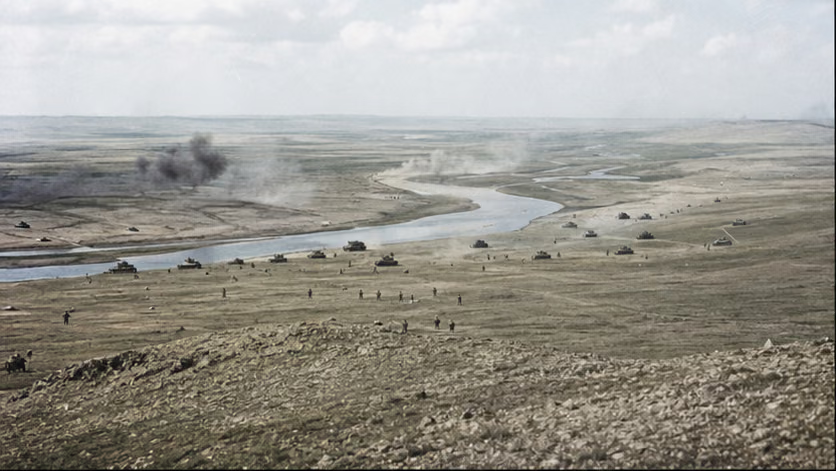
| Item | Zhanggufeng | Nomonhan |
|---|---|---|
| Time | 1938.7.29 - 8.11, about two weeks | 1939.5 - 9.16, with large-scale fighting in July-August |
| Location | The Zhanggufeng and Shacaofeng heights downstream from the mouth of the Tumen River - the China-Soviet-Korean tri-border area, within Hunchun, Jilin, China (the border line was based on the 1886 Hunchun Boundary Agreement and other instruments; the line of territorial attribution remains unverified) | The east bank of the Khalkha River - disputed ground along the border between "Manchukuo" and Outer Mongolia, in today's China-Mongolia border area west of New Barag Left Banner, Inner Mongolia |
| Belligerents | Japanese 19th Division vs Soviet Far Eastern forces | Japan's Kwantung Army 23rd Division and other units vs the Soviet First Army Group (commander: Zhukov) and Mongolian forces |
| Result | Soviet forces controlled the disputed heights; armistice agreement on 8.11; the line was drawn according to the Soviet claim | Japanese forces suffered a crushing defeat; armistice agreement on 9.15 (effective 9.16, dates vary by account); the Soviet-Mongolian side held de facto control of the disputed area east of the Khalkha River |
| Name | Japanese side called it the "Zhanggufeng Incident"; Soviet side called it the "Battle of Lake Khasan" | Japanese side called it the "Nomonhan Incident"; Soviet side called it the "Battle of Khalkhin Gol" |
Neither fight was called a "war" by the two sides; both were deliberately downgraded into "incidents" - nominally not a Soviet-Japanese war, only "border conflicts."
Belligerents
| Item | Japanese Side | Soviet Side |
|---|---|---|
| Zhanggufeng | The 19th Division, from about 7,000 to 10,000 men (figures vary by statistical basis), with limited heavy weapons and strict Imperial General Headquarters orders not to expand the fighting | Far Eastern forces reinforced in sequence to more than 10,000 men, with an advantage in artillery, tanks, and aviation |
| Nomonhan | The 23rd Division as the main force, about 13,000-25,000 men (figures vary by statistical basis), with the Third and Fourth Tank Regiments, artillery, and air units attached | Zhukov concentrated about 50,000-60,000 men, more than 500 tanks and armored cars, more than 500 guns, and more than 500 aircraft (figures vary by statistical basis) - Soviet consumption of ammunition and fuel was several times that of the Japanese forces |
Nomonhan was a demonstration of mechanized war crushing old-style infantry: Soviet forces used overwhelming firepower and armor to encircle, and the bayonet charges in which Japanese forces took pride became targets on the open steppe.
Terrain and Conditions
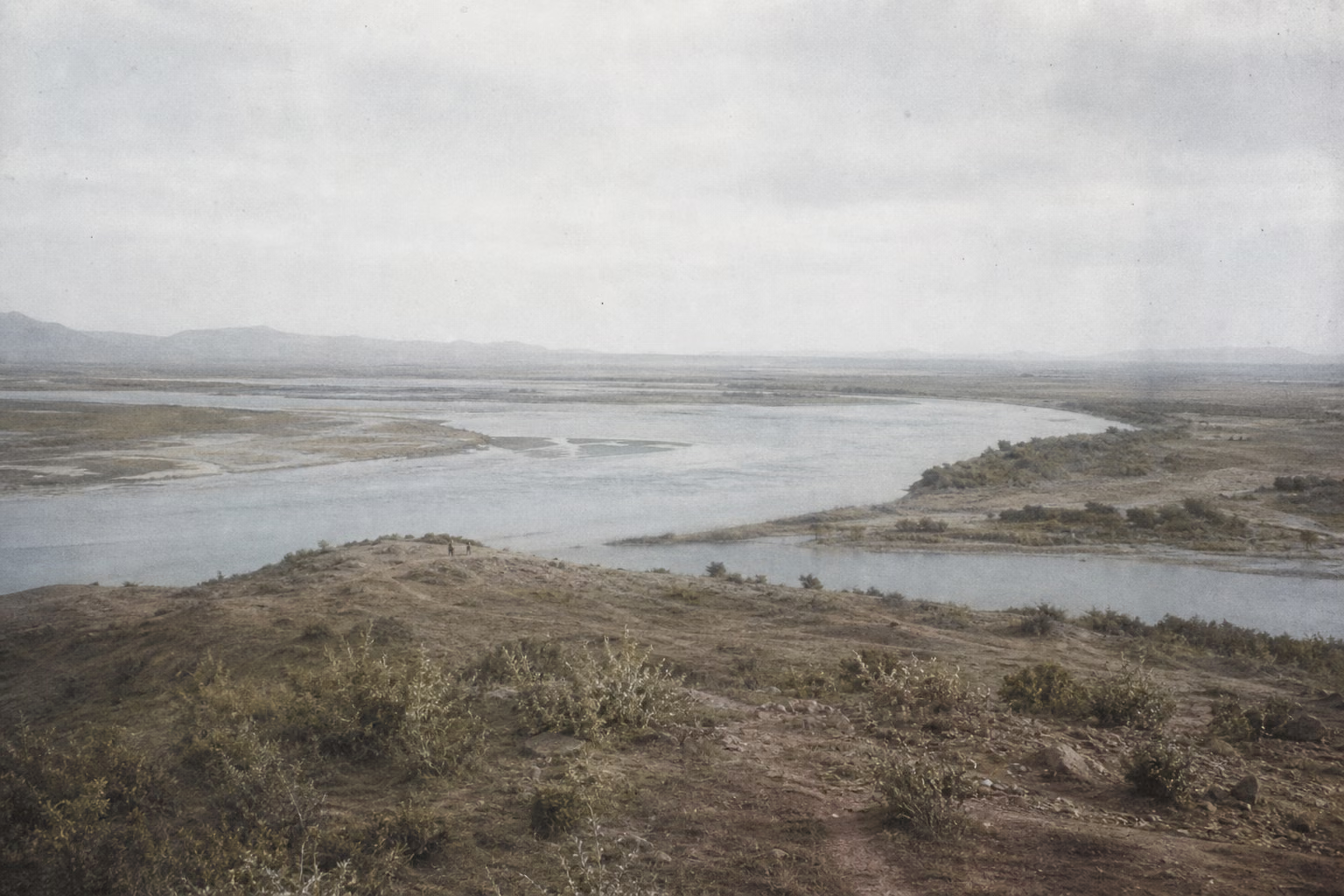
(For the larger situation, see *Fourteen-Year War of Resistance · War Overview*. This section covers only the two border areas.)
Zhanggufeng: a commanding point downstream from the mouth of the Tumen River, little more than 100 meters above sea level, with the China-Soviet-Korean tri-border area directly below. From the peak one could see the Sea of Japan - but Tumen River access to the sea had already been sealed off after the territorial losses under the 1860 Treaty of Peking, and the Zhanggufeng line was precisely the endpoint of that scar (details of the treaty sequence unrecorded). Hunchun in 1938 was caught in the gap among Japanese-occupied "Manchukuo," the Soviet Union, and Japanese-occupied Korea.
Nomonhan: the Mongolian steppe east of the Khalkha River, open, without cover, and short of water - on the steppe, battle was a contest of firepower and supply radius. The battlefield lay in the disputed border area between Mongolia and "Manchukuo": Outer Mongolia was a Soviet satellite, "Manchukuo" was Japan's puppet, and both were pushed to the front on behalf of their overlords.
Chinese border residents: once the Zhanggufeng fighting began, local Chinese border residents in Hunchun were forcibly conscripted by the Japanese side to build works and transport supplies; their homes were affected by shellfire, and after the fighting their homes fell on the Soviet side of the de facto line (the accessibility of sources on forced conscription and damage remains unverified). Mongolian herders and Han farming settlers around Nomonhan were likewise driven off and requisitioned (details unverified). The two states that fought the battles negotiated the border; the Chinese people on the ground had no voice.
Why It Was Fought
As the Battle of Wuhan reached high summer, the main strength and attention of the Japanese Army were fixed on the Yangtze line; at the end of July 1938, shots suddenly rang out on the northernmost frontier - Zhanggufeng at the mouth of the Tumen River. The front shifted to Northeast Asia: in this article, the combatants were Japan and the Soviet Union, and China was not a belligerent, yet both battlefields lay on China's sovereign map.
The two battles came from the same source. One end was the conflict between Japanese and Soviet border claims along the line from China's Northeast to Outer Mongolia: Zhanggufeng was the commanding point downstream from the Tumen River mouth; from the peak one could see the Sea of Japan; below lay the China-Soviet-Korean tri-border area, and the boundary basis had to be traced back to the 1886 Hunchun Boundary Agreement (wording on the attribution line unverified). Nomonhan, on the east bank of the Khalkha River, was the disputed border area between "Manchukuo" and Outer Mongolia - Outer Mongolia was a Soviet satellite, "Manchukuo" was Japan's puppet, and both were pushed to the front on behalf of their overlords. The other end was the "northward advance" impulse inside the Japanese Army: in 1937, Japan was bogged down in the China theater, yet some within the Kwantung Army insisted on a hard-line probe against the Soviet Union, to measure the Red Army's quality.
The timing was tied entirely to the China theater. In the summer of 1938, all available Japanese Army troops were inside the passes, Wuhan was at full intensity, and Imperial General Headquarters most feared opening another front in the north. What the Soviet Union saw was the reverse of the same fact: Japan could not fight on two fronts, so a forceful reply could consolidate the Far East, deter Japan, and stabilize Mongolia - especially since Moscow at that moment was still aiding China, and Chinese and Soviet air forces were jointly defending the skies over Wuhan (see *Battle of Wuhan · Campaign Overview*).
Decision-making pulled back and forth between Tokyo and Xinjing. After the shots at Zhanggufeng, Imperial General Headquarters' tone was "do not expand": the General Staff and the Ministry of War sent repeated cables to place a ceiling on the fighting, and even aviation was not permitted to be used (original cables and sequence unverified). Tokyo's basis was the arithmetic of available forces - the battlefield inside the passes had not one soldier left to spare for the north; what was missing was a judgment of the limit of Soviet commitment. At Nomonhan, the tugging changed direction: the General Staff had approved a limited expulsion operation, but the front line raised the stakes layer by layer; in late June, without prior request for permission, the Kwantung Army crossed the border and bombed airfields deep in Mongolia, acting first and reporting afterward (date and approval procedure unverified). The Kwantung Army dared to gamble because it held an old judgment: the steppe had no water and no roads, so the Soviet Army could not sustain large formations. Soviet rail and truck transport capacity was absent from that intelligence estimate, and that was precisely Zhukov's confidence: he wanted to hurt the Japanese Army once, so that "northward advance" would be written off from then on (transport scale varies by account). There was always opposition in the military center, on the grounds that no reinforcements could be drawn from the theater inside the passes and that provoking the Soviet Union could collapse the whole situation; the opposition did not stop it. The inertia of an "army on the spot" acting first and reporting afterward, together with the casualties already paid by the 23rd Division, all underwrote escalation. No record has been found of dissent within the Soviet decision-making level (unverified).
Each battle had its own fuse. At the end of July 1938, Soviet forces first occupied the Zhanggufeng and Shacaofeng heights, and the Japanese 19th Division retook them in a night attack (sequence details unverified); two weeks of attack and defense began from there - a division-level probe. In May 1939, friction between Mongolian forces and "Manchukuo" forces along the Khalkha River escalated; the Kwantung Army's 23rd Division intervened, and the front line insisted on raising the stakes - a wager of unauthorized escalation. Both battles were deliberately downgraded by the two sides into "incidents." But the stakes were concrete: both times Japan lost, and what was lost was a border line on Chinese land. The Hunchun border residents forcibly conscripted to build works below Zhanggufeng, the herders and farming settlers driven off around Nomonhan - the two states that fought sat down to negotiate borders, and the Chinese people on the ground had no voice.
Course of the Engagement
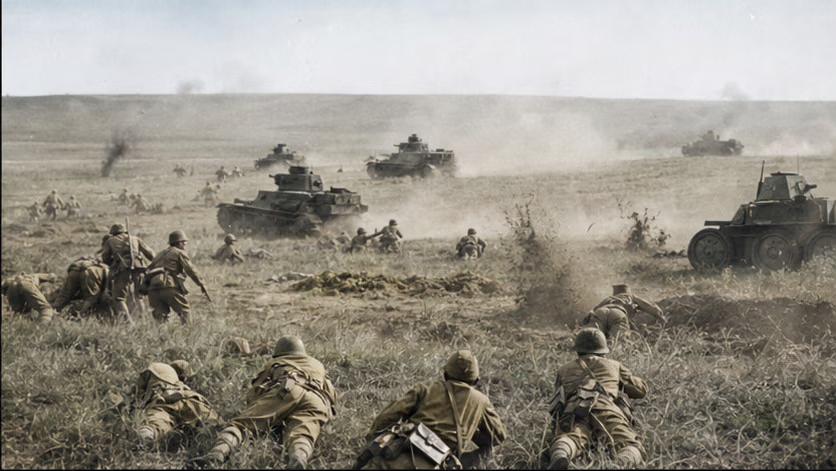
| Phase | Time | Key Points |
|---|---|---|
| Zhanggufeng: seizing the heights | 1938.7.29-7.31 | Soviet forces first occupied Zhanggufeng and Shacaofeng; the Japanese 19th Division retook them in a night attack (sequence details unverified) |
| Zhanggufeng: stalemate and armistice | 8.1-8.11 | Soviet forces kept up pressure with artillery fire and reinforcements; Japanese forces were under strict orders not to expand and not to use aviation, and held out under growing casualties; 8.10 Moscow negotiations, 8.11 armistice, Soviet forces controlled the heights |
| Nomonhan: friction escalates | 1939.5 | Mongolian forces and "Manchukuo" forces clashed on the Khalkha River; the Kwantung Army's 23rd Division intervened and suffered setbacks in the first fighting in May-early June; the Kwantung Army and the General Staff repeatedly pulled back and forth over whether to expand the fighting |
| Nomonhan: air and ground attrition | June-July | Large-scale air battles (the two sides' claimed results differed sharply by statistical basis); the Japanese July offensive stalled before the Soviet fire net; the Kwantung Army once used Unit 731 to release bacteria into rivers (recorded in both Japanese and Soviet materials, details unrecorded)※ |
| Nomonhan: Zhukov's general offensive | 8.20-8.31 | Soviet armor encircled from the northern and southern wings; the 23rd Division was almost annihilated, and division commander Komatsubara Michitaro nearly committed suicide (later relieved of command, details unverified) |
| Armistice | 9.15-16 | Germany signed a non-aggression pact with the Soviet Union on 8.23 and invaded Poland on 9.1; Japan suddenly felt isolated, and signed the armistice agreement on 9.15 |
Casualties and Losses
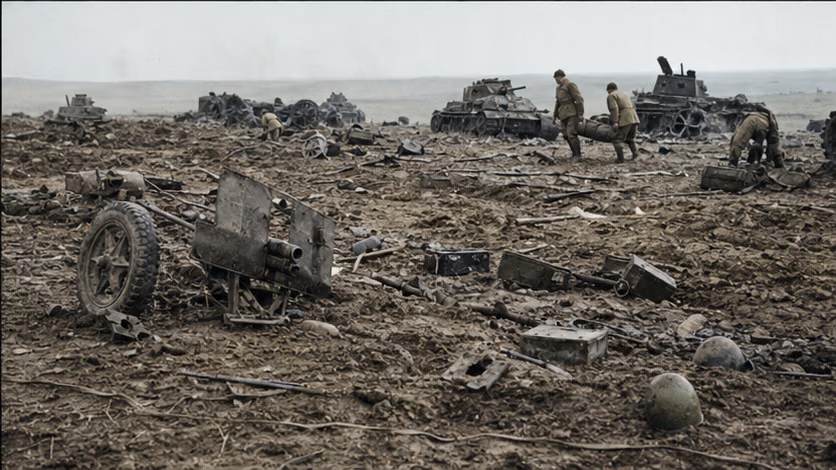
- Japanese forces: at Zhanggufeng, casualties were about more than 1,000 (figure disputed); at Nomonhan, casualties ranged from 17,000 to 60,000, with sharply divergent statistical bases - the Japanese Ministry of Health and Welfare count was about 17,000-19,000, the Soviet side claimed 60,000 killed and wounded, and scholars commonly take roughly 17,000-20,000 (multiple accounts are placed side by side; none is chosen).
- Soviet forces: at Zhanggufeng, casualties were about several hundred to more than 1,000 (figure disputed); at Nomonhan, Soviet-Mongolian casualties were about 8,000 to 25,000 (bases placed side by side; accounts vary).
- Chinese border residents: the deaths, injuries, and displacement from forced conscription and collateral damage have no systematic statistics (scale unrecorded) - this is the heaviest column in the Chinese dimension of this article: the battles were fought on Chinese ground, but the Chinese civilians who died were not in either side's ledger of results.
- Land: after Zhanggufeng, the Soviet side held de facto control; the question of Tumen River access to the sea along the "Tuzi boundary marker" line has continued to the present; the disputed Nomonhan area came under Mongolian de facto control.
Aftermath
- Causal chain: the crushing defeat at Nomonhan -> the Japanese Army's "northward advance" faction lost ground and the "southward advance" faction rose -> 1941.4, the Soviet-Japanese Neutrality Pact -> Japan moved south with confidence -> 1941.12, the Pacific War broke out. The guns of Nomonhan changed the direction of the Pacific War - this is not hindsight embellishment, but one of the clearest links in the chain of Japan's strategic turn; yet it was only one link in the chain: the fundamental drivers of the southward advance lay in resources and the conflict with the United States; Nomonhan was the "switch point," not the "locomotive" (level note: one direct trigger, not the fundamental cause).
- For the China theater: the Soviet Union concentrated on the western front against Germany, and aid to China contracted; after the "northward advance" quieted down, the main force of the Kwantung Army remained stationed in the Northeast, while elite units were gradually transferred south to the Pacific - the later shape of the China theater (the structure of Japanese troop strength, and China's isolation after the cutoff of Soviet aid) was indirectly shaped by these two battles.
- For Japan and the Soviet Union: in 1945.8, the Soviet Union declared war on Japan and swept through the Kwantung Army - the account of Nomonhan was settled six years later (see *August Storm*, separate article).
Accounts of Those Present
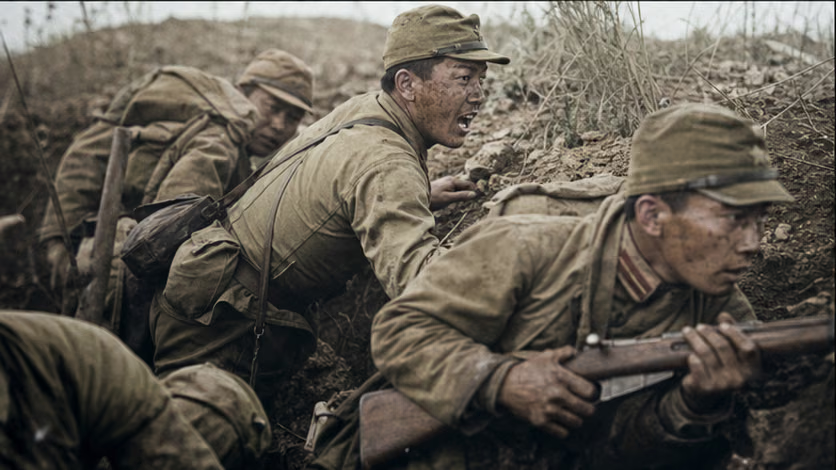
- A war pressed down into an incident: Imperial General Headquarters strictly ordered the 19th Division "not to expand"; front-line soldiers held under shellfire while reinforcements and air support were forbidden - a battle fought with politics gripping it by the throat (Japanese recollection materials unverified).
- Zhukov's steppe: Soviet forces supplied the front by rail and with ten thousand trucks, and front-line ammunition consumption was counted in tens of thousands of tons - on the open steppe, logistics was tactics (figure disputed).
- The end of the bayonet: Japanese night attacks and bayonet charges fell in batches before tank and machine-gun fire; regiment-level units of the 23rd Division disappeared as organized formations - Bushido discourse first failed before modern firepower, and Japanese survivors often described it as "hell" in recollections (specific titles unverified).
- The shadow of Unit 731: Nomonhan was one of the first occasions on which Unit 731 used bacterial weapons in actual combat, releasing bacteria into the Khalkha River - the result reportedly injured more than 1,000 Japanese troops themselves (this account circulates; basis and figures disputed)※.
- Chinese farmers beyond the boundary: Hunchun border residents were forcibly conscripted to build works, and after the armistice their homes were drawn into the Soviet de facto line - no one asked them (accessibility of sources unverified).
The Ground
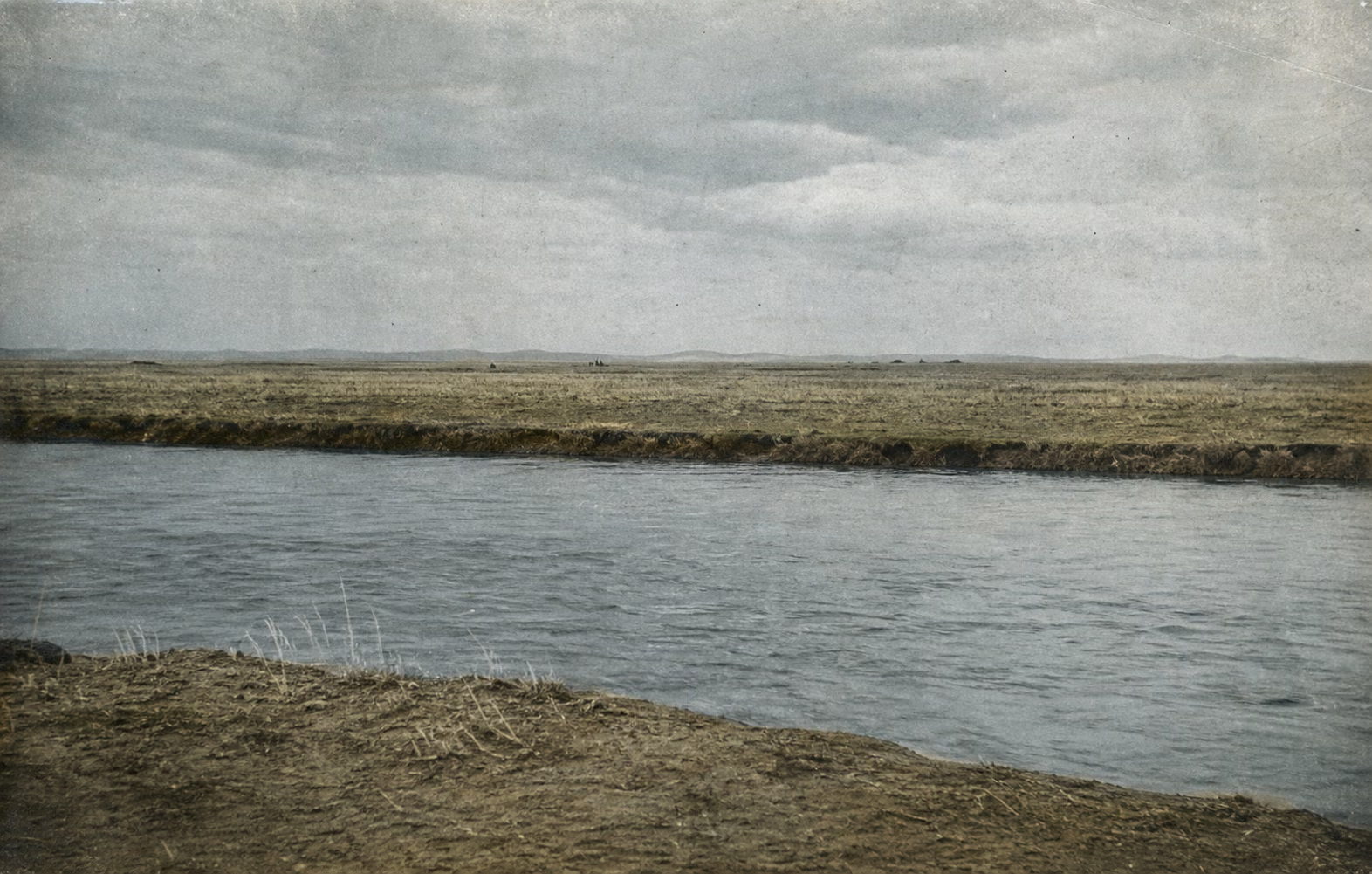
- Zhanggufeng: a small height of a little more than 100 meters, overlooking the mouth of the Tumen River and the Sea of Japan - a space of "seeing three countries at one glance," with the scale of a small borderland community, yet its strategic meaning was nailed to access to the sea.
- Nomonhan: uncovered steppe, a single river, and an encirclement zone seventy kilometers deep - a prototype space of mechanized deep operations, where Zhukov rehearsed everything he would later do on the Eastern Front.
- What the two battlefields shared: both lay on the edge lines of China's sovereign map - the first layer of the spatial narrative is "this is Chinese land."
How Each Side Records It
- Japanese side: called them "incidents" to downgrade them; within the Japanese Army, Nomonhan became an almost taboo memory of catastrophic defeat, and postwar military-history research only gradually opened up.
- Soviet/Russian side: Zhanggufeng (Lake Khasan) and Nomonhan (Khalkha River) are both official memories of victory, with monuments; Zhukov rose from here.
- Mongolia: the Battle of Khalkhin Gol is commemorated as a national defense war.
- Chinese side: the two battles long remained marginal in Chinese narratives - they were not battles fought by the Chinese army; but from the perspective of "foreign wars on Chinese soil," they were the direct continuation of Russo-Japanese War memory: the same Northeast land, for the second time in forty years, served as the proving ground for great powers.
Disputes and Sensitivities
- Line of territorial attribution: Zhanggufeng lay within Hunchun jurisdiction, and the disputed Nomonhan area lay inside China's sovereign map (the internationally recognized borders of the 1930s) - the tension between current Soviet/Russian and Mongolian narratives of de facto control and the Chinese sovereignty narrative is marked in layers in this article and not avoided.
- Sharply divergent casualty figures: Japanese Ministry of Health and Welfare figures, Soviet claims, and scholarly estimates are placed in three columns side by side.
- Unit 731 bacterial release and self-inflicted casualties: this involves ※ writing on atrocities; accounts are placed side by side, remain to be verified, and sensational versions are not adopted.
- "Changed the direction of the Pacific War": the causal chain is distinguished by evidentiary level - one direct trigger, not the sole cause; this article does not present a single-line determinist account.
- Zhanggufeng touches on contemporary China-Russia-Korea Tumen River issues; Nomonhan touches on contemporary Russian-Mongolian commemorative narratives.
Sources and Open Questions
Known main sources:
- The Japan Defense Agency War History Office's relevant volumes of *Senshi Sosho* on the Kwantung Army (Japanese official history)
- Russian/Soviet military histories and archives (volumes on Lake Khasan and the Battle of Khalkhin Gol, specific titles to be checked)
- Western scholarship on Nomonhan by Edward Drea and others (specific bibliography to be checked and supplemented)
- Hunchun local gazetteers and border archives (entry points for verifying the Chinese dimension)
Open questions: the boundary-treaty sequence for Zhanggufeng and the accurate wording of the line of territorial attribution; both sides' troop strength and casualty bases at Zhanggufeng; both sides' troop strength, equipment, and casualty bases at Nomonhan; claimed results in the air battles; details of Komatsubara Michitaro's outcome; details of Unit 731's bacterial release and figures for self-inflicted casualties; the accessibility of sources on forced conscription of Hunchun border residents and damage to them; the level of causal wording between the Soviet-Japanese Neutrality Pact and Nomonhan; the dates and clauses of the Soviet-Japanese armistice agreement; current wording on the Tumen River "Tuzi boundary marker" situation; original cables and issuing sequence for Imperial General Headquarters' "do not expand" policy; the date and approval procedure for the Kwantung Army's cross-border air raid on airfields deep in Mongolia; sources for Japanese reviews of the misjudgment of Soviet logistical capacity; statistical bases for the scale of Soviet forward transport; records of dissent within the Soviet decision-making level (none found).
All images on this site are AI-generated depictions. They are not historical photographs, not primary sources, and do not depict any real individual.