Engagement Archive · Battle of the Zhongtiao Mountains
One hundred eighty thousand men had held a "great fortress behind enemy lines in North China" for three years; once Japanese forces closed the ring from all sides, it evaporated in little more than ten days -- not defeated by enemy strength, but by its own inner decay, where the systemic illness of the frontal battlefield rotted into its most complete specimen.
Engagement Data
| Item | Content |
|---|---|
| Time | 1941.5.7 – 5.27; the main battlefield collapsed in little more than ten days, while Japanese clearing and mopping-up continued into June |
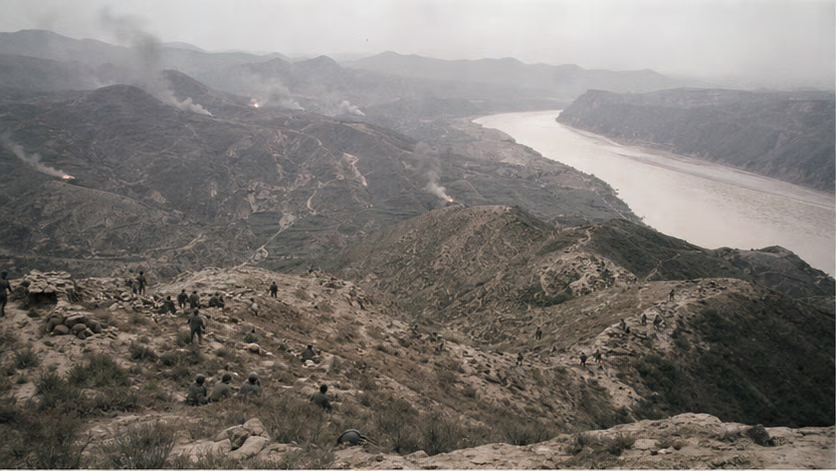
| Location | Zhongtiao Mountains in southern Shanxi, north of the Yellow River and south of the Linfen–Yuncheng line |
| Part of | Fourteen-Year War of Resistance · operations in southern Shanxi during the stalemate phase |
| Chinese side | Zhongtiao Mountains defense forces of the First War Area (commander-in-chief Wei Lihuang), including the Fifth and Fourteenth Group Armies and other units; the main forces were the Third Army, 15th Army, 43rd Army, 98th Army, and others |
| Japanese side | North China Area Army (commander Hayao Tada), concentrating the First Army and other units, more than 100,000 men in all, with additional troops and aviation support drawn from Central China and the Kwantung Army (transfer details unrecorded) |
| Result | The Chinese defense line collapsed across the front in little more than ten days; the main forces were encircled and annihilated or scattered; Japanese forces occupied the Zhongtiao Mountains, and KMT forces thereafter withdrew from southern Shanxi |
Belligerents
| Item | Chinese side | Japanese side |
|---|---|---|
| Strength | About 180,000, long stationed in the Zhongtiao Mountains for nearly three years | More than about 100,000, deployed for encirclement from all sides |
| Firepower | Artillery was scarce, ammunition reserves insufficient, and fieldworks had still not been systematically strengthened after three years of garrisoning | Divisional artillery + aviation support |
| Air | Essentially no air superiority | Air-group support, with bombing used to blockade Yellow River ferries |
| Special arms | -- | Airborne troops committed (Japanese war histories say that parachute and/or air-landing detachments in the southern Shanxi operation seized key points; details unrecorded) and fast units drove straight to the Yellow River ferries |
| Situation | Fighting with their backs to water: the Yellow River lay to the south, and the ferries were the line of retreat, yet no bridgeheads had been built and no boats had been prepared in advance | The campaign objective was annihilation, not expulsion: first seal the ferries, then turn back to sweep the area |
Terrain and Conditions
(For the wider situation in 1941 -- the international context, Japan's North China deployment before the southward advance, and the tension between the KMT and the CPC -- see *Fourteen-Year War of Resistance · War Overview*; here only southern Shanxi and the Zhongtiao Mountains are covered.)
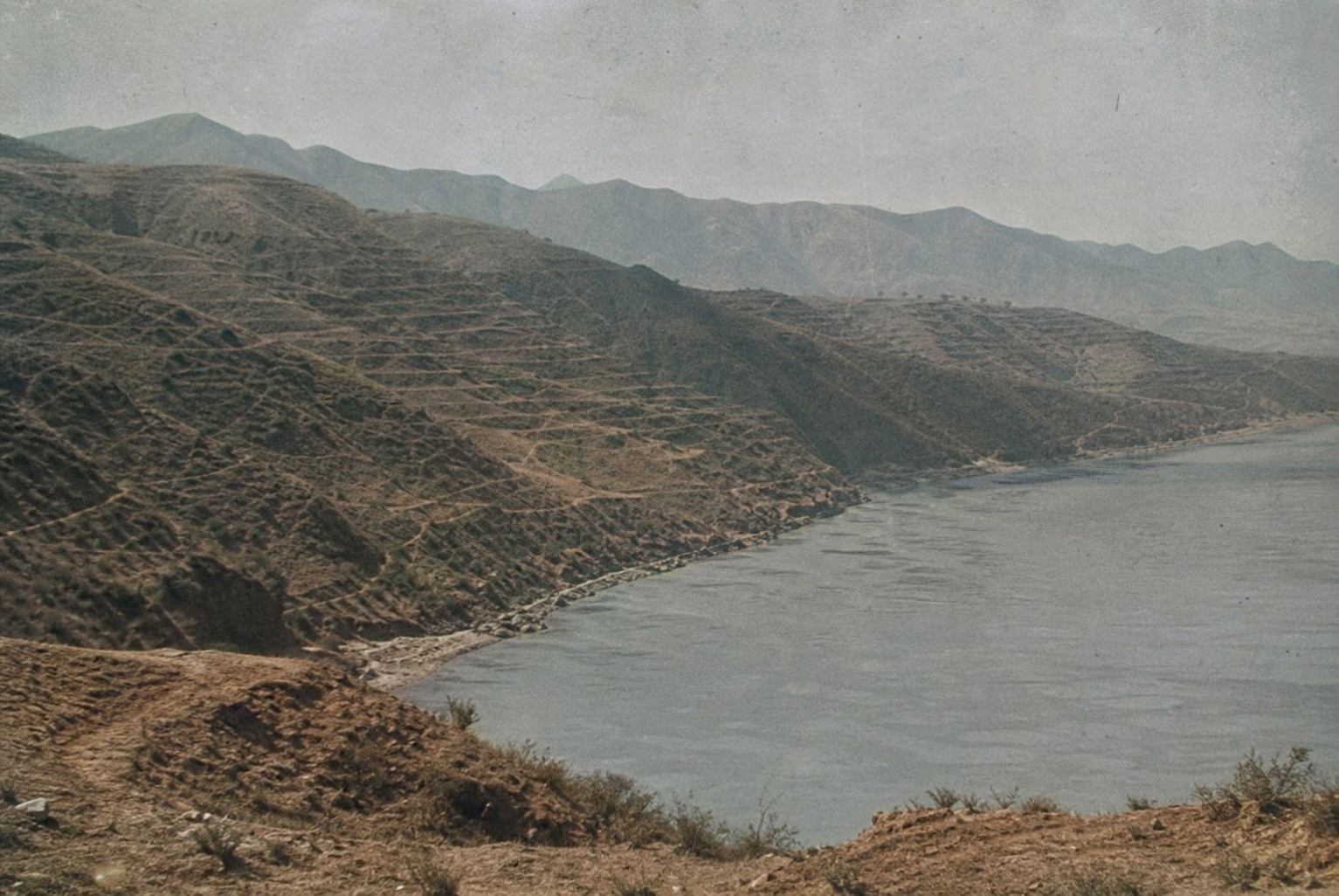
What this position was for: The Zhongtiao Mountains stretch across the north bank of the Yellow River, joining the Taihang Mountains to the east and looking toward the Lüliang Mountains to the west. After the fall of North China, they were the last sizeable salient that the Chinese frontal battlefield still held north of the Yellow River -- shielding Tongguan, Luoyang, and the western section of the Longhai Railway, and serving under Chongqing's banner as a "counteroffensive base" left in the North China interior. For this purpose, nearly 180,000 troops of the First War Area had been stationed there since 1938; during that time Japanese forces attacked more than ten times, large and small, and were beaten back each time (the counts "twelve" and "thirteen" both appear; unverified).
What three years of garrisoning had made of it: The garrison had lived in one place too long, with little fighting for too long; discipline and fighting spirit slackened together. Land reclamation, business, and trade with the rear became routine for some units (exact scale unrecorded); the defensive works, though "the mountain terrain was perilous and the standoff had lasted nearly three years, had not been actively strengthened" (postwar review wording; original source unverified). More fatal still, the south side of the position was the Yellow River -- if the defense held, it was as secure as a fortress; if it failed, there was nowhere to retreat. Yet at each ferry, "the bridgeheads on which life and death depended received no attention at all, and no works were heard of" (same as above). Before the battle, the First War Area command system was also running badly because of personnel changes: Wei Lihuang, suspected by Chongqing under accusations such as being "ineffective against the Communists," was summoned to Luoyang and Chongqing on the eve of battle; the front was put under He Yingqin's touring command, leaving a layered and overlapping command structure at the moment of combat (personnel details unrecorded).
Why It Was Fought
The 33rd Division that Shanggao had failed to pocket left northern Jiangxi in April and moved north -- its return to North China was tied to a major battle the North China Area Army was planning (transfer and order-of-battle details unrecorded). Hayao Tada was gathering troops for a real battle of encirclement and annihilation: from Central China, from the Kwantung Army, more than 100,000 men converged on southern Shanxi, with aviation transferred as well. The target was the Zhongtiao Mountains.
On Japanese maps, the Zhongtiao Mountains were the last nail driven between the occupied zone of North China and the north bank of the Yellow River. North China had been occupied for nearly four years. "Pacification" and "security cleansing" swept the guerrilla war behind enemy lines, but above them there still hung this regular-army position of the frontal battlefield: about 180,000 men, garrisoning the mountains for nearly three years, touching the Taihang to the east and looking to Lüliang in the west, shielding Tongguan, Luoyang, and the western Longhai line to the south. Chongqing called it a "counteroffensive base." Japanese forces had attacked more than ten times ("twelve" and "thirteen" both appear; still unverified), and each time had been stopped. In spring 1941, the North China Area Army decided to stop driving it off and instead eat it whole: concentrate superior force for a battle of encirclement and annihilation (called by the Japanese side the "Central Plains Campaign" / southern Shanxi operation; specific codename unverified) -- the objective was not to take ground, but to seal all 180,000 men of the First War Area between mountains and river. The method began with the line of retreat: send fast units straight to the Yellow River ferries and airborne detachments to seize key points in depth, close the southern escape route, then turn back to encircle and sweep. Before the battle, deception and secrecy hid the intention. The timing also mattered: preparations for the southward advance were already taking shape, and before moving, Japan first had to nail down this back yard in North China.
The 180,000 men in the mountains were no longer the 180,000 men of three years before. Long garrison duty with little fighting had made land reclamation, business, and rear-area trade the daily work of some units; after nearly three years facing the enemy, fieldworks had "not been actively strengthened" (postwar review wording; original source unverified); behind them lay the Yellow River, yet at this place of life and death there were no bridgeheads and no boats prepared in advance. Command on the eve of battle was even more tangled: Wei Lihuang, suspected by Chongqing under accusations such as being "ineffective against the Communists," was summoned to Luoyang and Chongqing just before the battle; He Yingqin toured the front and commanded, layering one system atop another. Chinese intelligence misread both the scale of Japanese concentration and the main direction of attack, and only improvised once battle was at hand (specific process of intelligence failure unverified).
Both sides put their resolve on paper, but the weight behind it was worlds apart. The North China Area Army's plan for the southern Shanxi operation had already taken shape in early 1941, and after approval from Tokyo it transferred troops month by month (plan codename and approval sequence unverified); Japanese prewar reconnaissance was detailed enough to cover command personnel -- Wei Lihuang's departure from the front and the change of war-area command were both in its intelligence (Japanese reconnaissance sources unverified). On the Chinese side, He Yingqin arrived in Luoyang on the eve of battle to assemble First War Area commanders and lay out the response (time and agenda unverified), but no anticipation was made of the Japanese method of "sealing the ferries first." The material account was just as one-sided: food and ammunition for 180,000 men had to be ferried boat by boat from the south bank of the Yellow River, and reserves could not sustain a high-intensity battle (reserve details unverified); once wired communications were cut, units were fighting on their own within days; air superiority remained in Japanese hands throughout. No systematic record has been found of anyone before the battle advocating abandonment of the Zhongtiao Mountains and contraction south of the Yellow River (unverified) -- the only case that reached the table was "hold."
One side had calculated every link of an annihilation battle around the ferries; the other had not even calculated clearly whether the opponent was coming.
On May 7, Japanese forces launched simultaneous pincer attacks from the east, west, and north; airborne detachments descended on rear-area key points, and fast columns drove straight toward the Yellow River ferries.
Course of the Engagement
| Phase | Time | Key Points |
|---|---|---|
| Encirclement opens | 5.7–5.9 | Japanese forces launched simultaneous pincer attacks from the east, west, and north; airborne detachments seized rear-area key points (locations unverified), and fast units drove straight to the Yellow River ferries; within days Chinese command and communications were in disorder, links among units were cut, and each fought on its own |
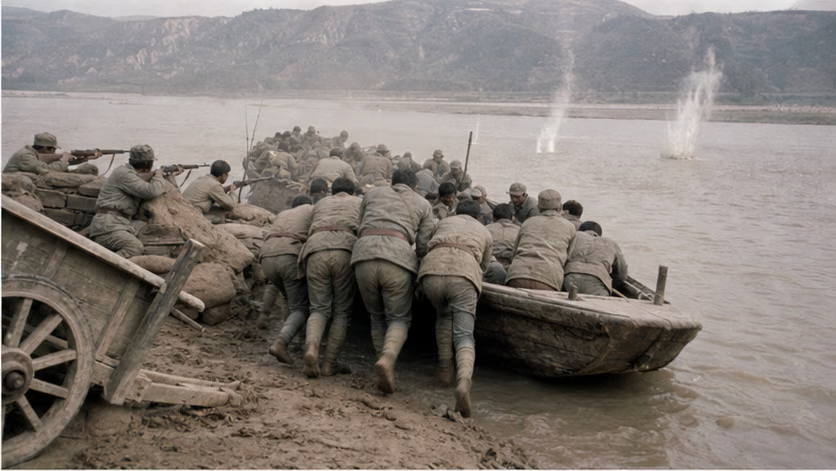
| Ferry blockade | Around 5.9 | The main Yellow River ferries were seized by Japanese forces or blockaded by fire, cutting off the retreat route; units breaking south were stopped by fire at the ferries and along the riverbank, while large numbers of routed soldiers and civilian laborers crowded the banks and many drowned (Japanese records say Yellow River drownings numbered in the thousands; the figure "three thousand" appears in citations from Japanese war histories; unverified) |
| Division and annihilation | 5.10–5.15 | Japanese forces divided the defensive area into several pockets and compressed them one by one; the Third Army and other units were intercepted repeatedly while breaking out, and army commander Tang Huaiyuan killed himself in martyrdom (5.12, location given as Xianshan in one account and Jianshan in another; unverified); Cun Xingqi, commander of the Twelfth Division, died at Maojiawan on 5.13 |
| Sweeping and clearing | 5.16–5.27 and after | After the main battlefield collapsed, Japanese forces repeatedly searched the mountains and swept up remnants; by 5.27 the battle had come to a close, and in mid-June the Japanese side announced the "victorious conclusion" of the battle (Japanese announcement date given as 6.15; unverified) |
Casualties and Losses
Two sets of figures are listed side by side, without choosing between them:
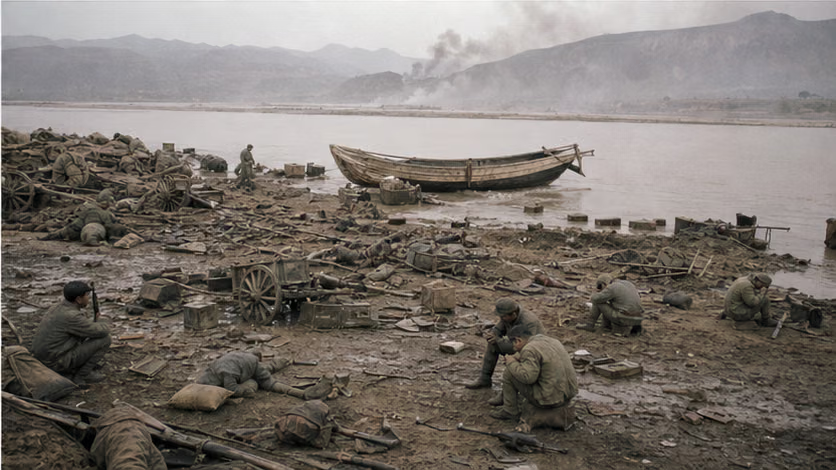
- Japanese statistics (North China Area Army battle-results announcement): about 42,000 Chinese bodies abandoned, about 35,000 captured (including a Japanese-side subcount of about 15,000 captured by Japanese forces and about 20,000 by Manchukuo forces; unverified); Japanese losses were 673 killed and 2,292 wounded. The Japanese side called it "a rare battle result since the Incident."
- Chinese figures: First War Area casualties exceeded 40,000 (combat deaths and drownings combined), with more than 35,000 captured, close to the Japanese battle-result figures but not necessarily the same statistical boundary (whether they include peripheral forces and civilian laborers is unverified); Chinese battle-report figures for losses inflicted on Japanese forces were far higher than Japanese self-reported figures (specific numbers and sources unverified).
- Whichever set is used: the main forces in a defensive zone of about 180,000 men disintegrated as organized formations in little more than ten days; combat deaths, drownings, and prisoners together approached half the total, while Japanese self-reported losses were under three thousand -- one of the most lopsided exchange ratios among battles on the frontal battlefield.
Aftermath
- The Zhongtiao mountain area changed hands from then on, and the frontal battlefield no longer had an organized regular-army position north of the Yellow River; once the shield was removed, Tongguan and Luoyang were directly exposed. Eighth Route Army units later gradually entered the Zhongtiao mountain area for guerrilla operations, and Japanese war histories also acknowledged Eighth Route Army activity in the area "after the Battle of the Zhongtiao Mountains" (original wording unverified).
- At the 5.28 battle review, Chiang Kai-shek called this battle "the greatest humiliation in the history of the War of Resistance" (seen in many later citations; original text and occasion unverified).
- Wei Lihuang was removed from posts including commander-in-chief of the First War Area (date and wording of the disciplinary action unverified); before and after the battle, the KMT and CPC accused each other over whether the Eighth Route Army had cooperated with an attack, making the issue a long-lived talking point in the history of KMT-CPC friction (see "How Each Side Records It").
- The Third Army was rebuilt from remnants; Tang Huaiyuan was later posthumously awarded the rank of full general, and in 2014 was included in the Ministry of Civil Affairs' first list of well-known anti-Japanese martyrs and heroes.
Accounts of Those Present
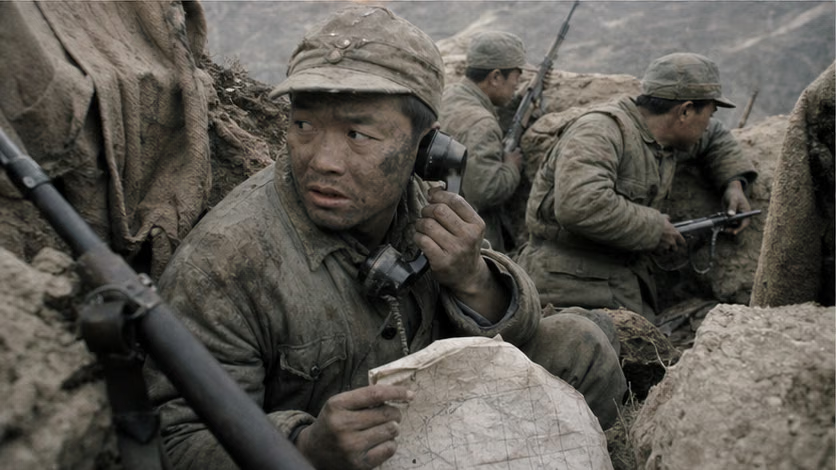
- "No army or division commander taken prisoner": On 5.12, with breakout hopeless, Third Army commander Tang Huaiyuan told those beside him: "China has only army and division commanders who die in battle, none who are taken prisoner; the Third Army must absolutely not set that precedent." (wording cited from commemorative reports; original source unverified) He then shot himself at Xianshan (one account says Jianshan; unverified), aged 55.
- Cun Xingqi: Commander of the Twelfth Division, from Yunnan. After being shot in the chest and having his right leg blown off, he still supervised the breakout; at Maojiawan he was intercepted again, and his left leg was also blown off. With both legs gone and breakout hopeless, he killed himself in martyrdom with his sword (5.13, aged 46; the account that "Mr. Sun personally bestowed the dagger" appears in commemorative reports; unverified).
- The people by the Yellow River: After the retreat route was cut, tens of thousands of routed soldiers, wounded soldiers, and civilian laborers pressed toward the riverbank. The boats that could be boarded were already far too few; groups trying to swim were swallowed by the torrent. Japanese records describe floating corpses on the river surface (the claim of "three thousand drowned" appears in citations from Japanese war histories; unverified) -- this is why "drownings" stand as a separate item within the death figures for this battle.
- The men who had held for three years: Many rank-and-file officers and soldiers had been stationed in the Zhongtiao Mountains for nearly three years; some had married, farmed, or gone into business (scale unrecorded). When the battle began, some first went home to bring their families, and some scattered on the spot -- the mixed military-civilian life produced by three years of garrisoning also became an accelerator of collapse.
- Tang Huaiyuan and Zhu De: The two were classmates at the Yunnan Military Academy in 1909. During the garrison period, the Third Army and the Eighth Route Army exchanged enemy intelligence and repeatedly conducted joint operations against Japan (specific cases unverified) -- this old connection later became material cited by both sides in the argument over "who should be blamed for Zhongtiao Mountain."
The Ground
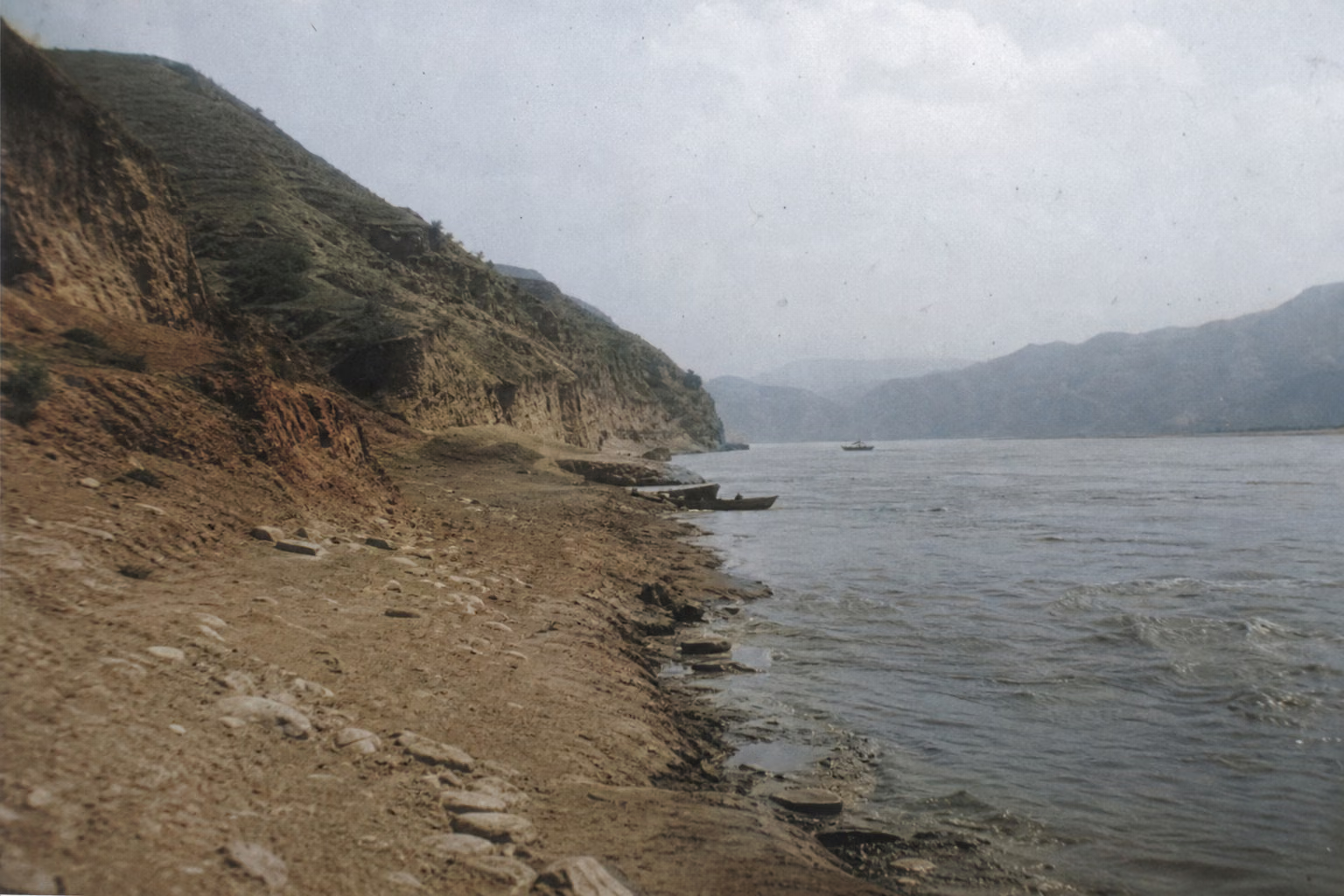
- The mountain area is about 170 kilometers long from east to west and only about 50 kilometers deep: a narrow mountain belt whose southern edge is the Yellow River -- the whole defensive zone was a pocket with a small mouth and a large bottom, and the bottom was the river; suited to being surrounded, not to breaking out.
- The key to Japanese operational art was not attacking the mountains but inserting forces at the ferries: fast columns on the east and west drove along the outer sides of the mountains straight for each Yellow River ferry, while airborne detachments seized key points in depth -- the front was still defending the mountains when the road out behind it was already gone.
- In this sector the Yellow River was a hard boundary: no bridges, few boats, and a fast current. After the defense line collapsed, the battlefield space suddenly shrank from "holding mountain positions" to "survival on the riverbank" -- the cruelest spatial transformation of this battle.
- The terrain in which the Zhongtiao Mountains, Taihang, and Lüliang formed mutual horns was, in ordinary times, the basis for calling it a "fortress behind enemy lines"; the presence of neighboring Eighth Route Army defense areas also made it a place where KMT and CPC zones interlocked like teeth -- the geographical "each side within the other" was capital for cooperation before the battle and the basis for mutual blame afterward.
How Each Side Records It
- Chinese side (Chongqing / National Government system): Recorded as a rare catastrophic defeat on the frontal battlefield, with emphasis on the word "humiliation" -- Chiang Kai-shek's phrase "the greatest humiliation in the history of the War of Resistance" became the settled judgment on the battle; reviews of the causes stressed faulty command, inadequate preparation, and intelligence failure. On the Eighth Route Army, the Chongqing-side narrative says that before the battle it had telegraphed orders for the Eighth Route Army to attack in coordination, and that Yan'an proposed conditions and did not act on schedule (dates and original texts of the telegrams unverified).
- Chinese side (Yan'an / CPC system): Recorded as the bitter fruit of the KMT's "passive resistance against Japan and active opposition to the Communists" -- emphasizing the long-term corruption of the garrison, the creation of friction, and incompetent command. On the question of coordination, the Yan'an-side narrative says that the KMT side imposed blockade and friction in ordinary times and demanded troops on the eve of battle, while the Eighth Route Army in North China was then under severe pressure from Japanese retaliatory mopping-up after the Hundred Regiments Offensive, and its requested conditions on pay, ammunition, and defense areas were not resolved (specific conditions unrecorded). The entry of Eighth Route Army units into the Zhongtiao Mountains for guerrilla warfare after the area's loss was used as evidence for "who persisted."
- Japanese side: Official war histories (North China Area Army battle-results announcement) record it as a "rare" success in encirclement and annihilation "since the Incident," stressing that it "achieved the purpose of destroying the enemy's main forces"; the descriptions of the Yellow River ferry blockade and sweeping results are detailed and cold. Japanese figures (42,000 abandoned bodies, 35,000 captured, own losses 673 killed and 2,292 wounded) became the most frequently cited figures in later writing, but Japanese battle-results announcements had a convention of exaggeration.
Disputes and Sensitivities
- The boundary of the explanation "defeated by inner decay": Land reclamation and business, lax discipline, unrepaired works, and an unsecured retreat route are causes of defeat that mostly come from postwar reviews and later syntheses; the primary materials for their exact scale and circumstances still need to be checked item by item. Attributing the defeat to "systemic illness" must not slide into humiliation of individual soldiers: the routed men who drowned were first of all those made to bear the failure of orders and system.
- KMT-CPC mutual blame: The Chongqing narrative of "urging the Eighth Route Army to attack" and the Yan'an narrative of "conditions not resolved" both have documentary support; this article lists the two accounts side by side and does not choose one. The original texts from both sides (Chiang Kai-shek's telegram order and the CPC Central Committee / Mao Zedong reply) still require checking against the original telegram archives for dates and wording.
- Casualty statistical basis: Japanese battle-results announcements and Chinese battle reports differ sharply, while the Chinese figure of "more than 40,000 killed" and the Japanese figure of "42,000 abandoned bodies" are close but may come through the same chain of citation.
- The internal condition of the defenders: Corruption, lack of fieldworks, and no line of retreat were themselves variables in failure; inner decay and the defenders' sacrifice coexisted.
- Chiang Kai-shek's phrase "the greatest humiliation" has circulated extremely widely, but the original occasion (the 5.28 review meeting? diary? instruction?) varies across later citations; the original text in *Chiang Kai-shek's Diary* or related documentary drafts still needs to be checked.
Sources and Open Questions
Known main sources:
- War History Office of Japan's Defense Agency, relevant volumes of the *Senshi Sosho* on the North China Pacification War (Japanese official history; source for the battle-results announcement figures)
- Guo Rugui and Huang Yuzhang, eds., *Operations on the Frontal Battlefield in China's War of Resistance Against Japan* (Chinese synthesis, including quotations from postwar reviews)
- Taiwan edition of *War History of the War of Resistance Against Japan*, relevant volumes (specific volumes unverified)
- Commemorative reports on Tang Huaiyuan and Cun Xingqi, and materials from the Tang Huaiyuan Memorial Hall in Jiangchuan, Yunnan (sources for individual details, often cited second-hand)
Open questions:
1. Original text, occasion, and date of Chiang Kai-shek's "greatest humiliation in the history of the War of Resistance" (5.28 review meeting / diary / instruction). 2. Location of Tang Huaiyuan's suicide: Xianshan and Jianshan both appear; date (5.12) and original source for his last words. 3. Details of Cun Xingqi's martyrdom: the sequence in which both legs were blown off, the account of "the dagger personally bestowed by Mr. Sun," the date of martyrdom (5.13), and the location (Maojiawan). 4. Original source for the subcount within the Japanese figure of 35,000 prisoners: "15,000 captured by Japanese forces / 20,000 captured by Manchukuo forces." 5. Original Japanese war-history wording for the claim that "three thousand" drowned in the Yellow River. 6. Specific strength of the Japanese airborne troops (parachute / air-landing) and the locations they seized. 7. Designations and numbers of the units transferred by Japanese forces from Central China and the Kwantung Army before the battle. 8. Original text and dates of Chongqing's telegraphic order for the Eighth Route Army to attack and Yan'an's reply with conditions. 9. Personnel-arrangement details for Wei Lihuang being summoned away from the front before the battle and He Yingqin's command on the eve of battle. 10. Chinese battle-report figures for losses inflicted on Japanese forces, and their sources. 11. Statistical basis for the counts of Japanese attacks repelled, "twelve" versus "thirteen." 12. Date (6.15) and original wording of the Japanese announcement that the battle had ended. 13. Time and wording of Wei Lihuang's postbattle disciplinary action. 14. Primary materials for the scale of the garrison's land reclamation and business activity. 15. Codename of the southern Shanxi operation plan and the sequence of approval by Tokyo. 16. Japanese reconnaissance sources for changes in Chinese command personnel. 17. Time and agenda of He Yingqin's Luoyang meeting. 18. Details of defender food and ammunition reserves and the Yellow River ferry supply capacity. 19. Records of any prebattle dissent advocating abandonment of the Zhongtiao Mountains and contraction south of the Yellow River (not found).
All images on this site are AI-generated depictions. They are not historical photographs, not primary sources, and do not depict any real individual.