Engagement Archive · Northeast Volunteer Army and the Anti-Japanese United Army (1931–1942)
After the Northeast fell, hundreds of thousands first rose with whatever arms they had and then scattered; later, a lone force held out in mountains at forty degrees below zero until only a little more than a thousand remained, and still would not put down its rifles -- the most isolated line of the Fourteen-Year War of Resistance.
Engagement Data
| Item | Content |
|---|---|
| Time | After 1931.9 – 1942 (1940–42: main forces withdrew into Soviet territory for reorganization and training; 1945: returned with Soviet forces, mentioned briefly and continued in later articles) |
| Place | The three northeastern provinces: mountain forests and guerrilla areas across southern Liaoning, eastern Liaoning, eastern Jilin, and northern Manchuria |
| Alignment | Fourteen-Year War of Resistance · localized resistance stage (continuing through the full-scale War of Resistance period) |
| Chinese side | Early stage: various Anti-Japanese Volunteer Armies (forces under Li Du, Wang Delin, Deng Tiemei, Tang Juwu, Ma Zhanshan, Su Bingwen, and others); later stage: the eleven armies of the Northeast Anti-Japanese United Army |
| Japanese side | Kwantung Army, Manchukuo Army, and Japanese-puppet police and intelligence organs |
| Result | Most Volunteer Army forces collapsed and scattered in 1933; the Anti-Japanese United Army persisted until around 1940, when its main forces were nearly exhausted; the remnants entered the Soviet Union and were reorganized as the 88th Independent Brigade, returning to the Northeast with Soviet forces in 1945 |
Belligerents
| Item | Chinese side | Japanese-puppet side |
|---|---|---|
| Troop strength | The Volunteer Armies were said at their peak to number 300,000 to 500,000 (statistical bases differ sharply, including armed groups of many kinds; figure disputed); the Anti-Japanese United Army numbered more than 30,000 at its height (organized as 11 armies) | Kwantung Army garrison forces + more than 100,000 Manchukuo Army troops + police and intelligence personnel; punitive operations often concentrated several times the strength to encircle and attack a single route |
| Firepower | Mainly captured weapons; guns and ammunition replenished by fighting; no heavy weapons | Standard equipment, aircraft, armored cars, chemical warfare agents (use records unverified) |
| Supply | No rear area, no source of pay, no unified command; dependent on secret camps, the populace, and captured supplies | South Manchuria Railway network + "collective hamlet" blockade + major winter punitive campaigns |
| Environment | Winters of thirty to forty degrees below zero, no doctors or medicine, salt and grain cut off | Cities and railway network in hand; "forced hamlet consolidation" used to sever the Anti-Japanese United Army from the populace |
Terrain and Conditions
(For the larger situation, see *Fourteen-Year War of Resistance · War Overview*; this article covers only the Northeast after occupation.)
- The popular level: After the Mukden Incident, order in the northeastern countryside collapsed -- the puppet regime imposed taxes and corvee labor, bandits rose everywhere, and anti-Japanese armed groups mixed with local "mountain strongholds"; peasants were caught among the Japanese-puppet authorities, Volunteer Armies, and bandit groups. This is the key to understanding why the Volunteer Armies rose so suddenly and scattered so suddenly: their manpower came from the people, and when they collapsed they scattered back into the people.
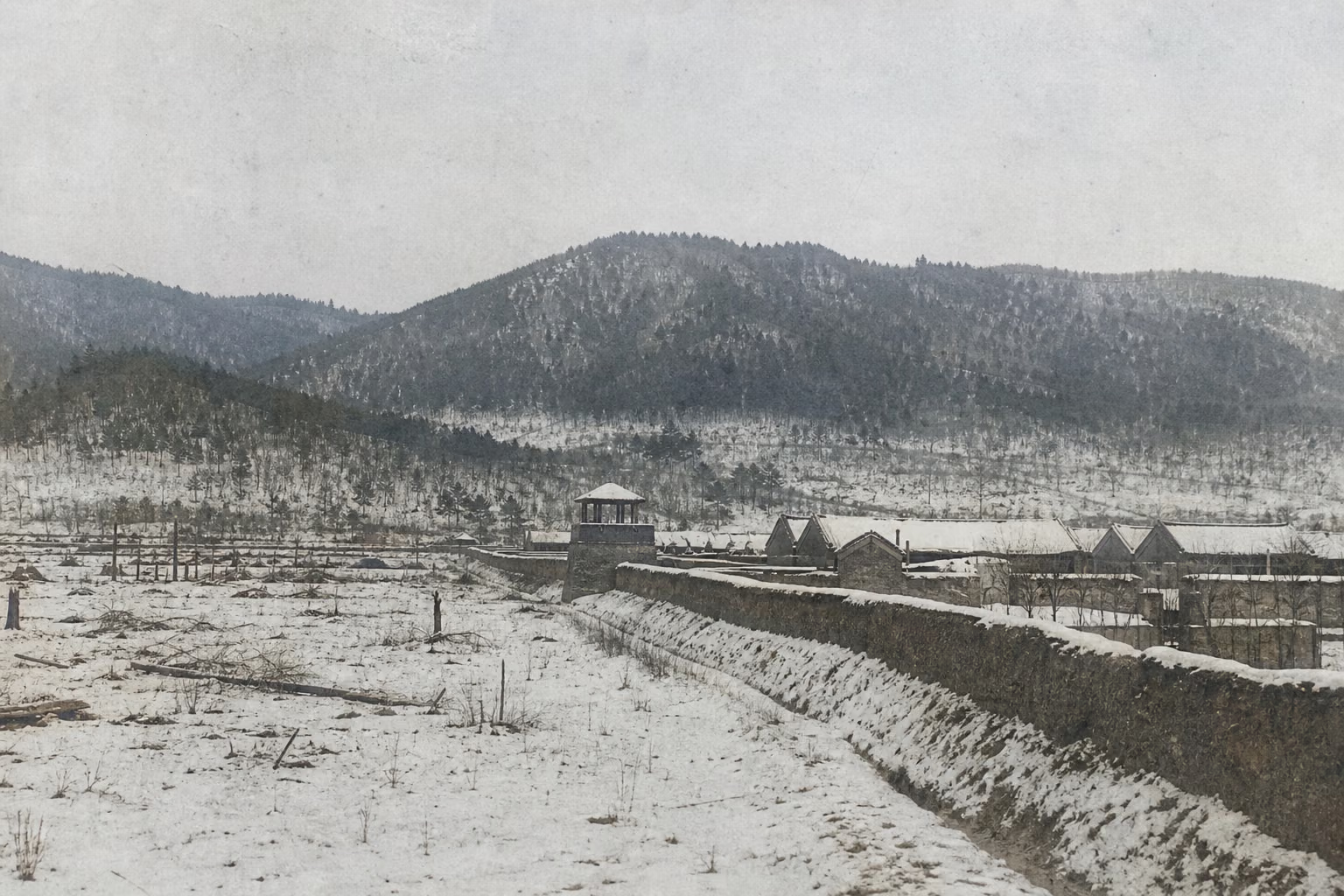
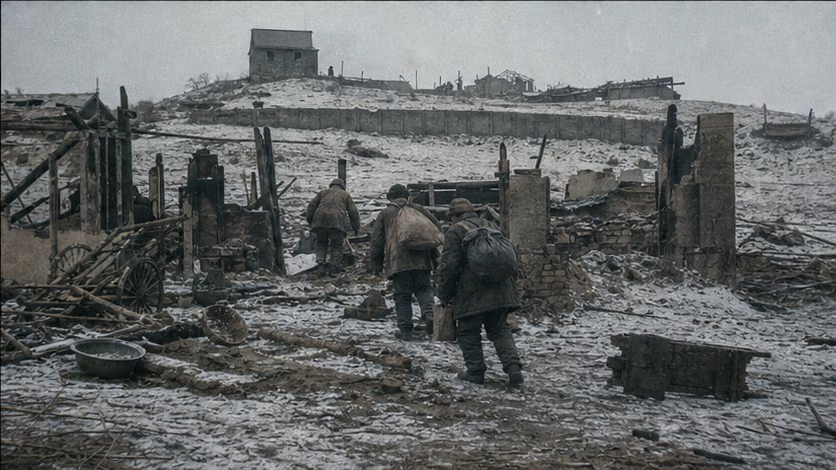
- Collective hamlets ※: From 1934, the Japanese-puppet authorities forcibly carried out "forced hamlet consolidation," burning scattered households, merging them into larger settlements, surrounding the hamlets with walls, trenches, and blockhouses, and checking papers on entry and exit -- the aim was to separate the Anti-Japanese United Army from the populace, a "separation of civilians and bandits." Scattered mountain households were burned in large swathes; those who refused were punished as "bandit collaborators" (figures for scale and deaths vary widely by source).
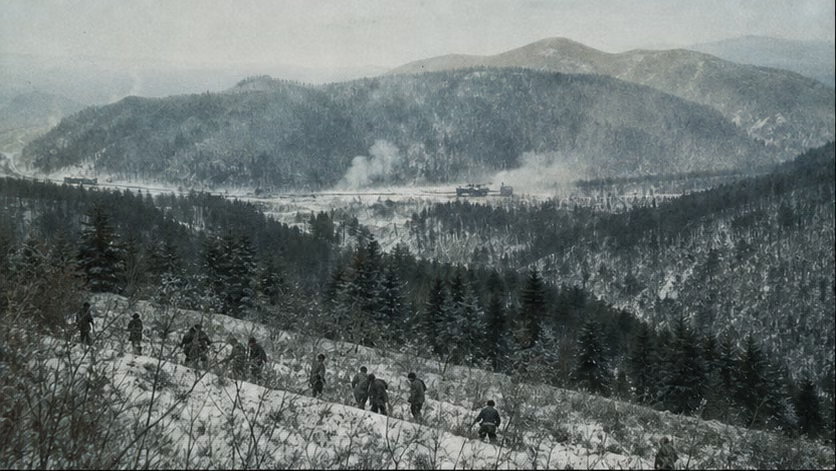
- Geography: The forests of the Changbai Mountains, the Wanda Mountains, and the Lesser Khingan range -- natural depth for guerrilla warfare; but in winter the forest was also a dead end. Without food and without the populace, the mountains became a grave.
Why It Was Fought
Formal resistance went out section by section. Shenyang was lost in a single night after the Mukden Incident, and the three provinces were lost in a little more than four months; in January 1932, Jinzhou was abandoned without a fight, and in February Harbin fell after its strength was spent. Li Du, Feng Zhanhai, and others led remnants away. In March, "Manchukuo" was put up in Changchun -- thirty million people in the Northeast were not asked for their opinion before they became "citizens of Manchukuo." The army had gone; the League of Nations commission arrived only the next spring, and its report later went no further than a statement of position. The question of whether to fight fell to the doorstep of every household.
There was no unified order to rise. Scattered officers and soldiers of the Northeast Army would neither enter the pass nor surrender to the puppet regime; Green Forest bands would not change flags; local militias defended their villages; peasants guarded their homes; students left school to join the army -- each rose on its own and fought on its own, under a bewildering range of banners, collectively called the Volunteer Armies. The half-month in which Ma Zhanshan's force held against the Japanese forces at Nen River Bridge (covered in another article) spread inside and outside the pass and proved that striking back was possible. Deng Tiemei in southern Liaoning, Tang Juwu in eastern Liaoning, Wang Delin in eastern Jilin, and Li Du after withdrawing from Harbin raised banners one after another. At their height they were said to number 300,000 to 500,000 -- armed groups of every sort included, with statistical bases still sharply divergent today. Their aims differed: some waited for armies inside the pass to fight back; some hoped to hold out until the League of Nations delivered justice; some only wanted to keep their own hamlet alive. Their shared misjudgment was the belief that the state that had withdrawn would still return.
The Japanese-puppet account book stood on the other side. The Kwantung Army believed the occupation was accomplished, that once "Manchukuo" was established popular feeling would naturally attach to it, and that punitive operations were merely police work. Japanese military histories recorded all of the following ten-plus years as "bandit suppression" and "pacification of public order." The wording itself is the fossil of a misjudgment: they thought they were suppressing bandits; in reality they were fighting a war that did not cease for more than ten years.
In 1933, the various Volunteer Armies, unpaid, poorly armed, and not subordinate to one another, mostly scattered under route-by-route punitive campaigns. The fire did not go out. Guerrilla forces in Panshi, Zhuhe, Mishan, and elsewhere under the CPC Manchurian Provincial Committee system continued on the ruins of the Volunteer Armies, and in 1936 they were reorganized as the Northeast Anti-Japanese United Army, eventually eleven armies. On the CPC side, the decision can be checked on paper: on the day after the Mukden Incident, the Manchurian Provincial Committee issued a declaration calling for armed resistance against Japan (the title is commonly given as *Declaration on Japanese Imperialism's Armed Occupation of Manchuria*, original document unverified) -- earlier than any regime inside the pass. From spontaneous uprisings to an organized lone force, these are the two segments of this history.
What tightened around this force was first material want, and only then punitive campaigns. The Volunteer Armies had no source of pay; weapons and ammunition came from private stores left by routed troops and from captures, and each shot fired left one less. Even when the Anti-Japanese United Army had 30,000 men at its height, it had no supply line at all; all logistics consisted of secret camps in the mountains and grain from the pockets of the populace. After "forced hamlet consolidation" in 1934, bringing grain into the mountains was a capital crime; winters with salt and grain cut off reached thirty to forty degrees below zero. Half the results credited to punitive detachments were won for them by cold and hunger (ratio of losses from freezing and starvation to battle deaths unverified).
The line also turned before. Earlier, remnants of the Volunteer Armies had been treated as old-style armed groups and kept at arm's length. In early 1933, an instruction letter from the CPC Central Committee to Manchuria (commonly called the "January 26 Instruction Letter," title and document number unverified) turned toward uniting all anti-Japanese forces -- the only correction this lone army received from its "rear." The options of surrender and departure also always remained on the table: Ma Zhanshan attached himself for a time to the puppet regime in spring 1932, then soon returned to the anti-Japanese side and rose again (course unverified); when the Volunteer Armies scattered, some entered the pass, some withdrew to the Soviet Union, some returned home, some became bandits, and some surrendered to the puppet regime. There had been no unified order to rise, and there was none to disband -- dissent and opposition are not found in written records, because there was never a table here where objections could be written down.
Course of the Engagement
| Stage | Time | Main Points |
|---|---|---|
| Volunteer Army uprisings | After 1931.9–1932 | After Ma Zhanshan's Resistance at Jiangqiao (covered separately), dozens of routes rose together, including Li Du's Jilin Self-Defense Army, Wang Delin's National Salvation Army, Deng Tiemei's Northeast People's Self-Defense Army (southern Liaoning), and Tang Juwu's Liaoning People's Self-Defense Army (eastern Liaoning); they operated even in the suburbs of Shenyang and Changchun and at one point raided Fengtian Airfield (details unrecorded) |
| Collapse and scattering | Winter 1932–1933 | Japanese forces suppressed them one by one; the Volunteer Armies had no unified command, no pay or equipment, and no mutual subordination, and most collapsed and scattered in 1933 -- Ma Zhanshan, Su Bingwen, Li Du, and others led remnants into the Soviet Union and then by detour into the pass; Deng Tiemei was captured and killed in 1934; Tang Juwu's force fought on into Rehe (details of each leader's ending unrecorded) |
| Transition | 1933–1936 | CPC-led guerrilla forces (Panshi, Zhuhe, Mishan, and others) continued on the ruins of the Volunteer Armies |
| Anti-Japanese United Army organization | 1936–1938 | Reorganized as the First through Eleventh Armies of the Northeast Anti-Japanese United Army, operating in three route armies; more than 30,000 at their height; guerrilla warfare harassed Japanese-puppet strongpoints and railways |
| Extreme hardship | 1938–1940 | Collective hamlets + successive years of major punitive campaigns; 1938.10: Eight Women Threw Themselves into the River ※; 1940.2.23: Yang Jingyu died for his country at Mengjiang ※; each route army suffered defeats in succession |
| Withdrawal into the Soviet Union and reduction | 1940–1942 | Remnants crossed the border into the Soviet Union; in 1942 they were organized as the 88th Independent Brigade of the Soviet Far Eastern Front (outwardly called a training brigade), led by Zhou Baozhong, Li Zhaolin, and others, with a little more than a thousand people |
| Coda | 1945.8 | Returned to the Northeast with Soviet forces, seized fifty-seven strategic points (figure disputed), and received the Eighth Route Army and New Fourth Army coming out through the pass -- briefly continuing into the later *Chinese Civil War · Overview* |
Casualties and Losses
- Volunteer Armies: no statistics to speak of. An uprising of 300,000 to 500,000 scattered in two or three years -- how many died, dispersed, returned home, became bandits, or surrendered to the puppet regime cannot be checked in archives (no archival basis).
- Anti-Japanese United Army: most of the army-level commanders of the 11 armies died for their country (Yang Jingyu, Zhao Shangzhi, Wang Detai, Chen Rongjiu, Li Yanping, and others, roster unverified); losses among ordinary soldiers cannot be counted -- whether more died of freezing and starvation or in battle, veterans said "more froze and starved to death" (source unverified).
- Japanese-puppet side: Japanese published figures for deaths and wounds in punitive operations are far lower than Chinese records; the two statistical bases are placed side by side and still await verification. The political price Japan paid to suppress the Anti-Japanese United Army -- the destruction of northeastern rural society by the collective hamlet movement ※ -- is passed over in Japanese military histories.
- Civilians ※: collective-hamlet burnings and forced relocations, collective punishment for "bandit collaboration," and torture of captured Anti-Japanese United Army personnel (the Zhao Yiman case) -- relevant figures are disputed.
Aftermath
- "March of the Volunteers" (1935): lyrics by Tian Han, music by Nie Er, theme song of the film *Children of Troubled Times* -- the name "Volunteer Army" was taken from the various Volunteer Armies of the Northeast. The later national anthem of the People's Republic of China had its lexical root in these scattered armed forces.
- In 1945, the remnants of the Anti-Japanese United Army returned to the Northeast with Soviet forces. Zhou Baozhong held a post such as deputy commander of the Soviet Changchun garrison (details unrecorded), maintaining the situation before the Northeast Bureau and troops coming out through the pass arrived -- between the final baton of the War of Resistance and the first baton of the civil war, the Anti-Japanese United Army was present.
- From the 1950s, the history of the Anti-Japanese United Army was gradually organized; Yang Jingyu, Zhao Shangzhi, Zhao Yiman, and the Eight Women Who Threw Themselves into the River entered public memory. Mengjiang County was renamed Jingyu County (1946).
- Japanese archives (Kwantung Army military police, Manchukuo police affairs) were partly organized and published after the war, becoming hostile-perspective sources for checking the history of the Anti-Japanese United Army.
Accounts of Those Present
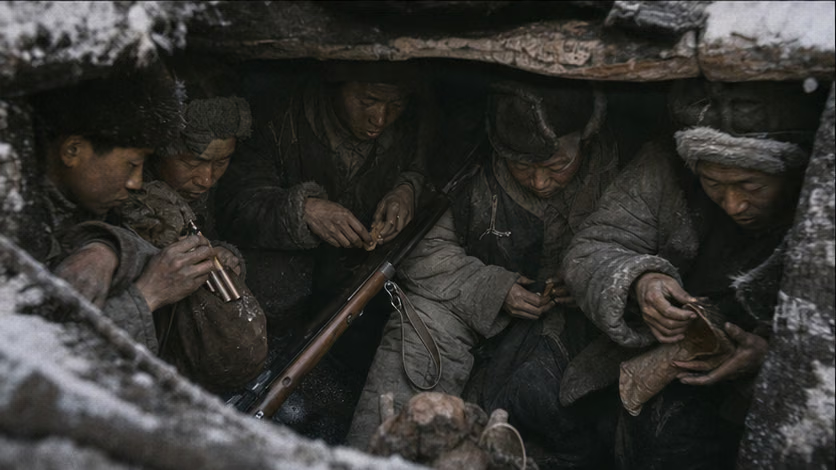
- Yang Jingyu ※: On 1940.2.23, at Sandaowaizi in Mengjiang County, he fought alone against several hundred Japanese and puppet troops for five days and nights, down to his last bullet. When the Japanese forces dissected his body, there was only cotton wadding, grass roots, and bark in his stomach, not a single grain of food -- Kishitani Ryuichiro (puppet Tonghua provincial police chief) is recorded as sighing at this, "though he was an enemy, I cannot but admire him" (wording differs among materials, unverified). No embellishment: five days and five nights, ice and snow, one person.
- Zhao Shangzhi: On 1942.2.12, he was ambushed in Heli County, seriously wounded and captured, and died for his country that day; his head was cut off by Japanese forces and sent to Changchun (the body was thrown into the Songhua River, unverified), and the head's whereabouts remained a mystery for sixty-two years. In 2004, a skull unearthed at Banruo Temple by Jingyuetan in Changchun was identified as Zhao Shangzhi's (identification procedure and objections unverified), and in 2008 he was buried in Chaoyang, Liaoning.
- Zhao Yiman ※: Wounded and captured in 1935, she endured torture for months without yielding (types of torture vary by source, unverified); on 1936.8.2 she was executed at Zhuhe, age thirty-one. Before execution, on the train, she wrote a final letter to her young son -- "It is truly a matter of regret that your mother was unable to fulfill her responsibility to educate you... after you grow into adulthood, I hope you will not forget that your mother sacrificed herself for the country!" The letter survives.
- Eight Women Threw Themselves into the River ※: In 1938.10 at the Wusihun River, eight members of the Fifth Army women's corps, including Leng Yun, ran out of ammunition, linked arms, waded into the river, and drowned in martyrdom -- the oldest was twenty-three, the youngest thirteen. The earliest record of the episode and differences in detail are unverified.
- Secret camps: Dugout shelters excavated in the deep mountains, holding a little grain, salt, and medicine; after 1938 the secret-camp system was exposed by turncoats and destroyed in large swathes -- in the later period of the Anti-Japanese United Army, betrayal by turncoats accounted for a large share of casualties (the defections of Cheng Bin and others, details unrecorded).
- Forty degrees below zero: Veterans recalled that frozen rifle bolts had to be thawed open with urine; those who lost fingers and toes to frostbite were beyond counting; people slept in snow hollows, and in the morning some often did not wake again (memoir source unverified).
The Ground
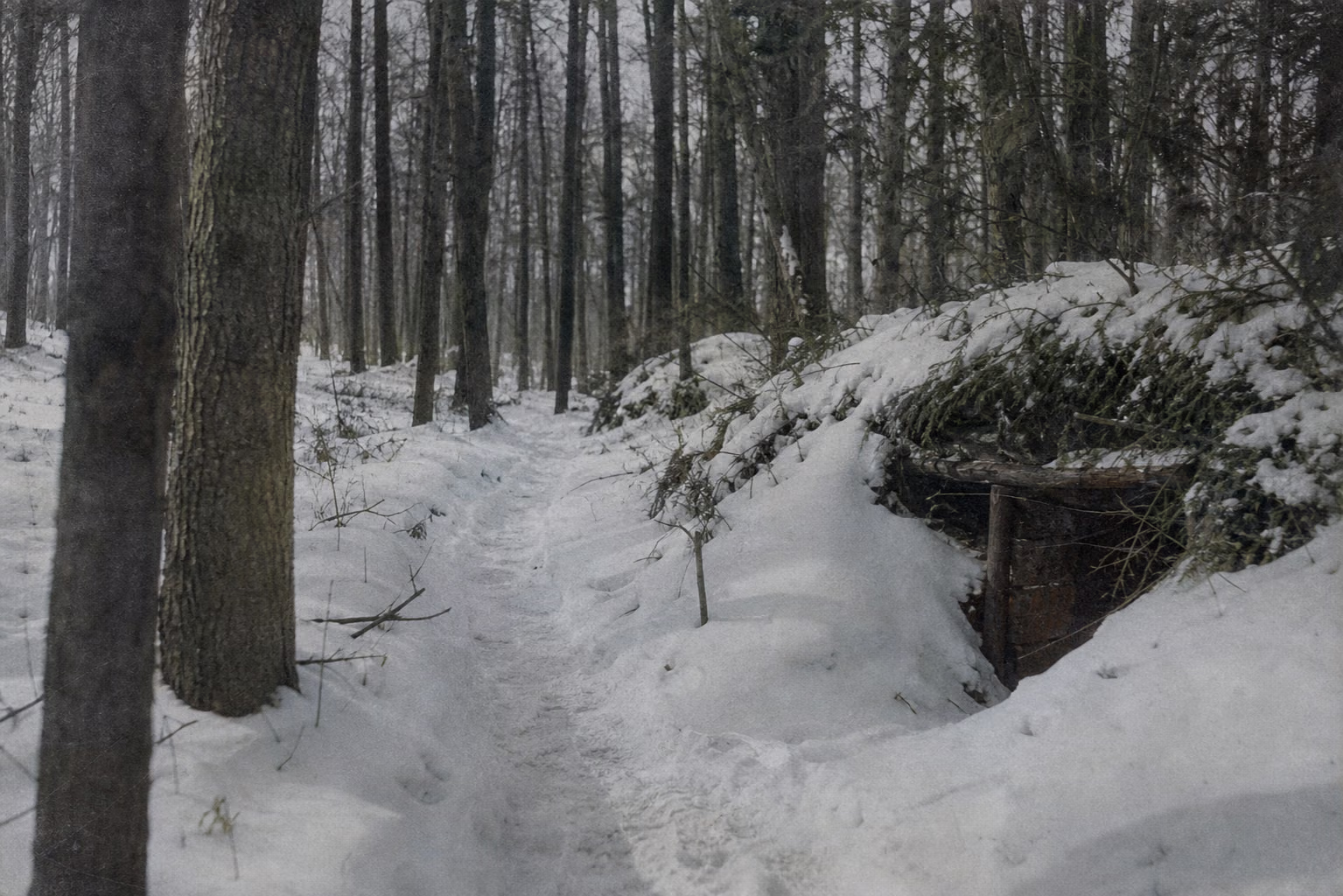
- Forest and snowfield: immense depth, extremely low visibility, and every footprint a trace -- tracking and counter-tracking were the core spatial grammar; snow was both cover and informer.
- Secret-camp network: point-distributed dugouts + underground communications lines; once one point was exposed, the entire network had to move.
- Collective hamlets: walls, trenches, blockhouses, passes -- the Japanese-puppet authorities made "spatial control" into a system; the Anti-Japanese United Army's responses were night raids, inside contacts, disguise, and hidden entry and exit.
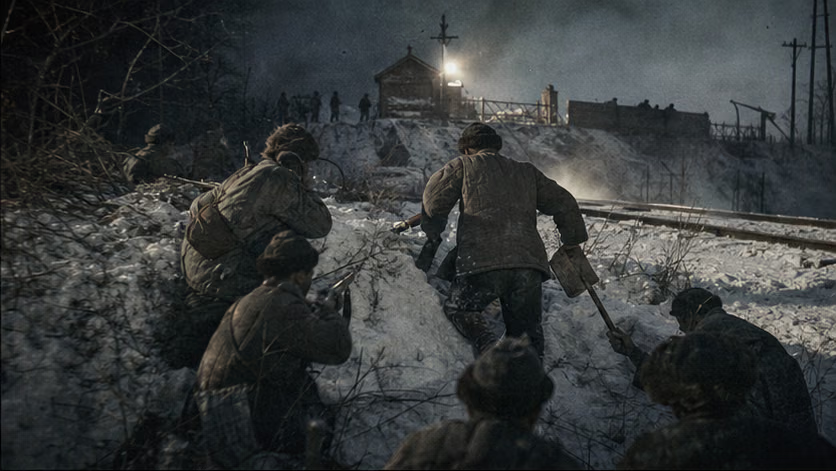
- Railways and the "comb" of punitive detachments: Japanese forces used railways to divide guerrilla areas, then swept in comb-like dragnets -- a confrontation between grids and the piercing of grids.
How Each Side Records It
- Japanese side: called it "bandit suppression" and "pacification of public order." Official materials grouped the Anti-Japanese United Army and the Volunteer Armies together as "bandits" and placed them within the framework of public-order operations; internal documents of the Kwantung Army staff evaluated people such as Yang Jingyu differently from the wording of public documents (specific wording unverified).
- Chinese side: the Anti-Japanese United Army is one of the "most arduous and outstanding" pages in the narrative of the Fourteen-Year War of Resistance; the Volunteer Army stage, because of its complex composition (including Green Forest bands, old soldiers, and secret-society groups), was long narrated only briefly -- in recent years local histories and oral histories have gradually filled it in.
- Korean perspective: the Anti-Japanese United Army included many ethnic Korean officers and fighters (Kim Il-sung once served as an Anti-Japanese United Army division commander -- the later narrative around this was enormously amplified in North Korea, and the divergence between Chinese and North Korean narratives itself remains an item for checking).
- Popular level: in northeastern popular memory, recollections of the "Anti-Japanese United Army" often overlap with memories of "huzi" bandits; oral accounts from victims of the collective hamlets have begun to be collected systematically in recent years (projects and institutions unverified).
Disputes and Sensitivities
- Volunteer Army manpower figures: claims of 300,000 and 500,000 coexist; how many were combat-capable troops and how many were nominal affiliates cannot be fixed from archives -- each claim uses a different statistical basis.
- Details of Yang Jingyu's death for his country: the betrayer, the course of the final battle, and the wording and authenticity of Kishitani Ryuichiro's sigh differ among materials and at different levels.
- Zhao Shangzhi's head: the 2004 skull identification has an official conclusion and also public objections; both are placed side by side.
- Earliest record of the Eight Women Who Threw Themselves into the River: it comes from a retelling in Zhou Baozhong's diary, with no surviving eyewitness at the scene -- this point has already been analyzed in scholarship, and this article does not avoid it.
- Kim Il-sung and the Anti-Japanese United Army: Chinese and North Korean narratives differ greatly, involving contemporary politics, with different sources for each account.
- ※ Atrocity nodes (collective hamlets, torture, handling of martyrs' bodies) are listed by node, without sensory embellishment.
Sources and Open Questions
Known main sources:
- Zhou Baozhong, *Diary of Northeast Anti-Japanese Guerrillas*
- Collected memoirs of veteran fighters of the Anti-Japanese United Army (individual volumes to be listed)
- Japanese Kwantung Army military police files and Manchukuo police affairs files (postwar organized editions)
- Zhao Yiman's final letter (original held by the Military Museum of the Chinese People's Revolution, unverified)
- *Historical Materials on the Northeast Anti-Japanese United Army*, collected series
Open questions: original sources for each statistical basis for Volunteer Army numbers; details of the endings of each Volunteer Army leader (date of Deng Tiemei's killing, Tang Juwu's fighting route, Li Du and Su Bingwen's route into the Soviet Union); roster of army-level commanders of the 11 Anti-Japanese United Army armies who died for their country; Japanese statistical bases for deaths and wounds in punitive operations; scale and death figures of collective hamlets; source for the wording of Kishitani Ryuichiro's sigh; procedural and objection materials concerning the identification of Zhao Shangzhi's head; earliest text recording the Eight Women Who Threw Themselves into the River; details of the defections of Cheng Bin and others; primary materials on Zhao Yiman's interrogation and torture; comparison of Chinese and North Korean archives on Kim Il-sung's posts in the Anti-Japanese United Army; number of strategic points seized by the 88th Brigade in 1945; materials on the composition background of "March of the Volunteers" (evidence for a direct connection between Tian Han's lyrics and the Northeast Volunteer Armies); original document and title of the CPC Manchurian Provincial Committee's September 18 declaration; title, document number, and meeting-document basis for the "January 26 Instruction Letter" and the earlier closed-door line; the course of Ma Zhanshan's attachment to the puppet regime and return to the anti-Japanese side; ratio of Anti-Japanese United Army losses from freezing and starvation to battle deaths.
All images on this site are AI-generated depictions. They are not historical photographs, not primary sources, and do not depict any real individual.