Engagement Archive · Suiyuan Resistance (1936)
In the winter of 1936, Japan pushed puppet Mongol forces westward against Suiyuan; Fu Zuoyi's troops first held the front at Hongge'ertu, then in a snowy night raid struck Bailingmiao and took the enemy's lair -- a rare clean victory since the Mukden Incident; one month later came the Xi'an Incident.
Engagement Data
| Item | Content |
|---|---|
| Time | 1936.11.15 – mid-12 |
| Place | Eastern Suiyuan Province: Hongge'ertu, Bailingmiao, Xilamulengmiao (Damiao) |
| Belongs to | the Fourteen-Year War of Resistance · localized-resistance stage (for the larger situation, see *the Fourteen-Year War of Resistance · War Overview*) |
| Defender | Fu Zuoyi's forces (the 35th Army and Suiyuan local troops) |
| Attacker | Puppet Mongol Army (Demchugdongrub and Li Shouxin), puppet Great Han Righteous Army (Wang Ying), planned and directed by Japanese special-service agencies |
| Result | The defense of Hongge'ertu blunted the frontal attack; Bailingmiao was recovered in a night raid, and Xilamulengmiao brought another victory; the puppet forces collapsed, and one part returned to the Chinese side |
Belligerents
| Item | Defender | Attacker |
|---|---|---|
| Strength | Several tens of thousands across Suiyuan as a whole, with several thousand committed on the front line (figure disputed) | About fifteen thousand puppet troops, plus Japanese advisers and special-service personnel (figure disputed) |
| Equipment | Mainly infantry, with a small amount of artillery and aircraft support (from the Taiyuan side -- this account unverified) | Japanese-supplied equipment, with aircraft in support and special-service-agency radio direction |
| Command | Fu Zuoyi held unified command; Peng Yubin, Dong Qiwu, Sun Changsheng, and Sun Lanfeng commanded separate battlefields | Japanese special-service agencies (Tanaka Ryukichi and others) did the actual planning; Demchugdongrub and Wang Ying appeared at the front |
Terrain and Conditions
(For the larger situation in 1936 -- the North China Autonomy Movement, the Liangguang Incident, and the eve of the Xi'an Incident -- see *the Fourteen-Year War of Resistance · War Overview*; this entry records only Suiyuan.)
Suiyuan: a place built up over five years. Fu Zuoyi had governed Suiyuan for several years, building canals, opening farms, and reorganizing troops; local finances and military-civilian relations were both fairly stable -- a different foundation from the looseness on other North China fronts.
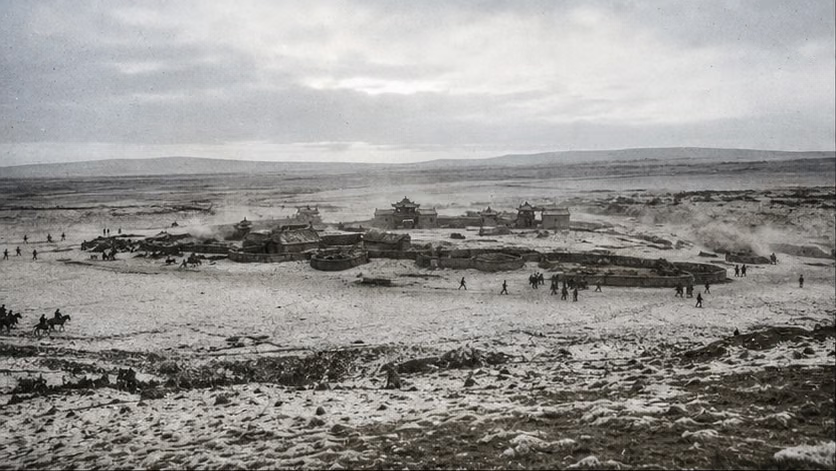
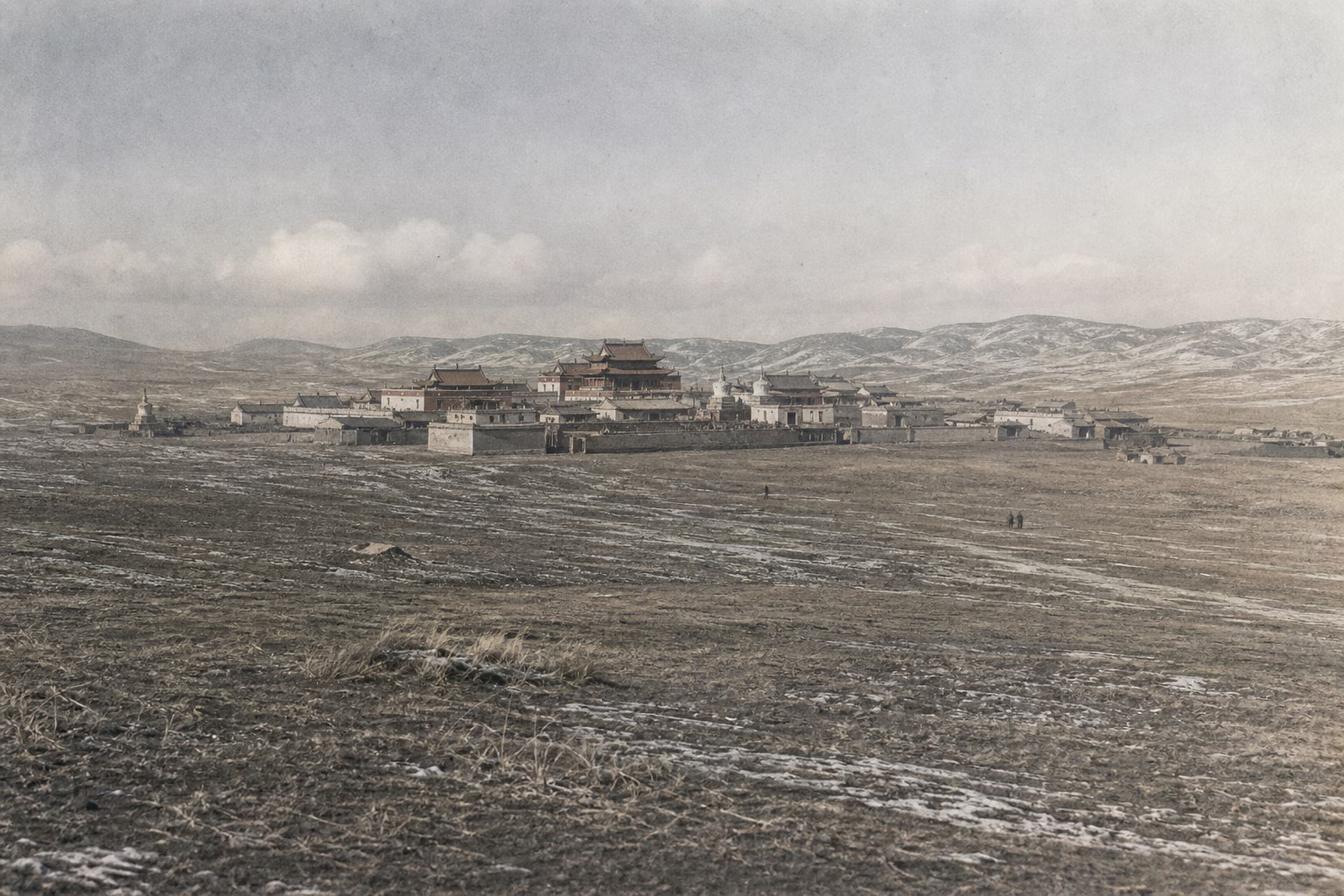
Bailingmiao: a religious and transport center on the Ulanqab grassland, both the political symbol and supply base operated by the puppet Mongol forces, with large stores of grain and ammunition. To strike Bailingmiao was to remove the relay station for the puppet Mongol westward advance.
Why It Was Fought
After the Allied Army was dissolved, counties such as Duolun in eastern Chahar again fell into Japanese and puppet hands. For the next three years, the struggle in North China was not fought with guns, but with documents: in the summer of 1935, the He-Umezu Agreement and Qin-Dechun-Doi Agreement drove the Central Army, Northeastern Army, and Kuomintang party offices out of Hebei and eastern Chahar; as winter came, the "North China Autonomy Movement" rose, the puppet regime in eastern Hebei put up its signboard in November, and the Hebei-Chahar Political Council was established in December -- one bite after another, while Beiping's students took to the streets on December 9. For three years the guns did not sound; from one year to the next, the map changed.
The next bite was aimed north of the passes. The Kwantung Army and puppet Manchukuo side supported Demchugdongrub, and in May 1936 established the puppet Mongol Military Government, seeking to advance westward into Suiyuan and sever North China from the Northwest; the forward base was set at Bailingmiao -- this temple town on the Ulanqab grassland, where large stores of grain and ammunition had been built up. The planning came from Japanese special-service agencies, and Tanaka Ryukichi again appears on the list, one of the self-directors of the Shanghai "Japanese monk incident" four years earlier; the method was the old one as well: provide money, guns, and advisers, with Wang Ying's puppet "Great Han Righteous Army" put in front as the vanguard and Li Shouxin's puppet Mongol Army as backing. For the Japanese side, this was a low-cost strategic advance -- if anyone died, they were puppet troops; if it succeeded, there would be "Mengjiang"; if it failed, the fire would not reach Japan itself.
The account book on the Suiyuan side was different. Fu Zuoyi had governed Suiyuan for five years, building canals, opening farms, and reorganizing troops; this place was the basic ground he had built with his own hands, and there was nowhere to retreat. The way of living that North China had demonstrated for three years by "not fighting" -- agreements, committees, changing flags -- could not work in Suiyuan, and the eyes of the whole country were on the northern frontier. As for whether the Central Government ordered the fight, or Fu Zuoyi resisted on his own and the Central Government later recognized it, the two narratives still coexist today (archival accounting bases vary by account); what can be confirmed is that the works at Hongge'ertu had been built in advance.
Before the fighting, Fu Zuoyi exchanged telegrams with Taiyuan and Nanjing, and Yan Xishan's side leaned artillery and supplies toward Suiyuan (telegram content and dates unverified). Fu's intelligence was not thin -- after five years of building up the locality, the locality itself was his eyes and ears, and the puppet troop concentration was known in advance. What the Japanese side lacked was exactly symmetrical: it did not know the defenders' readiness, or how deep Fu Zuoyi would dare to strike.
The material boundary was asymmetrical on the two sides. The puppet forces depended on the Japanese side for money and guns and on special-service agencies for advisers -- Japan's refusal to send regular troops was both the ceiling on cost and the fatal vulnerability: once the front-stage force collapsed, the whole board was lost. On the Suiyuan side, five years of farming and settlement could support a border fight, but not a full war -- there was only one way to fight: decide it quickly, hold the front, then take the grain and ammunition stores at Bailingmiao and let the puppet forces disperse on their own (this judgment is inferred from the supply structure, unverified).
The constraint came from the Central Government: only the puppet forces were to be fought, and the conflict was not to be allowed to expand into a direct Sino-Japanese clash (original instruction unverified). No record has been seen of dissent within Fu's side over resistance. On the puppet-force side, Wang Ying and Demchugdongrub were not under one another's command and each had his own calculations -- once the front line was defeated, Jin Xianzhang and Shi Yushan immediately led their troops back to the Chinese side; the cracks were visible before final defeat arrived.
Japanese military histories later recorded this battle as the "Suiyuan Incident," treating it as a setback for the Kwantung Army's strategic work (original text unverified). The root of that setback was that it treated Suiyuan as another piece of North China that would yield once pushed, and did not calculate that five years had built up another kind of foundation here. On November 15, 1936, several thousand men of Wang Ying's force fiercely attacked Hongge'ertu in eastern Suiyuan. The guns that had been silent for three years sounded again from here.
Course of the Engagement
| Stage | Time | Main Points |
|---|---|---|
| Defense of Hongge'ertu | 11.15–11.18 | Several thousand men of Wang Ying's force fiercely attacked Hongge'ertu, while the defenders held by means of prepared works; Fu's commanders Peng Yubin and Dong Qiwu directed reinforcements and counterattacks, and on 11.18 took the enemy's front-line strongpoint, forcing the puppet troops to retreat in disorder |
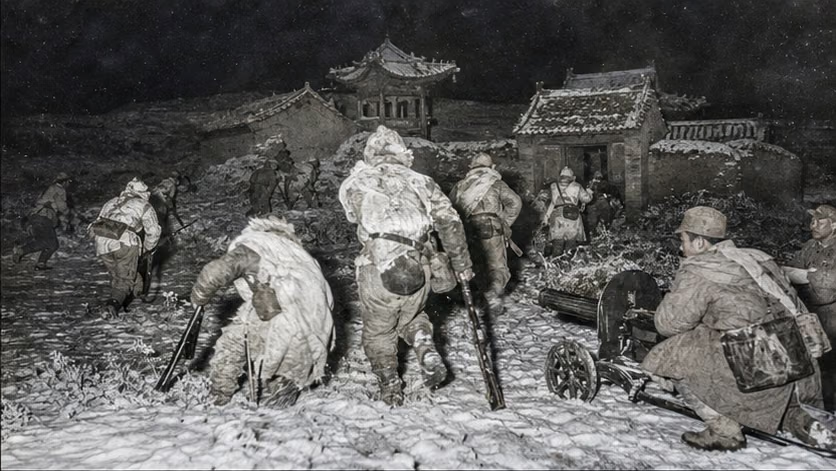
| Night raid on Bailingmiao | 11.23–11.24 | The forces of Sun Changsheng and Sun Lanfeng made a snowy night raid, recovering Bailingmiao on the morning of 11.24, inflicting several hundred enemy losses and taking many prisoners; the puppet Mongol lair and its accumulated grain and ammunition were both lost |
| Xilamulengmiao | early 12 | The puppet forces counterattacked and were defeated again; Wang Ying's brigade commanders Shi Yushan, Jin Xianzhang, and others led their troops back to the Chinese side (numbers and dates vary by account), and the puppet-force system collapsed |
| Aftermath | mid-12 | A nationwide high tide of comfort missions for the troops followed; on 12.12 the Xi'an Incident broke out, and the fighting therefore stopped at this line |
Casualties and Losses
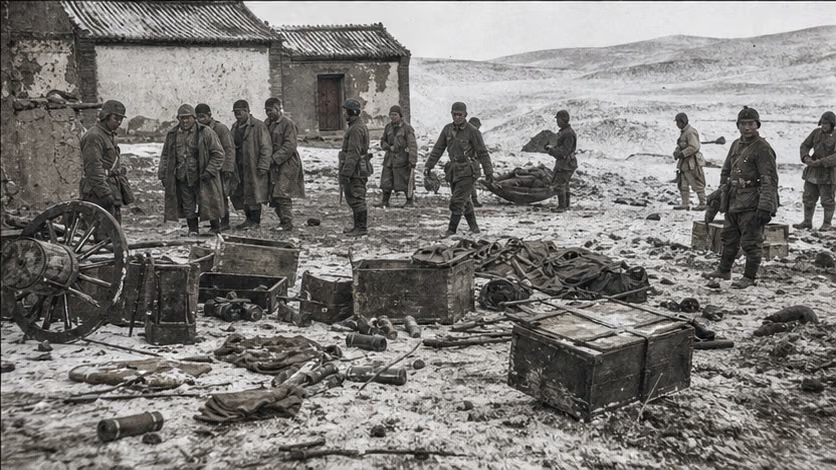
- Defender: several hundred casualties in the three engagements combined (figures vary by source; figure disputed).
- Attacker: several thousand killed, wounded, and captured in total (figures vary by source; if those who returned to the Chinese side are included, the puppet forces in effect disintegrated by nearly ten thousand -- figure disputed).
- ※ Civilians: grassland operations covered broad, sparsely populated ground, and there are few records of direct civilian casualties (record unverified).
Aftermath
- Nationwide tide of troop comfort: donations, sympathy delegations, and student representatives came to Suiyuan in a steady stream, and newspapers seethed over the "great victory at Bailingmiao" -- this was a rare clean victory since the Mukden Incident, the first release after five years of stifled frustration.
- The Japanese-puppet plan for a westward advance into "Mengjiang" was set back, and afterward shifted toward operating in northern Chahar.
- One month later the Xi'an Incident broke out, and the situation changed sharply. Suiyuan's morale was the ground tone of that winter -- this link is interpretive, not a causal assertion, and is specially marked.
Accounts of Those Present
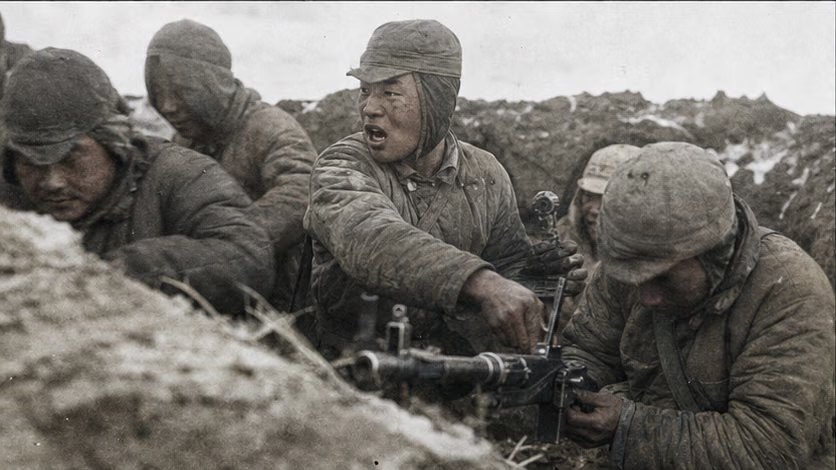
- Snowy night raid: in late November the grassland was twenty degrees below zero, and the raiding troops hid by day and moved by night. A widely circulated detail says that soldiers wore their fur coats inside out, using the white lining as snow camouflage -- the image is plausible, but the original source is unverified.
- Secrecy and feints: before the battle, Fu Zuoyi guarded the operational plan very tightly, and even his subordinate commanders received their orders only on the eve of fighting (details unclear).
- Japanese advisers who died in China: Japanese special-service-agency personnel were killed in the Battle of Bailingmiao (names and numbers disputed) -- "puppet troops fought, Japanese directed" was literal fact in this battle.
- Wang Ying: commander of the "Great Han Righteous Army"; after defeat followed defeat, he was abandoned by followers and subordinates returned to the Chinese side, and after the battle he disappeared from sight (ending unverified).
- The people who comforted the troops: Beiping students made the hard journey to Suiyuan to offer support and comfort, and people from all sectors in Shanghai donated funds -- this was a rehearsal for the later full-scale War of Resistance pattern of "the front fighting, the rear comforting the troops."
The Ground
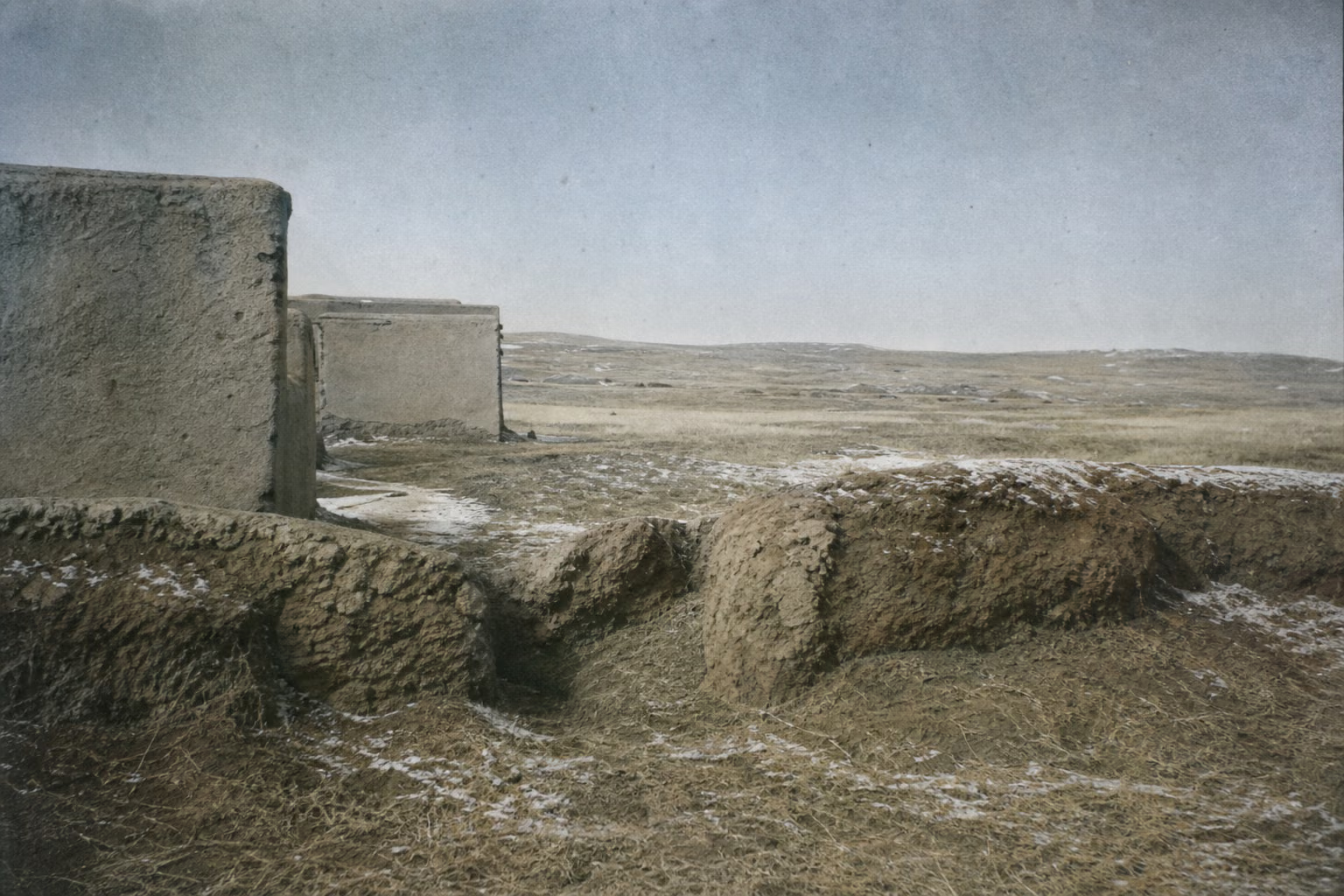
- Winter grassland: no cover and no concealment; daylight was nearly the same as exposure -- a night raid was not a choice, but the only solution.
- Hongge'ertu: village strongpoint defense, with works added to the settlement, on the scale of a single village.
- Bailingmiao: a temple complex turned into a fortress, encircled by low hills (terrain details unrecorded), and a depth strongpoint for storing grain and ammunition -- take it out, and the puppet forces' front line lost its root.
How Each Side Records It
- Chinese side: nationwide jubilation, with Fu Zuoyi's reputation rising to a peak for a time; the "Suiyuan Resistance" became the only bright narrative of the localized-resistance stage.
- Japanese side: military histories and archives record it as the "Suiyuan Incident," viewing it as a setback for the Kwantung Army's strategic work (original text unverified); for the results reported in Chinese battle reports, Japanese records give lower figures, and the two accounting bases are placed side by side.
Disputes and Sensitivities
- Who authorized the fight: the two narratives, "the Central Government ordered Fu Zuoyi to fight" and "Fu Zuoyi resisted independently and the Central Government recognized it afterward," coexist; this concerns the relationship between Chiang Kai-shek and the Suiyuan Resistance, and archival accounting bases remain unverified.
- The number of puppet troops who returned to the Chinese side, and the dates, vary from book to book.
- The degree of Japanese participation (advisers, command, and levels of fire support) differs across archival levels.
Sources and Open Questions
Known main sources:
- Fu Zuoyi-related chronologies, biographies, and compilations of historical materials on the Suiyuan Resistance (editions unverified)
- Dong Qiwu's memoirs (a participating commander)
- Japanese side: Kwantung Army and special-service-agency archives, relevant volumes of *Senshi Sosho* (specific items unrecorded)
Open questions: specific casualty figures for the three engagements; the number and dates of puppet troops returning to the Chinese side; the names of Japanese advisers killed; the source of the detail about wearing fur coats inside out; original telegrams on the command relationship between the Central Government and Fu Zuoyi; statistical bases used in various books for the total puppet-force strength; the content and dates of Fu Zuoyi's telegram exchanges with Taiyuan and Nanjing; details of Yan Xishan's artillery and supply support to Suiyuan; the original instruction behind the Central Government's line of "fight only puppet forces, do not allow expansion"; specific records showing Wang Ying and Demchugdongrub were not under one another's command.
All images on this site are AI-generated depictions. They are not historical photographs, not primary sources, and do not depict any real individual.