Engagement Archive · Winter Offensive
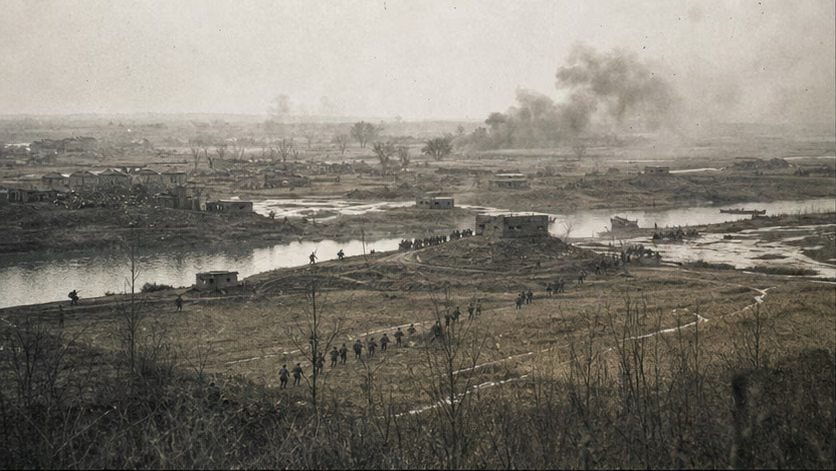
In the winter of 1939, more than one hundred divisions across the frontal battlefield threw themselves at Japanese strongpoints at the same time, from Suiyuan to southern Guangxi. This was the only active full-front general offensive by Chinese forces in the Fourteen-Year War of Resistance, and it was also a general measurement of the frontal battlefield's offensive capacity: it measured that the will to fight was still there, and also measured the ceiling imposed by assault firepower.
Engagement Data
| Item | Content |
|---|---|
| Time | 1939.12 – 1940.3 (each war area opened at different times, mostly in early to mid-December; the southern Guangxi direction remained entangled beyond February) |
| Location | The full frontal battlefield: from the Hetao area of Suiyuan in the north to southern Guangxi and northern Guangdong in the south; the main emphasis lay in central and northern Hubei (Fifth War Area) and northern Jiangxi and northern Hunan (Ninth War Area) |
| Part of | Fourteen-Year War of Resistance · stalemate phase, the frontal battlefield's only full-front general offensive |
| Chinese side | Unified command by the Military Commission, with ten war areas committed in succession: Wei Lihuang in the First War Area, Yan Xishan in the Second War Area, Gu Zhutong in the Third War Area, Zhang Fakui in the Fourth War Area, Li Zongren in the Fifth War Area, Zhu Shaoliang in the Eighth War Area (Fu Zuoyi's forces doing the actual main fighting), Xue Yue in the Ninth War Area, and others |
| Japanese side | China Expeditionary Army (commander-in-chief Nishio Toshizo), with the Eleventh Army (Okamura Yasuji, Wuhan direction), 21st Army (South China), North China Area Army, and Mongolia Garrison Army under it |
| Result | The planned objectives such as recovering Wuhan were not achieved; the offensive exhausted itself and ended in spring 1940. Japanese forces held their points and lines, but acknowledged that the shock they received far exceeded expectations |
Belligerents
| Item | Chinese Side | Japanese Side |
|---|---|---|
| Strength | Ten war areas committed 132 divisions and 9 independent brigades in succession, with about 550,000 directly engaged (Chinese statistical bases vary by account, all unverified); among them, the Third, Fifth, and Ninth War Areas, which carried the frontal main attacks, had about 60 divisions (basis in Guo Rugui's *Operations on the Frontal Battlefield*) | Defending across the whole front, dispersed among cities and transport-line strongpoints; there is no unified basis for first-line total strength (this claim unverified), with reinforcement by interior-line movement along railways and the Yangtze waterway |
| Firepower | Soviet-aid arms had partly arrived, and infantry weapons had improved; after heavy artillery and ammunition were divided across the whole front, they remained thin, so assaults on fortified points relied mainly on infantry close combat | Strongpoints had permanent works, with divisional artillery, aviation, and Yangtze naval firepower intact |
| Air | Essentially no air superiority | Aviation supported each direction |
| Supply | The offensive grew thinner as it continued, with long rearward lines for food and ammunition | Ample stores accumulated inside the works, holding points while awaiting relief |
| Intelligence | Chinese codes were broken by the Japanese side, and the offensive deployment was known in advance (attested in one source only) | Broke Chinese codes and waited at ease for an exhausted enemy (attested in one source only) |
Terrain and Conditions
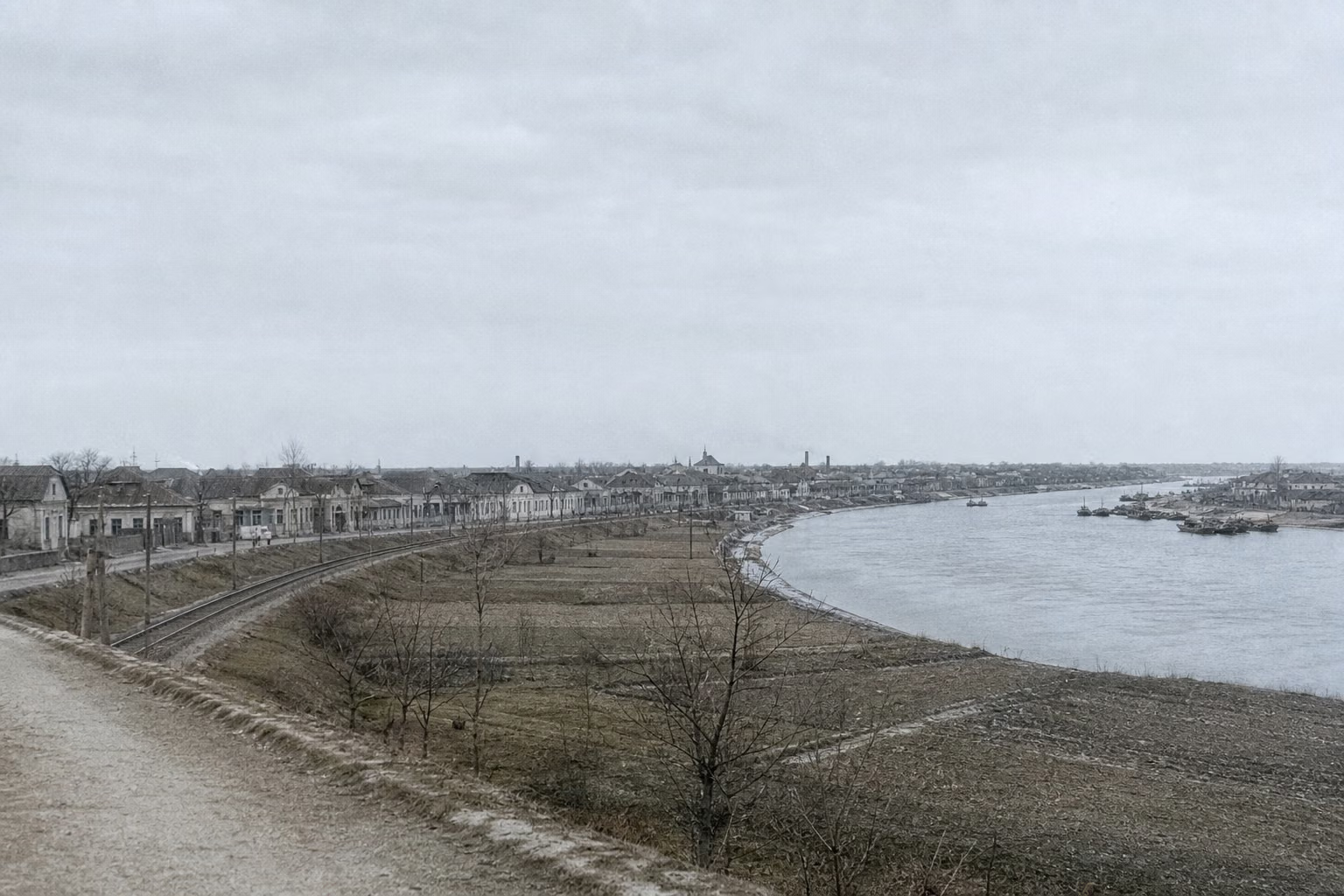
(For the larger situation at the end of 1939 -- the outbreak of the European war, Soviet-Japanese relations, and Japan's policy of "feeding war with war" -- see *Fourteen-Year War of Resistance · War Overview*; here only the situation on the frontal battlefield is treated.)
Japanese forces shifted from attack to defense, exposing gaps. One year after Wuhan and Guangzhou were lost, Japanese forces had turned to "securing the occupied areas": holding cities, railways, and the Yangtze waterway, while the broad countryside lay outside the points and lines. In the First Battle of Changsha (1939) in September-October 1939, Japanese forces reached the outskirts of Changsha and then withdrew. On this basis, the Chinese side judged that Japanese offensive capacity had bottomed out. Point-and-line defense meant gaps everywhere; this was the geographic basis for daring to launch a full-front general offensive.
Chinese capital and anxiety. Soviet-aid arms had partly arrived by this time, and the army had recovered somewhat after a year of reorganization and training (arrival scale unrecorded). The anxiety was political: Wang Jingwei had defected to the enemy in December 1938 and was preparing to establish a separate "Central Government." "Surrender" or "war" stood before everyone. Chongqing needed a full-front offensive to make its position clear: the war was still being fought, and would continue to be fought.
Why It Was Fought
When the assault at Kunlun Pass opened, a much larger operation had already spread across the whole front. In that November, as Japanese forces advanced toward Nanning, Chongqing formally issued the order for the Winter Offensive on November 19. Southern Guangxi was the battlefield chosen by Japanese forces; the Winter Offensive was the one chosen by the Chinese side: the only active full-front general offensive on the frontal battlefield in the Fourteen-Year War of Resistance.
The judgment came from northern Hunan, where fighting had just ended. In October 1939, the Military Commission laid out the account at the Nanyue Military Conference: in the First Battle of Changsha (1939), Japanese forces had reached Changsha's outskirts and then withdrawn on their own. Their offensive capacity had bottomed out. "Overextended front, declining combat power": those eight Chinese characters fixed the counteroffensive policy.
The capital at hand had also just become usable: Soviet-aid arms had partly arrived, and the army had recovered somewhat after a year of reorganization and training (arrival scale unrecorded). What truly fixed the date was politics: Wang Jingwei had defected at the end of 1938 and was now preparing to establish a separate "Central Government"; "surrender" or "war" stood before everyone. Chongqing needed a full-front offensive to answer, and to answer with gunfire. Beyond the capital that had come to hand lay the detailed accounts that had not: heavy guns were few, and once divided among more than one hundred divisions, each main attacking direction could receive only a handful; ammunition was issued by quota across the whole front, and even main attacking units had only enough for a dozen-odd days of high-intensity expenditure (quota details unrecorded). Manpower depended on conscription and replenishment; prices in 1939 were already rising, and military grain and able-bodied men were beginning to bite into the rear's flesh (grain-price data unverified).
The plan's core pointed toward Wuhan: the Third War Area would blockade the Yangtze with firepower and mines, isolating Japanese forces in Wuhan; the Fifth War Area would advance toward Hankou, and the Ninth War Area toward Wuchang, joining to recover Wuhan; all other war areas would pin the enemies opposite them, so that Japanese forces holding points would be bitten everywhere and have no troops to transfer. Ten war areas and more than one hundred divisions opened in succession from late November to early December, with the end scheduled for March of the following year.
Both sides had entries in their accounts that were miscalculated. The Chinese side read the Japanese "defense" as weakness, but underestimated reinforced concrete: infantry without heavy guns facing permanent works would soon have the ceiling of assault measured by casualties. Japanese forces, for their part, had completely failed to imagine that the opponent could still launch an offensive on this scale. "Far exceeded our expectations" was the original wording later used in the Japanese official war history. Another record states that the Japanese side had broken Chinese codes and knew the offensive deployment in advance (attested in one source only).
In the process by which the plan passed through the supreme command, no record of open objection has been found (no record of objection found; whether the Military Operations Department and war-area levels had reservations is unverified). There was none on the desk, but there was at the front: Yan Xishan in the Second War Area was breaking with the Communist-led New Army (the December Incident), and the offensive by his forces existed in name more than in fact. Among the ten war areas, some used that winter to fight another civil war (details unrecorded). After the war, Chiang Kai-shek criticized some war areas by name for ineffective command; how much of that ineffectiveness was inability to fight, and how much unwillingness to fight, was not separated in the summary at the time (unverified).
In early to mid-December, the ten war areas moved in succession. On the 12th, the Fifth War Area divided its forces into six corps and launched a general attack; Zhang Zizhong led thirteen divisions east across the Xiang River. From the Hetao area in the north to southern Guangxi in the south, the whole line threw itself in the same winter against strongpoints and railways.
Course of the Engagement
| Direction | Time | Key Points |
|---|---|---|
| Unified opening | Early to mid-December 1939 | Ten war areas moved almost simultaneously; from 12.12, the Fifth War Area divided its forces into six corps and launched a general attack |
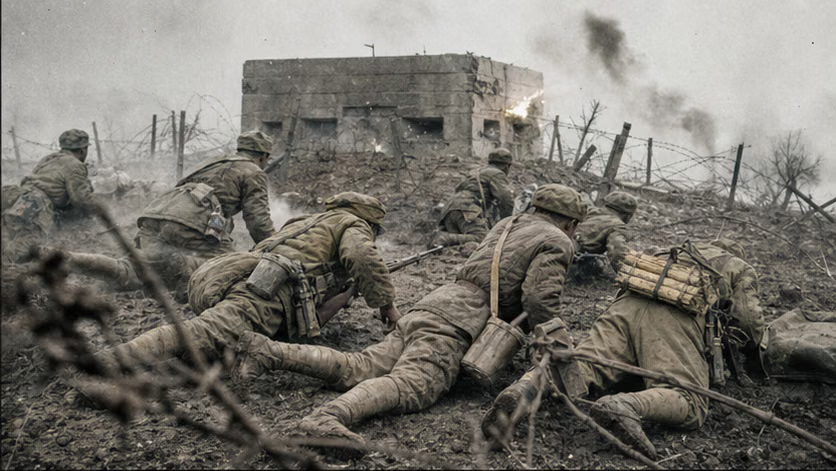
| Fifth War Area (main emphasis) | Mid-December – January of the following year | Li Zongren deployed about 30 divisions in central and northern Hubei; Zhang Zizhong led the Twenty-Ninth and 33rd Army Groups and the 84th Corps, together 13 divisions and about 90,000 men, east across the Xiang River and fiercely attacked Japanese strongpoints in the Jingshan and Zhongxiang directions. This was the hardest-fought section of the whole offensive. Japanese forces counterattacked, and the two sides seesawed repeatedly; without heavy guns for assault, most strongpoints could not be bitten through |
| Ninth War Area (main emphasis) | From December | Attacked enemies in northern Jiangxi, southern Hubei, and northern Hunan, besieging strongpoints and raiding communications, with limited progress |
| Third War Area | From December | Used artillery bombardment and night crossings to lay mines and blockade the Yangtze waterway, for a time cutting Japanese shipping (duration of the cutoff and results unverified) |
| First War Area | From December | Wei Lihuang's forces raided into eastern and northern Henan, at one point entering Kaifeng, Shangqiu, Qinyang, and other places (entry details unrecorded) |
| Eighth War Area | 1939.12 – 1940.3 | Fu Zuoyi's forces made a long-distance surprise attack in December and entered Baotou, killing Lieutenant General Mizukawa Isao, commander of a Japanese cavalry group (Japanese bases vary by account on whether he was killed in action, details unrecorded); Japanese forces retaliated, and this developed into the Suiyuan West Operation of early 1940, continuing to the Great Victory of Wuyuan in March (usually recorded in a separate article) |
| Southern Guangxi direction | 1939.12 – 1940.2 | Japanese forces had already taken Nanning in November; the Battle of Kunlun Pass (from 12.18, with the Fifth Corps assaulting fortified positions) took place at the same time as the Winter Offensive. It is usually listed separately as an article on the Battle of Southern Guangxi, but is often counted into the general account of the Winter Offensive |
| Exhaustion and end | 1940.1–3 | The offensive in each direction exhausted itself section by section, and none of the scheduled objectives was recovered; in March the offensive ended according to the original plan |
Casualties and Losses
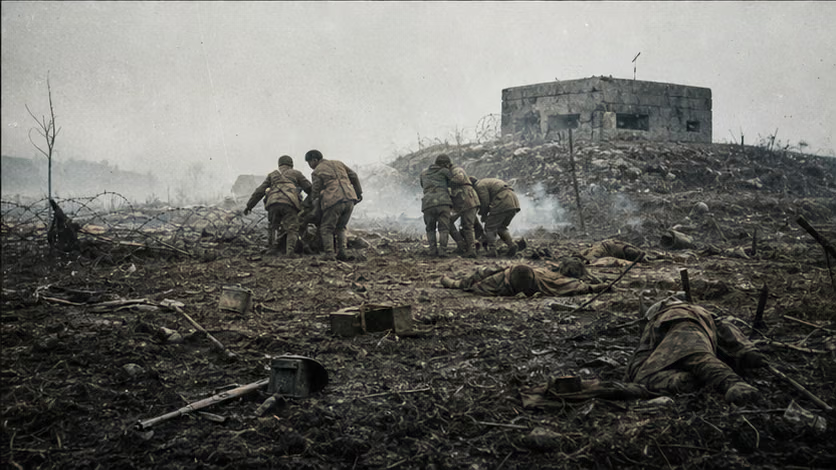
- Chinese side: no authoritative unified figure exists for its own casualties; the war areas reported separately, and Chinese military histories often record them as "heavy casualties" (specific bases vary by account).
- Japanese losses, two bases listed side by side: Military Commission statistics on the Chinese side claimed more than 20,000 Japanese killed and wounded, more than 400 captured, and one major general and two colonels killed (Chinese battle-report bases vary by account); Chinese military histories citing Japanese materials state that Japanese forces suffered 50,000 to 60,000 killed and wounded across the whole Winter Offensive, among which the Japanese side acknowledged about 8,000 casualties in the Eleventh Army (cited bases vary by account, original material numbers unverified). The two sets of figures differ severalfold, and no unauthorized choice is made here.
- Whichever basis is used: Japanese forces held their points and lines, while the Chinese side paid casualties out of proportion to what was gained. The ceiling imposed by assault firepower was measured by casualty figures.
Aftermath
- The Japanese side raised its assessment of Nationalist Army combat power. The Japanese official war history *Army Operations in the China Incident* acknowledged: "the scale and fighting will of this Winter Offensive far exceeded our expectations, and the counteroffensives of the Third, Fifth, and Ninth War Areas in particular were extremely fierce"; this battle "became an opportunity for Japanese forces to recognize anew the combat power of the Chinese army." The conclusion of Okamura Yasuji, commander of the Eleventh Army, was that "destroying the enemy's will to resist is extremely difficult."
- The Japanese response was to strike back. The Japanese side judged the Fifth War Area to be the greatest threat, and in May 1940 launched the Battle of Zaoyang–Yichang to drive straight for Yichang. The Winter Offensive had made one thrust; what thrust back was a major campaign.
- "Surrender" and "war" each placed a stone. In the same month that the offensive ended, on March 30, 1940, the Wang Jingwei puppet regime was established in Nanjing.
- The Chinese side's own summary was unsparing. Chiang Kai-shek criticized some war areas after the battle for ineffective command and poor results (the specific wording at the Liuzhou conference is unverified).
- This was a general measurement. The result measured was this: more than one hundred divisions could still throw themselves forward at the same time, showing that the army's skeleton had not scattered and its resolve had not collapsed; but fortified strongpoints could not be bitten through, and major cities could not be recovered, showing that an offensive without heavy firepower had its ceiling. The frontal battlefield never again launched a full-front general offensive of this kind.
Accounts of Those Present
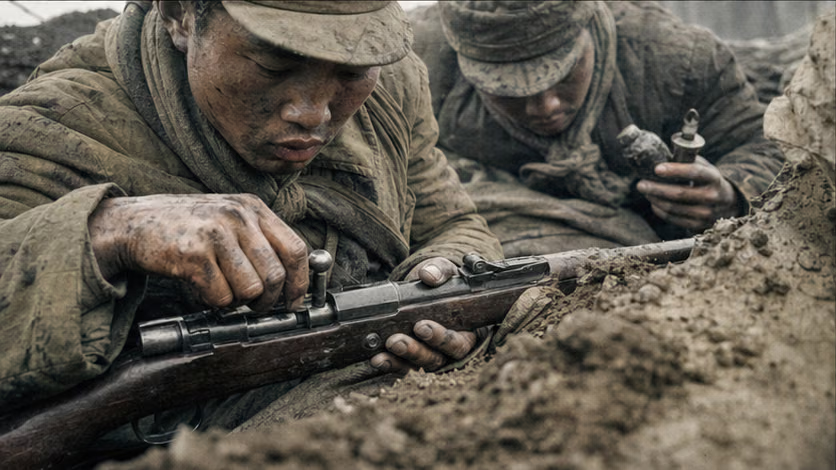
- Zhang Zizhong's last round of offensive action. The hardest-fighting route in the Fifth War Area was Zhang Zizhong's: he personally led 13 divisions east across the Xiang River to attack Japanese strongpoints. Half a year later, in the Battle of Zaoyang–Yichang, he was killed in action at Nanguadian. The Winter Offensive was the last active offensive of his military career.
- Night crossings to lay mines. The Third War Area's blockade of the Yangtze relied on mine-laying teams crossing secretly by night and laying mines close to the banks, working in the gaps between Japanese naval patrols (specific cases and names unverified).
- Raid on Baotou. Fu Zuoyi's forces made a long-distance raid on Baotou in the severe winter cold of the Hetao area and at one point entered the city. The Mizukawa Isao who was killed was one of the highest-ranking Japanese generals killed by the Chinese side in the War of Resistance ("lieutenant general" as posthumous promotion or active rank unverified).
- What the ceiling looked like in practice. Units besieging Japanese bunker strongpoints had no heavy guns available and relied on infantry night attacks, close combat, and satchel charges; taking one bunker often had to be paid for with the casualties of a battalion or a company (general description, specific cases unverified).
The Ground
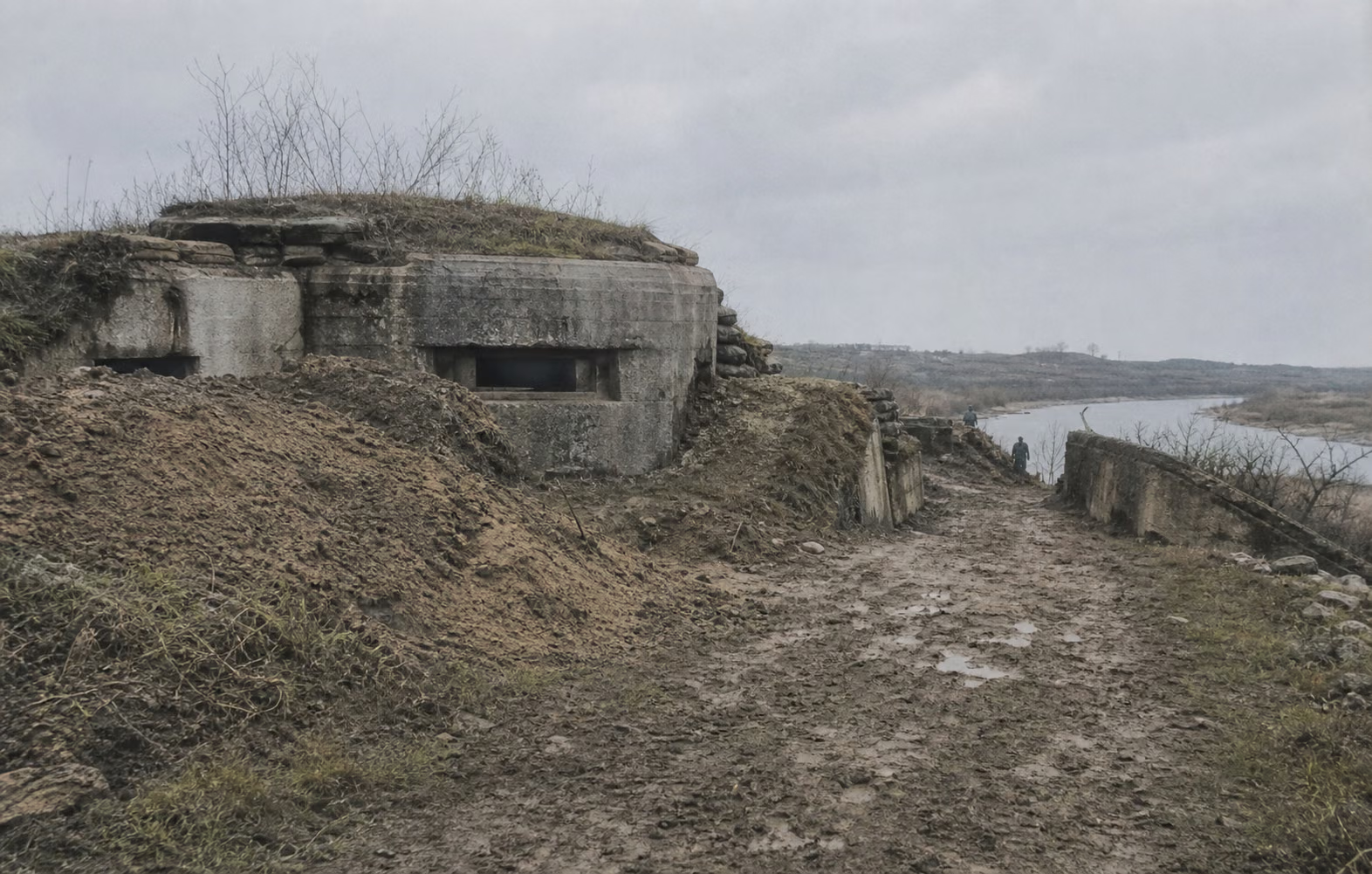
- This was not one battlefield, but the whole line: from the Hetao area of Suiyuan in the north to southern Guangxi and northern Guangdong in the south, the spatial grammar was "points and lines against a full network." Japanese forces held points (urban strongpoints) and lines (railways, the Yangtze), while the Chinese side pressed points with area.
- Sub-battlefields that can each stand as separate articles: strongpoint sieges in the hills of northern Hubei (Xiang River crossings, bunker groups); mine-blockade fighting on the Yangtze waterway; winter raids across the Hetao steppe; mountain assaults at Kunlun Pass (separate article).
- The vertical element was not prominent; the decisive element was fortification: Japanese reinforced-concrete bunkers against Chinese rifles and grenades. That is the whole spatial metaphor of this battle.
How Each Side Records It
- Chinese side: mainland scholarship positions it as "the only active full-front offensive on the frontal battlefield during the War of Resistance" and "the largest offensive operation," affirming its strategic and political meaning while also acknowledging that debate has always existed over its limited results and disproportionate cost; the specific basis in Taiwan military history (*Resistance Against Japan and Defense Against Insult*) varies by account.
- Japanese side: official war history acknowledged that its scale and fighting will far exceeded expectations and that it became an opportunity to recognize anew the fighting power of the Chinese army; at the same time, it recorded that the Chinese side "lacked artillery and had weak assault capability," and that although the attacks were fierce, they were difficult to make shake the strongpoints. The records of the two sides on the same fact are unusually close: the offensive was real, and so was the inability to bite through.
Disputes and Sensitivities
- The dispute over "not worth the cost." Whether the results were proportional to the casualties drew sharp criticism inside the supreme command even at the time; those who affirm the offensive emphasize its political declaration and its value in pinning the enemy, while those who deny it argue that using elite troops to assault fortified strongpoints meant putting one's short board against the enemy's long board.
- Sequence and comparison with the Hundred Regiments Offensive. The Winter Offensive (1939.12) came before the Hundred Regiments Offensive (1940.8); the two narratives have each been used to prove "who was truly fighting," but the facts and statistical bases are independent.
- Whether Kunlun Pass counts as part of the Winter Offensive. The Battle of Southern Guangxi and the Winter Offensive were simultaneous and both under Military Commission orders; whether to treat it as a separate article or include it in the general account differs among military histories. This article treats it as a separate article while mentioning it in the general account.
- The two casualty bases differ severalfold, and the numerical gap between the two sides is large; this article lists both accounts side by side.
Sources and Open Questions
Known main sources:
- Guo Rugui and Huang Yuzhang, eds., *Operations on the Frontal Battlefield in China's War of Resistance Against Japan* (Chinese campaign survey)
- War History Office, Japan Defense Agency, *Army Operations in the China Incident* (*Senshi Sosho*, Japanese official history)
- Academy of Military Science, *History of China's War of Resistance Against Japan* (including citations of Japanese war-history evaluations)
Open questions:
1. Participating-strength bases: the original sources and statistical boundaries for the three bases of 132 divisions and 9 independent brigades, about 550,000 men, and about 60 divisions in the three war areas 2. The separately reported casualty figures from each Chinese war area and their aggregate 3. The original material numbers for the two bases of Japanese losses (more than 20,000 killed and wounded / 50,000-60,000 killed and wounded, with the Eleventh Army acknowledging 8,000) 4. Volume and page numbers for the evaluation wording in *Army Operations in the China Incident*; source for Okamura Yasuji's statement that "destroying the enemy's will to resist is extremely difficult" 5. Japanese archival basis for the claim that the Japanese side broke Chinese codes (currently only isolated evidence) 6. Batches and scale of Soviet-aid arms that had arrived 7. Duration of the Third War Area's cutoff of the Yangtze, number of mines laid, and results 8. Entry details and sequence for the First War Area's entry into Kaifeng, Shangqiu, and Qinyang 9. Mizukawa Isao's rank (whether lieutenant general was active rank or posthumous promotion) and Japanese military-history records of the Battle of Baotou 10. Original wording of Chiang Kai-shek's postwar summary conference (Liuzhou conference) criticism of the Winter Offensive 11. Specific dates on which each war area opened (at present only the Fifth War Area's 12.12 is relatively definite) 12. The basis used by Taiwan's *Resistance Against Japan and Defense Against Insult* in recording the Winter Offensive 13. Details of ammunition quotas and heavy-artillery distribution to each main attacking direction 14. Data on 1939 prices, military grain requisition, and conscription of able-bodied men 15. Whether there is any record of reservations when the Winter Offensive plan passed through the supreme command 16. Details of the Second War Area (Yan Xishan) offensive existing in name more than in fact 17. The list of commands Chiang Kai-shek criticized after the battle for "ineffective command" and the original documents
All images on this site are AI-generated depictions. They are not historical photographs, not primary sources, and do not depict any real individual.