Campaign Overview · Battle of Xuzhou (1938)
A group of "miscellaneous armies" long looked down on by the central authorities - Sichuan troops, Guangxi troops, Northwestern Army units, and Northeastern Army units - were braided into a single cord in Li Zongren's hands: 600,000 against 240,000, at Xuzhou, the junction of the Jinpu Railway, they won the first major victory of the full-scale War of Resistance; at the end, another 600,000 men broke out of the encirclement in organized formations, turning a defeated withdrawal into a "victorious retreat." The two words "miscellaneous armies" were washed clean by blood in this battle.
Engagement Data
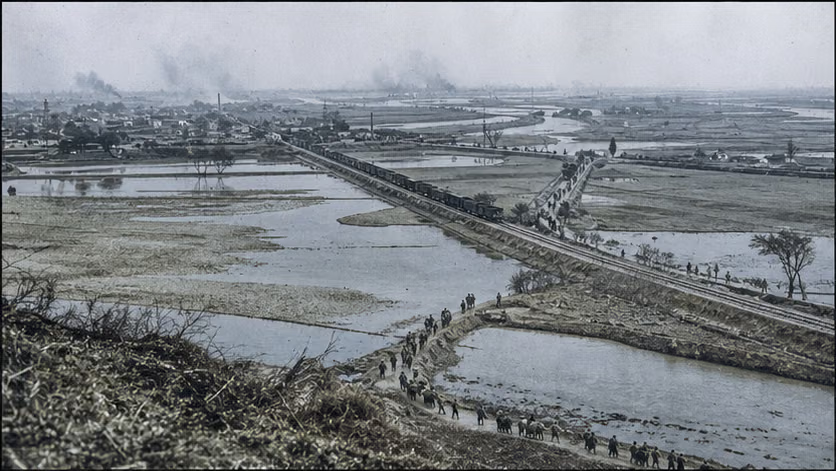
| Item | Content |
|---|---|
| Time | 1938.1 – late May (main battlefield mid-March – April) |
| Part of | Fourteen-Year War of Resistance (for the larger situation, see *Fourteen-Year War of Resistance · War Overview*; for Tengxian and Tai'erzhuang, see the separate articles) |
| Place | Xuzhou, Jiangsu, and both sides of the Jinpu Railway in southern Shandong and northern Anhui: the Huai River, Tengxian, Linyi, and Tai'erzhuang |
| Chinese side | Fifth War Area (commander-in-chief Li Zongren), about 600,000 in sequence (figures vary by statistical basis) - a mixed assembly of Guangxi, Sichuan, Northwestern, Northeastern, and Central Army systems, with only Tang Enbo's force from the central direct line |
| Japanese side | North China Area Army (Terauchi Hisaichi) and Central China Expeditionary Army (Hata Shunroku) advancing from north and south, about 240,000 (figures vary by statistical basis), with the main force consisting of Isogai's Tenth Division and Itagaki's Fifth Division |
| Result | After the Battle of Tai'erzhuang, Japanese forces reinforced and encircled Xuzhou; in mid-May, the Chinese side broke out by separate routes, and Xuzhou was abandoned on 5.19 - the victory and the abandonment of the city are recorded together |
Belligerents
| Item | Chinese Side | Japanese Side |
|---|---|---|
| Strength | About 600,000 (figures vary by statistical basis), with miscellaneous armies from many provinces gathered together, uneven in equipment and training | About 240,000 (figures vary by statistical basis), with the northern and southern armies coordinating concentrically |
| Firepower | Generally short of heavy artillery; Sichuan troops and other units did not even have enough rifles (see the separate article *Defense of Tengxian*); Tang Enbo's corps had the strongest artillery in the war area | Division artillery + tanks + aviation held the advantage throughout |
| Air control | Largely lost | Held |
| Coordination | Factional barriers were deep; Li Zongren had to knit the forces together through personal coordination and credibility | The two forces advanced from north and south but did not coordinate with each other; the Fifth and Tenth Divisions overextended and were defeated separately - the Japanese forces' "failure of cooperation" is also recorded in Japanese war histories (original wording unverified) |
Terrain and Conditions
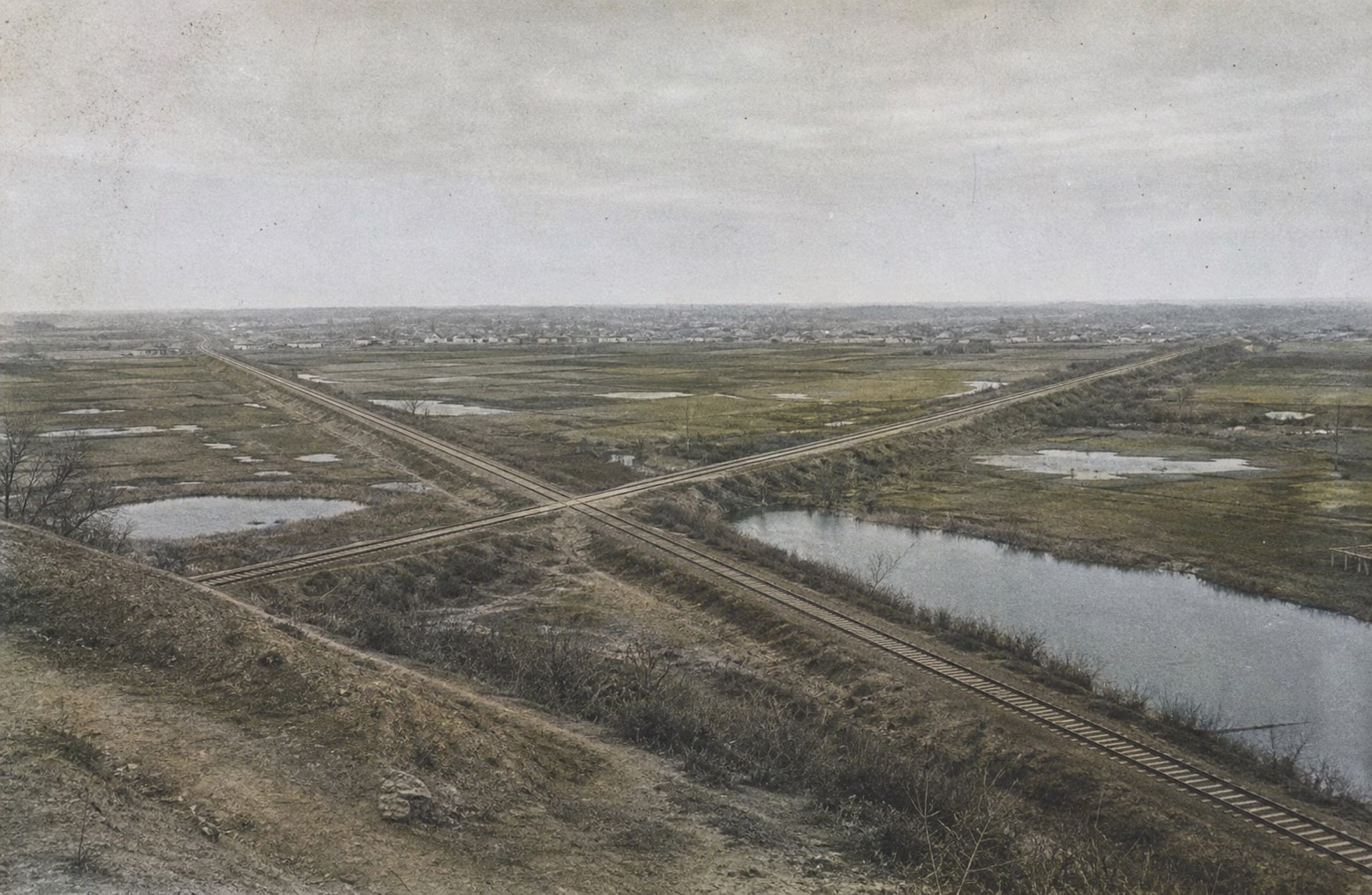
Xuzhou: a military crossroads since antiquity, where the Jinpu and Longhai railways intersected. If Xuzhou were taken, Japanese forces in North China and Central China would be joined into one piece, and railway supply could flow directly through. After Nanjing fell at the end of 1937, this was the next clasp by which the northern and southern Japanese forces would advance toward each other and close. The terrain of southern Shandong and northern Jiangsu: plains cut by river networks, with Weishan Lake and the Grand Canal running through them. Tai'erzhuang stood on the north bank of the canal and was the northeastern gate of Xuzhou.
Society in the war area: Han Fuju abandoned Shandong without fighting (abandoned Jinan in 1937.12; executed by Chiang Kai-shek in 1938.1). The people of Shandong met this battle under the humiliation that "their own provincial chairman ran first." Li Zongren, himself from a non-central system, took over the wreckage and drew people together by "not discriminating against miscellaneous armies."
Why It Was Fought
Nanjing fell on December 13, 1937. Almost at the same time, the north was collapsing too: Shandong provincial chairman Han Fuju abandoned Jinan without fighting, and the northern gate of the Jinpu Railway lay wide open. This great railway running north-south had already fallen to Japanese forces at both ends; only the middle section remained in Chinese hands. The junction in that middle section was called Xuzhou.
What was Xuzhou worth: the Jinpu and Longhai railways intersected there. Once it was taken, the occupied zones in North China and Central China would be joined into one piece, and troops and supplies could be poured straight along the railways; westward along the Longhai Railway, the line pointed toward Zhengzhou and toward Wuhan's flank and rear. With Nanjing already fallen, Japanese forces resolved to advance from north and south, meet at Xuzhou, open the Jinpu Railway, and then take Wuhan in the west. Tokyo did not arrive at this decision smoothly: at the beginning of the war, Imperial General Headquarters' policy had been to restrain the front and prevent further expansion (policy document wording unverified), but the North China Area Army and the Central China Expeditionary Army pressed for battle at the front, pushing the center into recognition after the fact.
Chongqing's calculation was the opposite: Xuzhou was to be defended not to keep Xuzhou, but to delay the Japanese westward advance and buy time for Wuhan. Factories, schools, and materiel along the Yangtze were moving west; if the front held for one more month, the rear could move for one more month. This policy was approved by the Supreme Military Council, and Chiang Kai-shek sent Bai Chongxi to Xuzhou to assist Li Zongren in planning (details unverified). The Chinese side had a general understanding of the designations and strength of the two Japanese routes; the uncertain part was its own side - 600,000 men from different factions, and how much coordination could actually be delivered would only be known once the fighting began.
The troops available for holding the line were the most mixed hand in the country. Under Fifth War Area commander-in-chief Li Zongren were, in sequence, about 600,000 men (figures vary by statistical basis): Sichuan troops, Guangxi troops, Northwestern Army units, and Northeastern Army units gathered together, with only Tang Enbo's force from the central direct line. Equipment was uneven and factional barriers were deep. Li Zongren had few direct-line cards in his own hand; he could only use territorial interests and personal credibility to nail each provincial force onto the defensive line one by one. This determined the mode of the whole campaign: hold strongpoints to delay, maneuver on the outer lines, and avoid forcing a decisive battle head-on. The material base of this hand drew the boundary for the method: firearms used differing calibers, heavy artillery was almost absent, and Sichuan troops did not even have enough rifles; the Jinpu and Longhai lines were both the object of the struggle and the Chinese side's arteries for troop movement and supply. The Japanese side was also constrained: the North China Area Army was tied down by the Shanxi battlefield, so only a little more than 200,000 men could be pressed forward, and all supply depended on the Jinpu Railway that had not yet been opened. The Japanese calculation was very quick: after consecutive victories at Shanghai and Nanjing, and with mostly "miscellaneous armies" before them, the northern and southern routes only had to close as scheduled. In reality, the two routes did not coordinate with each other and each overextended; Japanese war histories later recorded this as a "failure of cooperation" (original wording unverified). As for the move to defend Xuzhou, no dissenting record has been found among Chinese generals (no dissenting record found). The other road only came onto the table when the encirclement took shape in May: abandon the defense and break out. Li Zongren proposed it, the central authorities approved it (sequence unverified), and that was the route then taken.
The opening of the battle came in the same month as an execution. In late January 1938, units including the Japanese Central China force's 13th Division crossed the Huai River northward, and Yu Xuezhong's Northeastern Army 51st Army fought along the Huai. The southernmost section of the Jinpu Railway heard the first shots; in mid-January, Chiang Kai-shek detained Han Fuju in Kaifeng, and at the end of the month had him shot in Wuchang for crimes including withdrawal in violation of orders (dates and locations vary by account). Military morale was shaken into discipline, and the provincial forces each weighed the meaning in their own minds: was this military law, or a borrowed knife? The road of withdrawing without fighting had just been taken by someone, and it had led to the execution ground.
Course of the Engagement
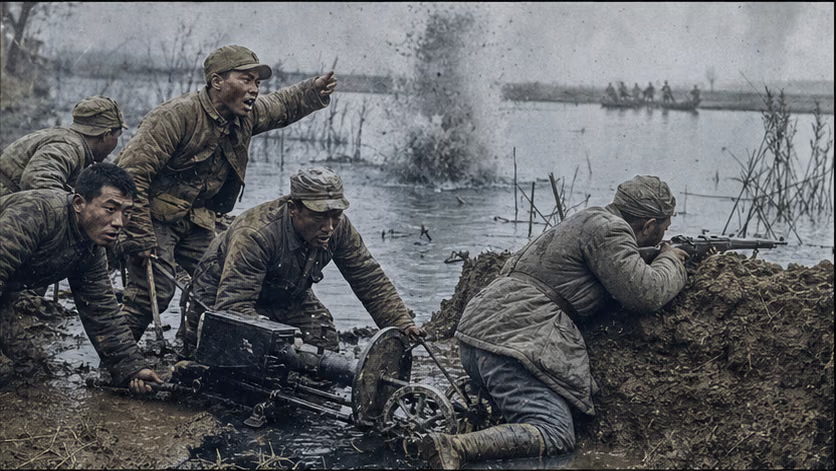
| Stage | Time | Key Points |
|---|---|---|
| Southern Jinpu · Huai River Blocking Action | Late January–February | The Japanese Central China force's 13th Division and others crossed the Huai River northward; Yu Xuezhong's (Northeastern Army) 51st Army held bitterly along the Huai, and Zhang Zizhong's 59th Army and others rushed in to reinforce and counterattack, pushing the southern route back south of the Huai River - from then on, the "south" in the north-south advance was cut off, and the Japanese forces on the northern route became an isolated force driving deep |
| Northern sector · Tengxian | 3.14–17 | Wang Mingzhang's 122nd Division of the Sichuan troops died with the city, buying time for the deployment at Tai'erzhuang (separate article: *Defense of Tengxian*) |
| Northern sector · Linyi | Early to mid-March–late March | Pang Bingxun's Third Corps (old Northwestern Army troops; in reality only about one army in strength) held Linyi bitterly, and Zhang Zizhong's 59th Army rushed to the rescue after a forced march of one day and night, attacking from inside and outside and twice repulsing Itagaki's Fifth Division. Pang and Zhang had an old grudge from the Central Plains War (Zhang Zizhong had once nearly died in a surprise attack by Pang's troops), and at Linyi they fought shoulder to shoulder and released the grudge - the specific details of the old grudge and its resolution belong to the circulating layer, and the level of the materials remains unverified |
| Tai'erzhuang | 3.23–4.7 | Sun Lianzhong's Second Group Army defended the walled town in a fight to the death, while Tang Enbo's corps maneuvered on the outer line; attacking from inside and outside, they routed the Seya Detachment of Isogai's division - the first major victory of the full-scale War of Resistance (separate article: *Battle of Tai'erzhuang*) |
| Japanese encirclement | Late April–mid-May | After the major victory, Japanese forces reinforced from north and south by more than 100,000 men and formed a large encirclement around Xuzhou; the Chinese main force broke out toward the southwest by separate routes |
| Xuzhou breakout | 5.15–19 | The 600,000-strong army jumped out of the encirclement by separate routes, and no unit was annihilated as an organized formation; Xuzhou was abandoned on 5.19. In contrast with the disorderly rout at Shanghai: an orderly "victorious retreat" is recorded together with the abandonment of Xuzhou, without concealment |
| Afterward | June | Japanese forces advanced west along the Longhai Railway, leading to the Battle of Lanfeng; on 6.9, the Yellow River dike was breached at Huayuankou to block the enemy (see in detail; ※ the civilian catastrophe is detailed in a separate article) |
Casualties and Losses
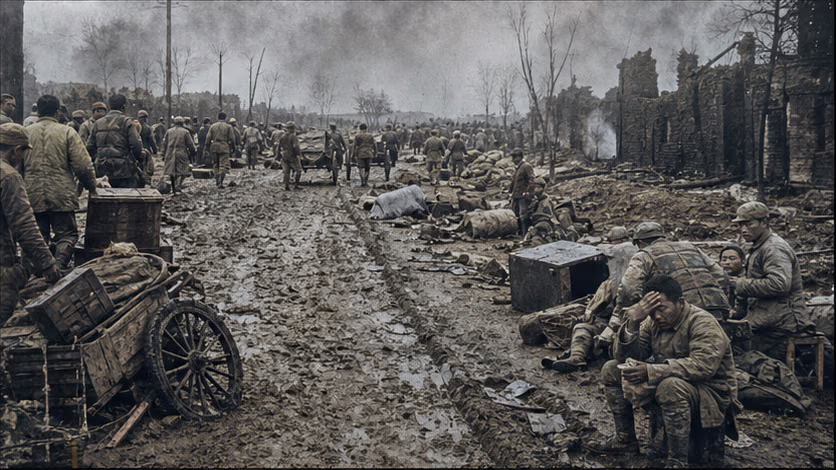
- Chinese side: no unified authoritative figure has been found for casualties across the whole campaign; the combined total of the battles was roughly several tens of thousands (figures vary by statistical basis). One division died in full at Tengxian (separate article), and units at Linyi and Tai'erzhuang all suffered heavy casualties.
- Japanese side: in the Battle of Tai'erzhuang, the Chinese basis gives more than 10,000 killed and wounded, while the Japanese side acknowledged several thousand (the two sets are recorded side by side; see the separate article); Japanese casualties for the whole campaign remain unverified across the different statistical bases.
- ※ Civilians: counties in the war area suffered from fighting and retaliatory killings by Japanese forces; records of massacres in Linyi and elsewhere are scattered through local gazetteers and investigation materials (each item unverified, to be entered in local articles).
Aftermath
- The timetable for the Battle of Wuhan was delayed by several months - Xuzhou was fought from January to May, and the Japanese westward advance toward Wuhan was forced to wait until after June; the rear area's relocation of factories, schools, and materiel won a window.
- The morale effect of Tai'erzhuang: 100,000 people in Wuhan marched in celebration, and the nationwide belief that "the War of Resistance can be won" had concrete evidence for the first time (see the separate article).
- The status of the Fifth War Area's miscellaneous armies was different from then on: Sichuan troops were despised when they left Sichuan, but after Tengxian the whole country honored them; Zhang Zizhong washed away the stigma of "traitor" through the two battles of Linyi and Xuzhou (the slander from his remaining in Beiping in 1937), and two years later died for the country at Zaoyang-Yichang (see *Battle of Zaoyang–Yichang*).
- The Huayuankou breach (6.9) was, militarily, a continuation of the Xuzhou retreat - the price of using water in place of soldiers was paid by civilians in Henan, Anhui, and Jiangsu. ※ Separate article.
Accounts of Those Present
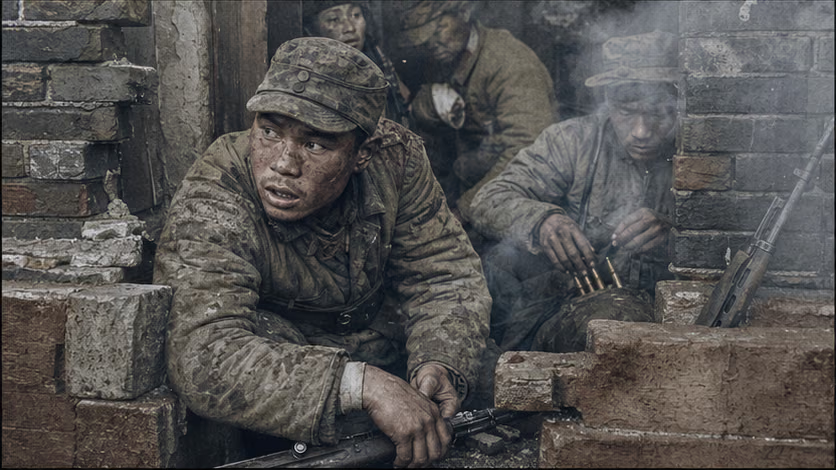
- Li Zongren's art of coordination: toward miscellaneous forces, he used three measures at once - "give them territory, give them supplies, give them trust." Pang Bingxun's force had originally been on the list for disbandment; Li strongly protected its organization, and Pang then held Linyi to the death in repayment. Personal obligation as combat power: this is the command study unique to this campaign.
- The execution of Han Fuju: on the eve of the fighting, Chiang Kai-shek lured and arrested Han Fuju in Kaifeng and had him shot for "withdrawal in violation of orders" (1938.1.24, unverified). Military morale was shaken into discipline, but the provincial miscellaneous armies also weighed it in their minds: was this military law or a borrowed knife? Li Zongren had to dissolve that layer of air.
- "No Sichuan, no army": when Sichuan troops left the province, they wore unlined clothing and straw sandals and carried Sichuan-made rifles; war areas refused to accept them, but Li Zongren said, "I will take them all," and brought them into the Fifth War Area. Tengxian was how they repaid that sentence.
- Zhang Zizhong's road of clearing his shame: he rushed to Linyi to aid Pang Bingxun - an old enemy - after marching 180 li in one night (mileage figures vary by statistical basis). What he saved was both Linyi and his own name.
- The night of the breakout: 600,000 men withdrew by separate routes without disorder, in contrast with Shanghai. Li Zongren's later memoirs treated the breakout as the proudest stroke of his life (original wording unverified).
The Ground
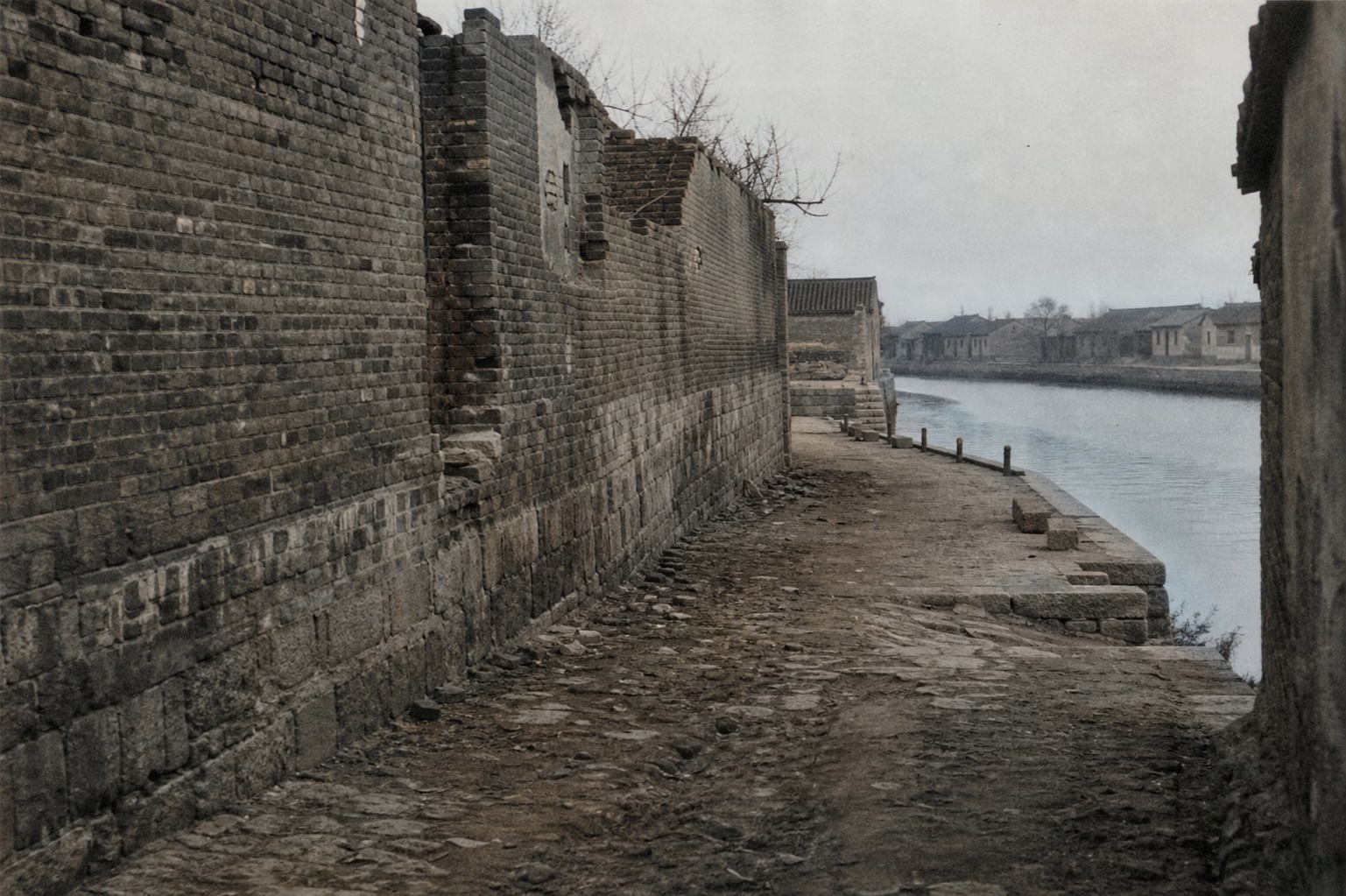
- Two railways and one cross: the Jinpu Railway ran north-south, the Longhai Railway cut east-west, and Xuzhou stood at their intersection. The spatial grammar of the whole struggle was "attack and defense along the lines."
- Huai River - Grand Canal - Weishan Lake: the water network cut the plain into corridors; the Huai River blocking action and Tai'erzhuang's fighting with water at its back were both the grammar of water.
- The walled town of Tai'erzhuang: brick-and-stone walls, canal wharves, and street-by-street fighting - a compressed sample of urban defensive space (see the separate article).
- Breakout corridor: the marching routes from Xuzhou toward the southwest and out of the encirclement - "retreat" as a spatial process, comparable with the rout from Shanghai.
How Each Side Records It
- Chinese side: the first major victory on the frontal battlefield of the full-scale War of Resistance; the "campaign of miscellaneous armies" is the focus of this article. Provincial forces that had been discriminated against won a major victory under Li Zongren's coordination, and the term "miscellaneous armies" was washed clean by blood here. Tai'erzhuang became a symbol of the spirit of the War of Resistance, and the 1986 film *The Bloody Battle of Tai'erzhuang* opened a new path for War of Resistance narratives across the Taiwan Strait (see the separate article).
- Japanese side: war histories called the retreat at Tai'erzhuang a "line adjustment" (the wording itself is a standpoint; see the separate article); the Xuzhou campaign as a whole was recorded as the "Xuzhou Operation," and they acknowledged that the results fell far short of expectations - Xuzhou was encircled, but the main force of the Chinese army was not.
- Third parties: reports on Tai'erzhuang by Western correspondents in China brought "China can win" into international opinion for the first time (specific reports unverified).
Disputes and Sensitivities
- "Victorious retreat": abandoning Xuzhou after the major victory already had two readings at the time - "a successful breakout that preserved the main force" and "a defeat that strategically still traded space for time." Both readings are recorded side by side.
- The debate over Tang Enbo: over the timing of the outer-line maneuver at Tai'erzhuang, the Sun Lianzhong-line narrative and the Tang-line narrative have long attacked each other ("Tang delayed and would not advance" versus waiting for the right moment to envelop). After distinguishing the level of the materials, both accounts are recorded side by side (see the separate article).
- The death of Han Fuju: the debate between military discipline and factional purge; the level of the materials remains unverified.
- The old grudge and reconciliation between Pang and Zhang, and circulating-layer narratives such as quotations from commanders, are all distinguished by evidentiary level and not treated as historical fact at that level.
- Divergence over casualty figures remains.
Contents
Sources and Open Questions
Sources: the Xuzhou chapter of *Operational Record of the Frontal Battlefield in China's War of Resistance Against Japan*; Li Zongren's memoirs (edited by Tang Degang); *Collected Historical Materials on the Great Battle of Tai'erzhuang* (volume list unverified); the Xuzhou campaign volume of *Army Operations in the China Incident* by the War History Office of Japan's Defense Agency; war histories of Zhang Zizhong's, Sun Lianzhong's, and other units.
Open questions: the different statistical bases for both sides' troop strength; the designations and sequence of each army in the Huai River blocking action; original records of the old grudge between Pang and Zhang; the precise dates of the two Linyi operations; the routes of each army in the Xuzhou breakout and army-by-army verification that no organized formation was annihilated; Li Zongren's original memoir wording on the breakout; the source in Japanese war histories for the self-recorded "failure of cooperation"; local-gazetteer entries on civilian massacres.
All images on this site are AI-generated depictions. They are not historical photographs, not primary sources, and do not depict any real individual.