Engagement Archive · Defense of Nanjing (※ Nanjing Massacre)
Before the routed forces from Shanghai had even been gathered in, the defense of the capital had begun - it held for 8 days; the order to withdraw came in haste, and there were no boats by the river; in the 6 weeks after the city fell, the deaths of 300,000 people turned the word "Nanjing" from the name of a city into a wound known across the world.
Engagement Data
| Item | Content |
|---|---|
| Time | 1937.12.1 (Japanese forces issued the order to take Nanjing) - 12.13 (city fell); ※ the massacre was concentrated over about 6 weeks beginning on 12.13 |
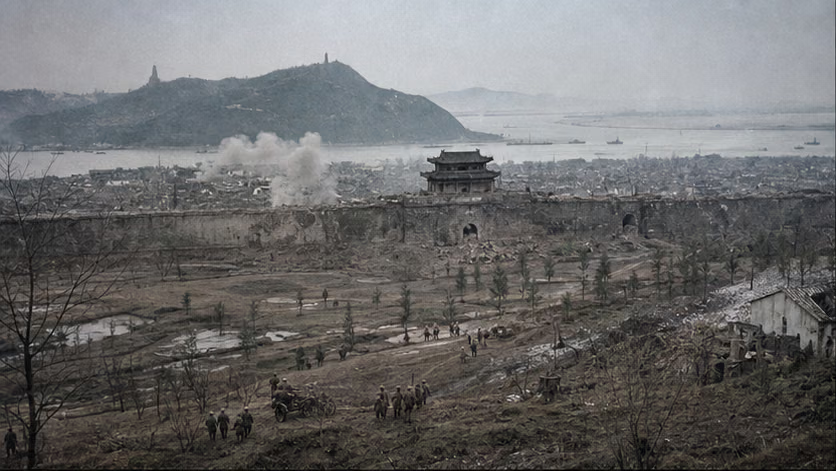
| Location | Nanjing's city walls and outer approaches (Chunhua, Tangshan, Qixia, Yuhuatai, Purple Mountain, Zhonghua Gate, the Xiaguan riverfront) |
| Part of | Fourteen-Year War of Resistance (for the larger situation, see *Fourteen-Year War of Resistance · War Overview*) |
| Defending side | Nanjing Garrison commander-in-chief Tang Shengzhi; defenders numbered about 100,000 to 150,000 (figures vary sharply by statistical basis, with no settled conclusion) - mostly units withdrawn from Shanghai without time to reorganize or replenish (Eighty-Seventh (87th), Eighty-Eighth (88th), and Thirty-Sixth (36th) Divisions, the Training Corps, Guangdong troops, Sichuan troops, etc.) |
| Attacking side | Japanese forces: Central China Area Army (Matsui Iwane), commanding the Shanghai Expeditionary Army (Prince Asaka Yasuhiko) and the Tenth Army (Yanagawa Heisuke), about 200,000 men (figures vary by account) |
| Result | 12.13, city fell; ※ systematic killing, rape, looting, and arson continued for weeks thereafter |
Belligerents
| Item | Defending side | Attacking side |
|---|---|---|
| State | Remnants from 3 months of bloody fighting at Shanghai, mixed with replacement troops short of men, weapons, and training | Victorious forces, with complete firepower organization |
| Works | Successive outer positions and the Ming city wall - a city wall could not stop the artillery of 1937 | Heavy artillery, aviation, tanks |
| Route of retreat | Defending with the Yangtze at their backs; ferries had already been placed under control and removed (handling of the boats unverified) - the absence of a withdrawal plan was the military premise of the disaster | Encirclement from three sides; the Tenth Army's spearhead had already moved toward Wuhu to cut the upstream route |
Terrain and Conditions
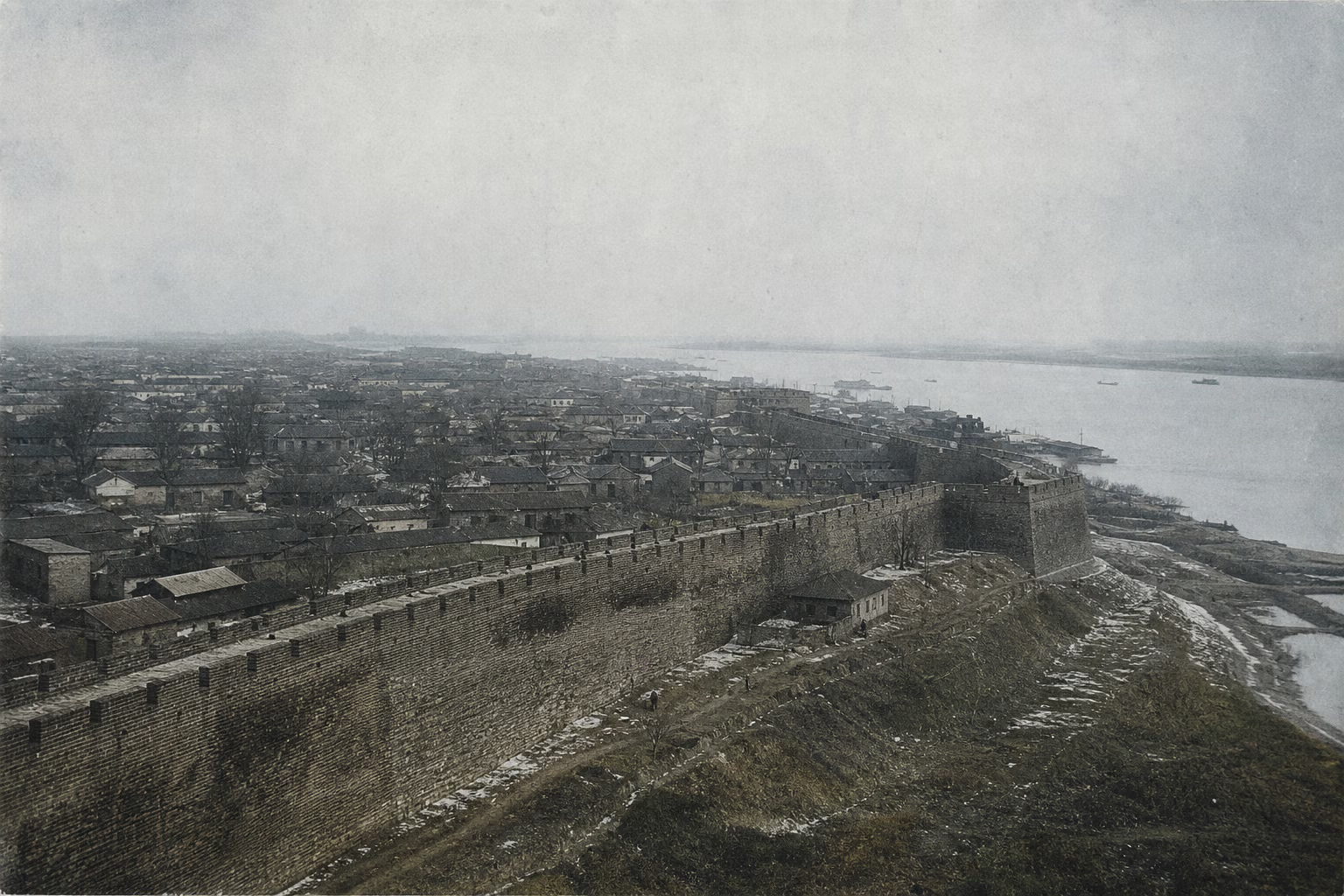
The capital: in November (11), the Nationalist Government announced the move of the capital to Chongqing; government organs withdrew westward, but the population had not all left - about 500,000 civilians and refugees remained in the city (figures vary by account). International residents stayed behind and formed the "International Committee for the Nanjing Safety Zone" (Rabe as chair, more than 20 Westerners), marking out a neutral zone of about 3.86 square kilometers that sheltered more than 200,000 refugees. The dispute over defending or abandoning the city: most in the high command favored declaring it an undefended city to protect the civilians, while Tang Shengzhi insisted on defending to the death ("to live or die with the capital"), and Chiang Kai-shek decided on a short defense - the political nature of the decision to defend the city (the capital as symbol, international visibility, the Soviet-negotiation-background argument, level-marked) overrode military reason.
Why It Was Fought
In the same month that the war in North China moved behind enemy lines, the frontal battlefield in the lower Yangtze no longer had a line. The Battle of Shanghai ended in a disorderly general retreat: in mid-November, Shanghai fell; routed troops surged west along the Shanghai-Nanjing line; the two prepared national-defense lines, the Wufu Line and Xicheng Line, scarcely functioned - from Shanghai to Nanjing there was not one defensible line that could stand. The disorder of the retreat from Shanghai was the military premise of the Nanjing tragedy.
The Japanese pursuit was initiated by the front itself. The originally designated operational boundary line could not restrain victorious formations, and Yanagawa's Tenth Army and other units crossed it and advanced west on their own - gekokujo enacted again; on December 1, Imperial General Headquarters did not so much issue an order as ratify events, formally giving the order to take Nanjing through Continental Order No. 8. Matsui Iwane's Central China Area Army advanced on two routes, with the Tenth Army's spearhead driving straight toward Wuhu in order to cut off the upstream route of this city with its back to the river. In Tokyo's calculation, taking the enemy capital meant approaching the end of the war; but on the Chinese side, the capital had already been moved to Chongqing in November - the capital could fall, and the war would not end with it. From the start, the two sides' calculations were misaligned.
The Chinese problem was that the city could not be held, yet could not simply be left undefended. Government organs had withdrawn westward, the population had not all left, and about 500,000 civilians and refugees were still inside the city (figures vary by account). In mid-to-late November (11), the Military Affairs Commission repeatedly conferred on whether to defend or abandon Nanjing (number and dates of meetings vary by account); most generals advocated declaring it an undefended city, abandoning military defense in order to preserve the civilians; Tang Shengzhi insisted on defending to the death, "to live or die with the capital"; Chiang Kai-shek took a middle course and fixed a short defense, appointing Tang Shengzhi as commander-in-chief of the Nanjing Garrison (date of the formal appointment order varies by account) - the capital as symbol, international perception (the Soviet-negotiation-background argument, level-marked), overrode military reason. The defenders were remnants withdrawn from Shanghai without time to reorganize or replenish, about 100,000 to 150,000 men (figures vary sharply by statistical basis, with no settled conclusion); ammunition and heavy weapons, consumed through 3 months at Shanghai, had not been replenished in time (actual replenishment unverified); they deployed with the river at their backs, while the ferries had already been placed under control and removed (handling of the boats unverified). When the order to defend to the death was issued, how much intelligence the high command had about the Tenth Army's spearhead driving straight toward Wuhu to cut the retreat route from upstream cannot be judged from the surviving records (unverified).
The undefined line between a short defense and a defense to the death planted the charge for the later withdrawal disaster. On December 4, fighting began on the outer approaches at Chunhua and Tangshan, which broke within 2 or 3 days; on December 9, the Japanese ultimatum calling for surrender reached the walls and was refused.
Course of the Engagement
| Phase | Time | Key Points |
|---|---|---|
| Outer fighting | 12.4-8 | The outer lines at Chunhua, Tangshan, and Jurong broke within 2 or 3 days - routed troops had no capacity for field battle |
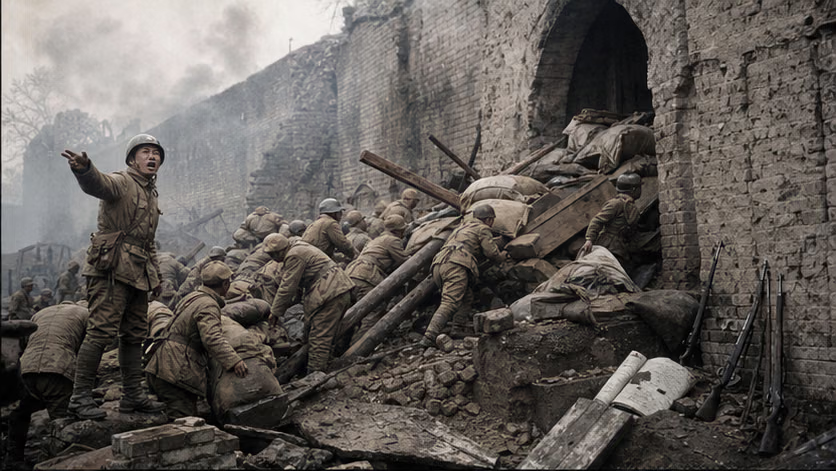
| Outer positions and city walls | 12.9-12 | The Japanese ultimatum was refused; Yuhuatai (the Eighty-Eighth (88th) Division's two brigade commanders Zhu Chi and Gao Zhisong died), Purple Mountain (the Training Corps fought to the death), Guanghua Gate (suicide squads blocked breaches in the city gate, while the Eighty-Seventh (87th) Division and others fought bloody actions), and Zhonghua Gate were fought over section by section |
| Withdrawal order | Afternoon of 12.12 | Chiang telegraphed the order to "withdraw as circumstances permit"; Tang Shengzhi hastily arranged the withdrawal that evening: most units were supposed to break out frontally, but in practice he orally permitted the armies to cross the river - the orders contradicted one another, and the armies crowded toward Xiaguan |
| Collapse | Night of 12.12-13 | Tens of thousands of soldiers and civilians at the Xiaguan riverfront fought to cross, with very few boats; at Yijiang Gate, men trampled one another, and blocking troops and withdrawing troops fired on each other (the tragedy of the Thirty-Sixth (36th) Division being ordered to seal the gate is unverified); countless people drowned trying to cross the river; those who failed to cross scattered into the city and threw away their weapons - organized resistance had basically ended by the morning of the 13th |
| City falls | 12.13 | Japanese units entered the city - ※ the atrocities began from here |
※ Nanjing Massacre (about 6 weeks beginning on 1937.12.13)
This section states facts and notes numerical bases and recorders; it does not dwell on details. Each item gives its source layer.
- Scale and definition: The Chinese government and the Nanjing Military Tribunal determined that more than 300,000 people were killed (1946 Nanjing trial judgment in the Tani Hisao case: "the total number of victims reached more than 300,000"); the International Military Tribunal for the Far East (Tokyo Trial) found that more than 200,000 civilians and prisoners of war were killed in the 6 weeks after occupation (not including the parts concealed by corpse disposal); Japanese scholarship ranges from "more than 100,000" and "tens of thousands" to denialist claims - Chinese findings, international tribunal findings, and the various Japanese-side statistical bases are set out side by side; this archive takes the judgments of the two tribunals as its baseline.
- Targets of killing: Prisoners of war and scattered soldiers who had laid down their weapons (mass killings at Caoxiexia, Yanziji, Meitangang, and other sites, with single incidents numbering in the tens of thousands - figures for each site vary by account); civilians (indiscriminate executions in the name of searching for "plainclothes soldiers").
- Rape: Estimated at 20,000 to 80,000 cases (the Safety Zone Committee's records and tribunal findings are placed side by side) - recorded as systematic atrocities, without elaborating the details.
- Looting and arson: About one-third of the city's buildings were burned (tribunal finding basis).
- "Hundred-man killing contest": The killing contest between two second lieutenants was reported by Japanese newspapers at the time (*Tokyo Nichi Nichi Shimbun*, serialized in 1937.12) - contemporary reporting by the perpetrators' own media is one of the least deniable layers of historical evidence; the two men were executed in Nanjing in 1948.
- Chain of recorders: International Committee for the Nanjing Safety Zone (the Rabe Diary, the Vautrin Diary, Bates materials) - day-by-day records by Westerners present on the ground; Reverend Magee's 16 mm film - the only moving images; diaries of Japanese officers and soldiers, postwar testimony by embedded reporters (one entry for Azuma Shiro's diary and litigation); survivor testimony (Li Xiuying, Xia Shuqin, and others, and their successful reputation lawsuits - a contemporary link in which courts again confirmed the historical facts); one entry for the publication process of the *Rabe Diary* in 1996.
- Safety Zone: Sheltered more than 200,000 people - Rabe (the complexity of a Nazi Party member's identity coexisting with a righteous act), Vautrin (Ginling Women's College, protecting 10,000 women and children, suicide after returning home in 1941 - her end belongs on the casualty list of this massacre).
- Remains and commemoration: Burial records by Chongshantang, the Red Swastika Society, and others (figures and doubts are placed side by side as disputed); in 1985, the Memorial Hall of the Victims in Nanjing Massacre by Japanese Invaders was established (the "300000" number wall); since 2014, 12.13 has been the National Memorial Day; in 2015, the archives were inscribed in UNESCO's Memory of the World Register.
Casualties and Losses
- Defending forces: combined figures for those killed in action and those captured and then killed vary sharply by statistical basis (tens of thousands killed in battle, tens of thousands captured and killed - the question of composition remains unverified); the roster of generals who died for the country, including Zhu Chi, Gao Zhisong, Xiao Shanling (deputy commander of the Military Police, killed by the river), remains incomplete (full list unverified).
- Japanese forces: several thousand casualties in the assault on the city (Japanese-side figures vary by account).
- ※ Civilians and prisoners of war: more than 300,000 killed (baseline as in the previous section).
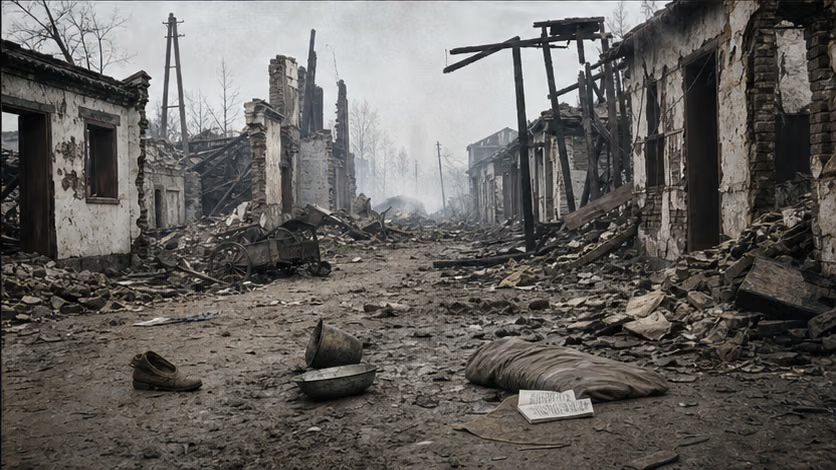
- City: after burning and looting, Nanjing's population at one point was less than one-quarter of its prewar level (figures vary by account).
Aftermath
- The Nationalist Government moved to Chongqing and continued the war - the capital fell, but the war did not stop; the meaning of "moving the capital to continue the War of Resistance."
- Matsui Iwane and Tani Hisao were executed by the Tokyo and Nanjing tribunals; Prince Asaka Yasuhiko was exempted from prosecution because of his imperial status - the exemption at the top of the chain of responsibility is written into this article.
- News of the massacre was carried out by Westerners present on the ground, shocking world opinion - but actual intervention by governments was close to zero (a history of international reaction: "they knew, and then what?").
- For the next 8 years, Nanjing served as the "capital" of Wang's puppet regime (from 1940; cross-reference the overview's Wang puppet-regime line).
- From the postwar period to the present: the Nanjing Massacre has become a core field of Sino-Japanese relations and East Asian memory politics - 70 years of commemoration, denial, litigation, and textbook disputes (one entry for contemporary history; see "How Each Side Records It" for details).
Accounts of Those Present
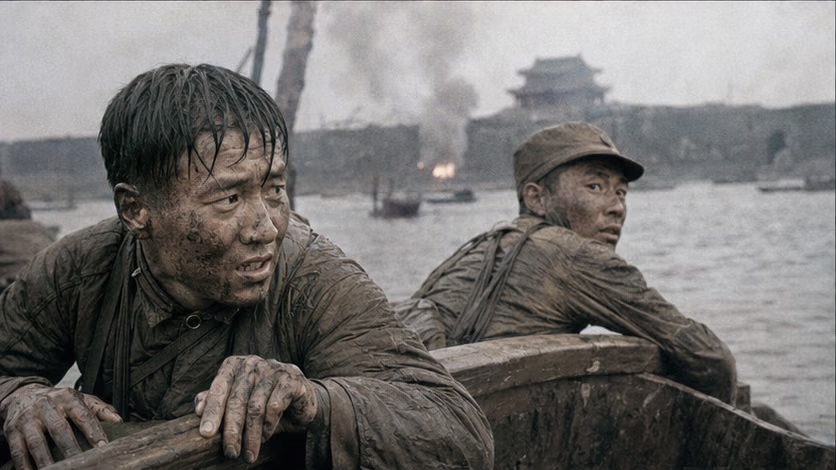
- Yijiang Gate: the city gate on the night of withdrawal - the gate-guarding troops had not received an order to let people pass, and Chinese troops inside and outside the city shot at one another and trampled one another in the gate tunnel (details unrecorded). That night's gate is the most concrete form of "systems failure killing people."
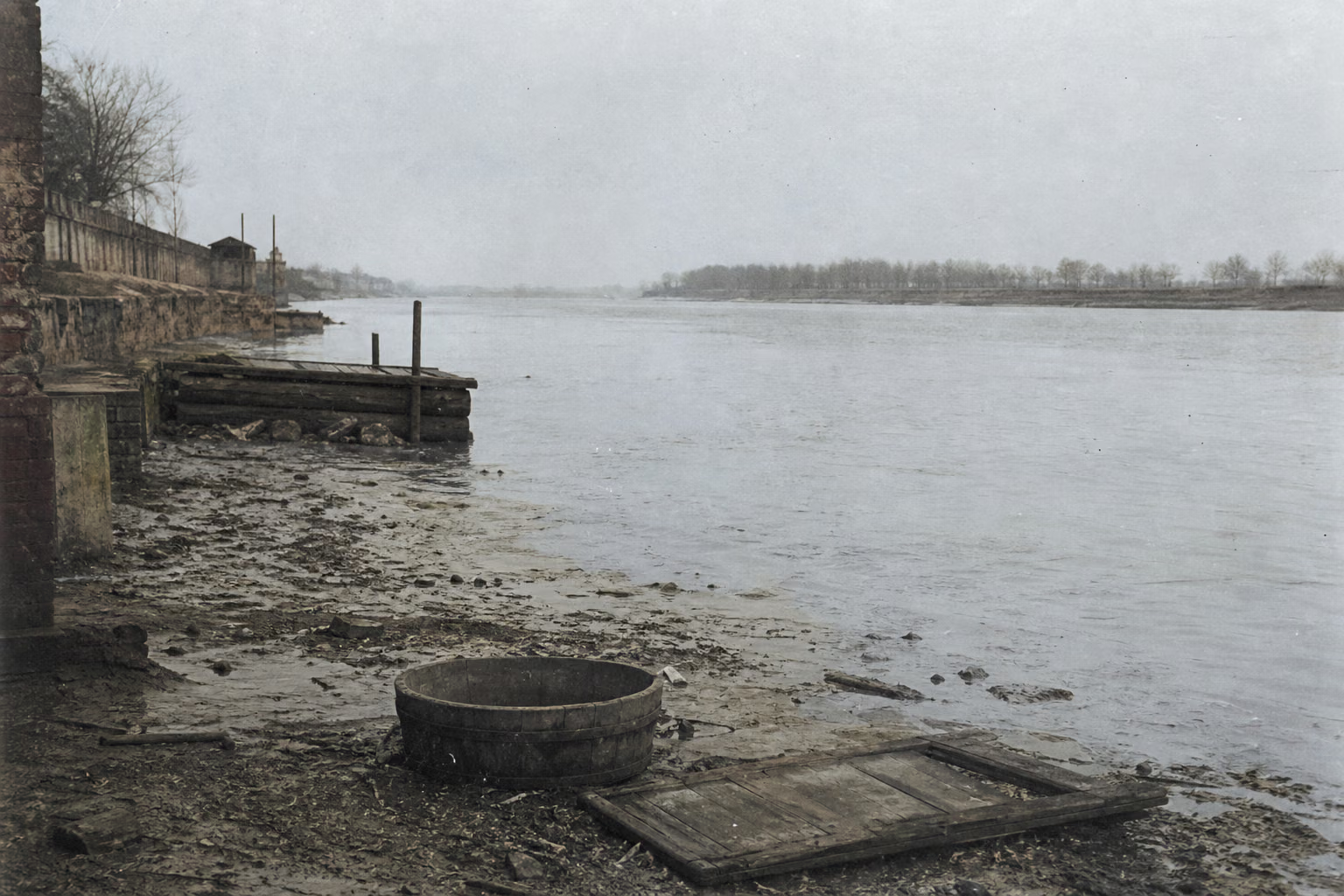
- Wooden tubs by the river: after there were no boats, soldiers crossed the river clinging to wooden tubs, door planks, and bathtubs, in the December river water (survivor-recollection layer) - the two fates of those who crossed and those who did not forked on the same riverbank.
- Rabe's flag: a Nazi Party flag spread in the courtyard to ward off air raids, sheltering 600 refugees - "the most ironic umbrella," and the complexity that human goodness is not determined by identity.
- The last page of Vautrin's diary: mental collapse in 1940 and return home, suicide in 1941 - "How I wish I could have saved more people" (diary quotation unverified). Outside the statistical tables of massacre casualties, there are names like this.
- Xiao Shanling: deputy commander of the Military Police and acting mayor of Nanjing, killed in battle on the morning of 12.13 at the Xiaguan riverfront - among the senior commanders defending the city, one who died at the final moment.
- The century of survivors: Li Xiuying (survived 37 knife wounds, died in 2004), Xia Shuqin (survived at age 8, won a reputation lawsuit) - they spent the rest of their lives testifying again and again; "survival" itself became a lifetime of service.
The Ground
- The Ming city wall and the artillery of 1937: the meaning and meaninglessness of a great work of the cold-weapons age before modern firepower - the fighting at the Zhonghua Gate barbican and the Guanghua Gate breaches.
- A city with its back to the water: the Yangtze was both barrier and dead end - the negative lesson space for "to defend a city, one must defend the route of retreat."
- Safety Zone: a sheltering space within the city - barbed wire, flags, and foreign bodies as boundaries; the "neutrality" of space could be violated at any time (records of Japanese forces entering the zone to search and seize people).
- Xiaguan riverbank: the terminal space of collapse - wharves, river water, the opposite bank; the darkest place among all the "retreat" spaces in this series.
- ※ Cluster of massacre sites (Caoxiexia, Yanziji, Jiangdongmen, etc.): today all have mass-burial-site memorials - a network of memory points in the city's geography, with the memorial hall itself built above the Jiangdongmen mass-burial site.
How Each Side Records It
- Chinese side: The military Defense of Nanjing was long covered over by memory of the massacre (the defenders' fighting has only in recent years been written more fully - "those who defended the city are also being remembered again"); commemoration of the massacre has been systematized since the 1980s in 3 tiers: memorial hall - National Memorial Day - Memory of the World Register.
- Japanese side: The most deeply divided field of memory - coexistence of those who acknowledge it (scholars such as Fujiwara Akira and Kasahara Tokushi, and veterans such as Azuma Shiro), the "middle" minimization school, and denialists (the "fabrication" thesis); textbook wording has gone through repeated reversals; the cycle of political gaffes, protests, and reshuffles has become a fixed program in Sino-Japanese relations. Within Japan there has always been a line of scholars and citizens who seriously study and acknowledge the historical facts.
- International: Iris Chang's *The Rape of Nanking* (1997) made Western publics see it again (she died by suicide in 2004 - another name exhausted by this history); the path from "the forgotten massacre" to the Memory of the World Register.
Disputes and Sensitivities
- Numbers: 300,000 (Chinese finding and commemorative baseline) / more than 200,000 (Tokyo Tribunal) / various Japanese-side schools - this article takes the judgments of the two tribunals as its baseline and places the different accounts side by side; the dispute over numbers must not slide into the relativizing trap of "conviction by number": under any statistical basis, this was a crime against humanity.
- The relationship between military narrative and atrocity narrative: the collapse of the defending forces does not constitute any explanation for the atrocities - causality and responsibility are kept strictly separate, and the prose must check itself at every moment.
- Tang Shengzhi's responsibility (the declaration of defending to the death and the disorderly withdrawal) - military review belongs to military review and is not mixed into responsibility for the atrocities.
- Recorders and survivors constitute an important entry point into the memory of the Nanjing Massacre.
- Prince Asaka's exemption from prosecution, doubts over Chongshantang burial figures, and the "plainclothes soldiers" defense - each is marked item by item, neither avoided nor magnified.
Sources and Open Questions
Sources: *Collection of Historical Materials on the Nanjing Massacre* (edited by Zhang Xianwen, 72 volumes - the first historical source for this article); *The Rabe Diary*; *The Vautrin Diary*; the judgment of the International Military Tribunal for the Far East, and the Nanjing Military Tribunal judgment in the Tani Hisao case; studies by Sun Zhaiwei, Kasahara Tokushi, Fujiwara Akira, and others; the Memorial Hall of the Victims in Nanjing Massacre by Japanese Invaders; the Magee film archive.
Open questions: the various statistical bases for defender strength and loss composition; the process by which boats were placed under control; details of the Yijiang Gate incident; figures for each mass-killing site; debates over burial records; the Vautrin diary quotation; the full roster of generals who died for the country; the peak number sheltered in the Safety Zone; the number and dates of Military Affairs Commission meetings on whether to defend or abandon Nanjing; the date of the formal order appointing Tang Shengzhi commander-in-chief of the Nanjing Garrison; the original text of Continental Order No. 8 (check Japanese war histories); how much intelligence the high command had, when it issued the order to defend to the death, about the Tenth Army's flanking move toward Wuhu; actual replenishment of ammunition and heavy weapons for the defending forces.
All images on this site are AI-generated depictions. They are not historical photographs, not primary sources, and do not depict any real individual.