Engagement Archive · Battle of Lanfeng and the Huayuankou Breach (1938) ※
After the breakout from Xuzhou, one Japanese division drove alone to the gates of Zhengzhou; more than ten Chinese divisions closed in but failed to destroy it, two army commanders abandoned cities in the face of battle, and one division commander was shot. The encirclement collapsed, and in the end Japanese forces were stopped by blowing open China's own Yellow River dike: 890,000 people (the postwar official basis) died in the yellow flood and the famine and epidemics that followed, and forty-four counties across Henan, Anhui, and Jiangsu were left as barren ground for ten years. This was the largest single case in the War of Resistance of "one's own people against one's own people."
Engagement Data
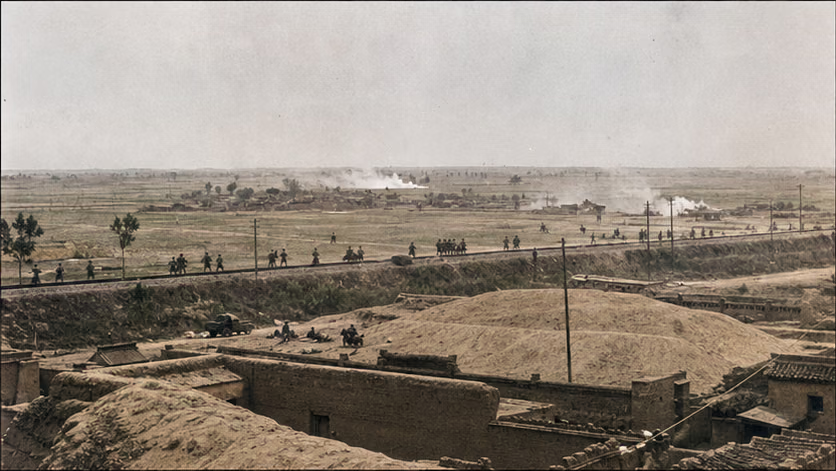
| Item | Content |
|---|---|
| Time | Mid-1938.5 - 6.9 (dike breach); the Lanfeng fighting was concentrated from 5.21 to early June |
| Location | Eastern Henan: the Lanfeng (today Lankao), Shangqiu, and Kaifeng line, on both sides of the Longhai Railway; the breach point was at Huayuankou north of Zhengzhou |
| Part of | Fourteen-Year War of Resistance · aftermath of the Battle of Xuzhou / prelude to the Battle of Wuhan |
| Chinese side | First War Area (Cheng Qian), with Xue Yue commanding at the front; main participating Central Army forces included more than ten divisions from the 27th Army (Gui Yongqing), the Eighth Army (Huang Jie), the 71st Army (Song Xilian), the 74th Army (Yu Jishi), and others |
| Japanese side | North China Area Army 14th Division (division commander Doihara Kenji), about 20,000 men (figures vary by statistical basis), crossing the Yellow River southward alone |
| Result | The encirclement failed; Lanfeng and Shangqiu were abandoned in succession; on 6.9 the dike was breached at Huayuankou, the Yellow River changed course southeast and captured the Huai, and the Japanese road west toward Zhengzhou was cut off by the flooded zone |
Belligerents
| Item | Chinese Side | Japanese Side |
|---|---|---|
| Strength | More than ten divisions, more than 100,000 men (figures vary by statistical basis), mostly exhausted troops withdrawn from the Xuzhou battlefield and temporarily assembled garrison units | The 14th Division, about 20,000 men, with heavy artillery and tanks attached, an isolated force without a rear |
| Firepower | Equipment uneven, few heavy weapons | Divisional artillery, armored cars, and air support |
| Situation | Outer-line encirclement, with several times the enemy's strength | Encircled on interior lines, but with the Yellow River at its back and supplies brought in from the north bank |
| Critical weakness | Command was not unified, and units holding points abandoned them at the first touch | An isolated force driving deep, attacked from front and rear - originally an ideal target for annihilation |
Terrain and Conditions
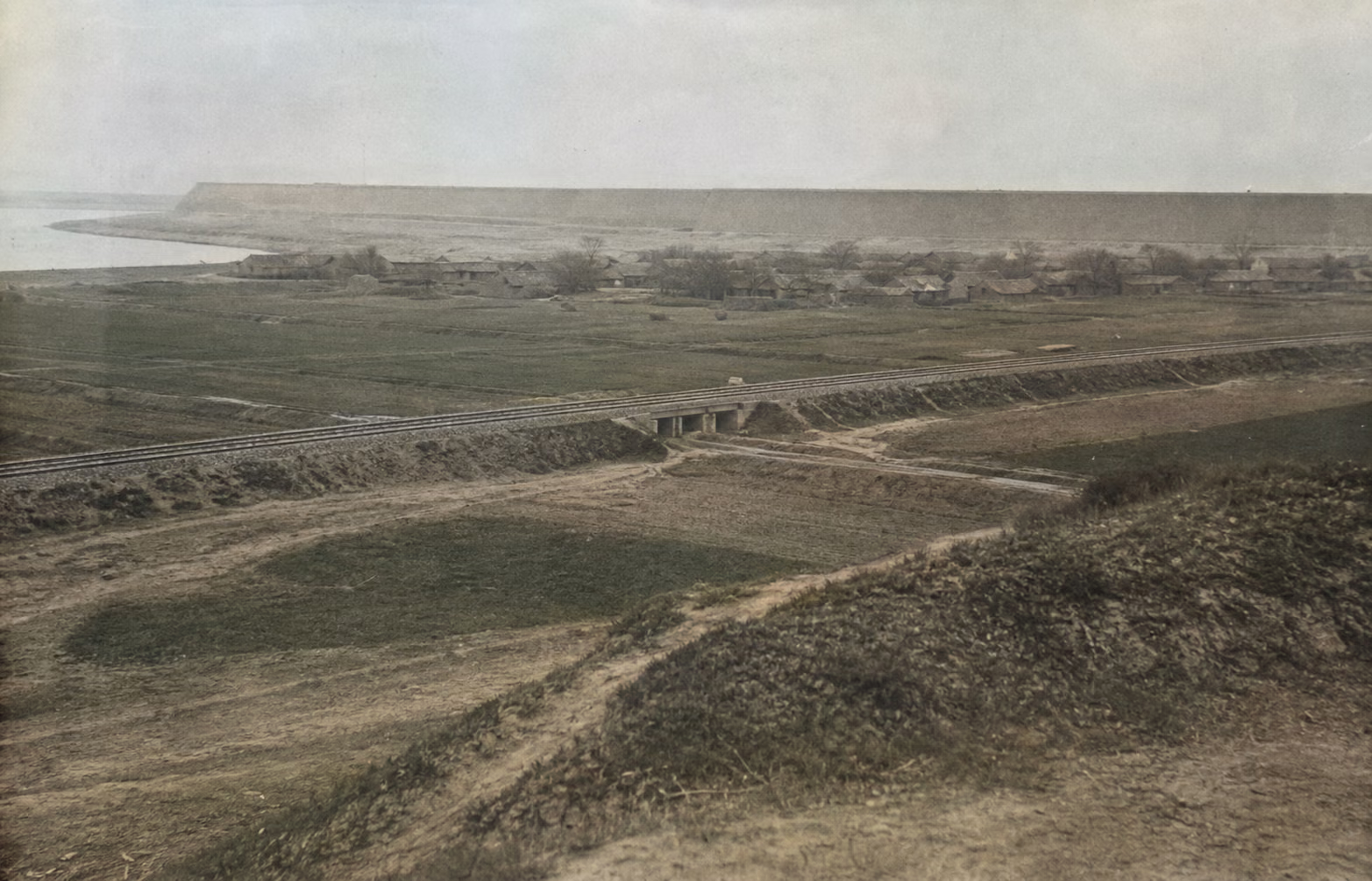
(For the larger situation in mid-1938 - the Battle of Xuzhou had just ended, and Japanese forces were advancing in a two-pronged pincer - see *Fourteen-Year War of Resistance · War Overview*; this article covers only eastern Henan.)
The eastern Henan plain: flat open country, with no defensible natural barrier; the only "barrier" was the Yellow River. The Longhai Railway ran east-west across it, and Zhengzhou was the national railway hub where the Pinghan and Longhai lines crossed. If Zhengzhou fell, Japanese forces could move south along the Pinghan line and directly threaten Wuhan; the Battle of Wuhan would have begun in advance at Zhengzhou's gate.
This river: from the Yellow River's northward change of course in 1855 (the Tongwaxiang breach) to this point, more than eighty years had passed (number of years unverified), and the old riverbed across Henan, Anhui, and Jiangsu had long since become farmland, villages, and towns. Inside the dikes, the riverbed stood higher than the plains on both sides - a "suspended river." Every account of the breach has to be calculated on this terrain.
Why It Was Fought
The congratulatory voices for Tai'erzhuang had barely faded when Japanese reinforcements were already on the road. Imperial General Headquarters, frustrated but unwilling to stop, reinforced from north and south by more than 100,000 men to encircle Xuzhou; in mid-May, the Fifth War Area's 600,000 men jumped out of the encirclement by separate routes, and Xuzhou was abandoned on 5.19 (see *Battle of Xuzhou · Overview*). Japanese forces had surrounded the city, but not the men; they then turned west along the Longhai line in pursuit. The battle of Xuzhou was over; the account of Xuzhou was not.
At this moment, the North China Area Army's 14th Division - division commander Doihara Kenji, about 20,000 men (figures vary by statistical basis) - crossed the Yellow River southward alone, cut the Longhai Railway, and pressed toward Zhengzhou. Its objective has two explanations: to support the Central China Japanese forces moving up the Yangtze toward Wuhan, or to drive straight down along the Pinghan line. The two explanations stand side by side and still require verification. Whichever is correct, both pointed at the same critical place: Zhengzhou, the crossing point of the Pinghan and Longhai lines. If it fell, Japanese forces could move directly toward Wuhan along the Pinghan line, and the Battle of Wuhan would begin in advance at Zhengzhou's gate.
What the Chinese side first saw, however, was an opportunity: one division, driving deep alone, exposed both front and rear, precisely the ideal target for annihilation. The war of annihilation that had not been achieved at Shanghai or Xuzhou was to be achieved at Lanfeng. Xue Yue was ordered to command the eastern Henan corps. More than ten divisions and more than 100,000 men (figures vary by statistical basis) from Gui Yongqing, Huang Jie, Song Xilian, Yu Jishi, and other commands closed in around Lanfeng, several times the enemy's strength and mostly direct-line Central Army troops. On paper, this was a battle that had to be won. What the paper did not write was that most of those more than ten divisions were exhausted troops withdrawn from the Xuzhou battlefield or temporarily assembled units, and command was not unified. Several times the strength encircling one division: whether the ring could hold depended entirely on execution. The decision to annihilate the enemy was made at Wuhan: the Supreme Military Council repeatedly dispatched telegrams to direct the operation, and Chiang Kai-shek personally wired rebukes and orders (telegram dates and wording unverified). What could not be calculated when the decision was made was whether the Chinese units' own organization had been restored, and whether orders could be carried to the front line.
The material account was more honest than the troop-strength account: ammunition meant the stocks left after Xuzhou's consumption; the eastern section of the Longhai line had already been cut, so movement depended on marching and the few railcars that remained; years of armies passing through eastern Henan had pushed local grain requisition nearly to the limit. The "quick decision" written into the encirclement plan was half forced by the family stores. Drag it out beyond two weeks, and both grain and ammunition would be empty (rounds carried by each army and supply details unverified).
The battlefield was biased too. The eastern Henan plain was flat open country, with no natural defense; the encircling ring had to be made by the troops themselves. Whoever loosened first would open a gap in the ring. In mid-May, the units closed in toward Lanfeng, Luowangzhai, and Quxingji, and the campaign began. The only "barrier" on the plain was the Yellow River: after the change of course in 1855, more than eighty years had passed (number of years unverified), and the riverbed inside the dikes had become a suspended river higher than the plains on both sides. If the encirclement failed, east of Zhengzhou there was nothing left to stop Japanese forces except this river. Proposals to dig open the dike to block the enemy had already appeared from different quarters (earliest proposer and text unverified); after Lanfeng and Shangqiu were both lost, the plan was submitted by the First War Area and approved by Wuhan, all within only a few days. Those who approved this order knew what lay under the suspended river: dozens of counties and the homes of several million people across Henan, Anhui, and Jiangsu. In the records that can be found today, no formal written objection remains; whether anyone on the military or political side advised against it in person at the time is not recorded (unverified).
Course of the Engagement
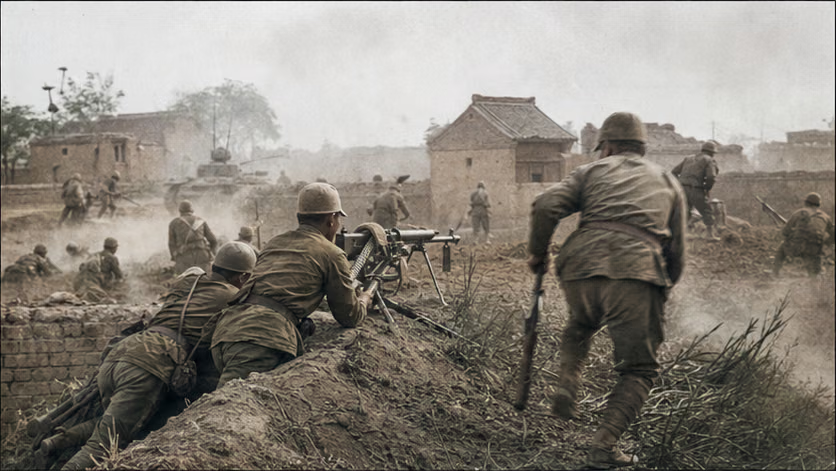
| Stage | Time | Key Points |
|---|---|---|
| Encirclement | Mid-May | Doihara's division occupied points around Lanfeng; Chinese units closed in toward Lanfeng, Luowangzhai, and Quxingji |
| First collapse | 5.23 | Gui Yongqing's 27th Army abandoned Lanfeng - as soon as the Japanese attack in front of it began, it collapsed, "withdrawing without even saying hello" (sense of Song Xilian's recollection; original text unverified); the encircling ring opened |
| Counterattack and renewed encirclement | 5.25-27 | The Chinese side organized a counterattack and retook Lanfeng (sequence unverified), again encircling Doihara's force around Sanyizhai and Quxingji |
| Second collapse | 5.29 | Huang Jie's Eighth Army abandoned Shangqiu - another gap opened toward Guide, and the encircling ring broke a second time; Doihara's force broke out westward, reoccupied Lanfeng, and its vanguard pressed toward Kaifeng and Zhengzhou |
| Accountability | June | Long Muhan, commander of the 88th Division, was shot for abandoning Lanfeng without authorization - the first direct-line Central Army division commander executed since the War of Resistance began (to be read together with the Jin-Sui Army case of Li Fuying: Li was the first lieutenant-general army-commander-level officer executed during the War of Resistance, though the statistical basis varies); Gui Yongqing and Huang Jie were only removed from their posts |
| Dike breach | 6.4-6.9 | The dike was first dug at Zhaokou in Zhongmou, but the water did not flow smoothly; on 6.9 the Yellow River dike was blasted open at Huayuankou north of Zhengzhou, and the yellow flood seized the opening and rushed southeast |
Casualties and Losses
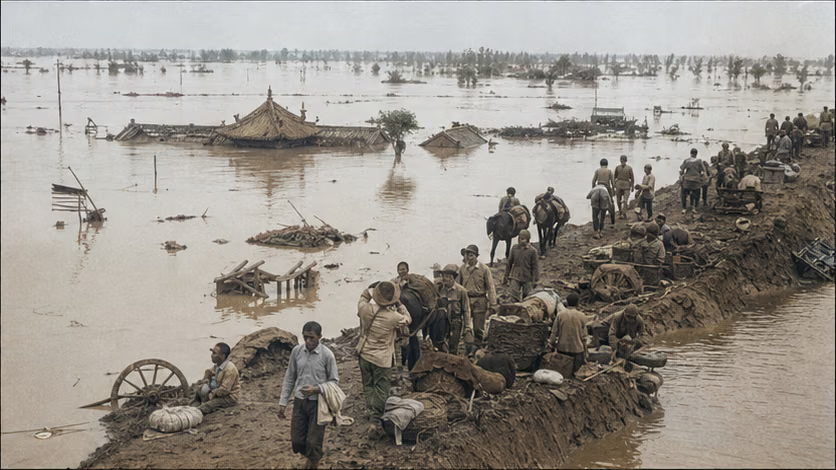
The military account: Chinese casualties in the Battle of Lanfeng numbered in the tens of thousands (figures vary by statistical basis); the objective of annihilation failed, and the main force of the Japanese 14th Division survived.
※ The Huayuankou account (two sets of statistical bases recorded side by side):
- Postwar official basis (Han Qitong and Nan Zhongwan, *Damage in the Yellow River Flooded Area and Postwar Relief*, 1948; figures vary by statistical basis): forty-four counties in Henan, Anhui, and Jiangsu became the flooded zone, more than 890,000 people drowned or later died of famine and epidemics in cumulative total, and about 3,900,000 fled.
- Various research bases: deaths range from more than 300,000 to 900,000, with the gap lying mainly in the statistical boundary between "drowned" and "later deaths from famine, epidemics, and disease." Two or more sets are recorded side by side, without making an unauthorized choice.
- Continuation of the flooded zone: the yellow flood seized the Huai and entered the sea; at its widest, the flooded zone was several tens of li across. Good farmland was sanded over and silted up, and more than ten years after the disaster it had still not recovered ("ten years of barren ground" is a summary statement; specific number of years unverified).
- Causal chain with the 1942-43 Henan famine: the ecology and cultivated land destruction in the flooded zone worsened the famine disaster. This is the "aggravation thesis"; scholars differ over its weight, and it was not the sole cause (the Henan famine has not yet been written as an article).
- Japanese side: units including the Japanese Fourteenth and Sixteenth Divisions inside the flooded zone were trapped by water, escaped through airdrops and boat rescue, and also suffered considerable losses (Japanese figure disputed).
Aftermath
- The Japanese plan to advance west to Zhengzhou and then move straight down the Pinghan line toward Wuhan was cut off by the Yellow River flooded zone, and the main axis shifted to moving up the Yangtze - the Battle of Wuhan thus unfolded along the river (see *Battle of Wuhan · Overview*). The time bought by "using water in place of soldiers" is measured in months (specific assessment bases differ).
- The Yellow River changed course southeast, creating a Yellow River flooded zone that lasted for years between Henan, Anhui, and Jiangsu. It also became a military barrier: for the next six years, Japanese forces did not again advance west from this direction (the flooded zone's military barrier effect and the people's cost are placed together, without offsetting each other).
- Accountability stopped with Long Muhan alone; Gui Yongqing and Huang Jie later still rose in the army (subsequent careers unverified). From then on, debate did not cease over "same crime, different punishment for direct-line and non-direct-line troops."
- At the time, the breach was described publicly under the taboo formula that "Japanese forces bombed the dike" (see the Disputes section).
Accounts of Those Present
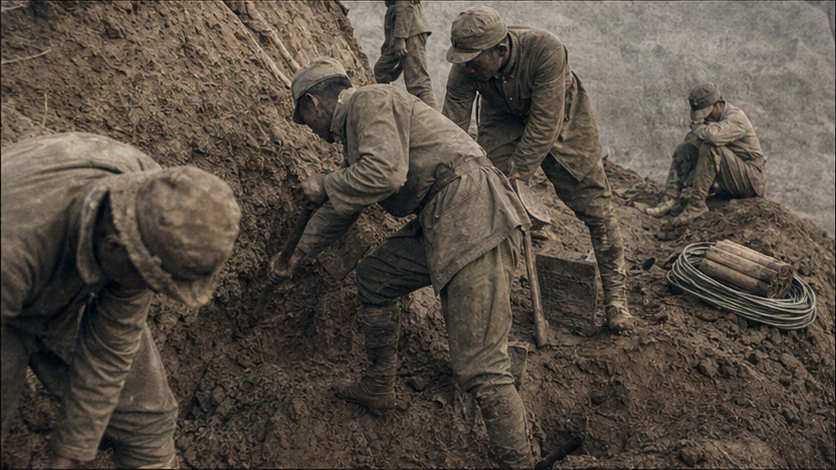
- The soldiers who dug the dike: the Huayuankou breach was carried out by the New Eighth Division (division commander Jiang Zaizhen) (designation and names unverified). Engineers dug on the dike for two days and nights, and the story that officers present "knelt on the ground and wept" when explosives opened the gap is widely circulated (circulating layer, source unverified).
- "A laughingstock for the ages": after Lanfeng was abandoned, Chiang Kai-shek wired a rebuke to the front-line generals, and the phrase "the defeat at Lanfeng is truly a laughingstock for the ages" has circulated as Chiang's wording (original text and telegram source unverified).
- Long Muhan: first class of Whampoa, commander of the 88th Division - a German-trained division commander who had fought through Shanghai and Nanjing, shot in Wuhan for the crime of abandoning a city (details of place and date unverified). When he was executed, Gui Yongqing and Huang Jie remained in office - the people in the same case with different fates.
- The people fleeing the water: after the breach, people in the flooded zone often fled at night after hearing the water, yet "people do not call out the water" - the water came without sound. Several million people abandoned their homes and fled east and west. This is the image that no narrative of "military gain" can press down.
- The Japanese forces surrounded by water: Japanese records state that their troops were divided by the yellow flood, supplied by motorboats and airdrops, and trapped for days on rooftops and dike ridges (Japanese war-history account, details unrecorded). Desperation was not on one side only.
The Ground
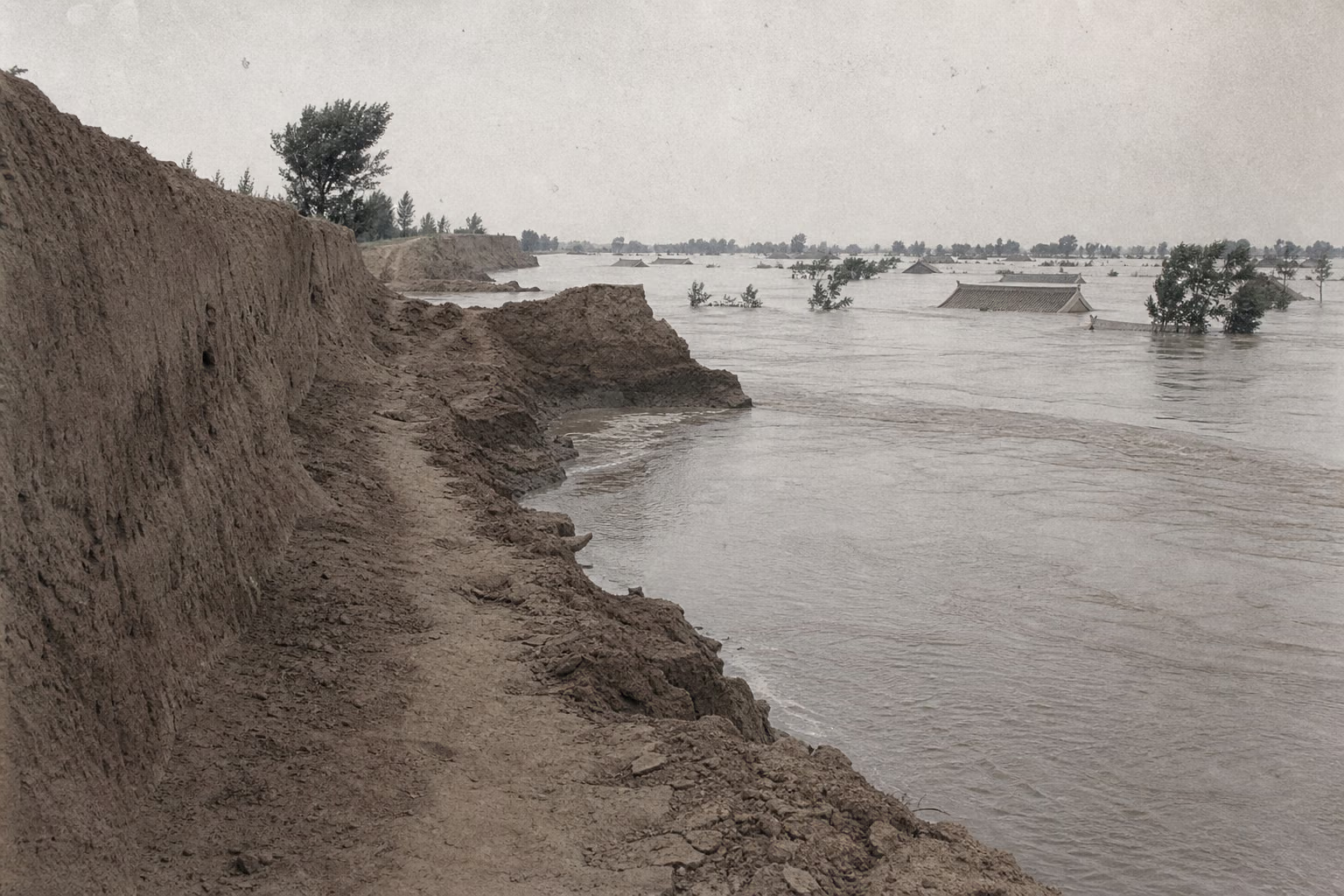
- The eastern Henan plain had no cover or obstruction. Villages, sand dunes, and railway embankments were the only supports - the space of the encirclement was a "drawn circle," not a circle made by terrain.
- Suspended river: a river whose bed stood higher than rooftops. The terrain contrast before and after the dike breach is the core spatial fact of this case.
- Flooded zone: villages under water, rooftops and treetops showing above the surface - the waterborne space formed after the Yellow River flood, the shape of a six-year military barrier.
- Breach points: Zhaokou and Huayuankou are placed side by side. The failed first attempt to dig the dike can itself enter the narrative.
How Each Side Records It
- Chinese side (at the time): the official public claim was that the dike had been breached by Japanese bombing, and newspapers reported it as "enemy aircraft bombed the dike" - a wartime propaganda basis.
- Chinese side (afterward): relief reports on the Yellow River flooded zone in the 1940s already counted the disaster on the basis of a self-breach; after the 1980s, archives and research on both sides of the Taiwan Strait gradually confirmed that the Chinese side had actively breached the dike. The history of this reversal itself is one section of this article (key literature and sequence unverified).
- Japanese side: war histories record the condition of its troops trapped by the Yellow River flood; Japanese scholarship often acknowledges that the breach delayed the attack on Zhengzhou and changed the route to the Yangtze (specific arguments unverified).
- Memory of the people in the flooded zone: in local gazetteers and oral histories, the "yellow flood" and "fleeing famine" form the ground tone of the ten years from 1938 to 1947 (overlapping with memory of the 1942 famine).
Disputes and Sensitivities
- The debate over "using water in place of soldiers": military effectiveness (delaying Japanese forces, forcing a change of route, creating a six-year barrier) and humanitarian catastrophe (several hundred thousand lives, forty-four counties as barren ground for ten years) coexist; neither side can be used to diminish the other. In the whole series, this is the article with the heaviest weight of "self-injury."
- Propaganda reversal: from "Japanese forces bombed the dike" to acknowledgement of self-breach, the shift in the official account over more than forty years also involves the recorders.
- Debate over accountability: killing Long Muhan while leaving two army commanders in place; whether the difference between direct-line and miscellaneous troops shaped military law - the accounts stand side by side and still require verification.
- Death figures: between 890,000 and 300,000 lies the problem of statistical boundaries. The gap between the two sets of figures is large, and this article records both.
- The Huayuankou breach was an order actively executed by the Chinese side, and its consequences are marked at the same level as *Defense of Nanjing*.
Sources and Open Questions
Known main sources:
- Han Qitong and Nan Zhongwan, *Damage in the Yellow River Flooded Area and Postwar Relief* (1948, basis of the Executive Yuan's National Relief and Rehabilitation Administration)
- Song Xilian, *The Hound General*, and other memoirs of participating generals (the process by which Lanfeng was abandoned)
- War History Office of Japan's Defense Agency, *Senshi Sosho*, relevant volumes on the North China security war / army operations in the China Incident
- Yellow River flooded zone local gazetteers and oral-history materials (to be collected)
Open questions: Doihara's division's strength and time of crossing south; the original text of the "laughingstock for the ages" telegram; the sequence of Lanfeng's fall and counterattack; Long Muhan case judgment and the basis for placing it together with the Li Fuying case; Gui Yongqing's and Huang Jie's postwar careers; the process of digging the dike at Zhaokou; the designation and names of the troops that carried out the dike breach; the statistical boundary of the 890,000 figure; the loss figures for Japanese forces trapped by water; key literature and sequence in the "history of reversal"; different schools' assessments of the military benefit of the dike breach; telegrams between the Supreme Military Council and the front over the encirclement decision, and Chiang Kai-shek's supervisory telegrams; rounds carried by participating armies and eastern Henan grain-requisition records; earliest proposer and text of the recommendation to dig the dike to block the enemy; the sequence of submission and approval for the dike-breach plan, and whether any record survives of advice against it at the time of decision.
All images on this site are AI-generated depictions. They are not historical photographs, not primary sources, and do not depict any real individual.