Engagement Archive · Beiping–Tianjin Operation
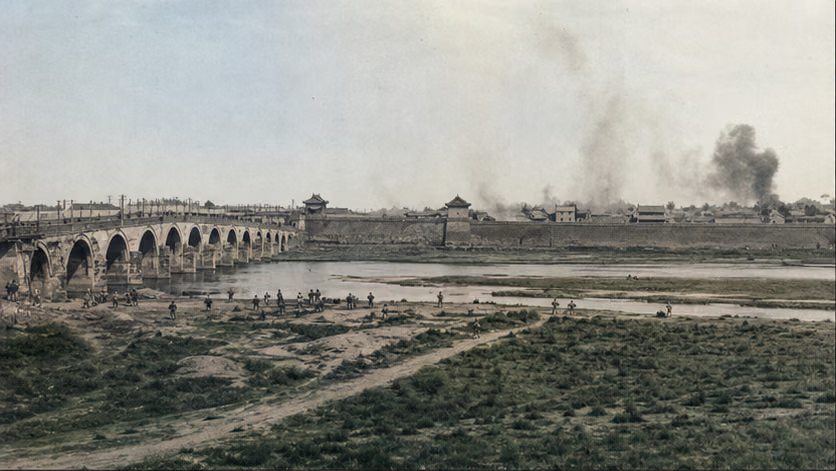
In July 1937, from one night of gunfire at Marco Polo Bridge to the abandonment of Beiping, only twenty-two days passed -- the full-scale War of Resistance opened with a hurried and confused loss, while the three words "Marco Polo Bridge" became the call that mobilized an entire nation.
Engagement Data
| Item | Content |
|---|---|
| Time | 1937.7.7 – 7.30 |
| Place | Wanping, Beiping · Marco Polo Bridge, Nanyuan, Beiping, Tianjin, Tongzhou |
| Belongs to | Fourteen-Year War of Resistance · beginning of the full-scale War of Resistance (for the larger situation, see *Fourteen-Year War of Resistance · War Overview*) |
| Defending side | 29th Army (army commander Song Zheyuan): 37th Division (Feng Zhi'an), 38th Division (Zhang Zizhong), 132nd Division (Zhao Dengyu), 143rd Division (Liu Ruming) |
| Attacking side | Japanese China Garrison Army (from mid-July under commander Kiyoshi Katsuki), about 5,700 men at the outbreak of fighting, rising to several tens of thousands after reinforcement by the Kwantung Army and Korea Army in late July (details unrecorded) |
| Result | 7.28 Nanyuan fell, and Tong Linge and Zhao Dengyu died for their country; 7.29 Beiping was abandoned; 7.30 Tianjin fell |
Belligerents
| Item | Defending side | Attacking side |
|---|---|---|
| Strength | About 100,000, but dispersed across Hebei, Chahar, Beiping, Tianjin, and surrounding areas, with limited troops available near Beiping and Tianjin | About 5,700 men at the outbreak of fighting, reinforced to several tens of thousands by the end of July (including the Kwantung Army's First and Eleventh Brigades and the Korea Army's 20th Division -- unit designations unverified) |
| Equipment | Firearms uneven, few heavy weapons, no air power | Artillery, tanks, and air arms all present; air superiority in hand |
| Situation | Already encircled on three sides by Japanese and puppet forces: along the Beining Railway, Japanese forces at Fengtai, and the puppet East Hebei government in Tong County | Held key points such as Fengtai, choking Beiping's southwestern throat |
Terrain and Conditions
(For the larger situation in 1937 -- the turn toward KMT-CPC cooperation after the Xi'an Incident and the agitation in the Japanese cabinet -- see *Fourteen-Year War of Resistance · War Overview*; this entry records only Beiping and Tianjin.)
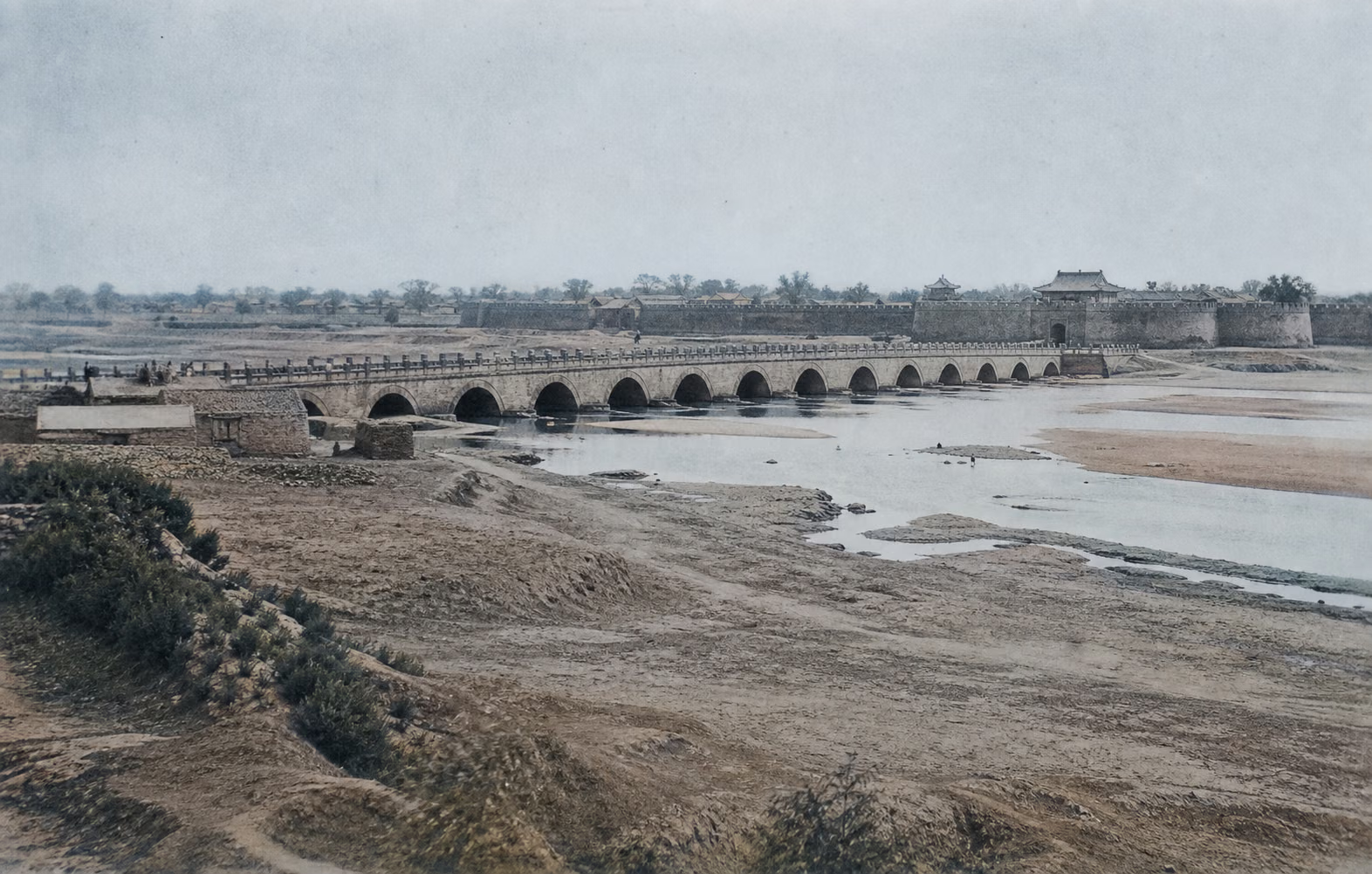
Beiping: a city encircled on three sides. After the Tanggu Truce, eastern Hebei was demilitarized, and in 1935 Yin Rugeng set up the puppet "East Hebei Anti-Communist Autonomous Government" in Tong County; the Japanese garrison held Fengtai, and Japanese troops were present all along the Beining Railway. Beiping's outside passage was reduced to a single throat in the direction of the Ping-Han Railway: Wanping and Marco Polo Bridge.
The 29th Army: an army in the cracks. Remnants of the Northwestern Army, survivors of the defeated side in the Central Plains War, it lived off territory in Chahar and Hebei-Chahar and handled both Chiang Kai-shek and Japan at the same time (see the "two tails" discussion in the relevant warlord-war entries -- source unverified). The reputation won at Xifengkou in the Defense of the Great Wall was the capital that let them stand in Beiping and Tianjin, and also the public-expectation burden that made them unable to speak lightly of withdrawal.
Why It Was Fought
The good news from Suiyuan warmed the country for only a month. On December 12, 1936, the Xi'an Incident, a military remonstrance, forced a turn in state policy: the civil war stopped, the KMT and CPC sat down together again, and Nanjing reorganized and trained its forces -- China was moving toward being "able to fight." Tokyo saw this direction more clearly than anyone: inside the military, the argument for "one blow against China" rose, saying China was vulnerable and would yield if struck before it was ready; and the Operations Bureau chief in the General Staff, who presided over "non-expansion," was precisely Kanji Ishiwara, the man who had lit the Mukden Incident -- the "insubordination from below" he had pioneered now turned back against himself.
The battlefield had in fact long been laid out. Since the Tanggu Truce, Beiping had been encircled on three sides: to the east, Tong County was Yin Rugeng's puppet "East Hebei Anti-Communist Autonomous Government"; to the south, Fengtai held the Japanese China Garrison Army; Japanese troops stood all along the Beining Railway. Only one southwestern throat remained for outside passage -- Wanping and Marco Polo Bridge on the Ping-Han Railway. In 1936 the garrison was enlarged and reinforced; by early summer 1937, it was drilling day after day beside this throat, often into the depth of night. Guarding it was Song Zheyuan's 29th Army: remnants of the Northwestern Army, old hands from Xifengkou, surviving between Chiang Kai-shek and Japan on the territory of Hebei and Chahar -- an army in the cracks, guarding a city in the cracks.
On the night of July 7, Japanese forces conducting exercises claimed that one soldier had "gone missing" and demanded entry into Wanping city to search -- the soldier, Shimura Kikujiro, had returned to his unit about twenty minutes later, yet the Japanese side still insisted on entering the city (level of the return-to-unit details unverified). The defenders refused. On the morning of July 8, Japanese forces shelled Wanping city, and Jin Zhenzhong's battalion of the 219th Regiment returned fire -- the first shot of the full-scale War of Resistance was fired here.
For the next three weeks, peace and war ran on two tracks at once. On the Beiping side, Song Zheyuan moved between compromise and preparation for battle -- he treated this as another piece of extortion that could be settled locally; in later accounts these three weeks have been read both as "seeking peace and harming the country" and as "enduring while waiting for aid," while negotiating and watching at the same time is the fact. The piece of intelligence he could not see while he maneuvered was that Tokyo had already decided to send troops (the extent of Song's knowledge of Japanese reinforcement movements unverified); on July 9 a ceasefire was once briefly agreed. On the Tokyo side, on July 11 the Konoe cabinet's Five-Minister Conference decided to send troops to North China, and Army Minister Hajime Sugiyama told the emperor that the incident could be settled in about a month; reinforcements from the Kwantung Army and Korea Army immediately set out -- before the ink on the negotiating table was dry, the reinforcement trains were already running. Nanjing's tone also changed this time: the day after the incident, the CPC Central Committee telegraphed the whole country, calling for a nationwide War of Resistance (original telegram unverified); on July 17 Chiang Kai-shek declared the "last moment" at Lushan, and Central Army units moved north along the Ping-Han Railway -- neither side intended to allow another localized North China Incident-style ending.
The capital of the two sides lay in plain sight. The 29th Army was said to number 100,000 but had very few heavy weapons, repaired arms through its own repair shops, and had no great rear area behind it; Beiping was both a war zone and Song Zheyuan's territory, and if the city truly became a battlefield, the finances and territory of Hebei-Chahar would burn together -- this was the account book that inclined him toward settling the matter locally. Japanese forces dared to move with 5,700 men because they were betting on the railway timetable for reinforcements.
Inside the army, peace and war were never of one mind: deputy army commander Tong Linge and division commander Feng Zhi'an favored fighting (see memoirs by Qin Dechun and others, details unverified), Zhang Zizhong's line inclined toward a local settlement, and Song Zheyuan compromised between the two. The argument of those who favored battle was that Fengtai had already been lost, only one throat remained, and another concession would turn the city into something trapped in a jar; the argument of those who favored peace was that the family resources of 100,000 men could not withstand aircraft and heavy artillery. Both arguments stood, but the decision was no longer in Beiping's hands.
On July 26, the Japanese side issued an ultimatum; on the 27th, it was refused; on the morning of the 28th, the general assault began. Counting from that night on the bridge to the fall of Beiping, twenty-two days passed.
Course of the Engagement
| Stage | Time | Main Points |
|---|---|---|
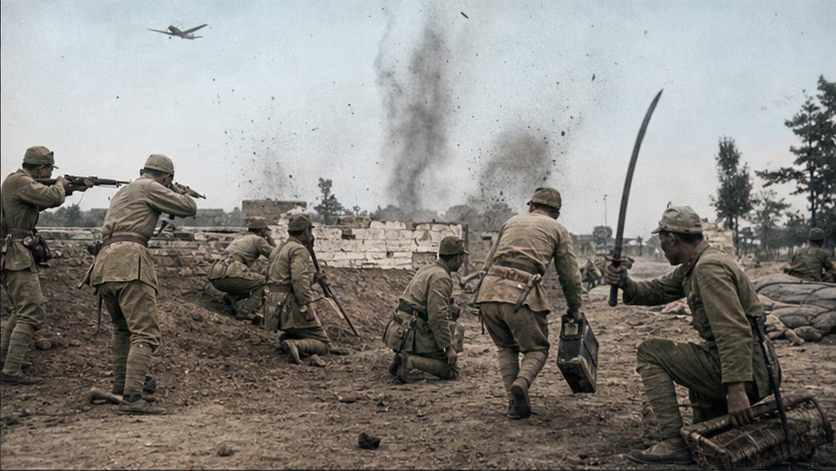
| Marco Polo Bridge | 7.7–7.9 | On the night of 7.7, exercises became provocation; on the morning of 7.8, Wanping was shelled, and Jin Zhenzhong's battalion held firm and returned fire; on 7.9 a ceasefire was briefly reached |
| Three weeks of peace and war | 7.10–7.27 | Song Zheyuan left Leling for Tianjin on 7.11 to negotiate with the Japanese side and returned to Beiping on 7.19; meanwhile the Langfang Incident on 7.25 and the Guang'anmen Incident on 7.26 kept escalating the conflict; on 7.26 the Japanese side issued an ultimatum, and on 7.27 it was refused |
| Nanyuan | 7.28 | Japanese forces launched a general attack on 29th Army headquarters at Nanyuan; under aircraft and heavy artillery there was no defensible ground; deputy army commander Tong Linge and Zhao Dengyu, commander of the 132nd Division, died for their country -- the first generals to die for their country in the full-scale War of Resistance; the directly attached student-soldier corps of the army headquarters suffered heavy casualties among more than a thousand student soldiers ※ |
| Abandoning Beiping | Night of 7.28–7.29 | Song Zheyuan, Qin Dechun, and others led their forces in withdrawal toward Baoding, while Zhang Zizhong remained in Beiping to maintain order; on 7.29 Beiping fell |
| Tianjin | 7.29–7.30 | Li Wentian, deputy commander of the 38th Division, and others led their forces in an active counterattack, striking the railway station, Dongjuzi Airfield, and the Haiguangsi barracks; after a day and night of fierce fighting, they withdrew on 7.30, and Tianjin fell |
| Tongzhou Incident | 7.29 | Zhang Qingyu's and Zhang Yantian's units of the puppet East Hebei Peace Preservation Corps changed sides, killing several hundred local Japanese troops and Japanese residents (the Japanese count is around two hundred-plus, including civilians; Chinese figures vary) -- the Japanese side long publicized it as an atrocity incident, and the narrative battle continues to this day |
Casualties and Losses
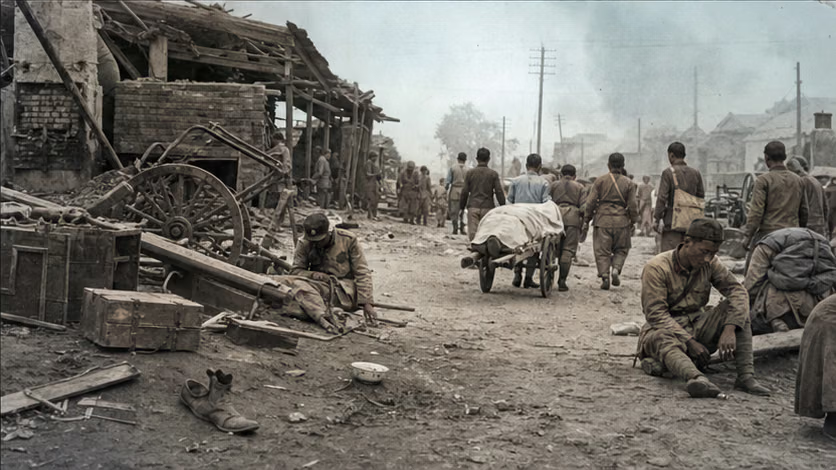
- Defending side: several thousand casualties in the Beiping–Tianjin Operation (figures vary by statistical basis; this figure disputed); Tong Linge and Zhao Dengyu died for their country; the student-soldier corps suffered more than one thousand casualties (figures vary by account).
- Attacking side: the Japanese side published several hundred casualties (figure disputed).
- ※ Civilians: the fighting and deaths that reached civilians in Nanyuan, Langfang, and urban Tianjin; Japanese-resident civilians killed in the Tongzhou Incident are listed according to the Japanese count, with Chinese accounts and figures placed beside them (each side's sources unverified).
Aftermath
- Beiping and Tianjin were lost, and the gate to North China was thrown open; in August, the Battle of Nankou and the Battle of Shanghai followed one after another, and the full-scale War of Resistance unfolded.
- Zhang Zizhong left Beiping in disguise in August and escaped danger; he later returned to command troops and died for his country at Zaoyi in 1940 -- *Beiping–Tianjin Operation* plants a line for this man here.
- Beiping and Tianjin were occupied for eight years, until their recovery in 1945.
- The loss and the call had the same source. Militarily, this was a hurried and confused failure over twenty-two days; spiritually, the three words "Marco Polo Bridge" from then on became the call that mobilized an entire nation. Defeat and awakening were the two faces of the same event.
Accounts of Those Present
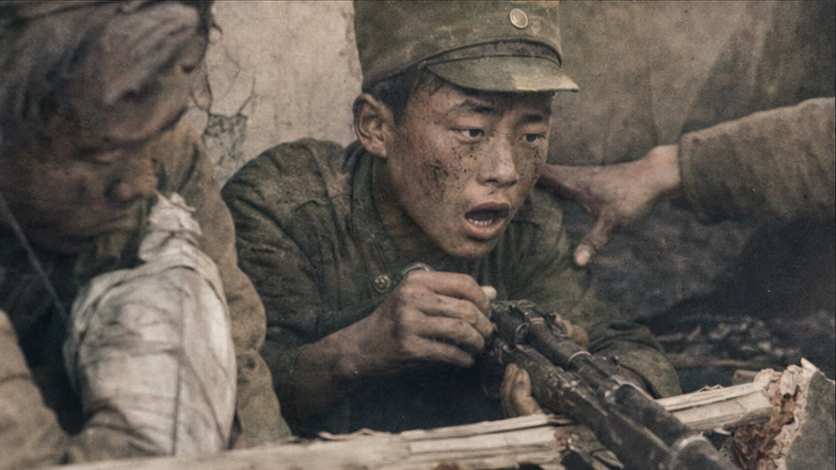
- The "missing" soldier: Shimura Kikujiro left his unit with diarrhea and returned about twenty minutes later -- the two words "pretext" are anchored in these twenty minutes.
- Tong Linge: before the battle, he vowed, "Since conflict cannot be avoided, we shall be the first to bear its brunt" (wording source unverified); on 7.28 he commanded fighting at Nanyuan and was hit by a bullet and died for his country during the breakout (location details unrecorded).
- Zhao Dengyu: an old commander of the dadao units at Xifengkou, he was ambushed on the way to Dahongmen, hit by several bullets, and died for his country; his final words, in the transmitted account, asked others to report back to his aged mother that loyalty and filial piety could not both be fulfilled (circulating account, unverified).
- "A soldier with one day of service" ※: the student-soldier corps numbered about 1,700 men (figure disputed), most of them students from Beiping and Tianjin, and they went to the front before they could receive training after enlistment -- for many, the first day as a soldier was also the last.
- Zhang Zizhong: he remained in Beiping to deal with Japanese forces, was denounced by public opinion as a hanjian, and kept silent without defending himself; after escaping danger, he asked only for a battle -- three years later he died at Nanguadian.
- Atop Wanping's walls: battalion commander Jin Zhenzhong directed the battle and was wounded in the leg (details unrecorded); bullet scars on Wanping's city wall can still be seen today.
The Ground
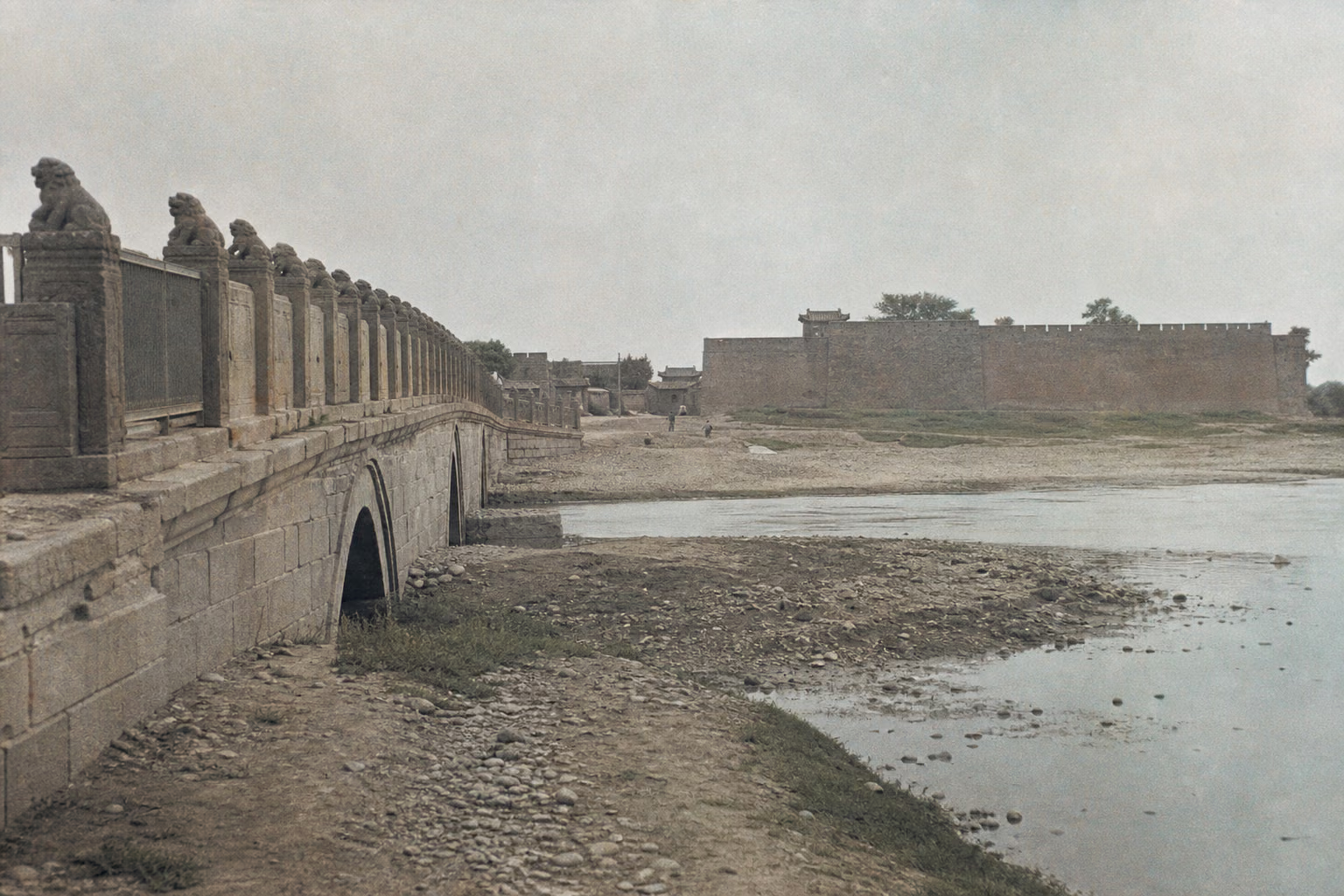
- Marco Polo Bridge-Wanping city: the Yongding River and the Ping-Han Railway bridge, Beiping's last southwestern throat; a stone bridge, a riverbank, and a small city, with the scale of one bridge and one city.
- Nanyuan: open barracks, no defensible ground, a place of death under aircraft and heavy artillery -- the defenders' situation and the terrain annotate each other.
- Dahongmen: a road ambush point, the place of martyrdom.
- Tianjin: urban streets and lanes, railway station, airfield, and barracks fought over at multiple points at once; the Japanese barracks at Haiguangsi were the hard point that could not be taken by assault.
- Tongzhou: a sudden close-range incident inside the old city, with the scale of one street and one barracks.
How Each Side Records It
- Chinese side: 7.7 is set as the starting point of the full-scale War of Resistance; Tong Linge and Zhao Dengyu gave their names to roads, and Beiping's Tong Linge Road and Zhao Dengyu Road remain today. Who fired the first shot: Chinese records state that Japanese forces shelled Wanping first.
- Japanese side: at the time it was called the "North China Incident," and after the war often the "Marco Polo Bridge Incident"; regarding the "first round," Japanese military histories and some studies (such as Hata Ikuhiko -- unverified) maintain that the Chinese side fired first. The two accounts are placed side by side, and the divergence itself is recorded with them.
- Tongzhou Incident: the Japanese side defines it as the "Tongzhou Massacre" and has long commemorated and publicized it; the Chinese side records it as revenge and loss of control during a mutiny by puppet peace-preservation troops. Two sets of casualty figures and characterizations are placed side by side, without arbitrarily choosing between them.
Disputes and Sensitivities
- Responsibility for the first shot: Chinese and Japanese military histories each hold to their own account, and the scholarly dispute continues to this day.
- How to judge Song Zheyuan's three weeks of hesitation: the accounts of "seeking peace and harming the country" and "enduring while waiting for aid" coexist; his position in the cracks -- remnants of a defeated army, between Japan and Chiang -- is the key to understanding these three weeks, but not a shield for absolution.
- Zhang Zizhong remaining in Beiping: the gap between public opinion at the time and later evaluation is enormous.
- Civilian deaths in the Tongzhou Incident: the gap between the Japanese narrative and the Chinese "changing sides" narrative, with figures coming from different sources.
Sources and Open Questions
Known main sources:
- *Historical Materials on the Marco Polo Bridge Incident* (Chinese historical-materials compilation -- edition unverified)
- Memoirs by participants such as Qin Dechun and Jin Zhenzhong (specific items unverified)
- Japanese Defense Agency War History Office, *Senshi Sosho · Army Operations in the China Incident* (Japanese official compilation)
- Hata Ikuhiko, *Study of the Marco Polo Bridge Incident* (Japanese study -- edition unverified)
Open questions: Shimura Kikujiro's return-to-unit details and reporting level; Japanese reinforcement unit designations and strength; statistical basis for total 29th Army casualties in Beiping and Tianjin; student-soldier corps numbers and casualties; details of Tong Linge's place of death; source of Zhao Dengyu's final words; sources for both sides' death figures in the Tongzhou Incident; the later fates of Zhang Qingyu and Zhang Yantian after changing sides; original text of the CPC Central Committee's July 8 telegram; text of the Konoe cabinet Five-Minister Conference decision to send troops; the extent of Song Zheyuan's knowledge of Japanese reinforcement movements; 29th Army arms-repair supply and grain-stock records for Beiping and Tianjin; memoir materials on Tong Linge and Feng Zhi'an favoring battle and Zhang Zizhong's line inclining toward local settlement.
All images on this site are AI-generated depictions. They are not historical photographs, not primary sources, and do not depict any real individual.