Engagement Archive · Defense of Hengyang
A depleted remnant force of 17,000 men, still unreplenished, held off five Japanese divisions in succession for 47 days inside a city emptied by evacuation - the longest urban defensive battle on the Chinese battlefield.
Engagement Data
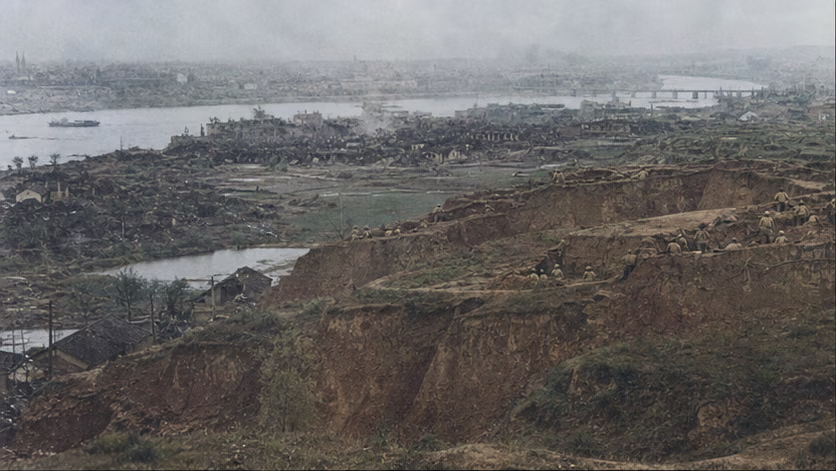
| Item | Content |
|---|---|
| Time | 1944.6.23 – 8.8, 47 days in all |
| Place | Hengyang, Hunan (the urban area on the west bank of the Xiang River and the surrounding hills) |
| Part of | Fourteen-Year War of Resistance · Battle of Changsha-Hengyang (the Hunan phase of Japanese "Operation Ichi-Go") |
| Defending side | National Revolutionary Army Tenth Army (army commander Fang Xianjue), comprising the Preparatory Tenth Division, Third Division, 190th Division, and Provisional 54th Division |
| Attacking side | Japanese Eleventh Army (commanding officer Isamu Yokoyama), which successively committed the 68th, 116th, 58th, 13th, 40th, and other divisions |
| Result | On 8.8 the city fell; Fang Xianjue led the remnants of his force in ceasing resistance; Japanese forces occupied Hengyang |
Belligerents
| Item | Defending side | Attacking side |
|---|---|---|
| Strength | About 17,000 (not replenished after losses suffered while rushing to aid the Battle of Changde; the 190th Division was almost an empty shell) | About 30,000 men in two divisions in the first assault; more than 100,000 committed cumulatively |
| Firepower | Mainly mountain guns and mortars; ammunition was already scarce by the middle phase | Divisional artillery + independent heavy-artillery units + aviation |
| Air | Chinese and American air forces contested air superiority and dropped supplies | Fifth Air Army |
| Special weapons | — | Chinese records in many places state that Japanese forces released poison gas; Japanese files call it "special smoke" (details unrecorded) |
| Supply | Airdrops were a drop in the bucket; the defenders relied mainly on prewar stockpiles | The Operation Ichi-Go line was overextended, and the attacking troops likewise fell into shortages of food and ammunition |
Terrain and Conditions
(For the larger situation of 1944 - global counteroffensive, Chinese retreat, and Japan's all-or-nothing throw - see *Battle of Henan–Hunan–Guangxi · Overview*. Here, only Hunan and Hengyang are covered.)
Hunan: from "it can be held" to collapse in days. Since the beginning of the War of Resistance, Hunan had been one of the few bright points on the frontal battlefield. The three Battles of Changsha had all held, and the phrase "Hunan has not fallen" sustained morale in the rear area. In June 1944, the Fourth Battle of Changsha was lost in only several days; Zhang Deneng, commander of the Fourth Army defending Yuelu Mountain, was executed by firing squad after the battle. Hengyang took up its battle amid this sudden collapse of morale.
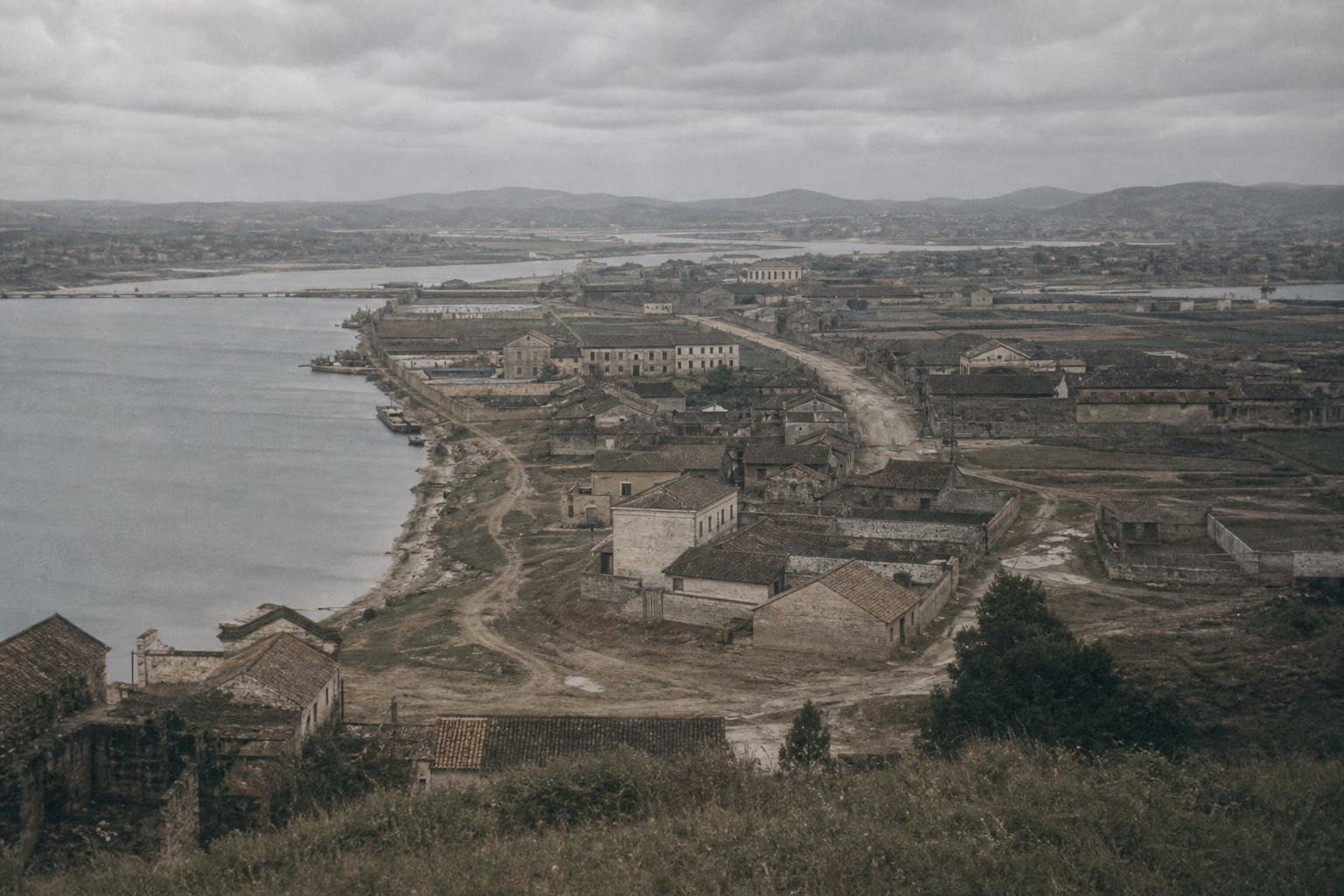
This city: The Yuehan and Hunan-Guangxi railways met here, and the Xiang River made it a key water-transport node. After the coast fell, industry and commerce moved inland, and Hengyang became a wartime commercial port of abnormal prosperity (the title "Little Shanghai" remains unverified). Before the battle, about 300,000 civilians were ordered to evacuate - what the Tenth Army received was a city already emptied out.
Why It Was Fought
Changsha had fallen too quickly. In the Fourth Battle of Changsha, the Japanese Eleventh Army took only a little over 20 days from launching the offensive to breaking into the city. Once the artillery positions on Yuelu Mountain were lost, the city that had held through the previous three campaigns did not hold the fourth time. South along the Xiang River, the next major railway station was Hengyang.
The reason Japanese forces wanted this city was direct: the Yuehan and Hunan-Guangxi railways intersected here. Taking it would open the middle section of the north-south continental line of communication; the airfield outside the city was one of the forward bases for U.S. bombers. In this very June, B-29s took off from Chengdu for the first time and bombed steelworks in Kyushu, making the timetable for taking airfields tighter than ever. In Isamu Yokoyama's hands was the Eleventh Army, fresh from breaking Changsha and at the height of its momentum; he allotted Hengyang only several days. Momentum did not mean there were no limits: the depot line ran from Wuhan to southern Hunan, thinning the farther south it went (details unverified). At that moment it did not yet bite; only dozens of days later would it show itself. This judgment later became the greatest miscalculation of the entire battle, but in June it was not reckless - Changsha, too, had taken only a little over 20 days.
On Chongqing's side, the accounting was far more complicated.
From spring to summer that year, central Henan had lost more than 30 cities in a little over a month, and Changsha then fell rapidly. These reports reached Washington just as the American side was reweighing one question: whether the Chinese battlefield was still worth continued investment, and whether Chinese armies should still be commanded by Chinese themselves. Stilwell's demand for command authority, in those months, first acquired a real possibility of being accepted. So in June 1944, a battle that could hold was not only a military necessity - what it had to prove lay beyond the national border.
The problem was what could be used to hold.
After central Henan and Changsha fell one after another, there were not many mobile units left. What landed at Hengyang was the Tenth Army: half a year earlier it had lost more than half its strength while rushing to aid the Battle of Changde, and since then it had received no proper replenishment or refit. It now had 17,000 men on paper (personnel figures vary by account), a substantial share of them replacement recruits. Sending a broken force to defend a city that had to be held was a contradiction that did not need hindsight to see - it was written into the deadline. The order gave 10 days to two weeks (the basis for the time limit varies by account). That number did not mean "how long this city needs in order to be held"; it meant "how long the outer main force needs to come back to its aid." From the moment the order was issued, what it required was not holding to the end, but holding until.
The premise of holding until was that someone would come. But the road the relief forces had to take had already been cut once before: once Changsha fell, the mobile routes south of the Xiang River lay under opposing fire, and what separated Hengyang from the outside was not just distance. Existing records are insufficient to judge what estimate was made, when the order was issued, of this road's passability (unverified).
There was another layer trapping the city: its own structure. The airfield Japanese forces needed to take was also the opening through which the defenders could be fed. Once the airfield was lost, only airdrops remained inside the city. What the defending side had to defend and what it depended on to stay alive were the same thing; the two could not both be preserved (the date when Hengyang airfield fell and the supply method during the siege remain unverified).
The Tenth Army had one other road: abandon the city, withdraw into the mountains of western Hunan, and preserve its formation. It did not take that road. Once Hengyang was abandoned, the gateway to the Hunan-Guangxi line would be thrown open, the airfield would be lost, and Changsha had only just fallen - Chongqing needed a city to hold. As for how the defenders themselves viewed this order, existing records leave no trace of dissent; on the attacking side, Japanese war histories likewise show no different voices inside the Eleventh Army (no record of dissent seen; whether there was any proposal to abandon the defense or any Japanese dissent remains unverified).
What Japanese forces had not calculated lay outside the city: the steep hill faces reshaped by engineer shovels. Later, in Japanese war histories, they acquired a name: the "Fang Xianjue trenches." What Chongqing had not calculated lay farther away - the units sent to relieve the siege would never fight their way in, and a two-week deadline would finally be stretched into 47 days.
On June 23, two Japanese divisions reached the outskirts of Hengyang. That night, the attack began.
Course of the Engagement
| Phase | Time | Key points |
|---|---|---|
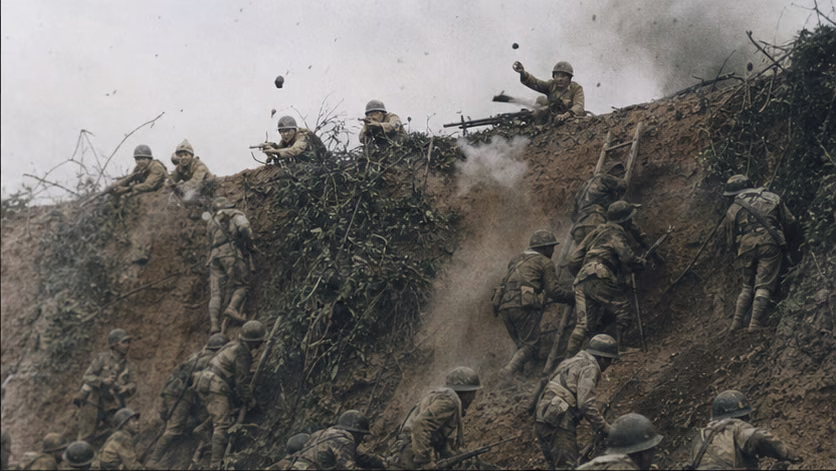
| Clearing and preparation | Early to mid-6 | About 300,000 people across the city were evacuated; the defenders burned civilian houses in the suburbs to clear fields of fire, cut the forward slopes of the hills into vertical cliffs 4 to 5 meters high (later called the "Fang Xianjue trenches"), placed grenade troops on the cliff tops, and hid machine guns on the flanks |
| Outer fighting | 6.23–27 | Japanese forces crossed the Lei River, completed the encirclement, and cleared the outer strongpoints (the sequence in which each point fell remains unverified) |
| First general assault | 6.28–7.2 | The main attack was directed toward Zhangjiashan and Huxingchao; before the cliffs, the Japanese offensive stalled and bodies piled in layers; Sakuma Tamehito, commander of the 68th Division, was seriously wounded (dates vary by account) |
| Second general assault | 7.11–7.20 | Hills were contested one by one, and Zhangjiashan changed hands several times; the defenders suffered more than half their strength in casualties, and wounded soldiers returned to the line to fight again |
| Siege and standoff | 7.20–8.3 | Japanese forces reinforced with three additional divisions; food and ammunition inside the city were nearly exhausted, and the wounded had no medicine |
| Third general assault | 8.4–8.8 | Five divisions encircled and stormed the city; on 8.6–7 the city walls were breached in many places, and high ground such as Tianma Mountain was lost; on 8.7 the army headquarters sent the "last telegram"; on the morning of 8.8 Fang Xianjue ceased resistance |
Casualties and Losses
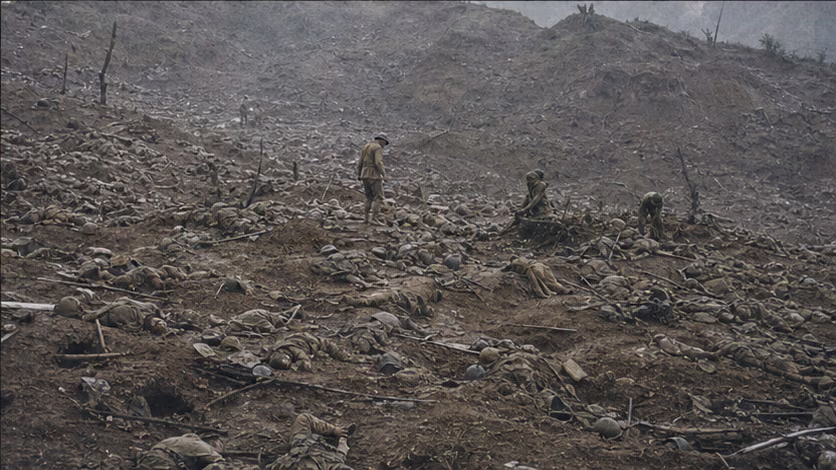
- Defending side: the Tenth Army suffered around 15,000 casualties, including about 6,000–7,600 killed (basis varies; unverified); by the end, fewer than 2,000 men were still able to fight.
- Attacking side: Japanese war histories acknowledge about 20,000 casualties (including 4,000 to 5,000 dead); Chinese battle reports claim more than 48,000 killed and wounded. The two sets of figures differ by more than a factor of two, and each side's statistical boundaries (whether outer fighting and the sick are included) await article-by-article checking.
- Whichever basis is used, this was one of the hardest siege battles that Japanese forces themselves acknowledged in the entire invasion of China, with attacking-side losses approaching or even exceeding the defenders' total strength.
Aftermath
- The Hunan-Guangxi line was thrown open, Operation Ichi-Go continued pushing south, and the Battle of Guilin–Liuzhou followed immediately.
- The failure to take Hengyang after 47 days of attacks, together with the fall of Saipan, was one of the pressures behind the collapse of the Tojo Hideki cabinet in July (the main cause lay in the Pacific; Chinese and Japanese historians differ in estimating Hengyang's weight).
- Fang Xianjue escaped danger and reached Chongqing in November, receiving the Order of Blue Sky and White Sun together with four division commanders; the "last telegram" appeared in newspapers and shook the country.
- Japanese forces once attempted to reorganize prisoners of war into the "Xianhe Army"; officers and soldiers escaped one after another, and the matter came to nothing (the full course remains unverified).
Accounts of Those Present
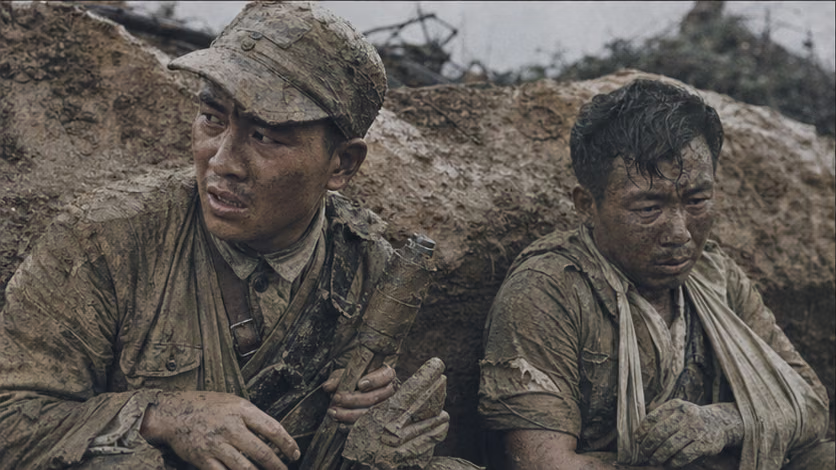
- "See you in the next life": the army headquarters' last telegram late on 8.7 - "...this telegram may be the last. See you in the next life." The telegraph key was operated by Lu Qingyi, a teenage radio operator; he lived past 90 and was interviewed many times in his later years.
- The Fang Xianjue trenches: the earthwork method of cutting hillsides into cliffs made Japanese infantry climbing tactics useless - they could only build human ladders, and the men on those ladders received grenades.
- Zhangjiashan: the Preparatory Tenth Division's position changed hands repeatedly; division commander Ge Xiancai wrote in his memoir that before the line, "corpses filled the valleys," with enemy and friendly dead no longer separable by layer.
- The wounded: after medicine ran out, "lightly wounded do not leave the line" was literal - bandages were exhausted, wounds bred maggots, and wounded men who could crawl crawled back into the works.
- Hunger on the other side: the supply line of the Japanese attackers also collapsed, and front-line Japanese soldiers went hungry in the rainy-season rice fields (Japanese war histories' own account; details unverified) - the desperate ground was not on one side only.
The Ground
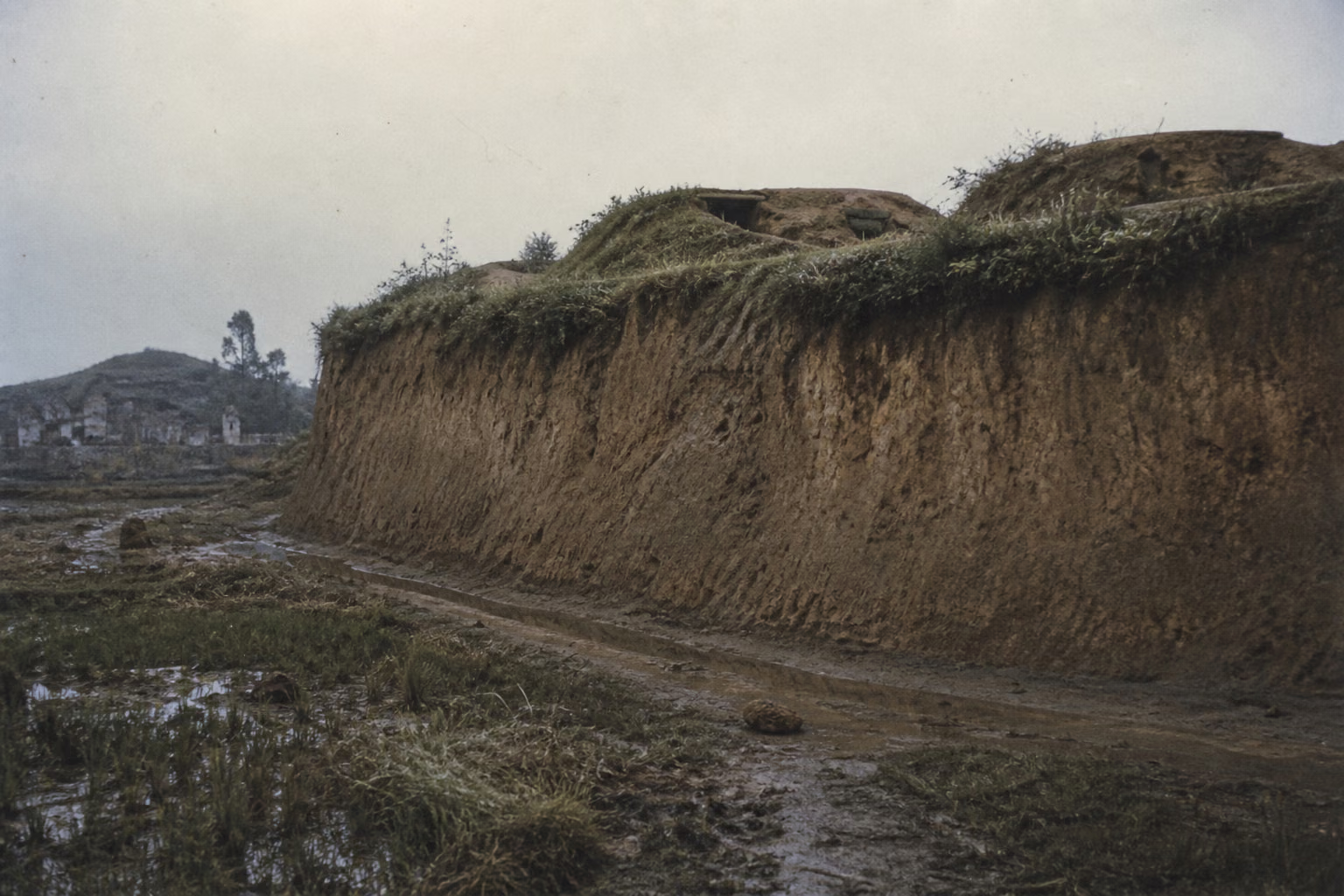
- The city lay on the west bank of the Xiang River; the Zheng River curved around its north, and water networks on three sides limited the axes of attack, so the Japanese main attack could only move through the southwestern hills.
- The defense line was not the city wall, but a ring of small hills in the suburbs: Tingbingshan, Zhangjiashan, Huxingchao, Tianma Mountain, Yueping Mountain, Wuguiling...each hilltop was an independent point of attrition, on a scale from dozens to several hundred meters.
- A city of 300,000 people was evacuated into an empty city - the street-fighting phase was fought inside a dead city.
- Vertical elements: 4-to-5-meter cliffs, rains of grenades from the cliff tops, reverse-slope works - a natural grammar of asymmetric defensive space.
How Each Side Records It
- Chinese side: set beside "a lone army defending to the death" is the grievance that "relief forces did not arrive" - for 47 days the outside relieving units could not fight their way in, and this was already a focus of public opinion at the time.
- Japanese side: official war histories list Hengyang as the hardest siege battle in the invasion of China, and participants' recollections often begin with the word "bitter."
- Yan'an's *Jiefang Ribao* published an editorial at the time affirming the courage of the defenders (original text unverified).
Disputes and Sensitivities
- "Ceasefire" or "surrender": Fang Xianjue's choice on 8.8 has carried two coexisting characterizations for 80 years - "exhausted, captured, and preserving the wounded" versus "failing to die for righteousness." His evaluation remains highly sensitive: in 2024, the film *The Reinforcements Will Arrive Tomorrow* was withdrawn before release because of this controversy.
- The two sets of casualty figures differ greatly.
- The ending of the Defense of Hengyang is one of the hardest narrative nodes to handle in the entire project.
Sources and Open Questions
Known main sources:
- Ge Xiancai, *Personal Account of the Bloody Battles of Changsha, Changde, and Hengyang* (memoir by a defending-side division commander)
- Bai Tianlin, *The Defense of Hengyang in the Sacred War of Resistance Against Japan* (Taiwan-published war history)
- Japan Defense Agency War History Office, *Senshi Sosho*, volume on the Hunan campaign (Japanese official history)
Open questions: original wording of the order setting the holding period; date and document number of the order to defend to the death (check the Military Operations Department's operations diary); the timing and manner of Chiang Kai-shek's personal attention to Hengyang (check the Chiang Kai-shek diaries, Hoover Institution collection); whether there were objections inside the Tenth Army to abandoning or holding the city (check the relevant chapters of Ge Xiancai's memoir and oral histories by other surviving officers of the Tenth Army); records evaluating the Tenth Army's depleted condition when it was ordered to defend Hengyang; the estimate made when the order was issued of the relief route's passability; the date when Hengyang airfield fell and the supply method during the siege; the sequence in which the outer positions fell; the date when Sakuma Tamehito was wounded; the statistical boundaries for both sides' casualties; the full course of the "Xianhe Army"; the original text of the *Jiefang Ribao* editorial; the source for Hengyang's wartime title "Little Shanghai"; the depot line and supply details of the Japanese Eleventh Army's attack on Hengyang; whether Japanese-side internal records show dissent over the strength committed and the time allotted for the attack on Hengyang.
All images on this site are AI-generated depictions. They are not historical photographs, not primary sources, and do not depict any real individual.