Engagement Archive · Defense of the Great Wall (1933)
In the first five months of 1933, from Yuguan to Rehe and then to the passes of the Great Wall, Chinese forces fought a series of localized resistances against Japanese forces -- the blood shed at several passes was finally let away by a single Tanggu Truce.
Engagement Data
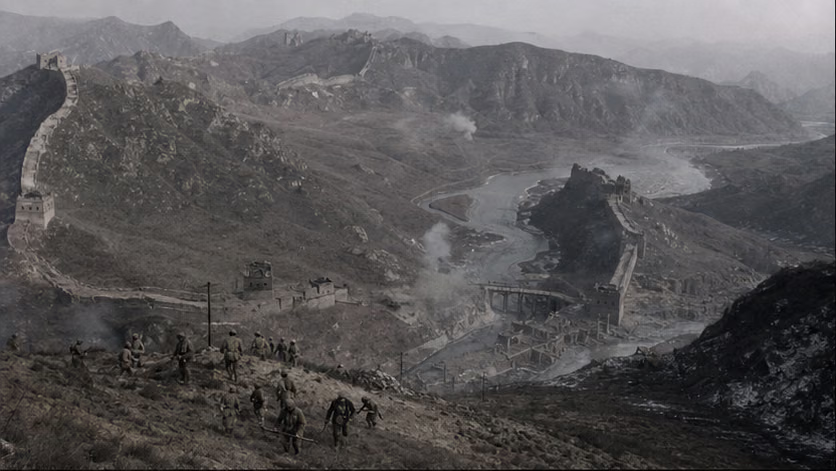
| Item | Content |
|---|---|
| Time | 1933.1.1 – 5.31 (from the Battle of Yuguan to the signing of the Tanggu Truce) |
| Place | Shanhaiguan (Yuguan), Rehe Province, the passes of the Great Wall (Xifengkou, Luowenyu, Gubeikou-Nantianmen, Lengkou, Jielingkou, etc.), and eastern Luan |
| Belongs to | Fourteen-Year War of Resistance · localized-resistance stage (for the larger situation, see *Fourteen-Year War of Resistance · War Overview*) |
| Chinese side | Remnants of the Northeastern Army (forces under He Zhuguo, Wang Yizhe, and others), the 29th Army (Song Zheyuan), the Central Army's 17th Army (Xu Tingyao), the 32nd Army (Shang Zhen), and others |
| Japanese side | Kwantung Army (elements of the Sixth and Eighth Divisions, etc.) and puppet forces |
| Result | The passes were successively broken through or abandoned, and eastern Luan fell in May; on 5.31 the Tanggu Truce was signed, making eastern Hebei a demilitarized zone |
Belligerents
This was a multi-sided fight, divided pass by pass; the forces are listed one by one, without forcing them into two columns.
| Side | Strength | Equipment and Condition |
|---|---|---|
| Chinese forces, combined | About 250,000 committed successively (statistical bases differ, including the Rehe direction -- figure disputed) | Equipment was uneven: the Central Army's 17th Army was a new-model Central Army force before German equipment became standard, with relatively good firepower; the 29th Army had poor firearms and used bayonets and dadao sabers together; the remnants of the Northeastern Army had suffered a severe blow to morale after the Mukden Incident |
| Japanese side | About 40,000 Kwantung Army troops plus tens of thousands of puppet troops (figure disputed) | Artillery, air arms, and armored cars were all present, and air superiority was in Japanese hands |
Terrain and Conditions
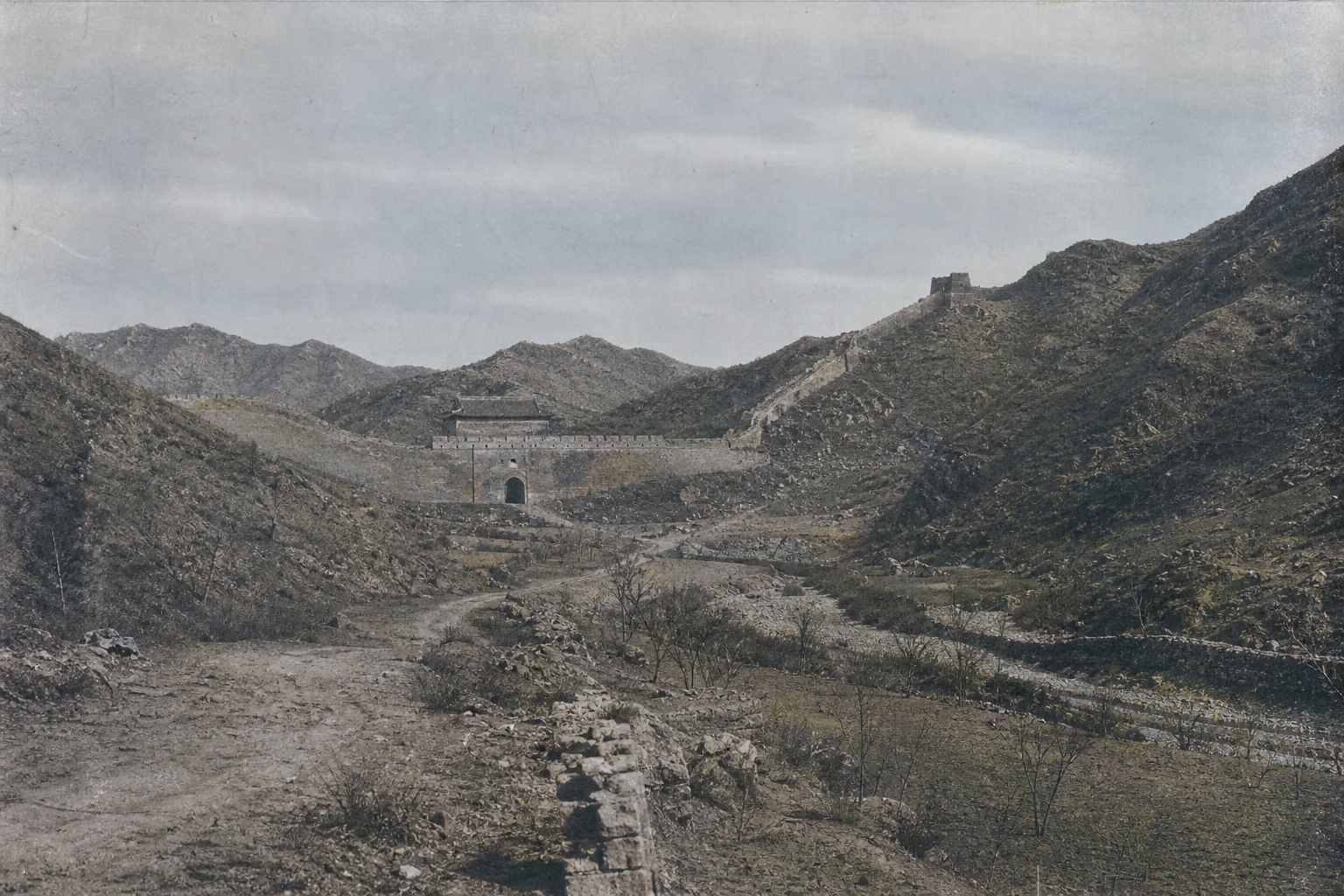
(For the larger situation in 1933 -- the Northeast lost after the Mukden Incident, League of Nations mediation falling through, and Nanjing's "internal pacification before external resistance" -- see *Fourteen-Year War of Resistance · War Overview*; this entry records only the North China local setting.)
North China: no one on the front line had final authority. Rehe provincial chairman Tang Yulin entrenched himself in Chengde, with military and civil power in one household; the Beiping Military Council was chaired by Zhang Xueliang, and the shadow of the Mukden Incident had not yet dispersed. Once Yuguan was lost, Beiping and Tianjin were shaken, and public feeling in North China grew unstable.
The Great Wall line: the passes of the Great Wall were mountain corridors between Hebei and Rehe; Xifengkou, Gubeikou, Lengkou, and others each controlled a river valley. After the Mukden Incident, remnants of the Northeastern Army withdrew inside the passes, and the Great Wall line became the de facto front.
Why It Was Fought
The gunfire in Shanghai stopped in early March 1932, and in May the Shanghai Ceasefire Agreement was signed -- Japanese forces had found the fighting in Shanghai far harder than expected, and pulled their hand back to the north. On March 9 of that year, "Manchukuo" had already been put up in Changchun. Its claimed territory was the four northeastern provinces: beyond Liaoning, Jilin, and Heilongjiang, there was still Rehe, not yet in hand. The annexation of Rehe thus became fixed policy for the Kwantung Army -- after puppet Manchukuo was "founded," Rehe was both the buffer between it and North China, and ground that had to be taken.
To take Rehe, the corridor between inside and outside the passes first had to be cut. On the night of January 1, 1933, Japanese forces used the "hand-grenade incident" as a pretext to launch a night attack on Shanhaiguan. He Zhuguo's defending force held for two days; on January 3 the city fell -- the first battle of 1933 began on New Year's night.
The timetable pressed against Geneva's calendar. The Lytton Report was published in 1932.10 and found that the Japanese action was not self-defense; in late February 1933 the League Assembly voted to adopt it, the Japanese delegation walked out, and in March Japan announced its withdrawal from the League. The Kwantung Army wanted to turn Rehe into an accomplished fact before and around the world's declaration of position -- in the same few days as the League vote, Japanese forces attacked Rehe in multiple columns. At this point, the road by which China had handed right and wrong to the League of Nations reached its end: the report passed, Japan left, and not one soldier was sent.
The Kwantung Army's calculation did not stop at Rehe: after taking it, it could press southward against the passes of the Great Wall, point its spearhead directly at Beiping and Tianjin, and force North China onto the negotiating table. Its judgment of the Rehe defenders was accurate -- once Japanese forces entered, the defenders collapsed at the sight of them. On March 4, the lead detachment of a little over one hundred cavalry entered Chengde (the commonly cited figure is 128 cavalry, figure disputed): more than one hundred thousand defenders abandoned the provincial capital to a hundred cavalrymen. What it had not calculated was that the passes of the Great Wall would become bloody battles.
On the Chinese side there was no single unified account book. Nanjing's policy was localized handling and avoiding expansion of the situation -- "resisting on one side, negotiating on the other" (original wording unverified), while the main forces were still being used southward for "bandit suppression"; Zhang Xueliang, carrying the blame of the Mukden Incident, chaired affairs in North China, and the Rehe battle was seen by national opinion as his chance to recover his reputation -- after Rehe was lost quickly, he stepped down in March to take responsibility; Tang Yulin was thinking of territory and family property. Whether to resist, and how far to resist, was not consistent among the front-line forces. A battalion died at Yuguan, Chengde did not fire a shot, and Xifengkou fought hand to hand -- three ways of fighting in the same war, rooted in this non-unified account book.
The resolve that landed on paper appeared in several places: the Kwantung Army's move to take Rehe had Tokyo approval (approval date and document number unverified); once Rehe was lost, Chiang Kai-shek went north to Baoding to handle the situation, Zhang Xueliang stepped down, He Yingqin took over the Beiping Military Council, and the Central Army's 17th Army was ordered north to take over the defense of Gubeikou -- localized resistance was raised into Central Army participation; after eastern Luan fell, Huang Fu was sent north to preside over negotiations with Japan, and the bottom line for signing at Tanggu was set by Nanjing (authorizing telegram unverified). Nanjing could see each force's family resources; beyond the League of Nations, it could not see any helping hand.
The material account determined that this could only be a limited fight: military funds and elite troops were on the "bandit suppression" battlefield in Jiangxi, while North China was mainly staffed by remnants of the Northeastern Army and old Northwestern Army units; defenders' ammunition was resupplied from the rear by rail, air superiority belonged to the Japanese side, and daylight belonged to the other side -- the 29th Army's night raids with dadao sabers were half forced out by the ammunition account.
There were also people on the table trying another road. In mid-May, while blood fighting at the passes had not yet stopped, Feng Yuxiang raised the banner of the Chahar People's Anti-Japanese Allied Army in Zhangjiakou and sent troops to recover eastern Chahar -- the most public refusal of a "negotiated ending"; Nanjing regarded this as interfering with negotiations and used military and political pressure to bring about its dissolution (course unverified; see *Chahar Resistance (1933)*). The Japanese side was not an iron plate either: the Kwantung Army pushed deep into eastern Luan and threatened Beiping and Tianjin, while the Tokyo General Staff was wary of excessive action (Japanese internal-debate materials unverified). Whether there were objections inside Nanjing's decision-making layer to signing at Tanggu is unclear; most opposition was in society and among those out of office, and no written record of opposition has been seen.
Course of the Engagement
| Stage | Time | Main Points |
|---|---|---|
| Battle of Yuguan | 1.1–1.3 | Japanese forces used the "hand-grenade incident" as a pretext for a night attack on Shanhaiguan; the defenders, the Andexin Battalion of Shi Shi'an's regiment under He Zhuguo, held the city wall; on 1.3 the city fell, and the Andexin Battalion almost entirely died with the city -- the first battle of 1933 |
| Loss of Rehe | 2–3 (February-March) | Japanese forces advanced into Rehe in multiple columns, and the defending units collapsed at the sight of them; provincial chairman Tang Yulin requisitioned large numbers of military vehicles to move private property first, then abandoned Chengde and fled; on 3.4 a Japanese lead detachment of more than one hundred cavalry (the commonly cited figure is 128 cavalry -- figure disputed) entered Chengde -- more than one hundred thousand defenders abandoned the provincial capital to a hundred cavalrymen |
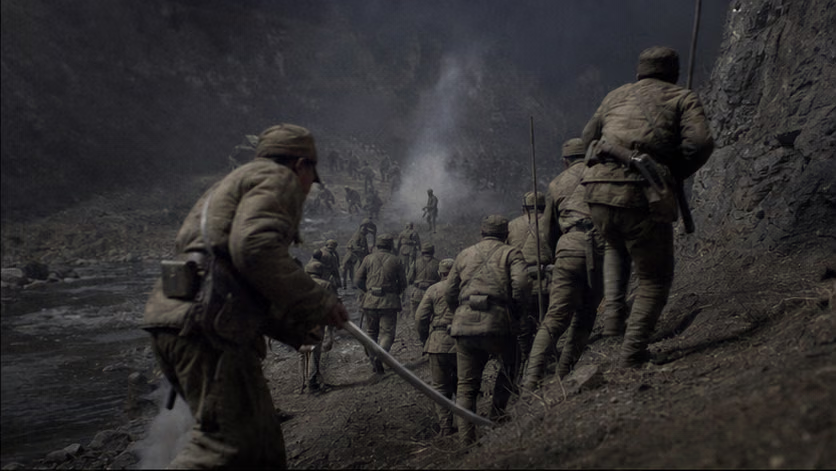
| Passes of the Great Wall | 3–5 (March-May) | Xifengkou: Zhao Dengyu's brigade of Song Zheyuan's 29th Army made a night attack on Japanese positions (3.9–12), fighting at close quarters with dadao sabers and killing or wounding several hundred Japanese troops (accounts differ by statistical basis); Luowenyu: Liu Ruming's force blocked tenaciously; Gubeikou-Nantianmen: Xu Tingyao's Central Army 17th Army took over the defense and fought a bloody battle, the fiercest and costliest along the whole line -- Guan Linzheng was wounded, Du Yuming took over command, and Dai Anlan was then a regimental commander; all passed through this battle; Lengkou: Shang Zhen's 32nd Army held it and later lost it; Jielingkou also saw fierce fighting (details unrecorded) |
| Loss of eastern Luan | 5 (May) | Part of the Japanese force crossed the Luan River and outflanked the line; defenders at the passes were attacked from the flank and rear, and the whole line withdrew; Japanese forces pressed toward Tongzhou and Shunyi, directly exposing Beiping and Tianjin |
| Tanggu Truce | 5.31 | Chinese representative Xiong Bin and Kwantung Army representative Okamura Yasuji signed the ceasefire agreement: Chinese forces withdrew west and south of the Yanqing-Changping-Gaoliying-Tongzhou line, and eastern Hebei was made a demilitarized zone |
Casualties and Losses
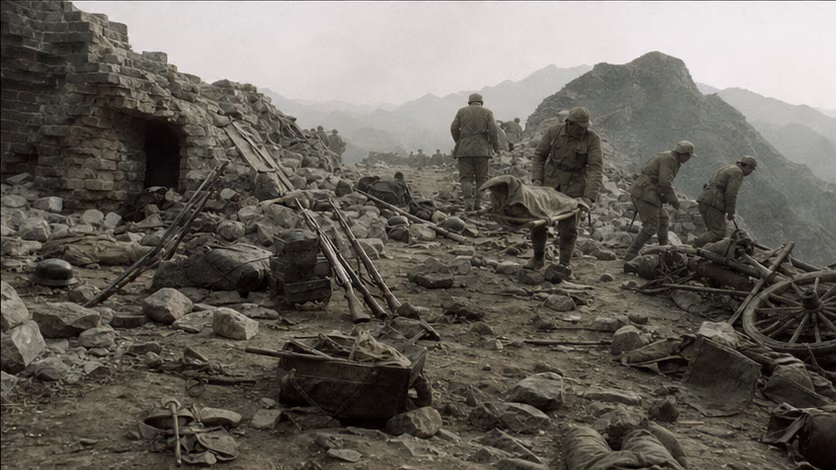
- Chinese side: total casualties of about 40,000 (statistical bases differ; one account includes more than 60,000 in the Rehe direction -- figure disputed); among them, the Central Army 17th Army in the Gubeikou-Nantianmen direction suffered the heaviest casualties.
- Japanese side: official published casualties were about 2,600-plus; Chinese battle reports claimed several thousand Japanese troops killed and wounded. The two sets of figures differ greatly, and their statistical boundaries (whether they include the Rehe operations and puppet forces) await article-by-article checking; both are kept side by side.
- ※ Civilians: records of civilians in the Rehe and eastern Luan war zones killed by fighting and by Japanese reprisals are scattered, and the counties of eastern Luan were especially hard hit (details unrecorded).
Aftermath
- The Tanggu Truce made the Great Wall line the de facto ceasefire line, effectively accepting the Japanese occupation of Rehe and the demilitarization of eastern Hebei -- the gate to North China was thrown open, and two years later the "North China Autonomy Movement" followed.
- Zhang Xueliang stepped down in March to take responsibility, and He Yingqin took over the Beiping Military Council.
- The 29th Army became famous because of the Battle of Xifengkou, and after the war it was expanded and stationed in Beiping and Tianjin -- this planted the fuse for the Marco Polo Bridge four years later.
- The blood shed at several passes was let away by a single agreement. The night attack at Xifengkou and the defense to the death at Gubeikou show that, militarily, it was not that no fighting was done; politically, it was that the fight was not allowed to go to the end -- the gap between localized gains and overall retreat is the whole weight of this article.
Accounts of Those Present
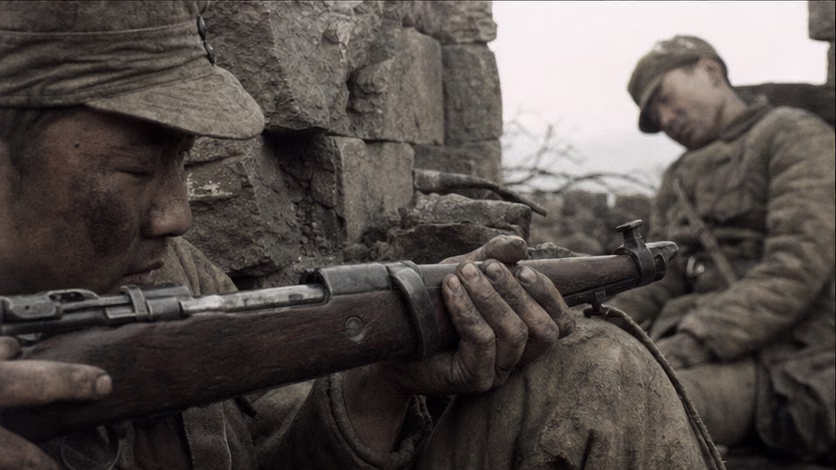
- Andexin: Hui battalion commander. When Yuguan city was broken, the whole battalion died with the city, with almost no survivors -- the first battle of 1933 began with one battalion.
- Tang Yulin: before fleeing, he requisitioned military vehicles to carry off private property (the commonly cited number is more than two hundred vehicles -- figure disputed), leaving no defenders on Chengde's walls.
- Dadao units: Zhao Dengyu's brigade made a night attack on the enemy positions at Xifengkou and fought at close quarters, using blades in place of bullets -- not legend, but a method forced out by a firepower gap too wide. In 1937 Mai Xin drew on this to compose "Dadao March" for the 29th Army; the root is here.
- The Seven Braves of Gubeikou: when Japanese forces occupied Gubeikou, seven soldiers held a high ground alone to cover the rear, fighting until all were killed; Japanese forces erected a stele for them reading "Tomb of the Seven Chinese Braves." The episode appears in Chinese records and in Japanese photographs of the stele, but the layered details of number and location (around Mao'er Mountain -- unverified) remain unverified.
- Cradle of generals: in the Gubeikou-Nantianmen battle, Guan Linzheng stayed in the fight after being wounded, Du Yuming took over command, and Dai Anlan was then a regimental commander -- later these names appeared across the major battlefields of the War of Resistance, and one battle brought out a generation of commanders.
The Ground
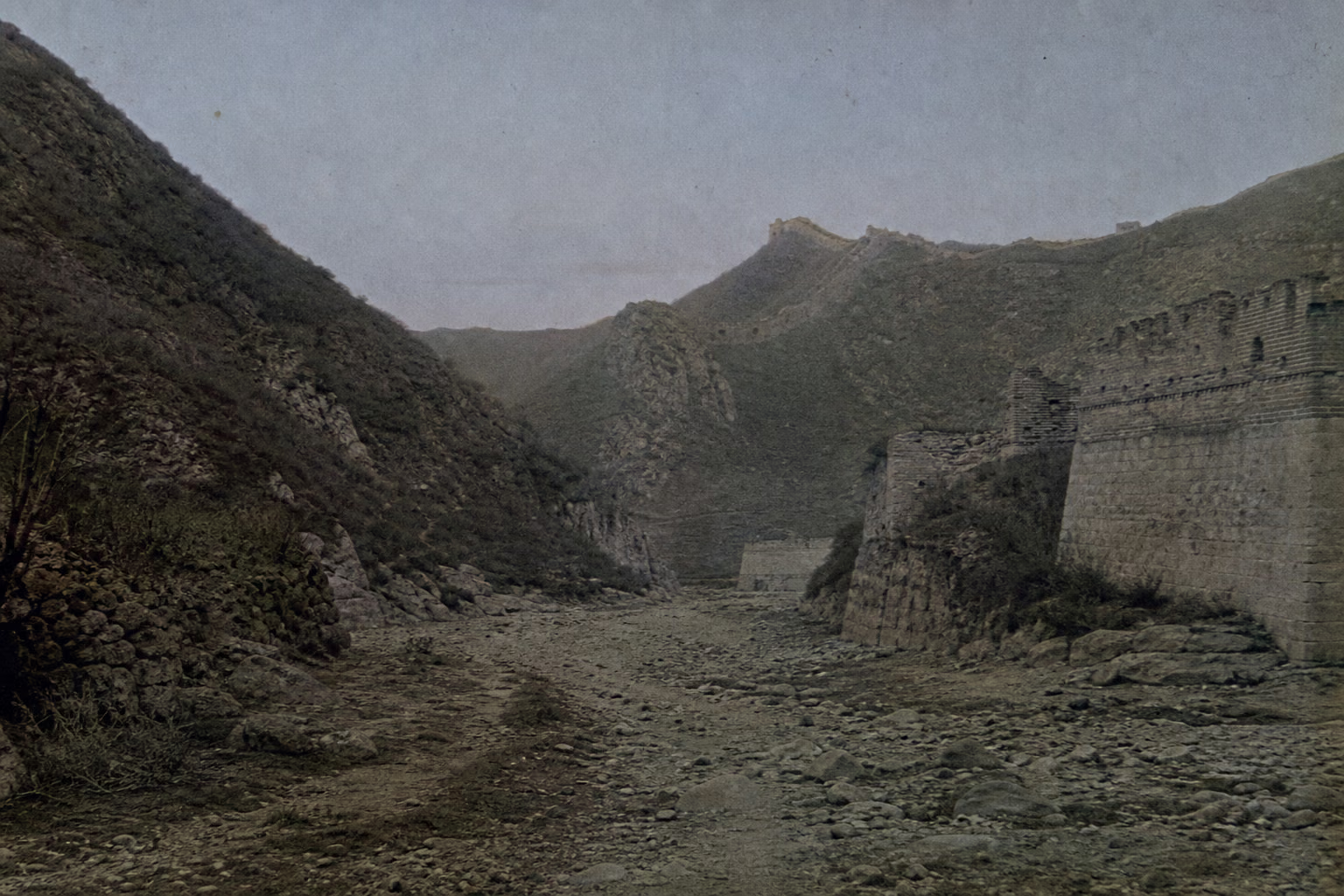
- The Great Wall was not a single wall, but a string of passes across mountain valleys: each pass was a road and a defile, ranging in scale from several hundred meters to several kilometers.
- Xifengkou-Panjiakou: a valley pressed between slopes, terrain for night attack -- close in through the dark, and the firepower advantage fails.
- Gubeikou: the key to the Chao River gorge; the Nantianmen ridge was the high ground before the pass, and the Central Army fought there slope by slope.
- Eastern Luan plain: no natural defenses to hold; once outflanked, the whole line was shaken.
How Each Side Records It
- Chinese side: the "great victory" at Xifengkou was a nationwide stimulant at the time, and the dadao units became one of the best-known symbols of the early War of Resistance; Gubeikou was recorded as the Central Army's first battle against Japan. The loss of Rehe, by contrast, is a narrative of shame, and "a hundred cavalry took Chengde" repeatedly appeared in newspapers.
- Japanese side: officially compiled military histories record "Rehe operations" and "operations inside the passes" separately, and acknowledge hard fighting and casualties in the Xifengkou and Nantianmen directions (details unrecorded); Okamura Yasuji's memoir mentions the assault on Nantianmen (original text unverified).
Disputes and Sensitivities
- How to characterize the Tanggu Truce: the accounts of a "traitorous agreement" and of "buying time under insufficient strength" coexist; in negotiations, the Chinese side was constrained by the Japanese frame of "no politics, only a military signing," while the source and original text of the clauses remain unverified.
- Dadao-unit result figures include wartime propaganda elements, and their statistical bases differ.
- The descriptions of Tang Yulin "fleeing without fighting" and "more than one hundred thousand abandoning the city to a hundred cavalrymen": both the total defender strength and the Japanese lead-detachment number need their statistical bases marked.
- Versions differ over the number and location of the Seven Braves of Gubeikou.
Sources and Open Questions
Known main sources:
- *Selected Materials on the Defense of the Great Wall* (Chinese historical-materials compilation)
- The prehistory section of *Senshi Sosho · Army Operations in the China Incident* by the Japanese Defense Agency War History Office, and Kwantung Army operational records (Japanese official compilations)
- Memoirs of participating commanders such as Du Yuming (including *Summary of the Gubeikou Resistance*, specific items unverified)
Open questions: casualty figures for the Yuguan defenders; the number of military vehicles Tang Yulin requisitioned when fleeing; the number of Japanese lead cavalry entering Chengde (128 cavalry); statistical bases for enemy losses in the Xifengkou night attack; the statistical boundaries for Chinese and Japanese casualty figures; the number, location, and stele details of the Seven Braves of Gubeikou; the original source for the clauses of the Tanggu Truce; relevant passages in Okamura Yasuji's memoir; the Tokyo approval date and document number for the Kwantung Army's Rehe operation; telegrams and documents on Chiang Kai-shek going north to Baoding, Zhang Xueliang stepping down, and He Yingqin taking over; the order moving the 17th Army north; Huang Fu's authorizing telegram for going north to preside over negotiations and the bottom line for signing at Tanggu; ammunition supply and logistics records for the North China defenders; the course of military and political pressure in the dissolution of the Chahar Allied Army; Tokyo General Staff internal-debate materials on the Kwantung Army's eastern Luan action; whether there are records of dissent within Nanjing's decision-making layer over the Tanggu Truce.
All images on this site are AI-generated depictions. They are not historical photographs, not primary sources, and do not depict any real individual.