Engagement Archive · Mukden Incident
A short stretch of railway blown up by the Kwantung Army itself, Shenyang lost in a single night, the entire Northeast lost in just over four months -- the Fourteen-Year War of Resistance is counted from here.
Engagement Data
| Item | Content |
|---|---|
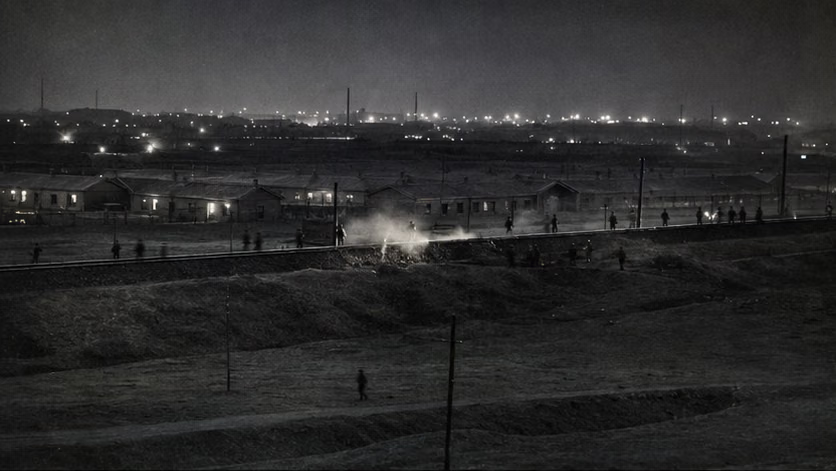
| Time | From the night of 1931.9.18; Shenyang fell that same day, Jinzhou was abandoned on 1932.1.3, and Harbin fell on 1932.2.5 |
| Place | Shenyang, Liaoning (Liutiaohu, Beidaying), and then the three provinces of Liaoning, Jilin, and Heilongjiang |
| Belongs to | Fourteen-Year War of Resistance · starting point of the localized-resistance stage |
| Chinese side | Northeastern Army (Zhang Xueliang's command); in the Shenyang direction, the Seventh Brigade (brigade commander Wang Yizhe) |
| Japanese side | Kwantung Army (commander Honjo Shigeru), with the Independent Garrison Unit and elements of the Second Division as the direct actors |
| Result | The main force of the Northeastern Army withdrew under orders not to resist; Japanese forces occupied the three northeastern provinces within just over four months (called the "Manchurian Incident" by the Japanese side) |
Belligerents
| Item | Chinese side (Northeastern Army) | Japanese side (Kwantung Army) |
|---|---|---|
| Strength | The Northeastern Army's total strength was over two hundred thousand, but its main force had already entered the passes with Zhang Xueliang; about one hundred thousand remained stationed in the Northeast (figure disputed), and the Seventh Brigade at Shenyang's Beidaying had about eight thousand men | At the time of the incident, the Kwantung Army in the Northeast had only one division plus railway garrison troops and related units, about ten thousand to fifteen thousand men (troop figures vary by account) |
| Firepower | The Shenyang Arsenal was then China's largest military-industrial enterprise; Dongta Airfield had more than two hundred aircraft | Mainly garrison troops and divisional organic artillery; after 9.19, Japanese forces immediately seized and used Chinese equipment |
| Situation | Far superior in troop strength, but under orders of "non-resistance," and no counterattack was organized | In an absolute numerical disadvantage, betting that the other side would not fight back -- and the bet won |
This comparison has to be set out: September 18 was not a case of being unable to fight. It was a case of not fighting.
Terrain and Conditions
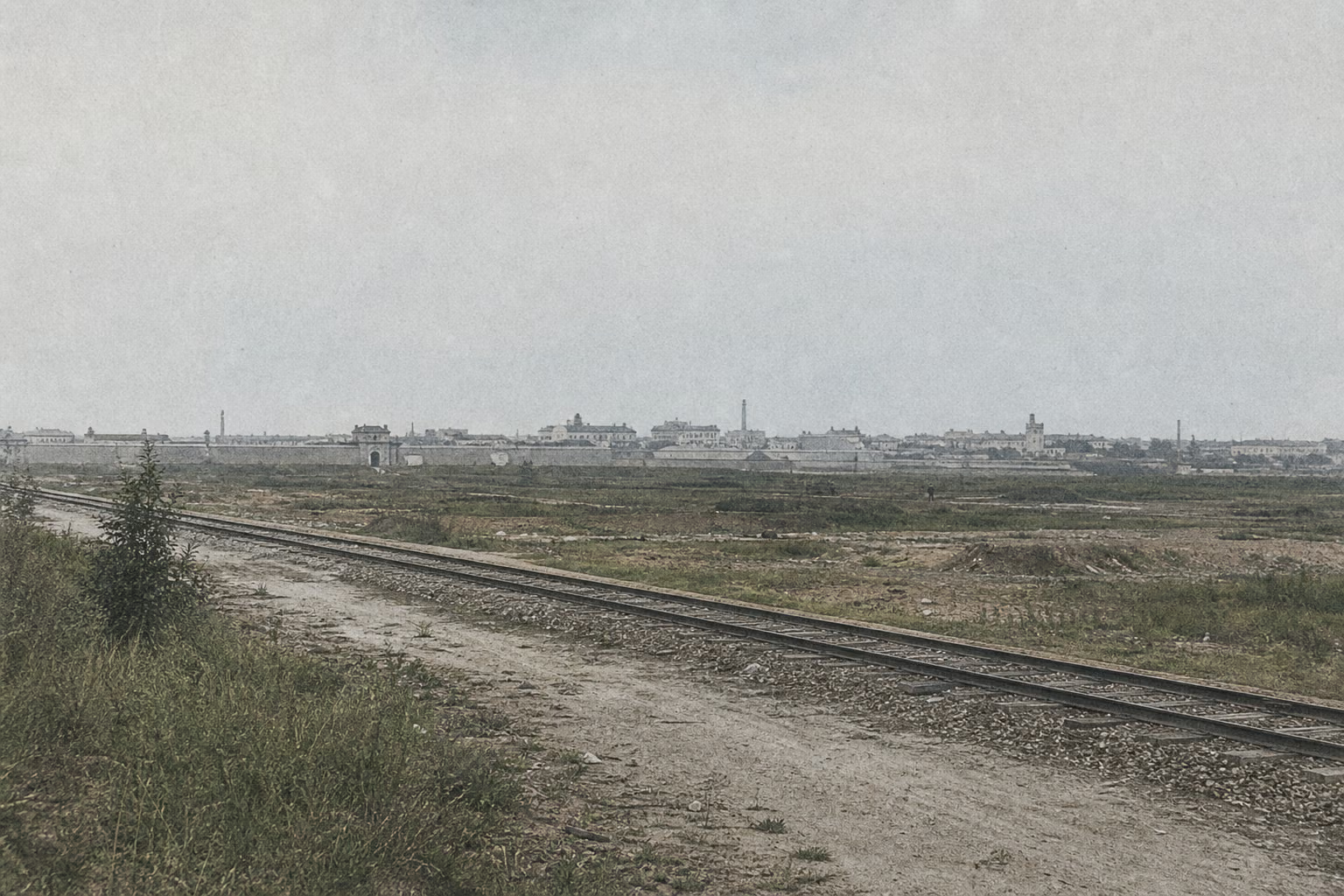
(For the larger situation -- the Great Depression, the rise of Japan's military, and China's unfinished civil wars -- see *Fourteen-Year War of Resistance · War Overview*. This entry records only the Northeast.)
The Northeast:
- Zhang Zuolin was killed by the Kwantung Army in the Huanggutun bombing in 1928. Zhang Xueliang took charge of the Northeast and, in the same year, "changed flags" and nominally submitted to Nanjing. Japan's accumulated grievances with the Zhang family's northeastern regime were already deep.
- In the summer of 1931, the Nakamura Incident (Japanese spy Nakamura Shintaro executed by Chinese garrison troops) and the Wanbaoshan Incident fermented one after another. Japanese domestic opinion and voices inside the military calling to "settle the Manchuria-Mongolia problem" grew more urgent by the day.
- The Northeastern Army's elite forces were inside the passes (stationed in North China after the Central Plains War (1930)), leaving Shenyang's defenses hollow; Zhang Xueliang himself was in Beiping on the night of 9.18, recuperating from illness and watching opera (details unrecorded).
Why It Was Fought
Seventeen years after the Siege of Tsingtao (1914), the Shandong question had been closed through the Twenty-One Demands, the May Fourth Movement, the Washington Conference, and redemption, but Japan's roots on the continent had not withdrawn: the Kwantung Leased Territory and the South Manchuria Railway, gained through the Russo-Japanese War, remained, and the troops guarding them had become an army of their own -- the Kwantung Army. In 1928, it killed Zhang Zuolin in the Huanggutun bombing; in the Central Plains War (1930), Zhang Xueliang issued a public telegram supporting Chiang on September 18, and more than one hundred thousand of his main-force troops entered the passes and remained long in Beiping and Tianjin. From then on, northeastern defense was hollow. On the same date one year later, the Kwantung Army acted.
"Manchuria and Mongolia are Japan's lifeline" -- the slogan Matsuoka Yosuke sounded in the Diet in early 1931 named a consensus the military had held for years; Kwantung Army operations staff officer Ishiwara Kanji turned it into a plan. The Great Depression wrecked Japan's exports and countryside, and the radicals pointed the way out toward the Northeast's coal, iron, and soybeans. That summer the powder gathered: in June, Japanese spy Nakamura Shintaro was executed by Chinese garrison troops; in July, the Wanbaoshan Incident provoked anti-Chinese riots in Korea, and Japanese newspapers clamored to "settle Manchuria and Mongolia." On the Chinese side, the Nanjing-Guangdong split was under way, and Nanjing was busy with internal struggle and "bandit suppression"; Zhang Xueliang had taken his main forces inside the passes and was in Beiping recuperating from illness. China had no capacity for full-scale war, the great powers had no attention to spare for the East, and the window opened that autumn.
The Kwantung Army made two bets: first, that the Northeastern Army would not fight back -- Ishiwara's plan assumed precisely that the other side would not fight; second, that Tokyo would not dare refuse recognition -- once the rice was cooked, no cabinet could bear the responsibility of withdrawing troops and admitting error. The Chinese side's judgment delivered itself to the door: Shenyang and Beiping both treated this as another provocation, and the policy was to avoid conflict, give no pretext, and leave justice to the League of Nations. In his late-life oral account, Zhang Xueliang acknowledged that he judged Japan's aim to be provocation, that he "could not fall for it," and did not expect that the other side wanted the whole Northeast. On both bets, the Kwantung Army won.
Beneath the wager lay lines drawn by material conditions. The Kwantung Army had only one division plus garrison troops, military spending was being cut year by year in the Depression, and regular procedure could not get through -- so only independent action remained: create an accomplished fact, making ratification cheaper than stopping it (structural inference, unverified). On the Chinese side, civil war had just emptied the treasury, flood relief was under way, and more than one hundred thousand northeastern elite troops were stationed inside the passes -- the capital for full-scale war truly did not exist. "Non-resistance" was half judgment and half family resources.
There was opposition on both sides. In Tokyo, the Wakatsuki cabinet and Foreign Minister Shidehara argued for non-expansion, and restraining orders were sent to Shenyang one after another; by the time they arrived, the fighting was already over. In Shenyang, no written record of dissent by the Northeastern Army's high command has been seen; inside the city, Huang Xiansheng led police resistance (level unverified), and there were also spontaneous counterattacks inside Beidaying -- non-resistance was an order, not a consensus.
The fuse was made by the perpetrators themselves. The operation had not been approved by Tokyo -- the General Staff, having heard that something was changing, sent Major General Tatekawa Yoshitsugu to Shenyang to restrain events, and he arrived in Shenyang on September 18 (details unrecorded). Around 22:20 that night, an explosion sounded on the South Manchuria Railway near Liutiaohu, so small in scale that an express train later passed through as usual; the garrison troops immediately used "Chinese troops blew up the railway" as a pretext to attack Beidaying. This was "independent action." But Tokyo's choice mattered more than the explosion: it did not stop it, did not punish it, and ratified its expansion all the way; the Wakatsuki cabinet fell, and after Inukai Tsuyoshi formed a cabinet, the occupation was accepted as an accomplished fact. From here, gekokujo, "the lower overriding the higher," became a military convention, running all the way to July 7. The Kwantung Army lit the fire; the whole Japanese state machine let it pass.
Course of the Engagement
| Phase | Time | Main points |
|---|---|---|
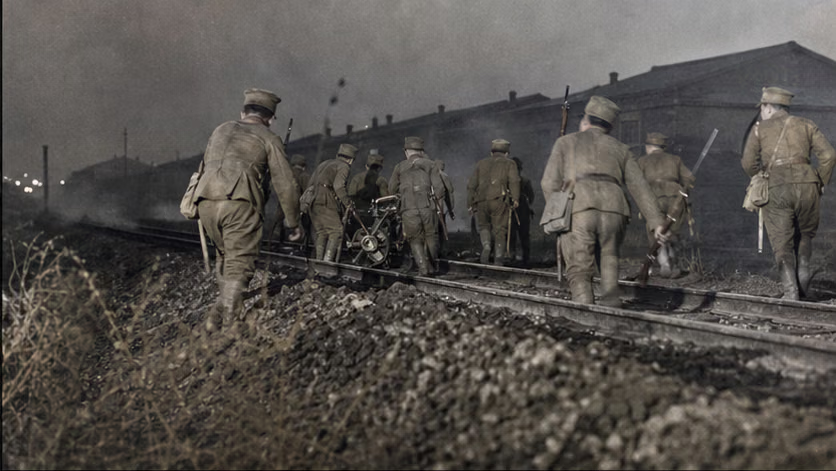
| Explosion and night attack | 9.18 22:20-9.19 morning | The garrison troops attacked Beidaying. About eight thousand men of the Seventh Brigade withdrew under orders of "non-resistance"; many rifles were locked in depots and not issued. There are accounts that Wang Tiehan's 620th Regiment fired back spontaneously (this claim appears in multiple memoir materials; level unverified, not amplified). Japanese forces occupied all of Shenyang in one night |
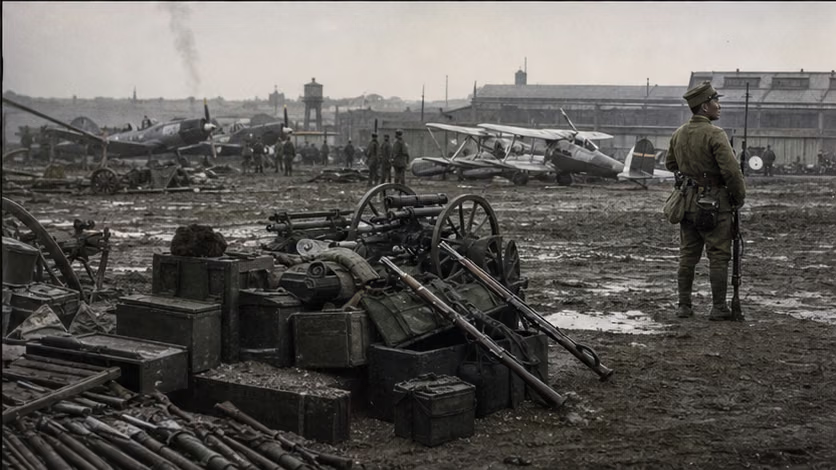
| Disarmament inventory | From 9.19 | The arsenal, more than two hundred aircraft at Dongta Airfield, and weapons stored in depots all fell to Japanese forces (the full list is scattered across memoirs and investigation materials, unverified) |
| Occupation of Jilin and Heilongjiang | Late September-October | Jilin's Xi Qia opened the door and surrendered; Japanese forces moving north met obstruction at the Resistance at Jiangqiao (Nen River Bridge) (separate article) |
| Loss of Jinzhou | 1932.1.3 | Zhang Xueliang's forces made no decisive battle in western Liaoning and abandoned Jinzhou, withdrawing south -- the Northeastern Army's last base area was lost without a fight |
| Loss of Harbin | 1932.2.5 | Li Du, Feng Zhanhai, and others held the city for several days (Jilin Self-Defense Army), then fell after exhausting their strength. At this point all three northeastern provinces had changed hands |
The "non-resistance" case: who issued the order of non-resistance has been argued over for nearly a century. Zhang Xueliang's late-life oral account (recorded by Tang Degang and others) acknowledged that non-resistance was his judgment and had nothing to do with Nanjing; another account cites Chiang Kai-shek's Xi telegram, archived telegraphic orders, and related materials, and holds that Nanjing had first given instructions. The two accounts stand side by side. The fact that can be determined is this: the order was carried out in the army, and eight thousand men at Beidaying withdrew before several hundred Japanese soldiers.
Casualties and Losses
- Territory: the three northeastern provinces, over one million square kilometers and thirty million people, changed hands in just over four months.
- Materiel: the Shenyang Arsenal (with a daily capacity for rifles, ammunition, and equipment then among the leading ranks in Asia), more than two hundred aircraft, rifles, artillery, and depot stores -- this equipment was turned around and used to fight Chinese people. The complete list remains unverified.
- Soldiers: several hundred casualties among the Beidaying defenders (Chinese-side basis about three hundred-plus; Japanese-side basis lower, figure disputed); Japanese forces reported extremely light killed and wounded.
- Politics: in 1932.3, the puppet Manchukuo was established, with Puyi as "chief executive."
Aftermath
- The League of Nations sent the Lytton Commission to the Northeast. Its report in 1932.10 found that the Japanese action was not self-defense and that Manchukuo did not represent popular will. In 1933.2, the League Assembly adopted the report, and Japan announced its withdrawal from the League in March -- the first, and also the only, formal statement by the international order against Japanese expansion; it stopped at a statement.
- The Northeastern Army withdrew inside the passes, and after the loss of Rehe in 1933, Zhang Xueliang stepped down and went abroad.
- Resistance that remained in the Northeast entered the volunteer-army stage (see *Northeast Volunteer Army and the Anti-Japanese United Army*).
- Around the losses of Jinzhou and Harbin, the January 28 Incident (Battle of Shanghai, 1932) erupted in Shanghai (separate article) -- localized resistance occurred at multiple points across 1931-32.
Accounts of Those Present
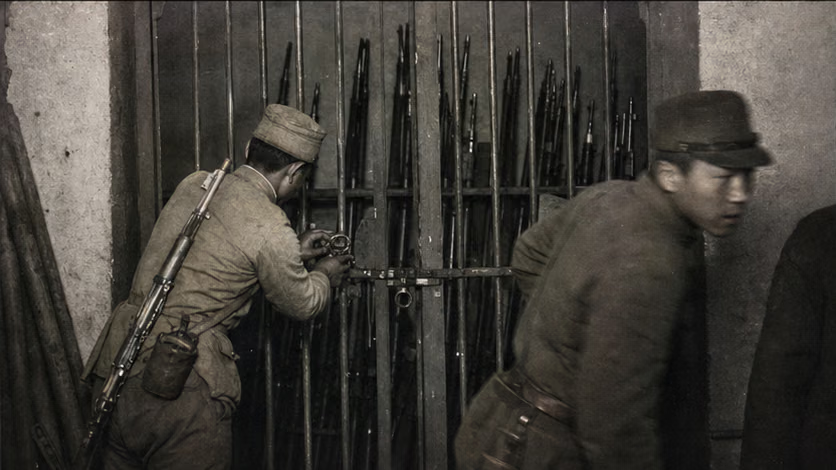
- Rifles locked in the depots: soldiers of the Seventh Brigade at Beidaying recalled that ammunition and rifles were locked in storehouses, leaving them empty-handed against the enemy in the rush: "could not fight, and could not run fast" (source unverified).
- The train that passed as usual: after the Liutiaohu explosion, an express train from Changchun passed through the blast point on schedule -- the Japanese side's pretext that "Chinese troops blew up the railway" was this small in scale.
- A city in one night: on the morning of 9.19, Shenyang residents opened their doors to find the Japanese flag already hanging on the city wall; arsenal workers were ordered to keep working as usual, producing for Japanese forces.
- Wang Tiehan: regimental commander of the 620th Regiment. Multiple materials say his unit fired back during the retreat, from which the phrase "the first shot of September 18" derives; this claim comes mainly from his own recollections, and its evidentiary level remains unverified.
The Ground
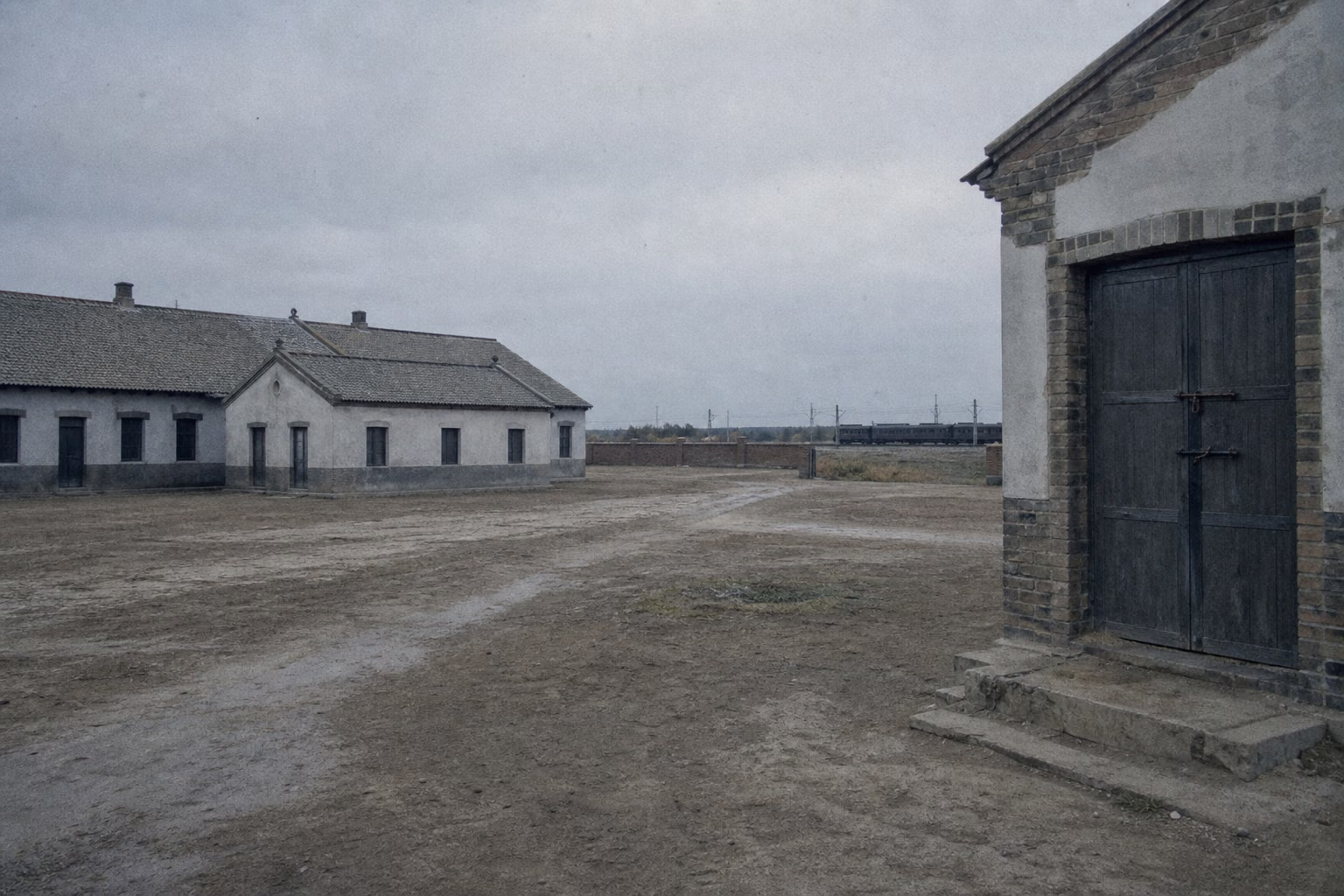
- Liutiaohu: along the South Manchuria Railway north of Shenyang, the blast point was only several hundred meters from Beidaying -- "planting evidence" and "taking action" overlapped in space.
- Beidaying: a square barracks compound, housing one brigade, with open ground on all sides; the defenders had barracks but no prepared combat works -- a peacetime barracks at the moment before a surprise attack.
- Shenyang city: the arsenal (east of the city), Dongta Airfield, and the former imperial palace -- in one night, an industrial center became an occupied zone.
- Scale note: the "battlefield" of this fight was not a position; it was an order -- a single order of non-resistance was larger than any defensive line.
How Each Side Records It
- Japanese side: called the "Manchurian Incident." Officially compiled narratives long used the frame of "Chinese troops blew up the South Manchuria Railway, and Japanese forces returned fire in self-defense"; after the war, the Tokyo Trial found that the incident had been staged by the Japanese side, and the mainstream of Japanese historiography now accepts the conspiracy thesis (some right-wing accounts still seek reversal).
- Chinese side: fixed it as the starting point of national humiliation, "never forget September 18"; Shenyang has the September 18 History Museum, and the broken-calendar monument is fixed at 1931.9.18.
- The change in counting method stated plainly: the official term was long "Eight-Year War of Resistance" (counted from the full-scale War of Resistance in 1937); the "Fourteen-Year War of Resistance" (counted from 1931) had long existed in scholarship, and in 2017 the Ministry of Education adopted the fourteen-year basis uniformly in textbooks -- counting from September 18 to August 15. This series follows the fourteen-year count.
Disputes and Sensitivities
- Responsibility for non-resistance: Zhang Xueliang's self-acknowledgment and the dispute over Nanjing's responsibility stand side by side; Zhang's own account is late-life oral material, while Taiwan-side archives and archived telegraphic orders differ from one another.
- Wang Tiehan's counterattack: the "first shot of September 18" is widely circulated, but it comes mainly from participant recollection and remains at the level of a single witness; this article marks that clearly.
- Loss inventory: accounts of the arsenal equipment, number of aircraft, and depot-store details differ across memoir materials, and archival sources still need to be checked back.
- The coexistence of the "non-resistance" order and localized fire in return is the central tension in the narrative of September 18.
Sources and Open Questions
Known main sources:
- Zhang Xueliang's late-life oral history (Tang Degang's *Zhang Xueliang Oral History* and related records)
- Relevant chapters of the Tokyo Trial judgment (judicial finding that the incident was staged by the Japanese side)
- The Kwantung Army volumes of the Japanese Defense Agency War History Office's *Senshi Sosho*
- The League of Nations' *Lytton Report* (1932)
Open questions: details of Zhang Xueliang's movements on 9.18; the original telegram and chain of issuance for the order of non-resistance; the casualty figures for Beidaying defenders by each basis; original materials for the arsenal/aircraft/depot-store loss inventory; corroborating evidence for Wang Tiehan's unit firing back; the counting basis for Kwantung Army strength (whether reservists resident locally and police are included); the specific process by which Xi Qia surrendered to Japan; the vote count and voting record for adoption of the Lytton Report; the specific telegrams and documents for the Wakatsuki cabinet and Foreign Minister Shidehara's non-expansion policy; corroborating evidence for Huang Xiansheng leading Shenyang police resistance; quantitative records for the Kwantung Army's military spending and troop strength being constrained by the budget.
All images on this site are AI-generated depictions. They are not historical photographs, not primary sources, and do not depict any real individual.