Engagement Archive · Battle of Zhejiang–Jiangxi (1942)
After the B-25 crews from the Doolittle Raid crash-landed in Zhejiang and were rescued by Chinese civilians, Japanese forces launched the Zhejiang–Jiangxi operation: they took out airfields, struck the Zhejiang–Jiangxi railway, and, during their withdrawal, released biological weapons and carried out retaliatory village massacres along the line; the bill for bombing Tokyo was sent to Zhejiang's civilians.
Engagement Data
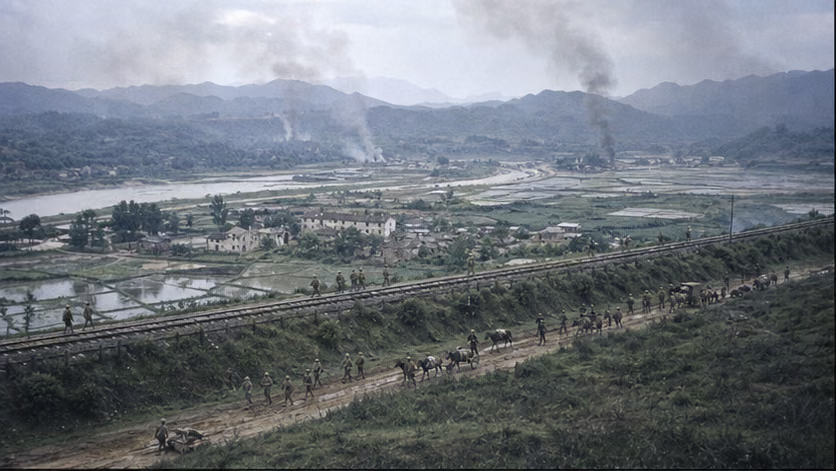
| Item | Content |
|---|---|
| Time | 1942.5.15 – late August (accounts differ on the point at which the Japanese withdrawal was completed; unverified) |
| Location | Zhejiang and Jiangxi: along the Zhejiang–Jiangxi railway -- Hangzhou–Jinhua–Quzhou–Shangrao–Yingtan |
| Part of | Fourteen-Year War of Resistance · stalemate phase on the frontal battlefield |
| Chinese side | Third War Area (commander-in-chief Gu Zhutong) |
| Japanese side | 13th Army (commander Sawada Shigeru) advanced west from eastern Zhejiang, while part of the Eleventh Army (Anami Korechika) advanced east from Nanchang, converging from east and west |
| Result | Japanese forces opened most of the Zhejiang–Jiangxi line, destroyed airfields at Quzhou and elsewhere, and from August withdrew according to plan, broadly restoring the earlier situation |
Belligerents
| Item | Chinese side | Japanese side |
|---|---|---|
| Strength | About 300,000 in the Third War Area (orders of battle vary by account) | Main force of the 13th Army, built around about five divisions, plus part of the Eleventh Army; about 140,000 in all (Japanese figures vary by account) |
| Firepower | Inferior, with little heavy firepower | Divisional artillery + aviation units |
| Special forces | — | ※ Unit 731 and the "Ei" Unit 1644 jointly carried out biological warfare (see "Course of the Engagement") |
Terrain and Conditions
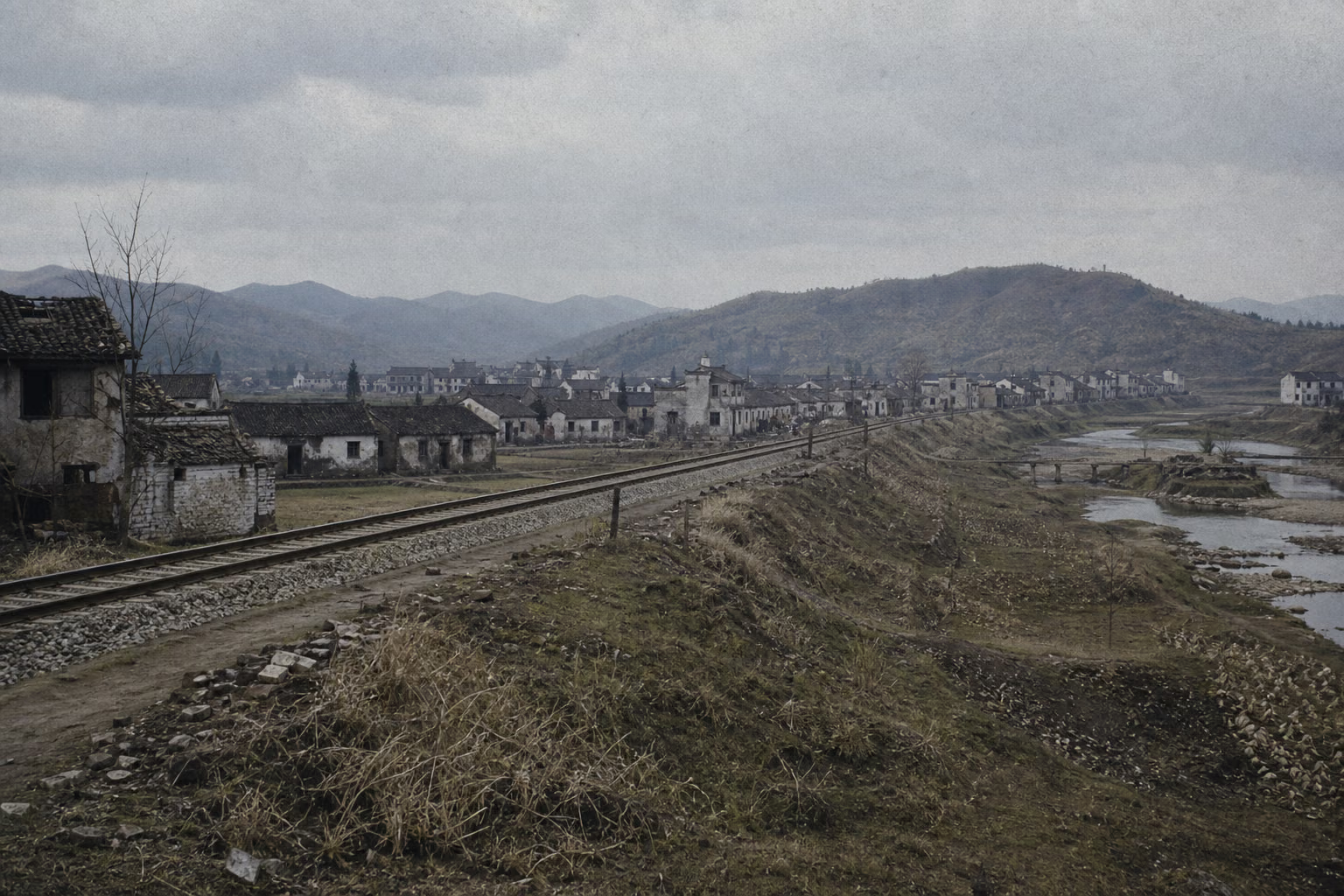
(For the wider situation -- the early Pacific War, the fall of Burma, and the Allied layout in the Pacific -- see *Fourteen-Year War of Resistance · War Overview*; here only Zhejiang–Jiangxi is covered.)
Parts of coastal Zhejiang had been occupied since 1937, and the Zhejiang–Jiangxi railway was the main artery between the southeast and the rear. Airfields at Quzhou, Lishui, Yushan, and elsewhere were planned as "forward airfields" for U.S. forces: bombers launched from carriers did not have enough range to return to the carriers, so the design was for them to land at these Chinese airfields. Towns and villages along the line had already paid one round of human obligation and risk to rescue downed American airmen.
Why It Was Fought
In that same May, the collapse in Burma was reaching its deepest point: Lashio had fallen, the road home had been cut, and tens of thousands of the Expeditionary Force had just entered the rain forest of the Savage Mountains. The domestic frontal battlefield had been quiet for only a few months when the war came back from a direction no one had expected: its point of origin was not in China, but in the skies over Tokyo.
On April 18, Doolittle led sixteen B-25s off the deck of the aircraft carrier *Hornet* and raided Tokyo and several other Japanese cities. It was the first bombing of the Japanese home islands: the weight of the bombs was light, the weight of the humiliation was heavy. By design, these bombers were not to return to the carrier after bombing -- their range was simply insufficient -- but to keep flying west and land at Quzhou and other airfields in Zhejiang to refuel and redeploy. Because the fleet had been detected early and forced to launch ahead of schedule, fuel was short, and most crews crash-landed or parachuted over Zhejiang, Jiangxi, and Anhui. The people who caught them were Chinese soldiers and civilians: hiding them in mountain homes, lifting the wounded onto stretchers, and passing them station by station toward the rear. Most rescuers did not know where "Tokyo" was; they only knew that they were saving friends who fought Japan.
Tokyo's response had two layers. One was strategic: Quzhou, Lishui, Yushan, and the other "forward airfields" planned for U.S. use had to be removed, otherwise the home islands could be hit at any time by another shuttle bombing. Beneath that was another layer, inconvenient to write into operational instructions: punishing the regions and people who had rescued American airmen. In late April, Imperial General Headquarters ordered the launch of the Zhejiang–Jiangxi operation (wording of the order unverified): the 13th Army would advance west from the Hangzhou line, part of the Eleventh Army would move east out of Nanchang, the two would converge from east and west, open the Zhejiang–Jiangxi railway, and destroy the airfields along the line.
The plan was drawn up by the China Expeditionary Army General Headquarters: the main force of the 13th Army would advance west, and part of the Eleventh Army would support from Nanchang. Japanese intelligence came quickly: captured American aircrewmen revealed where the mission had come from and the assembly function of Quzhou airfield (level of interrogation records unverified). But the available strength was enough only to open the line, not to occupy it. The 13th Army also had to guard the Nanjing–Shanghai–Hangzhou area, and the divisions it detached had to return to their defenses after the operation. "Open the line -- destroy -- withdraw": these three steps were already scheduled from the planning stage (original plan text unverified).
At first Chongqing wanted to accept this battle, and the Military Commission once planned to organize a decisive battle at Quzhou. It later changed the order: avoid a main-force decisive battle and preserve strength (Chiang's decision line and telegrams unverified). That revised order determined the form of the whole campaign: when the enemy advanced, we withdrew; when the enemy withdrew, we returned. It also determined something else: with no decisive battle at Quzhou, the main force was preserved, but the towns and villagers along the line were left on the Japanese line of march.
The revised order counted capital: the Third War Area consisted largely of local forces, was poorly equipped, and had almost no heavy artillery. If its main force was put into a head-on fight in the Quzhou basin, the capital would not withstand it. The object to be defended in a decisive battle was the airfields, and airfields were precisely the least defensible point targets: the main force and the airfields could only save one side (this is an inference, with no direct record, unverified). Before the decisive battle was canceled, surviving records show no objections from War Area generals (unverified). Inside the Japanese side there was another kind of argument: how to release biological weapons, and whether they would affect their own supply lines. Such disputes appeared in exchanged documents, and Japanese materials also record epidemic casualties among Japanese forces themselves (seen only in Imoto's diary and similar records; details unverified).
On May 15, the 13th Army attacked westward from the Hangzhou line. The bill for bombing Tokyo began to be sent to Zhejiang.
Course of the Engagement
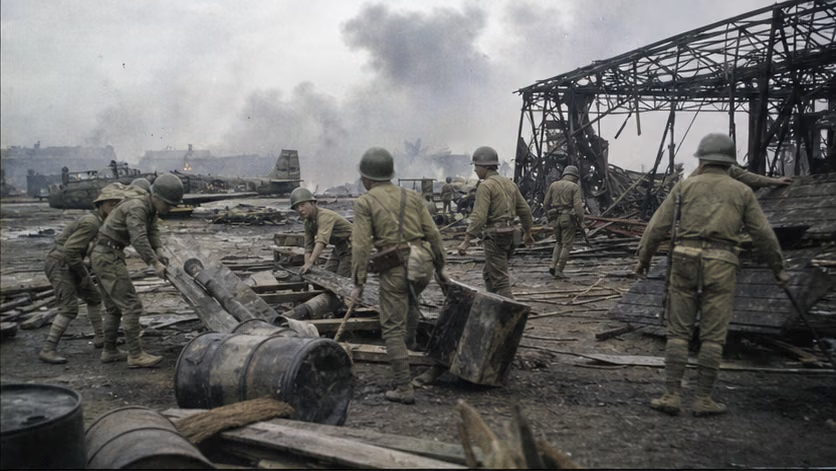
| Phase | Time | Main points |
|---|---|---|
| Eastern Zhejiang offensive | 5.15–5.28 | The 13th Army attacked westward from the Hangzhou line; on 5.28 Jinhua and Lanxi fell. Lieutenant General Sakai Naoji, commander of the Japanese 15th Division, was killed by a land mine at Lanxi (5.28; details unverified) -- an example of a serving division commander of the Japanese invasion forces in China being killed at the front |
| Quzhou and the airfield | Early to mid-June | The Chinese side abandoned the planned decisive battle at Quzhou; Japanese forces occupied Quzhou in early June and thoroughly destroyed the airfield facilities (date of the city's capture varies by account) |
| Opening the Zhejiang–Jiangxi line | June–July | Japanese forces advanced from east and west, meeting around 7.1 at Hengfeng and opening the Zhejiang–Jiangxi line (meeting place and date vary by account); railways, airfields, and mining facilities along the line were systematically destroyed and looted |
| Withdrawal | August | Japanese forces contracted and withdrew according to the established plan, broadly restoring the earlier situation except for retained key points such as Jinhua -- the form of this engagement was "open the line -- destroy -- pull back," not long-term occupation |
| ※ Biological warfare | During the withdrawal | Unit 731 (Ishii Shiro personally went to direct operations, unverified) and the "Ei" Unit 1644 cooperated in releasing pathogens including plague, cholera, typhoid, and anthrax into wells, homes, and food along the withdrawal route, and induced infection with plague-carrying fleas and contaminated food. Quzhou, Yiwu, Jiangshan, Jinhua, and other places suffered repeated epidemics in the years that followed. Postwar Chinese investigations estimated tens of thousands of epidemic deaths (local investigative bases vary; academic estimates range from tens of thousands to more than 200,000, listed side by side and still unverified). Victims of anthrax-caused "rotten-leg disease" have survived with open wounds down to the present (there were still living victims in the 2020s), and civil claims against Japan followed (Wang Xuan and other victim representatives, litigation in Tokyo beginning in 1997; in 2002 a Japanese court recognized the fact of biological warfare but rejected the compensation claim -- key points of the judgment unverified) -- long-tail harm |
| ※ Retaliatory massacres | Throughout the operation | Japanese forces carried out raids, arson, and killings against villages that had rescued American airmen. The commonly cited claim that "about 250,000 Chinese civilians were killed" comes from postwar American literature (source chain unverified); historians have reexamined this figure and consider it single-sourced and insufficiently grounded, with the actual scale lacking reliable statistics -- common citation and historiographical critique are listed side by side |
Casualties and Losses
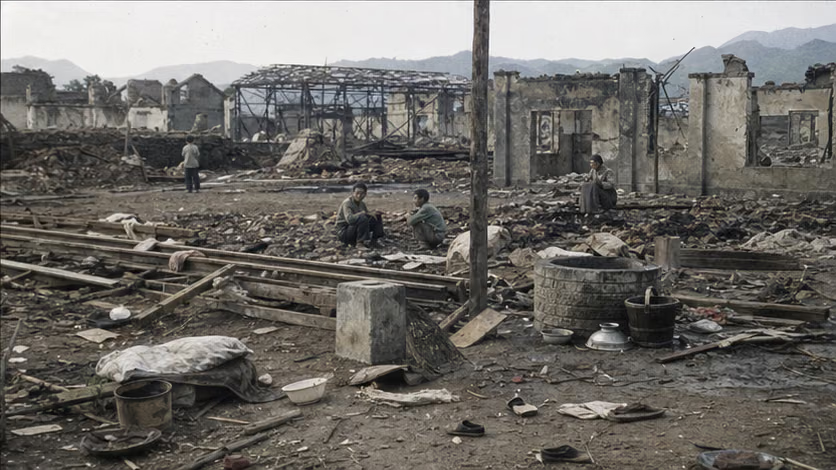
- Chinese military: tens of thousands of casualties (Chinese figures vary by account, and statistical boundaries are unverified); the main force was preserved because a decisive battle was avoided.
- Japanese side: Japanese war histories record about 17,000 dead and wounded (including the sick -- statistical bases vary by account); Chinese battle reports give higher figures, listed side by side.
- ※ Civilians: epidemic deaths from biological warfare ranged from tens of thousands to more than 200,000 (statistical bases listed side by side and vary by account); the scale of retaliatory massacres has no reliable statistics (for the status of the "250,000" claim, see above). The greatest cost of this battle was not borne by armies, but by civilians.
Aftermath
- The Chinese side recovered most of the Zhejiang–Jiangxi line, but the airfields at Quzhou and elsewhere had already been destroyed, and the airfield system moved back to western Hunan (later becoming one of the preconditions for the 1945 Battle of Western Hunan -- connection unverified).
- ※ The epidemic sources from biological warfare remained along the Zhejiang–Jiangxi line for years: plague broke out repeatedly in the 1940s, and anthrax "rotten-leg" wounds never healed over a lifetime. Victim investigations and lawsuits against Japan extended into the twenty-first century -- a battle in which people were still dying after the war ended is not common.
- Most of the Doolittle crews survived; Doolittle himself was promoted and decorated. The Chinese villages that rescued them paid the bill. An Allied victory operation was paid for by Chinese civilians.
Accounts of Those Present
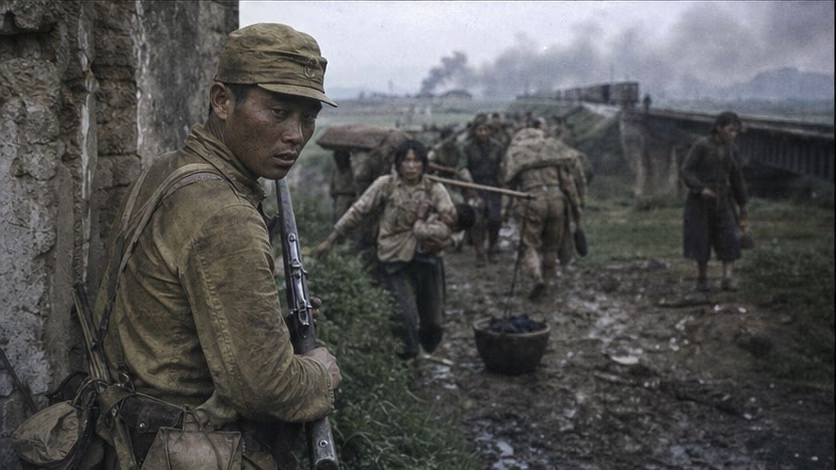
- Rescuers: Zhejiang villagers hid parachuting American airmen in mountain homes and carried wounded men on stretchers station by station toward the rear -- most rescuers did not know where "Tokyo" was, only that these were "friends who fought Japan." Japanese forces later entered villages demanding the men; when villagers could not hand them over, the troops burned and killed.
- "Rotten legs": anthrax wounds rotted for decades on farmers' lower legs. In Yiwu, Quzhou, and nearby areas, surviving victims in old age rolled up their trouser legs to show investigators, journalists, and Japanese lawyers the wounds -- the quietest evidence of biological warfare.
- Wang Xuan: an investigator of biological-warfare victims who studied in Japan and returned to China, she organized 180 plaintiffs (exact number unclear) to sue the Japanese government in Tokyo. The ten-year lawsuit was lost, but it obtained a Japanese court's judicial recognition of the fact of biological warfare.
- Sakai Naoji: commander of the Japanese 15th Division, killed by a mine on the Lanxi front -- only after the war did the Chinese engineer mine-laying team learn what they had blown up (level of historical materials unverified).
The Ground
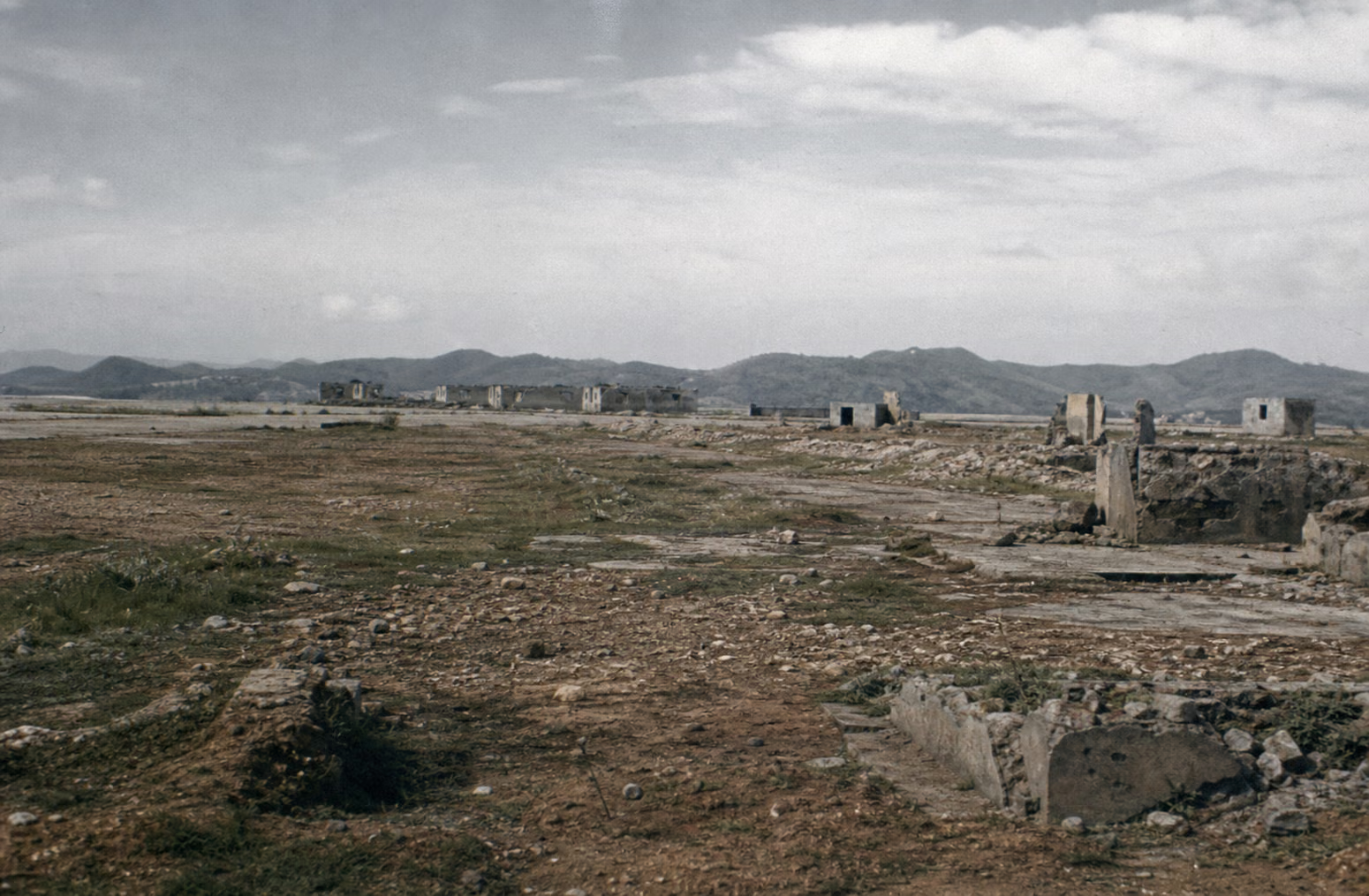
- The Zhejiang–Jiangxi railway was a corridor on the scale of 500 kilometers: hills, river valleys, and basins alternating with one another; the Jinhua–Quzhou basin was the main battlefield.
- Airfields were point targets: Quzhou, Lishui, Yushan. Both the engineer work of destroying airfields and the defender's delaying actions took place at these points.
- ※ Spatial characteristics of biological warfare: the battlefield moved with the withdrawal route, the weapons remained in wells and food, and the area of harm spread with epidemic water sources and market towns -- the "front line" began killing only after the army had left.
How Each Side Records It
- Chinese side: the Third War Area credited itself with "luring the enemy in, wearing him down, and preserving the main force," recording battle-results propaganda alongside "enemy atrocities."
- Japanese side: official war histories record it as an "opening and destruction" operation that achieved its purpose; biological warfare was long omitted, and after the 1990s gradually appeared in Japanese research together with Unit 731 files and litigation materials (state of Japanese scholarly records unverified).
- ※ Japanese court judgment in 2002: recognized the fact that the former Japanese army carried out biological warfare in violation of international law, but rejected compensation on grounds such as "state immunity" (key points of the judgment unverified) -- the fact was judicially acknowledged, while responsibility had nowhere to land; this state of affairs is recorded together with it.
Disputes and Sensitivities
- ※ Scale of biological-warfare harm: figures from tens of thousands to more than 200,000 coexist, with large differences in sources and statistical methods; no midpoint is taken and no reconciliation is imposed.
- ※ The "250,000" claim: common citation and historiographical critique are listed side by side, as above; this number cannot be treated as exact.
- Canceling the decisive battle at Quzhou: avoiding a decisive battle preserved the main force of the Third War Area, and also amounted to handing the towns and civilians along the line over to the enemy -- merit and fault are listed together, without a verdict.
- The causal chain between rescuing American airmen and retaliatory massacres still needs supplementation on how Japanese archives and American literature corroborate each other.
Sources and Open Questions
Known major sources:
- Third War Area detailed battle report on the Battle of Zhejiang–Jiangxi (status of inclusion in Taiwan-published war histories unverified)
- Relevant volumes of the Japanese Defense Agency War History Office's *Senshi Sosho* (official Japanese history; biological warfare portions absent)
- Chinese investigations of biological-warfare victims (civil and scholarly investigations in Quzhou, Yiwu, and elsewhere beginning in the 1990s)
- Tokyo District Court judgment in the biological-warfare litigation (2002) and appeal materials
Open questions (unverified): original text of the Imperial General Headquarters order for the Zhejiang–Jiangxi operation; Japanese force organization and self-recorded casualty bases; details of Sakai Naoji's death; date of Quzhou's fall; date and place of the Hengfeng meeting; Chiang's telegram canceling the Quzhou decisive battle; organization of the Zhejiang–Jiangxi operation by Unit 731/Unit 1644 and Ishii Shiro's movements; bases and statistical methods for local epidemic-death investigations; original source chain for the "250,000" claim; current state of investigations into living victims of rotten-leg disease; original key points of the Tokyo judgment; rescue routes of the Doolittle crews and lists of villages subjected to retaliation; interrogation records of captured American aircrewmen; original text of the Zhejiang–Jiangxi operation plan; records, if any, of objections by War Area generals before the Quzhou decisive battle was canceled; the disputes over biological-warfare deployment and Japanese forces' own epidemic cases recorded in Imoto's diary.
All images on this site are AI-generated depictions. They are not historical photographs, not primary sources, and do not depict any real individual.