Engagement Archive · Resistance at Jiangqiao (Nen River Bridge)
After the Mukden Incident, at the bridgehead over the Nen River, Ma Zhanshan said the first "no" to Japanese forces and fought for half a month -- the story of the "first shot of organized armed resistance against Japan" begins here.
Engagement Data
| Item | Content |
|---|---|
| Time | mid-1931.10 – 11.18 |
| Place | Around Jiangqiao Town, Tailai, Heilongjiang Province (Nen River Bridge, Daxing Station, Sanjianfang), along the Tao'an Railway |
| Belongs to | Fourteen-Year War of Resistance · Local Resistance Phase · Aftermath of the Mukden Incident |
| Chinese side | Heilongjiang Provincial Defense Force (acting chairman Ma Zhanshan), roughly more than ten thousand men (figures vary by counting basis) |
| Japanese side | Kwantung Army (Nen River Detachment, main force of the Second Division, etc.) and Zhang Haipeng's puppet troops |
| Result | On 11.18 Ma Zhanshan abandoned Qiqihar, led his troops eastward to Hailun, and Japanese forces occupied the Heilongjiang provincial capital |
Belligerents
| Item | Chinese side | Japanese side |
|---|---|---|
| Strength | Mainly the Heilongjiang Provincial Defense Force, with roughly more than ten thousand men committed in succession along the Jiangqiao line (including a guard regiment, infantry, and cavalry brigades; details unrecorded) | Zhang Haipeng's puppet troops first served as the vanguard, followed by the Nen River Detachment; in the later phase the main force of the Second Division was committed, totaling around ten thousand men cumulatively (figure disputed) |
| Firepower | Mainly infantry and cavalry, with a small number of mountain and field guns and mortars | Divisional artillery, armored cars, and aircraft in support |
| Air | None | Kwantung Army air units conducted reconnaissance and bombing |
| Logistics | No rear-area replenishment; every round of ammunition spent meant one fewer remaining | Supplies along the South Manchuria Railway, with reinforcements continuing to arrive |
Terrain and Conditions
(For the larger situation, see *Fourteen-Year War of Resistance: War Overview*; for the course of September 18, see *Mukden Incident*. This article covers only Heilongjiang.)
- After September 18, Japanese forces quickly occupied Liaoning and Jilin, making Heilongjiang the next target. Provincial chairman Wan Fulin was in Beiping, and provincial government had no one in charge; in early October Zhang Xueliang appointed Ma Zhanshan, commander of the Heihe garrison, acting provincial chairman and commander-in-chief of military affairs by telegram.
- The Kwantung Army was not yet in a position to act openly itself, so it first fostered Zhang Haipeng, garrison commander of Taoliao (who had already surrendered to Japan), to lead puppet troops northward -- Japanese money and weapons, Chinese fighting Chinese: an early sample of the puppet-troop model.
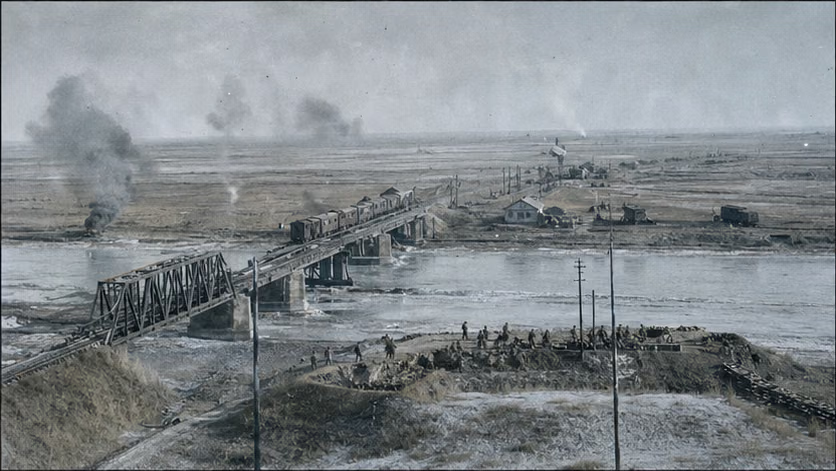
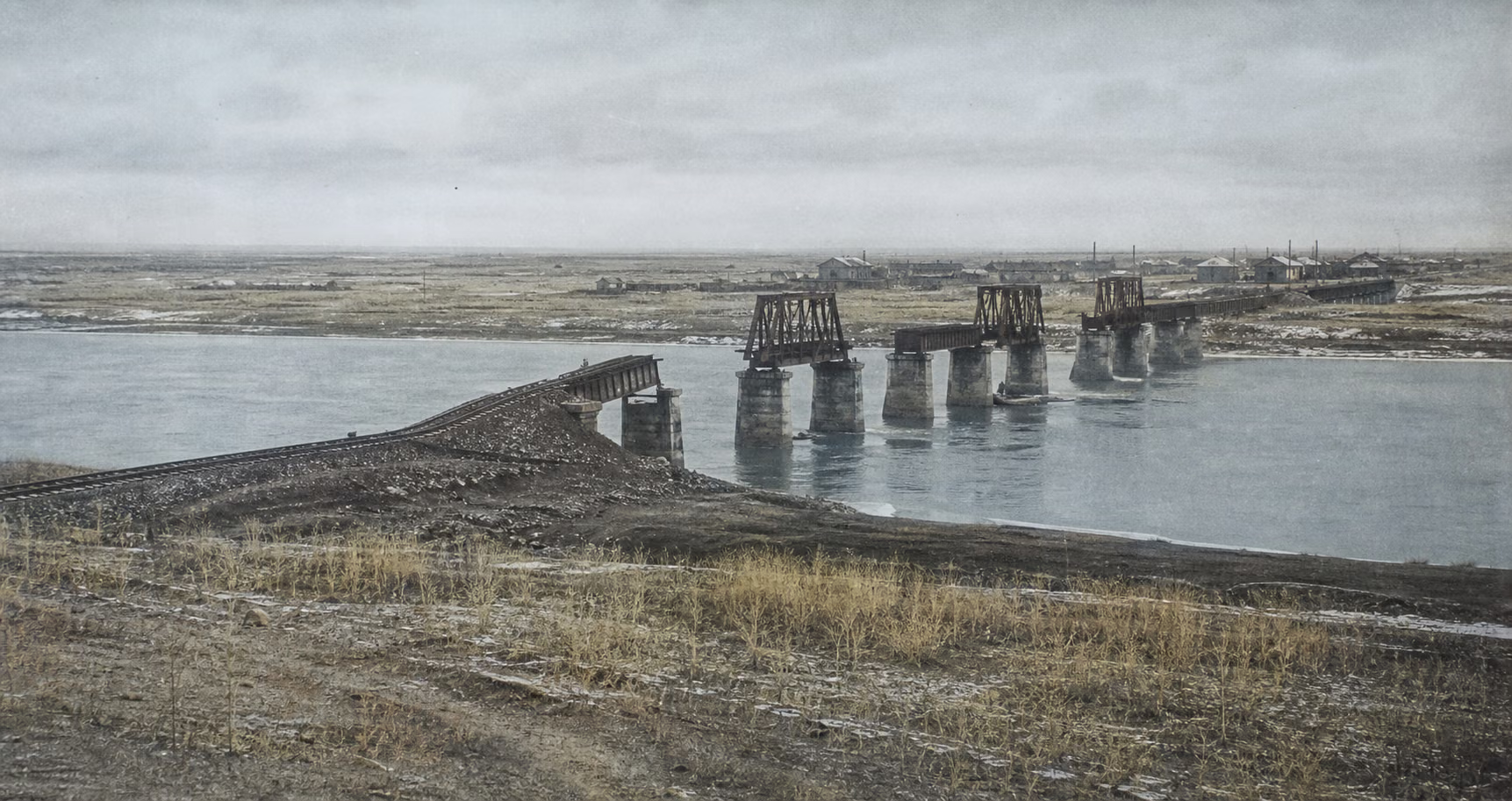
- Nen River Bridge (the bridge by which the Tao'an Railway crossed the Nen River) was the north-south throat: so long as the bridge stood, Japanese mechanized units could drive straight on Qiqihar.
Why It Was Fought
The dozens of banners counted in the previous article trace back to Nen River Bridge: before the volunteer armies rose everywhere, the first formed unit to strike back was the Heilongjiang Provincial Defense Force. Turn the clock back to October 1931 -- Japanese forces had already taken Liaoning and Jilin, and the next target was Heilongjiang. Provincial chairman Wan Fulin was in Beiping, and no one was presiding over the provincial government; in early October, Zhang Xueliang appointed Ma Zhanshan, commander of the Heihe garrison, acting provincial chairman and commander-in-chief of military affairs by telegram. That appointment placed a question directly before Ma Zhanshan: whether to defend the provincial capital, Qiqihar. In mid-October, Ma Zhanshan reached Qiqihar to assume office.
Qiqihar lay north of the Nen River. The Tao'an Railway came up from the south, and there was only one bridge across the river. If the bridge stood, Japanese mechanized units could drive directly at the provincial capital; if the bridge was broken, the northward advance would have to stop. Nen River Bridge was the north-south throat, and both sides saw this clearly.
At the time, the Kwantung Army was not yet in a position to act openly itself: Tokyo's policy of "non-expansion" was still on its lips, and northern Manchuria lay next to the Soviet-operated Chinese Eastern Railway. So it changed the method -- foster Zhang Haipeng, the Taoliao garrison commander who had already surrendered to Japan: the Japanese supplied money and guns, puppet troops led the way, and Chinese fought Chinese, an early sample of the puppet-troop model. The timetable for the Kwantung Army to act itself was pinned down from the other end: the Army General Staff imposed restrictions layer by layer -- not for Ma Zhanshan, but for the Soviet Union. The first calculation was whether the Russians would move; only after it had judged that Russia would not send troops was the ultimatum issued (telegrams between the Kwantung Army and the central authorities unverified). In mid-October, Zhang Haipeng's troops invaded northward; as soon as the vanguard crossed Jiangqiao, it was routed by the provincial defense forces, and several spans of the bridge were blown up. With the puppet troops defeated, the Japanese side immediately changed its wording: this road had been built with South Manchuria Railway loans; since the bridge was damaged, the South Manchuria Railway needed to "repair the bridge" -- using bridge repair as the name for an advance in fact. The Kwantung Army sent Ma Zhanshan an ultimatum, demanding that the defenders withdraw to more than ten kilometers from the bridge and reply by a deadline. Ma Zhanshan's answer was four characters: "The defense of one's soil is one's duty."
The accounts on the two sides are not hard to reconstruct. The Japanese side thought Heilongjiang would fall as Liaoning and Jilin had -- since September 18 it had been moving through empty cities where no one resisted, and this time it was still betting on non-resistance; Japanese war histories later acknowledged that the tenacity of this battle was unexpected (specific wording unverified). The Kwantung Army's capital lay in the unbroken flow of supplies and reinforcements along the South Manchuria Railway. In Ma Zhanshan's hands there was only one province, Heilongjiang: roughly more than ten thousand provincial defense troops, with Shenyang's arsenal already in the other side's hands and not a single bullet to be replenished from the country at large (inventory details unverified). What he could see was the bridge at Nen River Bridge; what he could not see was when the Kwantung Army would move and how large its reinforcement would become (provincial reconnaissance records unverified). What Nanjing and Beiping could provide were telegrams: orders of commendation, and comfort funds wired to the front (details unverified) -- telegrams could not replace reinforcements. Zhang Haipeng had already demonstrated another path: change the flag, keep the office. Ma did not take it. It was not that no one in the provincial government advised taking one step back, and some people packed up their valuables and fled toward Harbin (persons, words, and acts unverified); within the army, however, no clear record opposing battle has been seen.
On 11.4, the deadline having passed, the Japanese Nen River Detachment (said to have been based on South Manchuria Railway guard troops; unverified) crossed the bridge and attacked Daxing Station. The defenders opened fire to block them, and the battle began. The return fire at Beidaying had been spontaneous that night (see *Mukden Incident*); frontal combat with command, organization, and a public declaration of resistance against Japan is counted from this day -- 47 days after September 18.
Course of the Engagement
| Phase | Time | Key Points |
|---|---|---|
| Puppet-troop vanguard | 10.13–mid-10 | Zhang Haipeng's puppet troops attacked Jiangqiao; the vanguard was destroyed, and the bridge was blown up (the Chinese side broke the bridge to block the northward invasion -- accounts from all sides agree, and the Japanese pretext of "bridge repair" arose from this) |
| Ultimatum and opening battle | 11.4 | The Japanese side demanded that the defenders withdraw ten kilometers; Ma Zhanshan refused, Japanese forces attacked Daxing Station, and the defenders returned fire |
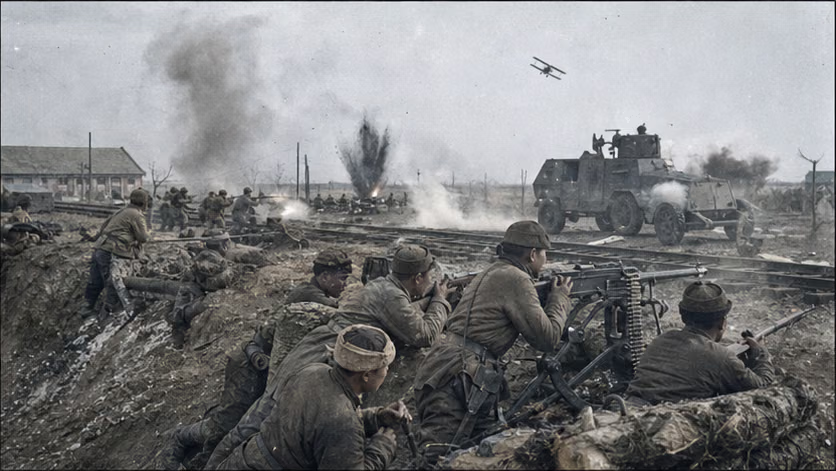
| Bloody fighting at Jiangqiao-Daxing | 11.4–11.7 | The position changed hands repeatedly. The defenders used rifles and machine guns against enemy artillery-air coordination and suffered heavy casualties, but lost and retook positions several times; Japanese participating units were also badly hit (Japanese self-reported casualty figures and Chinese battle reports differ greatly, so both are placed side by side as disputed) |
| Continued fighting at Sanjianfang | 11.12–11.18 | The front shifted north to Sanjianfang; the main force of the Japanese Second Division was committed, while the defenders' food and ammunition were nearly exhausted and no aid could be expected |
| Abandonment | 11.18–11.19 | Ma Zhanshan led his troops out of Qiqihar and withdrew to Hailun; Japanese forces occupied the provincial capital |
Casualties and Losses
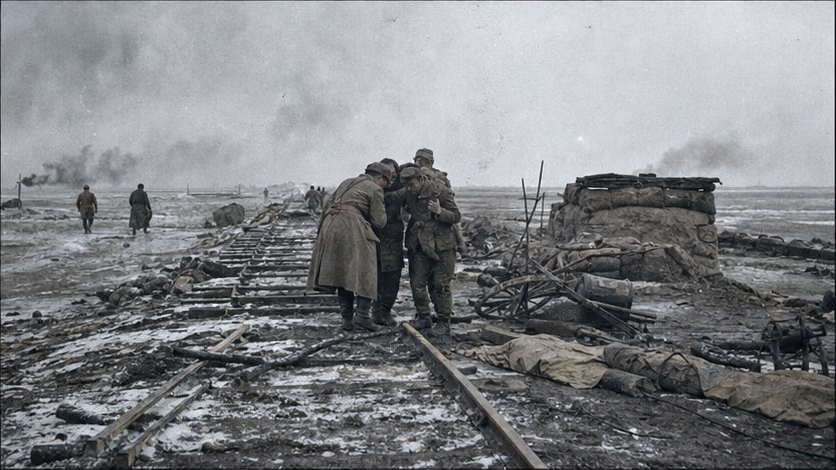
- Chinese side: about two thousand casualties among the provincial defense forces (Chinese battle-report basis; details unrecorded), mostly front-line infantry.
- Japanese side: Japanese forces self-reported several hundred killed and wounded, while Chinese battle reports claimed more than one thousand killed or wounded -- the two counting bases differ greatly; they are placed side by side, and the statistical boundary remains unverified.
- Whichever counting basis is used: this was the first time after September 18 that Japanese forces were hurt on the battlefield. Before this, they had been moving through empty cities with no resistance.
Aftermath
- Support surged across the country: donations and sympathy telegrams flew toward Heilongjiang like snowflakes; students in many places petitioned to go north to aid Ma. Goods using Ma Zhanshan as their appeal, such as "Ma Zhanshan brand" cigarettes, appeared in the market (popular phenomenon; the specific brand history remains unverified).
- Ma Zhanshan himself, and his complexity: In February 1932, Ma Zhanshan briefly took office as governor of Heilongjiang Province and minister of military and political affairs in the puppet Manchukuo; in April, he quietly left for Heihe with funds, weapons, and ammunition, issued a telegram returning to the resistance, and reorganized anti-Japanese forces to fight again -- after more than forty days of surrender to Japan, what he took away was the puppet regime's guns and money. Historians have interpreted his taking of puppet office in February in two ways, as "feigned surrender" and as "wavering"; the materials are placed side by side. During the period in puppet office, he did not open fire on anti-Japanese forces (evidentiary level of this section unverified).
- After Jiangqiao, volunteer armies rose everywhere (see *Northeast Volunteer Army and the Anti-Japanese United Army*); the meaning of the "first shot" lay not in the battlefield result, but in proving that someone dared to fight.
Accounts of Those Present
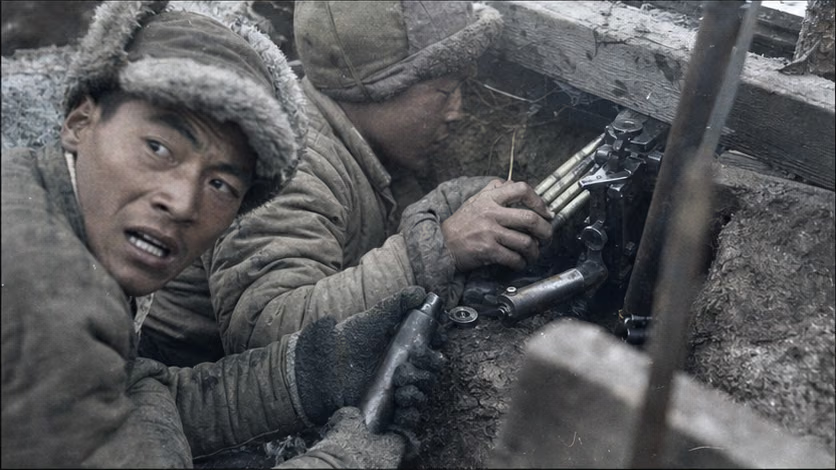
- "The defense of one's soil is one's duty": Ma Zhanshan's public telegram answering the Japanese ultimatum, four plainspoken characters, spread across the country that year.
- Blowing up the bridge: Breaking the bridge delayed the Japanese mechanized advance by half a month -- one bridge, repaired and fought over again and again, became the fulcrum of the whole engagement.
- Winter in Heilongjiang: By November the Songnen Plain had entered winter. The defenders fought bitterly for days in fieldworks, with frostbite and battle wounds occurring together (details unrecorded).
- A city full of comfort goods: Fur hats, gloves, and canned food donated by people in the rear were shipped to the front -- this was the first high tide of popular mobilization during the Local Resistance Phase.
The Ground
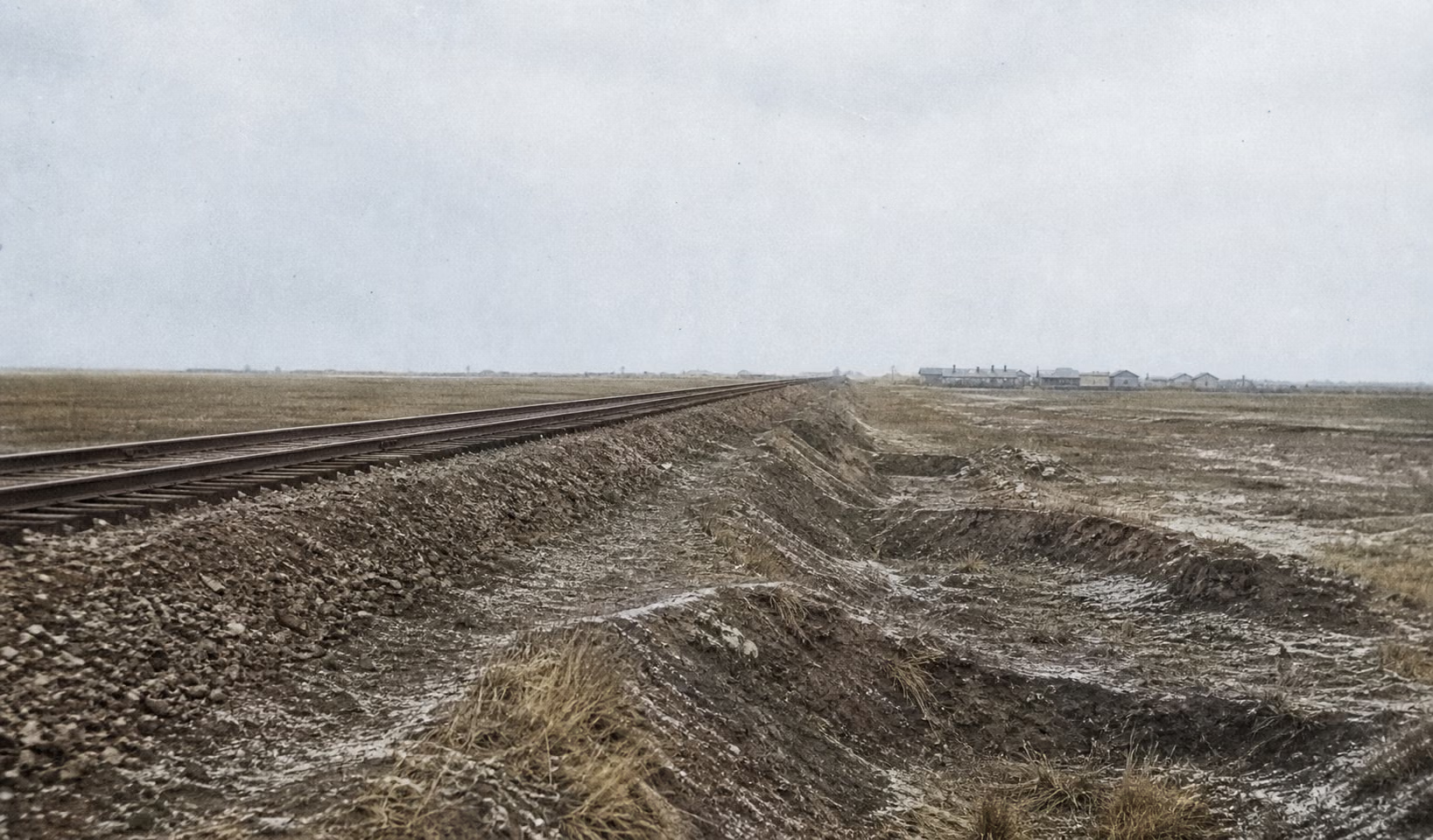
- Nen River Bridge: a single railway bridge, with Daxing Station to the north and the Japanese approach from the south -- a single-channel key point and naturally favorable ground for the defense.
- Jiangqiao-Daxing-Sanjianfang-Qiqihar: four points arranged from south to north along the Tao'an Railway; the engagement was a step-by-step withdrawal along this line.
- Songnen Plain: open and without cover, giving the attacker good artillery visibility; the defender could only build fieldworks around villages, stations, and the roadbed.
How Each Side Records It
- Chinese side: the common formulation calls it the "first shot of organized armed resistance against Japan." The distinction in counting basis must be marked: Wang Tiehan's unit at Beidaying returned fire earlier (see *Mukden Incident*), while Jiangqiao's "first" refers to frontal combat with command, organization, and a public declaration of resistance against Japan -- the two claims belong to different levels and are placed side by side, not swallowed into one another.
- Japanese side: called it something like the "fighting near the Nen River," folding it into the punitive narrative of the "Manchurian Incident"; Japanese war histories acknowledge the unexpected tenacity of this battle (specific wording unverified).
- Popular level: this battle was the first focus of national public opinion in the winter of 1931. Newspapers reported on it for days, and Ma Zhanshan became a national symbol of resistance against Japan almost overnight.
Disputes and Sensitivities
- Ma Zhanshan's taking of puppet office in February-April 1932: The evaluation is highly sensitive. The "feigned surrender" and "wavering" interpretations each have supporting materials; his specific actions during that period and the original text of his telegram returning to the resistance still require checking against primary materials. This experience coexists with the Resistance at Jiangqiao.
- Attribution of the "first shot": The Wang Tiehan (night of September 18) and Ma Zhanshan (Jiangqiao) claims coexist. The distinction in counting basis has already been noted above; the archive does not elevate one claim alone.
- Casualty figures follow two sets of counting bases, and this article marks the source side throughout.
Sources and Open Questions
Known main sources:
- Ma Zhanshan's circular telegrams and proclamations (preserved in newspapers of the time)
- Chinese battle reports and participants' recollections (such as Xie Ke's *Diary of the Resistance at Jiangqiao*; editions unverified)
- The Manchurian Incident volume of the Japanese Defense Agency War History Office's *Senshi Sosho*
Open questions: details of the participating strength of the provincial defense forces; the composition of the Japanese participating units (whether the Nen River Detachment was based on South Manchuria Railway guard troops); each side's casualty figures and statistical boundaries; the specific execution and sequence of blowing up the bridge; the start and end dates of Ma Zhanshan's taking of puppet office and his actual actions during that period; the brand and manufacturer origins of "Ma Zhanshan brand" cigarettes; the edition of Xie Ke's diary; the specific wording in Japanese war histories on the fighting at Jiangqiao; the exact date when Ma Zhanshan arrived in the province to assume office; telegrams between the Kwantung Army and the Army General Staff concerning operations in northern Manchuria; details of the National Government's commendation telegrams and comfort funds; ammunition-inventory details for the provincial defense forces; persons in the provincial government who advocated peace or avoided battle, and their words and acts; provincial reconnaissance records on Kwantung Army deployments.
All images on this site are AI-generated depictions. They are not historical photographs, not primary sources, and do not depict any real individual.