Engagement Archive · Hundred Regiments Offensive
One hundred and five regiments tore up North China's railways in the same night: the largest active offensive on the battlefields behind enemy lines, with brilliant results and a heavy price; for the next forty years, this battle fought another, longer battle of its own: from achievement to charge to rehabilitation, the political life of one engagement lasted longer than its military history.
Engagement Data
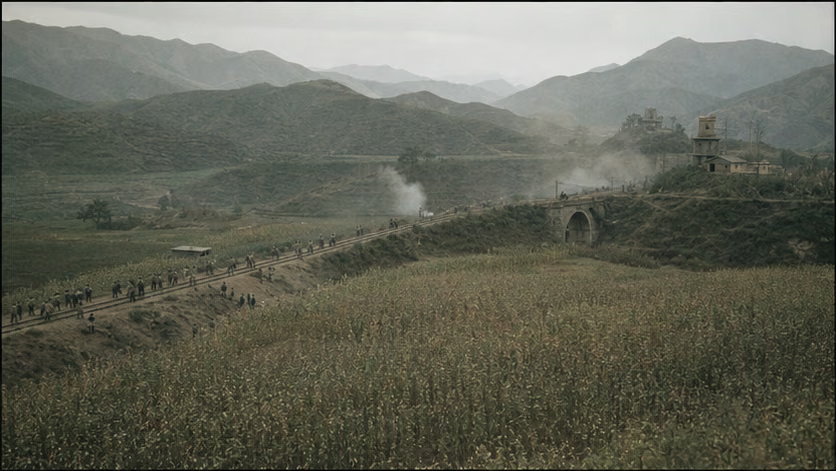
| Item | Content |
|---|---|
| Part of | Fourteen-Year War of Resistance · Battlefields Behind Enemy Lines (for the whole picture, see *Battlefields Behind Enemy Lines · Overview*) |
| Time | 1940.8.20 – 1941.1.24 (three phases) |
| Location | Transport network across North China: the Zhengtai Railway as the axis, with the Tongpu, Pinghan, Jinpu, and Baijin lines struck in parallel |
| Belligerents | Eighth Route Army Headquarters (Peng Dehuai in actual command, with deputy chief of staff Zuo Quan assisting), 105 regiments totaling more than two hundred thousand troops (regiment count and troop-strength statistical basis vary by account) / Japanese North China Area Army (Hayao Tada) and puppet forces |
| Result | Zhengtai Railway paralyzed for more than a month; Jingxing Coal Mine damaged; the third phase shifted into brutal counter-"mopping-up" fighting ※ |
Belligerents
| Item | Eighth Route Army | Japanese and Puppet Forces |
|---|---|---|
| Strength | The original plan called for 22 regiments to sabotage the Zhengtai Railway; units from each area joined on their own, bringing the total to 105 regiments -- the name "Hundred Regiments Offensive" came from battle-report statistics after the fact (naming process unverified) | North China Area Army, roughly 250,000 plus puppet forces (statistical bases vary by account), but dispersed along points and lines |
| Firepower | Short of artillery for fortified assault; demolition depended on locally made explosives and engineers' picks | Strongpoints and fortifications + armored rail patrol cars + aviation |
| Civilian support | Hundreds of thousands of people along the lines helped tear up the tracks (scale of mass participation unclear) | -- |
Terrain and Conditions
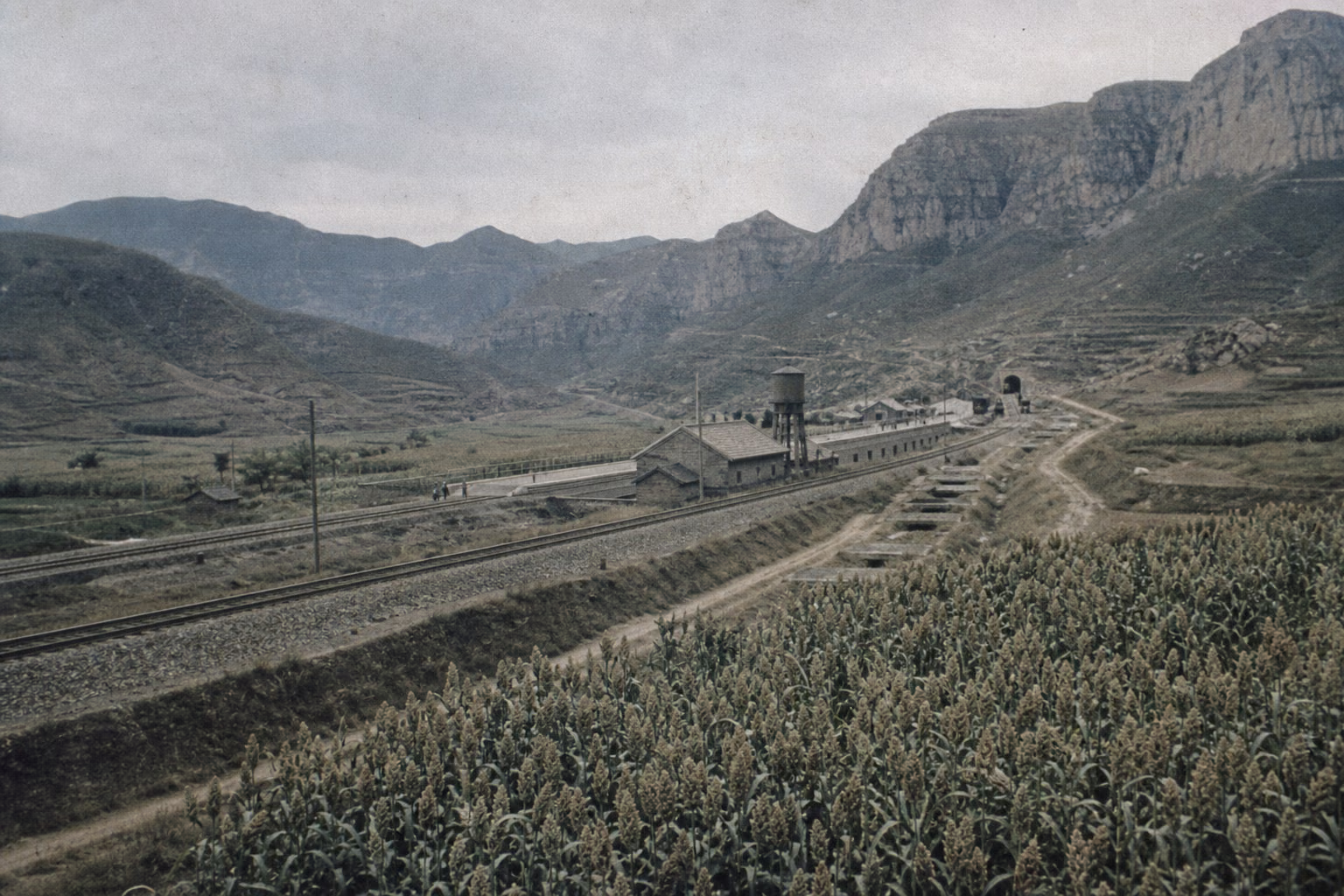
The darkest moment of 1940: France in Europe had fallen; the Wang Jingwei puppet regime had opened at the beginning of the year; talk of compromise hung in Chongqing's air. In North China, the "cage policy" tightened, and the base areas were cut into fragments by railways, roads, and blockhouses. Eighth Route Army Headquarters chose to answer three things with a visible major battle: break the cage, raise morale, and block the argument for surrender -- the political component of the campaign motive was on the table from the start.
Why It Was Fought
The summer after Yichang was lost was one of the heaviest stretches of air since the War of Resistance began. France had surrendered; in Europe, only Britain was still holding out. The Wang Jingwei puppet regime had opened in Nanjing at the beginning of the year. Japanese aircraft used Yichang as a forward airfield and bombed Chongqing month after month -- compromise talk found a market in the great rear. In North China, meanwhile, Hayao Tada's "cage policy" was tightening grid by grid: railways as pillars, roads as chains, blockhouses as locks. The base areas were cut into fragments, and the roads between one fragment and another were severed one by one.
Eighth Route Army Headquarters decided to answer all this with a visible major battle. The three objectives were explicit from the beginning: break the cage, raise morale, and block the argument for surrender -- beyond military pressure relief, the element of political statement is not avoided.
The decision can be checked in the record: on July 22, 1940, Eighth Route Army Headquarters issued a preparatory order for the campaign, signed by Zhu De, Peng Dehuai, and Zuo Quan, and reported it at the same time to the Central Military Commission (original text to be checked word by word); on August 8 it issued the operational order, and twelve days later the whole line opened the attack. The judgment in hand when the decision was made: Japanese strength was spread along points and lines, and the Zhengtai Railway was thinly defended, which reconnaissance supported; on July 17 Britain closed the Burma Road for three months, almost cutting off outside aid to the great rear, so "what if Chongqing cannot hold on" was a real item in Yan'an's account book; if the cage tightened further, the base areas would fragment beyond repair. The missing piece of intelligence was how severe a retaliation this battle would bring, and how much ammunition accumulated over years it would burn through -- after the battle, Headquarters itself reviewed that it had underestimated the long-term nature of the struggle (source of original wording unverified). The material boundary was drawn from the beginning: no heavy artillery for fortified assault, rifle cartridges counted in tens (statistical bases vary by account), demolition dependent on locally made explosives -- the skeleton of the campaign could only be sabotage, fortified assault was bound to be the short side, and when the second phase pulled out strongpoints by force, the family stock was thinned. No record of opposition before the launch has been found (unverified); dissent grew afterward -- five years later, the North China work forum began settling the account of "exposing strength." What the Japanese side wanted was very clear: lock North China shut with the cage; it held the railways, blockhouses, and armored rail patrol cars; the only thing it had not counted on was that its opponent would dare put two hundred thousand men on the table at once.
The Zhengtai Railway was chosen for the first cut because it was the most important pillar in the cage: from Shijiazhuang to Taiyuan, crossing the Taihang Mountains, it was the transfusion tube for Japanese forces in Shanxi, with Jingxing Coal Mine just beside the line -- tear it up, and the coal and transport capacity of Japanese forces in North China would be cut together. The time chosen was late August: the green curtain of tall crops was at its height, giving large forces a whole season of cover for movement near the lines.
Both sides misjudged the same thing: neither imagined the other side would reach this scale. Japanese forces deployed according to the account book of "pacification warfare," spreading strength along points and lines, and never believed the opponent could launch a campaign-level simultaneous offensive -- *North China Pacification War* later admitted that they "suffered a major blow they had not anticipated" (original text unverified). On the Eighth Route Army Headquarters side, the original plan was for 22 regiments to sabotage the Zhengtai Railway; once the order went down, units from each area joined on their own, rolling into 105 regiments and more than two hundred thousand men -- the name "Hundred Regiments Offensive" grew out of battle-report statistics after the fighting began (naming process unverified). The problem that the campaign had not been fully reported to Yan'an in advance (the dispute over launch procedure -- Peng Dehuai's late-life account and Party-history textual verification set side by side, with levels marked) later became part of the political controversy.
On the night of August 20, stations, bridges, and tunnels along the whole Zhengtai Railway were attacked at the same moment -- the whole North China night lit up at once.
Course of the Engagement
| Phase | Time | Key Points |
|---|---|---|
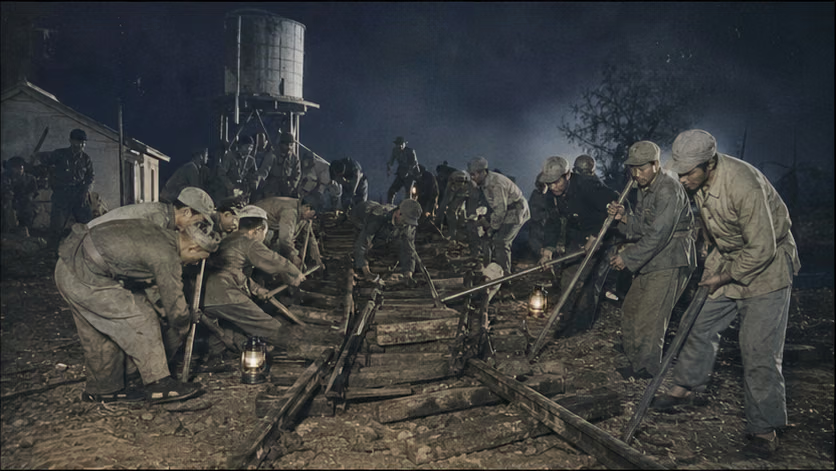
| General sabotage | 8.20–9.10 | The entire Zhengtai Railway erupted at once: stations, bridges, tunnels, and water towers were destroyed, and the equipment at Jingxing Coal Mine was blown up (destruction statistics: more than four hundred seventy kilometers of railway, more than one thousand five hundred kilometers of road, and so on; figures vary by statistical basis); the Zhengtai Railway was paralyzed for more than a month |
| Fortified assaults and taking strongpoints | 9.20–early 10 | Campaigns such as Lai-Ling and Yu-Liao pulled out lines of strongpoints; the shortcoming in fortified assault was exposed: without artillery to attack blockhouses, flesh was exchanged for fortifications |
| Guanjianao | 10.29–31 | Okazaki Battalion, more than five hundred men, was besieged on the heights of Guanjianao; after two days it was not taken, and casualties exceeded one thousand (figures on both sides disputed); the dispute over Peng Dehuai's insistence on attack and objections from Liu Bocheng and others (the debate over a "loss-making battle" -- the dispute over annihilation-battle determination and cost still requires layered textual verification) |
| Counter-"mopping-up" | 10–1941.1 | Japanese retaliatory large-scale "mopping-up": the "Three Alls" escalated ※, and the base areas entered their most difficult period (see the separate article *Counter-"Mopping-Up" Operations*) |
Casualties and Losses
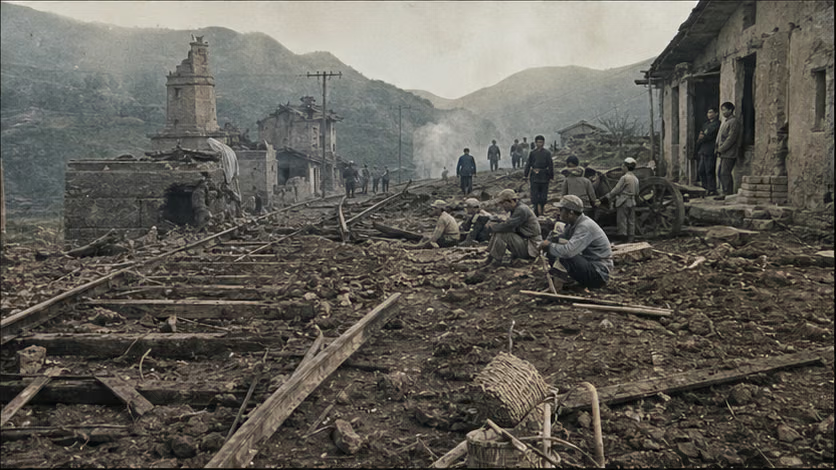
- Japanese and puppet forces: Eighth Route Army battle reports gave more than twenty thousand Japanese killed and wounded, and more than five thousand puppet troops (CPC statistical basis); Japanese war histories acknowledge far lower losses (several thousand, statistical bases vary by account) -- the two sets are listed side by side, and the statistical boundary (including casualties from sabotage and from clearing strongpoints) remains disputed.
- Eighth Route Army: more than seventeen thousand casualties (statistical bases vary by account); many were injured by poisoning ※ (Japanese forces repeatedly released poison gas -- records and Japanese archives unverified).
- ※ Civilians: no statistics exist for casualties among the people who helped in the fighting; afterward, the retaliation of the large-scale "mopping-up" first fell on villages along the lines -- the chain linking battlefield results and retaliation.
Aftermath
- Military gains and losses: the cage was torn open for a season, and Japanese forces were compelled to turn back toward "pacification" -- the tying-down effect was real; but the exposure of strength brought the brutal retaliation of 1941–42, and the base areas were reduced by nearly half -- whether the battle "was right to fight" was disputed for decades within the army and the Party.
- The political life history of a battle (a section unique to this article): praised nationwide in 1940 (Chongqing also sent a congratulatory telegram -- Chiang's telegram text unverified) -> criticized at the 1945 North China forum for "exposing strength too early" -> after the 1959 Lushan Conference became one of the "charges" against Peng Dehuai -> criticism escalated during the Cultural Revolution -> rehabilitated after 1978 and reentered the canon -- the same battle was treated in different eras as a medal, an error, and evidence of guilt; the archive records that curve itself.
- Peng Dehuai's self-defense and self-examination in *Autobiography* (quotation unverified); the Guanjianao controversy became a classic case in the study of the conditions for annihilation battles.
Accounts of Those Present
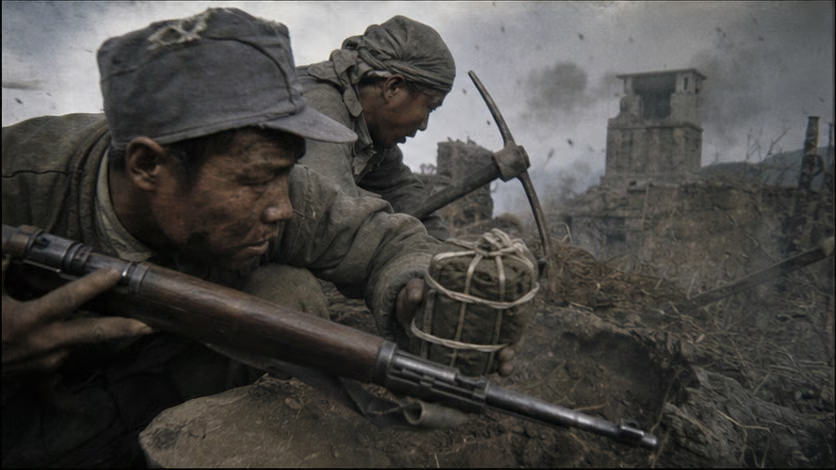
- The night of tearing up the railway: hundreds of thousands of soldiers and civilians went onto the roadbed overnight -- sleepers became firewood, rails were carried away for smelting, "turn the enemy's blood vessels into our military-industry raw material" (wording level unverified); the encounter between farm tools and a modern railway is the most sharply formed image of war behind enemy lines.
- The miners of Jingxing Coal Mine: they destroyed the mine they descended into every day -- the same hands that smashed the machines had oiled them the day before; details of miners guiding demolition teams (details unverified).
- Peng Dehuai at Guanjianao: he personally came to the forward observation post to supervise the attack, red-eyed for two days (scene details unverified) -- the commander's obstinacy and the soldiers' cost exist in the same frame.
- Nie Rongzhen and Mihoko: a Japanese orphan girl rescued from the fighting at Jingxing; Nie returned her to the Japanese forces with a letter attached (in 1980 Mihoko visited China and acknowledged the kindness -- a loop across forty years ✓) -- one exceptional moment at the point of fiercest violence, without sentimentality.
The Ground
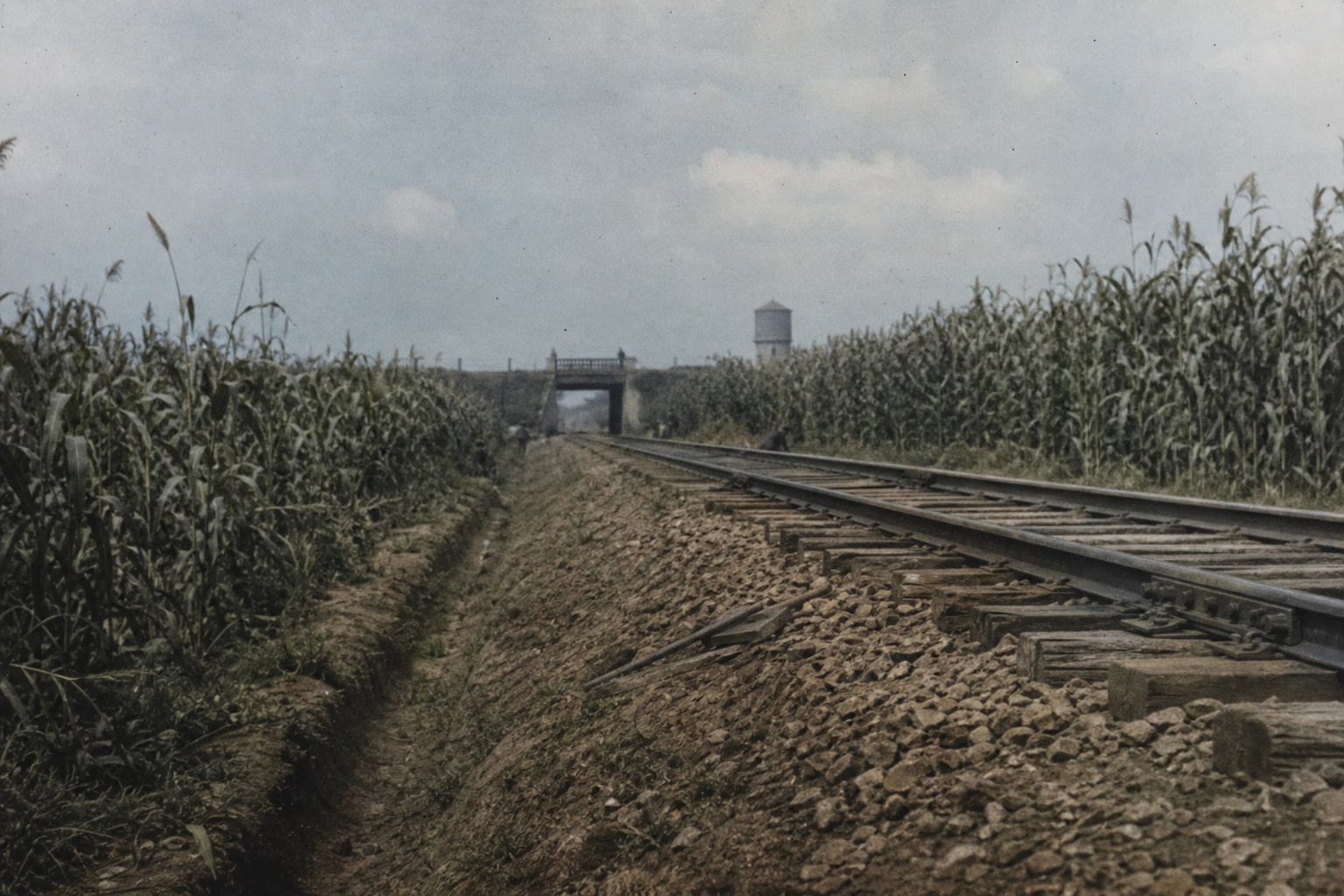
- Simultaneity: one hundred regiments struck at the same moment -- the campaign opening in which "the whole North China night lit up at once," a spatial structure like a large chorus.
- The railway as a spatial axis shared by enemy and self: in ordinary times it was the enemy's blood vessel, in wartime our battlefield, and after dismantling our raw material -- three identities for one line.
- Guanjianao: a dead ground for fortified assault, with ring-shaped works on a plateau -- a measuring ground for the ceiling of the Eighth Route Army's fortified-assault capability.
- Strongpoints and the green curtain: the seasonal cover of sorghum fields (the rise and fall of the green curtain determined the rhythm of operations behind enemy lines -- a lunar calendar of space).
How Each Side Records It
- CPC canon: the largest offensive campaign on the battlefields behind enemy lines, and one of the markers of Peng Dehuai's military career; in recent years, its history of political rise and fall has been written more fully.
- Japanese side: *North China Pacification War* acknowledged that they "suffered a major blow they had not anticipated" and thereafter comprehensively revised their assessment of Communist military capability (original text unverified) -- the opponent's shock is the best testimony to the battle's weight.
- Local society: villages along the Zhengtai Railway retain both memories of helping in the fighting and memories of being retaliated against (oral materials, evidentiary level unverified) -- victory narrative and memory of cost in the same batch of villages.
Disputes and Sensitivities
- The dispute over launch procedure and "exposing strength too early" -- Party-history levels set side by side.
- The cost of Guanjianao remains disputed.
- Two statistical bases for battlefield results coexist.
- This political life history is tied to the Lushan Conference and the Cultural Revolution; this article records only the parts related to this battle.
Sources and Open Questions
Sources: *War History of the Eighth Route Army*; Peng Dehuai, *Peng Dehuai's Autobiography*; War History Office of Japan's Defense Agency, *North China Pacification War*; *Selected Historical Documents on the Hundred Regiments Offensive*; Nie Rongzhen's memoirs (Mihoko matter).
Open questions: number of participating regiments and troop-strength statistical basis; tables of destruction statistics; casualty statistical bases for both sides; poison-gas records; figures and dispute records for both sides at Guanjianao; Chongqing congratulatory telegram; original Japanese wording for "major blow"; finalized details of the Mihoko matter; original texts of the July 22 preparatory campaign order and the August 8 operational order; level of linkage between the Burma Road closure and the campaign decision; Headquarters' prewar estimate materials concerning the intensity of Japanese retaliation and ammunition consumption; source for the review wording "underestimated the long-term nature of holding out behind enemy lines"; statistical basis for Eighth Route Army ammunition reserves and rifle-cartridge allocation; records of objections before the campaign launch (not found).
All images on this site are AI-generated depictions. They are not historical photographs, not primary sources, and do not depict any real individual.