Engagement Archive · Battle of Shanggao
A rare clean victory on the frontal battlefield during the stalemate phase: Luo Zhuoying's 19th Group Army, centered on Wang Yaowu's 74th Corps, prepared a pocket in advance and encircled the overextended 34th Division of the Japanese forces on both banks of the Jinjiang around Shanggao in northern Jiangxi. It badly mauled the division; although it did not annihilate it in a single encirclement, the Chinese side held the battlefield initiative throughout.
Engagement Data
| Item | Content |
|---|---|
| Time | 1941.3.14/15 – 4.9, about 25 days (accounts differ on whether the starting point was 3.14 or 3.15; still unverified) |
| Place | Shanggao County, Jiangxi, and its outskirts (both banks of the Jinjiang; the Guanqiaojie, Sixi, Gao'an, and Fengxin line) |
| Belongs to | Fourteen-Year War of Resistance · stalemate phase · northern Jiangxi direction of the Ninth War Area |
| Chinese side | 19th Group Army (commander-in-chief Luo Zhuoying): centered on the 74th Corps (Wang Yaowu), with the 70th Corps, 72nd Corps, 49th Corps, and other units in cooperation |
| Japanese side | Eleventh Army (commander Sonobe Waichiro): 33rd Division (Sakurai Shozo), 34th Division (Oga Shigeru), Twentieth Independent Mixed Brigade (Ikeda Naozo, unverified) |
| Result | The Japanese 34th Division broke out and withdrew; the Chinese side recovered all lost ground; the Chinese side called it the "Great Victory at Shanggao" |
Belligerents
| Item | Chinese side (19th Group Army) | Japanese side (participating units of the Eleventh Army) |
|---|---|---|
| Strength | About 110,000 (Chinese military-history troop figures vary by account) | About 65,000 (Chinese military-history troop figures vary by account) |
| Core units | The 74th Corps (Fifty-First, Fifty-Seventh, and Fifty-Eighth Divisions) was the direct-line elite, the foremost main force of the Central Army before its American re-equipment | The Thirty-Third and Thirty-Fourth Divisions were both Type B / security-nature divisions (organizational details unrecorded) |
| Firepower | Mainly divisional mountain guns and mortars; ammunition and firepower were far inferior | Divisional artillery plus air support; aircraft covered the breakout |
| Air | No air superiority | Air units supported the ground breakout |
| Special weapons | - | Chinese accounts record in several places that Japanese forces used poison gas during the breakout at Guanqiao, poisoning officers and soldiers of the 173rd Regiment, 58th Division, 74th Corps (Chinese records; matching Japanese archival records unverified) |
| Situation | Prepared in advance, operating on interior lines, with several corps acting in coordination | The divided advance failed to converge: the northern route's 33rd Division withdrew midway, while the central route's 34th Division protruded alone |
Terrain and Conditions
(For the larger situation in 1941--stalemate, the deadlock, KMT-CPC relations after the Southern Anhui Incident, and Japan's debate over advancing south or north--see Fourteen-Year War of Resistance · War Overview. This entry discusses only northern Jiangxi.)
Northern Jiangxi: Nanchang was in enemy hands. After the Battle of Nanchang (1939), Nanchang and the line south of the Xiushui were occupied by Japanese forces, while Chinese troops held the mountains around Jiuling, Shanggao, and Gao'an. Nanchang was a wedge by which the Japanese forces in central China projected toward the Ninth War Area; northern Jiangxi therefore became a buffer battlefield between Changsha and Wuhan, with small actions constantly occurring but no major battle breaking out--until the Japanese forces began thinking about transferring troops.
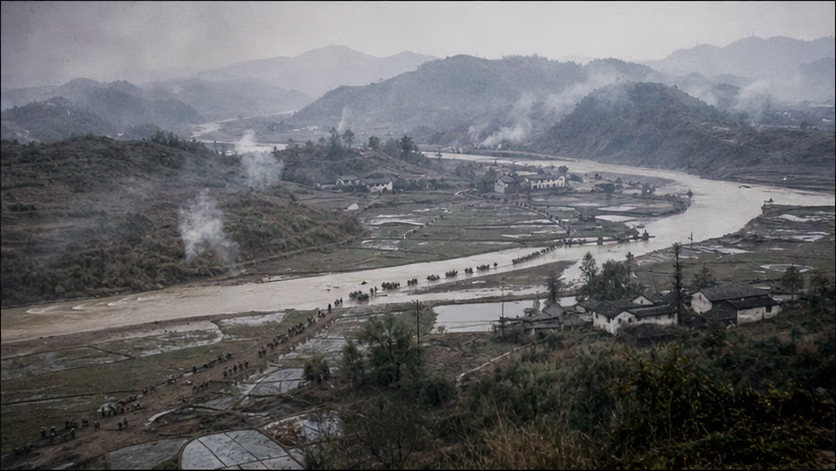
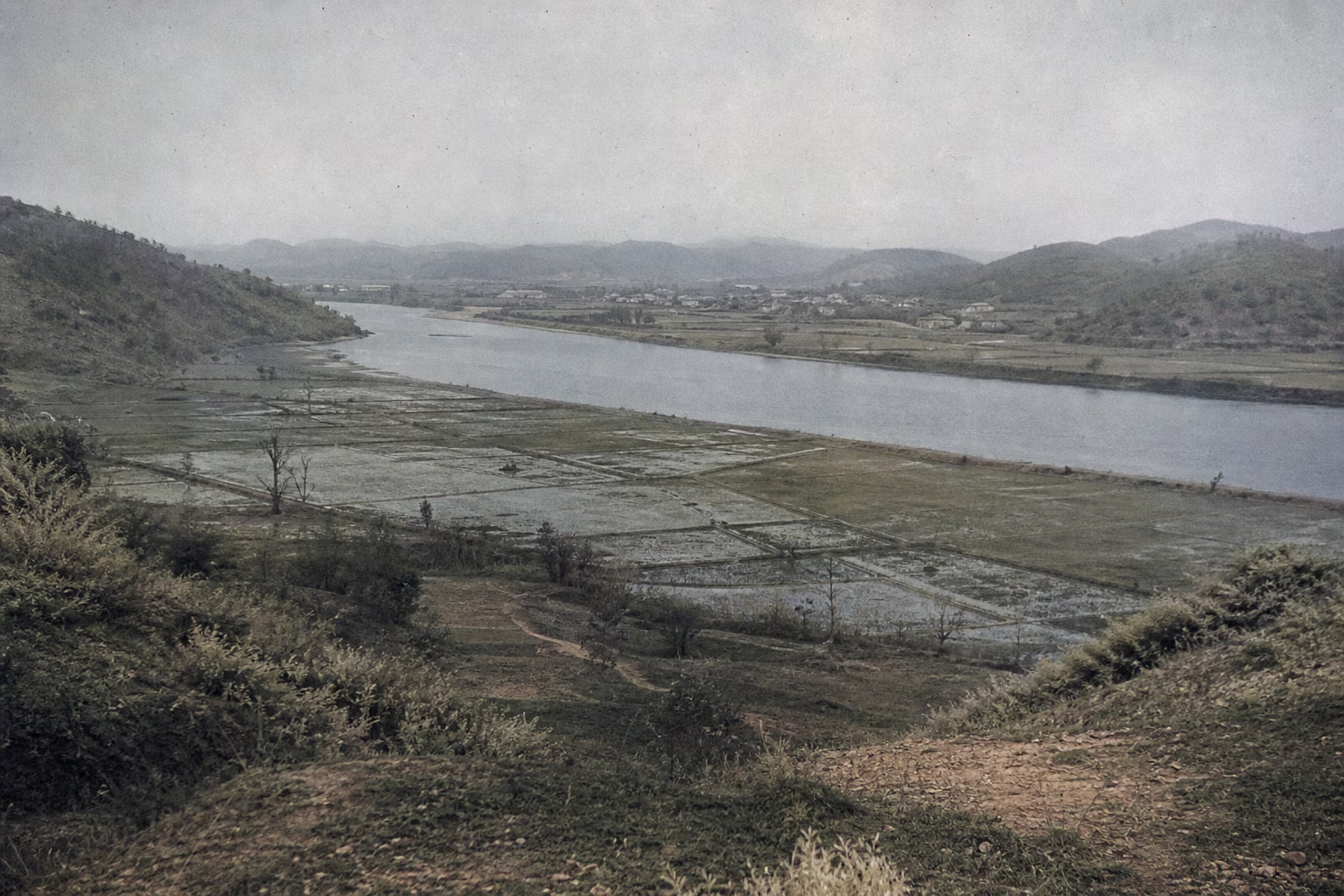
This ground: Shanggao County lies southwest of Nanchang, with the Jinjiang running across it and hills enclosing paddy fields on both banks. The hills were positions; the river was the axis. Whoever controlled the hilltops and crossing points on both banks of the Jinjiang blocked the westward road out of Nanchang. Wartime evacuation by local civilians and the Nationalist army's scorched-earth measures (specific scale unrecorded).
Why It Was Fought
The war of strangulation in North China required troops, and those troops had to be drawn from other battlefields inside the passes. In early 1941, the Japanese forces decided to transfer the 33rd Division stationed in northern Jiangxi to North China to reinforce the forces for the "pacification war." The frontal battlefield therefore received a linked bill: northern Jiangxi, the buffer battlefield where major fighting had not erupted but small actions had never stopped since the Battle of Nanchang (1939), suddenly had to fight a large battle.
The calculation lay in the timetable for redeployment. Once the 33rd Division left, only Oga Shigeru's 34th Division and other units would remain around Nanchang, leaving the force thin. Sonobe Waichiro, commander of the Eleventh Army--the same man from the Battle of Zaoyang-Yichang--decided to fight a battle before the redeployment: the Thirty-Third and Thirty-Fourth Divisions, together with the Twentieth Independent Mixed Brigade, would advance west in three routes, strike the Ninth War Area's field forces in northern Jiangxi, and "consolidate the perimeter of Nanchang." In essence, this was a brief punitive offensive before redeployment, not an operation to seize and hold ground; it would leave after fighting. That purpose of "fight and leave" planted the whole foreshadowing: the northern route could withdraw once it completed its immediate blow, while the central route, if it did not contract with it, would be a lone force walking into a pocket.
On the Chinese side, this was exactly the kind of battle they had been waiting for. Shanggao lies southwest of Nanchang, with the Jinjiang running across it and hills enclosing paddy fields on both banks: whoever controlled the hilltops and crossing points on both banks of the Jinjiang blocked the westward road out of Nanchang. Luo Zhuoying's 19th Group Army, centered on Wang Yaowu's 74th Corps, prepared a pocket in advance: first-line units would fight while withdrawing, drawing the attackers toward preset positions around Shanggao held by the 74th Corps (the term "magnet tactic" and its source unverified), and the surrounding corps would then close in to encircle them. The pocket had been set beforehand, not improvised on the spot; on the frontal battlefield of the same period, that was a scarce thing.
The misjudgments on the two sides were not symmetrical. The Chinese side was already familiar with the Japanese pattern--a short, sharp thrust, withdrawal once the objective was achieved, seen repeatedly since the Battle of Suizhou-Zaoyang. The Japanese forces, however, had no awareness of the opponent's preparations, and still less anticipated that their three routes would become one: after the northern route withdrew according to plan, Oga Shigeru did not contract his force but led the 34th Division onward toward Sixi and Guanqiaojie, leaving its flanks exposed. The postwar Japanese military history characterized this as underestimating the enemy and advancing rashly (specific wording unverified).
On March 14 or 15 (two starting dates coexist; still unverified), the Japanese forces advanced west in three routes, with the central route following the Jinjiang toward Gao'an and Shanggao.
Course of the Engagement
| Phase | Time | Main points |
|---|---|---|
| Japanese divided advance | From 3.14/15 | Three routes advanced west: the northern route, the 33rd Division, aimed at Fengxin; the central route, the 34th Division, followed the Jinjiang toward Gao'an--Shanggao; the southern route, the Twentieth Independent Mixed Brigade, moved along the south bank of the Jinjiang |
| Drawing in the enemy through successive resistance | 3.15–3.19 | Luo Zhuoying's predetermined "magnet tactic" (the term and its source unverified): first-line units fought while withdrawing, drawing Japanese forces toward the preset positions around Shanggao held by the 74th Corps |
| Northern route withdrawal, central route isolated | 3.19–3.20 | After completing its immediate blow, the 33rd Division withdrew to Anyi according to the original "short-cut" plan (Japanese records on the reason for withdrawal unverified); the commander of the 34th Division, Oga Shigeru, did not contract with it, but continued to thrust rashly toward Sixi and Guanqiaojie, leaving his flanks exposed |
| Encirclement | 3.20–3.24 | The 74th Corps held firm frontally; after breaking the enemies before them, the Seventieth, Seventy-Second, and 49th Corps closed in toward the main Shanggao battlefield; on 3.24, Li Tianxia's 51st Division captured Gao'an, cutting the 34th Division's line of retreat |
| Encirclement battle | 3.24–3.27 | The 34th Division was encircled around Guanqiaojie on both banks of the Jinjiang, the days with the heaviest casualties on both sides; on 3.25, the Japanese Eleventh Army urgently ordered the 33rd Division back to relieve it and drew reinforcements from the Jiujiang direction |
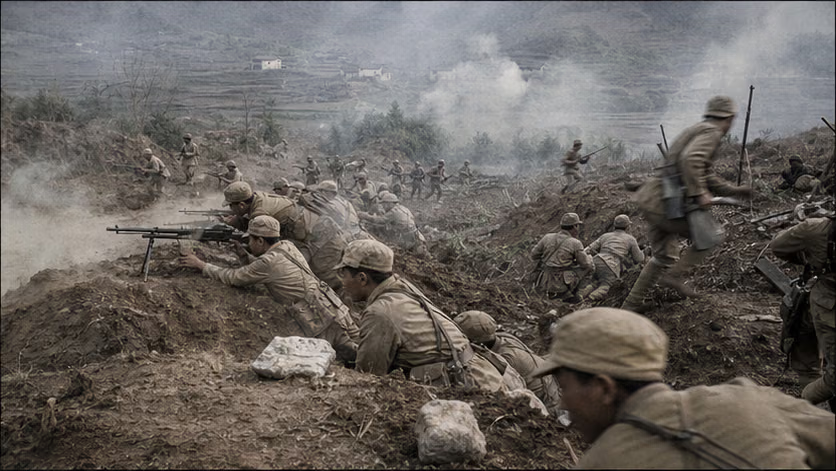
| Breakout and pursuit | 3.27–4.2 | On 3.27–28, under cover of poison gas and air units, the Japanese forces broke out from the direction of Guanqiao and Yeshi and fled east, joining the returning 33rd Division; Chinese corps intercepted and pursued them, retaking Gao'an on 3.31 and Fengxin on 4.2; by 4.9 all lost ground had been recovered |
Casualties and Losses
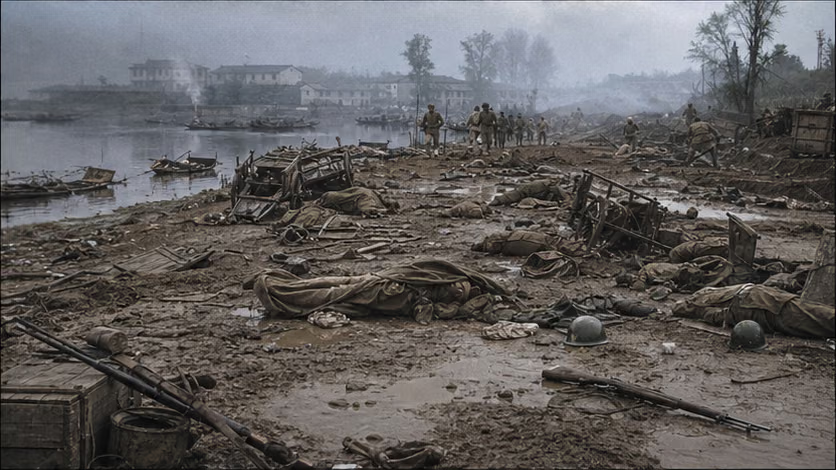
- Japanese side: Chinese battle reports claimed more than 15,000 Japanese killed and wounded (including a major-general commander named Iwanaga--details of name and rank unverified--and regimental commander-level officers), and that the 34th Division and the Twentieth Independent Mixed Brigade each suffered casualties of more than half their strength (Chinese statistical basis). The figures in Japan's official military history are clearly lower (specific figures disputed; the two sets of statistical basis are listed in parallel).
- Chinese side: about 20,000 casualties (Chinese casualty figures vary by account). Although Chinese casualties were higher than Japanese casualties (using the Chinese statistical basis), by the exchange-ratio standard of the frontal battlefield it was already the major battle with the most favorable casualty ratio since the War of Resistance began.
- The 34th Division "nearly suffered annihilation in a single encirclement" but was not annihilated--this is the most important truthful sentence about the battle: it was encircled, it was badly mauled, and it was not consumed.
Aftermath
- Conditions analysis: This battle showed what conditions allowed the frontal battlefield in the stalemate phase to "win a battle"; it also showed how harsh those conditions were.
- The enemy advancing rashly as an isolated force was the premise. Half of the 34th Division's defeat was self-inflicted: the Japanese operational purpose was a brief sweep before redeployment; the northern route's 33rd Division withdrew after completing its mission, while Oga Shigeru pressed a lone force two days' march deep. Once three routes became one, encirclement became mathematically possible. Not every opponent offers such a gift. When Japanese forces later faced units like the 74th Corps, they "would not lightly seek a decisive battle without absolute superiority" (a circulated postwar Japanese lesson, original text unverified); this kind of opportunity came only once.
- Our own coordination arriving on time was the other half. The pocket was preset, not improvised: Luo Zhuoying's successive resistance drew the enemy to the predetermined battlefield; the 74th Corps held at the point of encirclement (the 51st Division cut the rear route, while the Fifty-Seventh and Fifty-Eighth Divisions counterattacked frontally); the surrounding Seventieth, Seventy-Second, and 49th Corps closed in on schedule. Four corps moved according to the same timetable. On the frontal battlefield of the same period, that was precisely the scarce thing; the Battle of the Zhongtiao Mountains in May of the same year (see Battle of the Zhongtiao Mountains) was the counterexample.
- Yet they still could not annihilate the enemy in a single encirclement. The Japanese forces relied on the 33rd Division's return to relieve them, poison gas, and air units to tear open an exit and break out. The conditions analysis is therefore complete: even with both conditions assembled, given the Chinese side's firepower and mobility at the time, there remained one last step between "surrounding" and "consuming." The victory was real; the failed annihilation was real as well.
- Sonobe Waichiro, commander of the Japanese Eleventh Army, was dismissed for faulty command, and Anami Korechika succeeded him (the event and its causal chain unverified).
- The 33rd Division's transfer to North China was delayed because of this battle.
- He Yingqin called this engagement "the finest operation since the War of Resistance began" (said in remarks to Central News Agency reporters and similar contexts; original source unverified); Chiang Kai-shek used this engagement in a Premier Memorial Week speech as evidence of "progress in military dispositions" (recorded secondhand in The Diary of Wang Zizhuang, unverified).
- The 74th Corps received the National Government's first citation for military merit and the "Flying Tiger Flag" (the formal title of the flag award and the details of its bestowal unverified); the name "Iron Army Against Japan" began from here. Cross-entry character line: this corps' next stops were Changde (see Battle of Changde), the Xuefeng Mountains, and Menglianggu--a cross-reference in one stroke; see the relevant overviews for details.
Accounts of Those Present
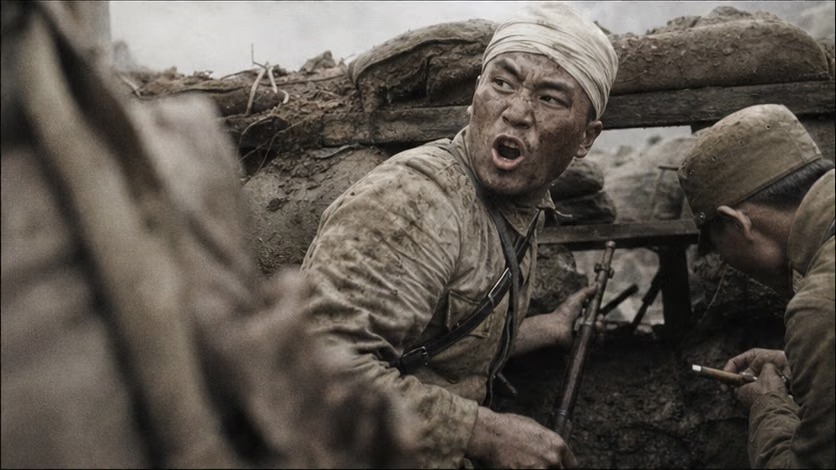
- Zhang Lingfu in the 58th Division: During the battle, Liao Lingqi, commander of the 58th Division, was away for training; Zhang Lingfu, as deputy division commander (one account says acting commander; appointment-order details unverified), commanded the 58th Division in a shoulder-to-shoulder bloody fight with Yu Chengwan's 57th Division. This man is the starting point of the Shanggao--Changde--Menglianggu character line.
- "Within one day, enemy and our casualties were both above four thousand": Luo Zhuoying's postwar telegram described the 74th Corps positions around 3.24 as "resisting with all force to the death; though flesh and blood flew and casualties were heavy, they still did not retreat in the slightest" (the original telegram text and date vary by account)--the quality of the victory was purchased at this density.
- The 173rd Regiment poisoned: On 3.27, when Japanese forces broke out at Guanqiao, they released poison gas, poisoning officers and soldiers of the 173rd Regiment, 58th Division (Chinese records)--breakout forces in extremity chose any means available.
- Luo Zhuoying's bitter regret: The Japanese wounded and routed troops, stretching for several li, ultimately escaped in organized formation, and Luo Zhuoying sighed with bitter regret (the story is widely circulated; original source unverified)--the commander himself knew how far this battle still was from annihilation in a single encirclement.
- Oga Shigeru: The defeated commander was not severely punished (postwar career unverified); Chinese accounts record that the Chinese side once offered a reward of 50,000 silver dollars to capture the division commander alive (source unverified).
The Ground
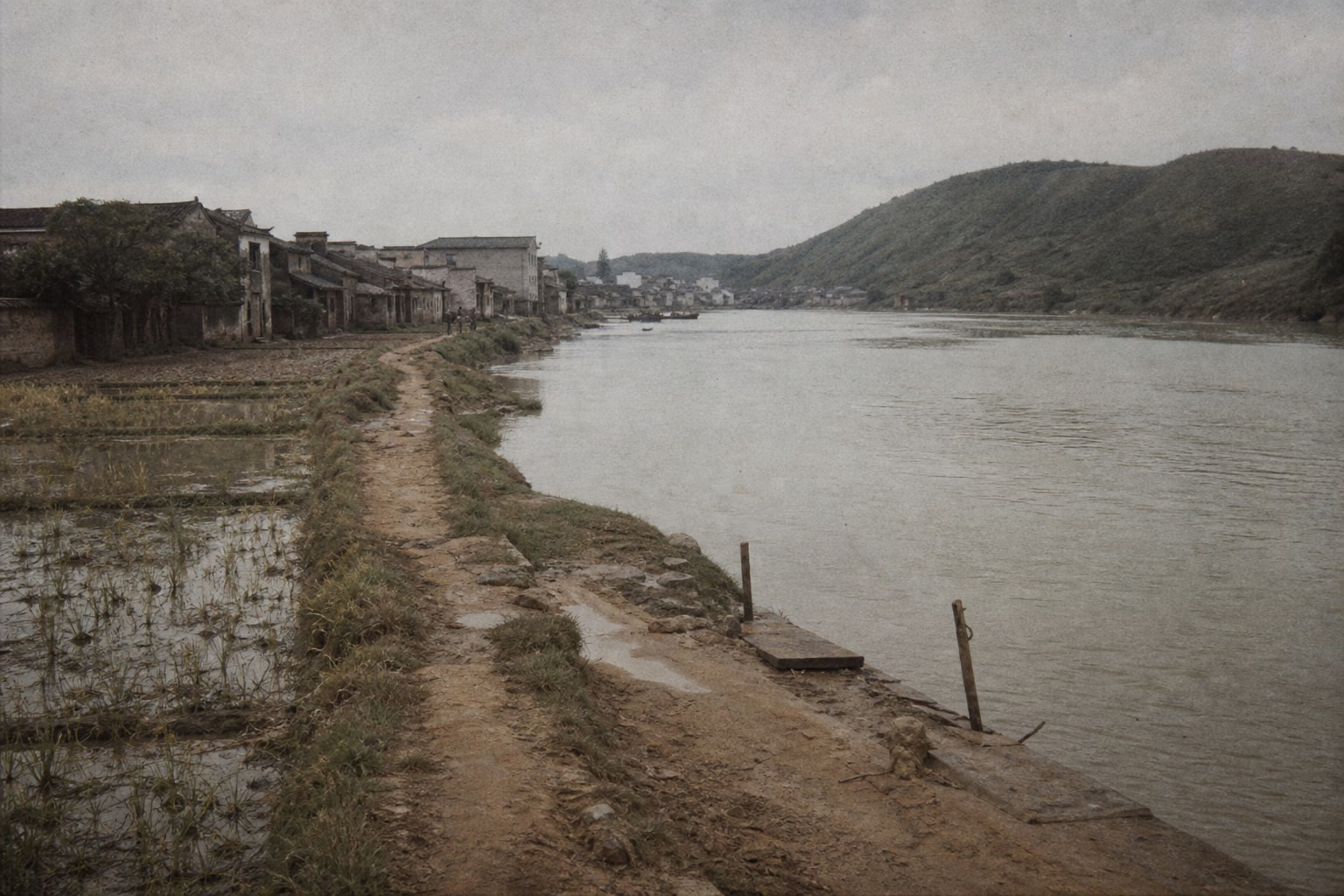
- The axis was the Jinjiang: the Japanese forces on the central route advanced upstream along the river, while Chinese troops blocked them along the river; the hills on both banks enclosed a natural corridor.
- The encirclement point lay on both banks of the Jinjiang around Guanqiaojie and Sixi--the bottom of a pocket made of hilltops, crossings, and market towns.
- Gao'an was the "button" of the pocket: if the 51st Division held Gao'an, the enemy's rear route was cut; if it lost Gao'an, the pocket broke. The spatial logic was plain.
- Scale: the phase of drawing in the enemy involved maneuver over several dozen kilometers; the encirclement phase compressed into a river-valley hill zone of several kilometers. From wide to narrow: this was the spatial grammar of the battle.
- In the pursuit phase, the space opened out again: from Guanqiao to Gao'an and Fengxin, the interception-pursuit route advanced continuously.
How Each Side Records It
- Chinese side: called it the "Great Victory at Shanggao" and positioned it as a classic battle example on the frontal battlefield since the War of Resistance began, one in which the initiative was held throughout and mobile warfare, positional warfare, and guerrilla warfare were combined. He Yingqin's "finest operation" and the 74th Corps' "Iron Army Against Japan" both came from this. Shanggao County now has a battle martyrs' cemetery and memorial facilities for fallen officers and soldiers (present condition unverified).
- Japanese side: the official military history treats it as a local setback in a brief operation before redeployment, caused by the 34th Division underestimating the enemy and advancing rashly. Its casualty figures are far smaller than the Chinese statistical basis, and Sonobe Waichiro's departure was the Japanese side's internal judgment on the command (specific wording in Japanese military history unverified). In postwar Japanese summaries of lessons learned, there is a lesson about Shanggao and the 74th Corps along the lines of "do not lightly seek a decisive battle with them" (circulated phrasing, original text unverified).
- Third parties / later generations: mainland scholarship has generally continued the "great victory" characterization and studied its coordination conditions in detail; Taiwanese military history also gives it a positive account (details of the Taiwan-edition military histories unrecorded).
Disputes and Sensitivities
- The substance of the "great victory": 15,000 enemy casualties inflicted (Chinese statistical basis) coexists with "failed annihilation in a single encirclement"--the result of this battle was that Japanese forces were badly mauled, but the encirclement did not complete annihilation.
- The two sets of casualty figures differ greatly, with a wide gap between the two sides' numbers; this entry lists both accounts in parallel. Within the Chinese statistical basis, there are also differences such as 15,000 and 16,000.
- The generalization of the Zhang Lingfu narrative: his performance at Shanggao became one of the foundations of the later "famous general against Japan" narrative, touching evaluations from both the KMT and CPC sides and the memory of Menglianggu.
- Use of poison gas: Chinese records are explicit, while matching Japanese archival evidence remains unverified; before the Japanese records are pinned down, this entry does not make a conclusive statement.
- The Battle of Shanggao was a rare victory, but the conditions for victory and the boundary of "not consuming the enemy" existed at the same time.
Sources and Open Questions
Known main sources:
- Relevant volumes of the Japanese Defense Agency War History Office's Senshi Sosho (Japanese official military history; the volume containing this battle unverified)
- Taiwan-edition military histories (such as War History of the War of Resistance Against Japan; details for this battle unrecorded)
- Luo Zhuoying's postwar reports and telegrams; He Yaozu's Overview of the Course of the Battle of Shanggao submitted to Chiang Kai-shek (1941.4, archival holding, cited indirectly through academic papers)
- Memoirs of participants (including recollections by Zhang Lingfu's subordinates, reprinted on the Memorial Network of the War of Resistance Against Japan; original sources still to be checked)
Open questions:
1. Starting date of the battle: 3.14 or 3.15. 2. The original statistical basis for committed strength on both sides (sources for the Chinese side's 110,000 and the Japanese side's 65,000). 3. Japanese casualty figures and statistical boundaries in Japan's official military history. 4. The original source and statistical boundary for the Chinese side's 20,000 casualties. 5. Name of the commander of the Twentieth Independent Mixed Brigade (Ikeda Naozo). 6. Original source for He Yingqin's "finest operation" remark (date and wording of the Central News Agency report). 7. The formal title, time of bestowal, and document number for the 74th Corps' "Flying Tiger Flag." 8. Relevant passages from Chiang Kai-shek's Premier Memorial Week speech on 1941.3.31 (recorded secondhand in The Diary of Wang Zizhuang). 9. Major General Iwanaga's name, position, and record of death in action (cross-verification between Chinese and Japanese accounts). 10. Japanese records on the 33rd Division's withdrawal on 3.19–20 (whether the original plan was a "short-cut" withdrawal, or whether it withdrew after being checked). 11. Matching Chinese and Japanese archival evidence on the use of poison gas (Guanqiao, 3.27; poisoning of the 173rd Regiment). 12. The causal chain between Sonobe Waichiro's dismissal and this battle (Japanese personnel files). 13. Oga Shigeru's postwar career; the source for the claim that a reward of 50,000 silver dollars was offered to capture the division commander alive. 14. The original source for Luo Zhuoying's "sighing with bitter regret." 15. Wartime source for the term "magnet tactic" (Luo Zhuoying's own words or a later summary). 16. Details of the appointment order concerning Liao Lingqi's training and Zhang Lingfu serving as acting commander of the 58th Division. 17. Present condition and founding date of the Shanggao Battle Martyrs' Cemetery.
All images on this site are AI-generated depictions. They are not historical photographs, not primary sources, and do not depict any real individual.