Engagement Archive · Assault on Linfen
In the spring of 1948, Xu Xiangqian led more than 50,000 troops newly upgraded from local forces, without heavy artillery, and by digging approach trenches and packing explosives into tunnels, blew open Linfen, the "Crouching Ox City," from beneath the ground in seventy-two days--the People's Liberation Army's "degree thesis" in assaulting fortified positions.
Engagement Data
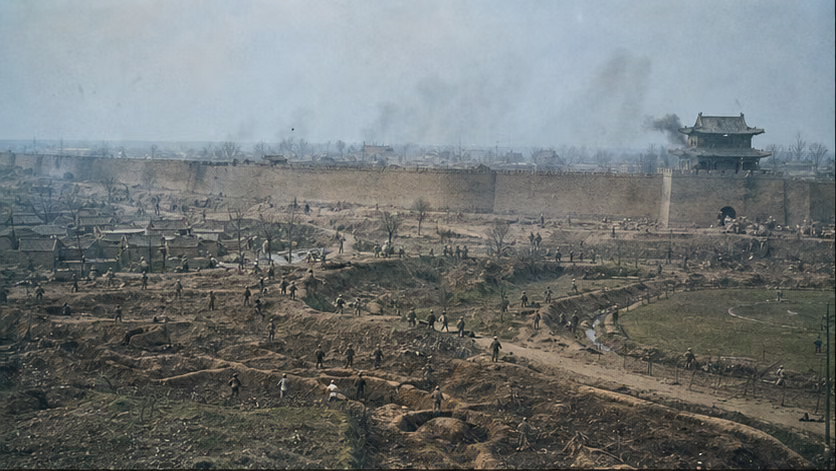
| Item | Content |
|---|---|
| Time | 1948.3.7 – 5.17, 72 days in all |
| Place | Linfen, Shanxi (southern Shanxi basin) |
| Part of | Chinese Civil War · Shanxi front in the strategic offensive phase (for the larger picture, see *Chinese Civil War · Overview*) |
| Attacker | Forward Command Post of the Shanxi-Hebei-Shandong-Henan Military Region (commanded by Xu Xiangqian), controlling the Eighth and Thirteenth Columns and elements of the Taiyue and Luliang Military Regions, about 53,000 men |
| Defender | Linfen garrison under the Taiyuan Pacification Headquarters (commander-in-chief Liang Peihuang), about 25,000 men (including Yan Xishan-line 66th Division, Hu Zongnan-line Reorganized 30th Brigade, and security units; composition details unrecorded) |
| Result | On 5.17 tunnel demolitions collapsed the wall, the garrison was annihilated, and Linfen was liberated; the Eighth Column's 23rd Brigade received the title "Linfen Brigade" |
Belligerents
| Item | Attacker | Defender |
|---|---|---|
| Strength | About 53,000 men, mostly newly upgraded from local forces and guerrilla units; most had not fought major engagements | About 25,000 men, a mix of regular army and security regiments, in the psychology of a trapped force |
| Firepower | No heavy artillery; a small number of mountain guns and mortars, relying mainly on explosives, grenades, and light machine guns | Comparatively strong artillery fire based on the city's defenses, with ample ammunition reserves (details unrecorded) |
| Works | None--the works had to be dug: approach trenches, communication trenches, and tunnels | Three-layer system: outer pillbox groups, outer ditch and electric wire, and an ancient city wall about ten meters high (the concrete figures for wall height and ditch depth remain disputed); Linfen had long been known as "Crouching Ox City," and its defenses had been maintained for years |
| Logistics | Supported nearby by the southern Shanxi base area, with large numbers of civilian laborers (front-support scale unverified) | A lone city without relief, but with abundant grain and ammunition stockpiled |
Terrain and Conditions
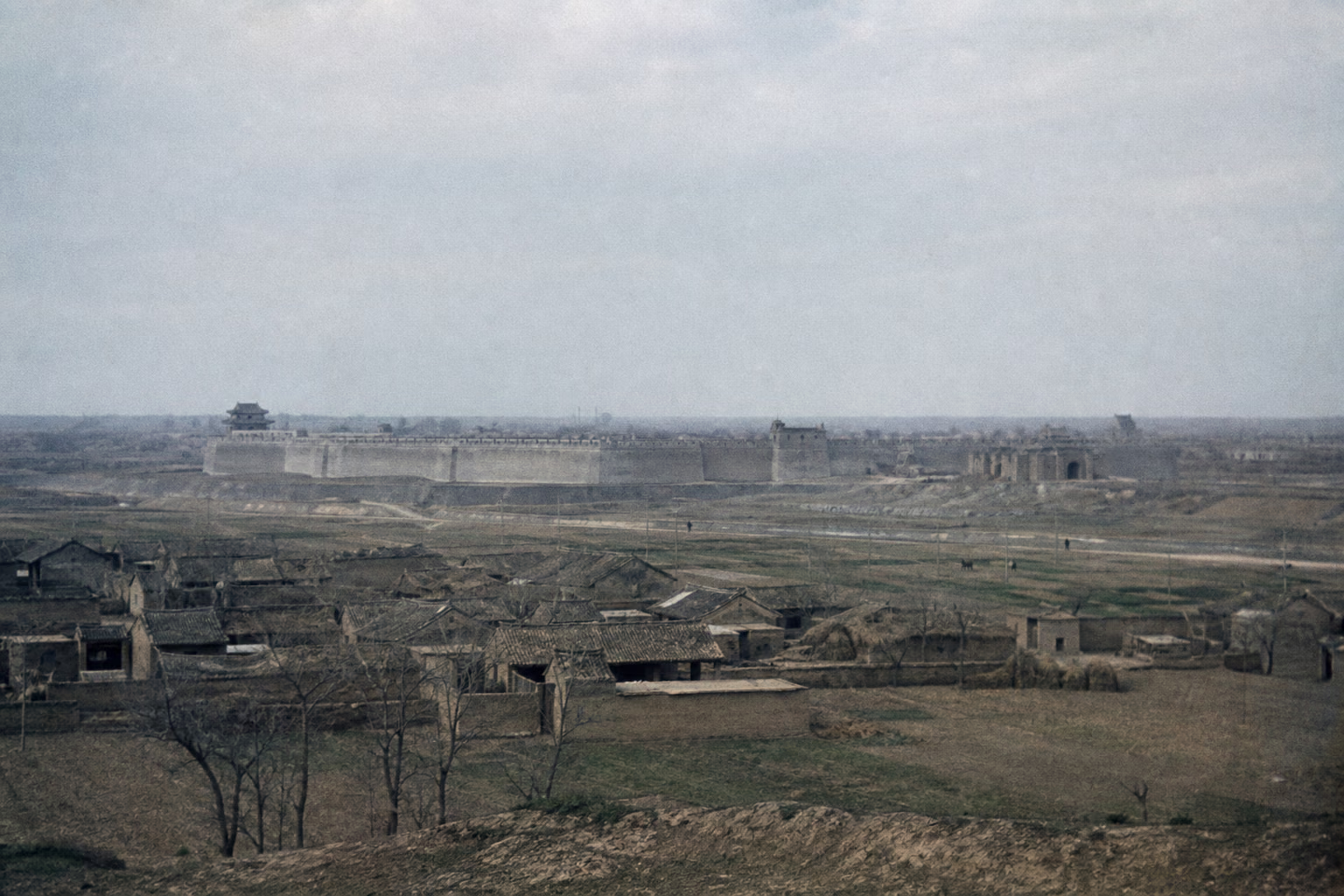
(For the larger situation in the spring of 1948--stalemate on the Central Plains front and Yan Xishan's forces contracting into points and lines within Shanxi--see *Chinese Civil War · Overview*; this section covers only southern Shanxi.)
Southern Shanxi: after Yuncheng was liberated at the end of 1947, Linfen was Yan Xishan's last major stronghold in southern Shanxi, and also a nail driven into the heart of the Shanxi-Hebei-Shandong-Henan base area--if it was not pulled out, the base area's flank and rear would remain unsettled, and the troops could not free their hands to move north into Jinzhong.
This city: Linfen's city wall was an old one dating from the Ming period onward, with high walls and deep ditches; outside the city, Dongguan was a natural forward fortress, and villages beyond the gate were dense. Yan Xishan had managed Shanxi for thirty years, and Linfen's defenses had been built up with pillbox groups, outer ditches, and electric wire; the defenders trusted that it was "solid as a fortress of metal and a moat of boiling water" (defender propaganda wording, unverified).
Why It Was Fought
After nine and a half brigades had been destroyed in succession in southwestern Shandong, Liu and Deng's 120,000-strong army threw off its rear area and drove all the way into the Dabie Mountains; Chen Geng and Xie Fuzhi's group followed by advancing into western Henan. In the second half of 1947, the main force of Shanxi-Hebei-Shandong-Henan thus moved outward one after another, carrying the war into Nationalist-controlled areas. Left at home were Xu Xiangqian and a force newly upgraded from local troops and guerrillas--some 50,000 men, most of whom had not fought major engagements, without heavy artillery. The farther the outer-line forces went, the clearer the inner-line task became: pull out, one by one, the remaining enemy strongpoints inside the base area.
Among southern Shanxi's strongpoints, after Yuncheng was liberated at the end of 1947 only Linfen remained. The city was nailed into the heart of the Shanxi-Hebei-Shandong-Henan base area; if it was not removed, the base area's flank and rear would remain uneasy, and the troops could not free their hands to move north into Jinzhong. It was also the hardest nail: the old city wall handed down from the Ming period was about ten meters high; outside the city, pillbox groups, outer ditches, and electric wire were layered one over another; the name "Crouching Ox City" had been used for centuries; and Yan Xishan, after thirty years of managing Shanxi, had made it the last lock on southern Shanxi. The defenders trusted that it was "solid as a fortress of metal and a moat of boiling water" (defender propaganda wording, unverified).
Xu Xiangqian wanted more than the city. His choice was to wait for no one and depend on no one: not to wait for the outer-line main force to return, and not to depend on higher command assigning fresh elite troops, but to use this "secondary force" to take on hard fighting on its own initiative--first Yuncheng, then Linfen, destroying the inner-line enemy one by one and building the troops' capacity for assaults on fortified positions. The harder the objective, the harder the troops produced by it. This was another verification of his army-building line of "turning local forces into main forces" (to be read together with his command genealogy from the Fourth Front Army period in *Battle of Sujiabu* and *Sichuan-Shaanxi Counter-Encirclement*). Inside the city, commander-in-chief Liang Peihuang had about 25,000 men under him: Yan Xishan-line 66th Division, Hu Zongnan-line Reorganized 30th Brigade, and security units mixed together (composition details unrecorded). The lone city had no relief, but grain and ammunition had been amply stockpiled. The defenders staked everything on the city defenses: opposite them were 50,000 new troops who had never fought major engagements and had no heavy artillery, who therefore should not be able to gnaw through a ten-meter wall. They had only half calculated correctly--the city truly could not be gnawed open by charges; later, the attackers came through from beneath the ground.
On March 7, 1948, the attacking troops tightened the encirclement from the directions of Yicheng and Quwo. The seventy-two days are counted from that day.
Course of the Engagement
| Phase | Time | Key Points |
|---|---|---|
| Clearing the perimeter | 3.7 – early April | Tightening the encirclement from the directions of Yicheng and Quwo, clearing outer pillbox groups point by point; the troops paid their first casualty tuition in assaulting pillboxes |
| Taking Dongguan | 4.10 – 4.11 | Tunnel demolition against the Dongguan wall, followed by two days and nights of bloody fighting to take Dongguan (date and explosive charge unverified)--with Dongguan taken, one layer was torn off the defensive system |
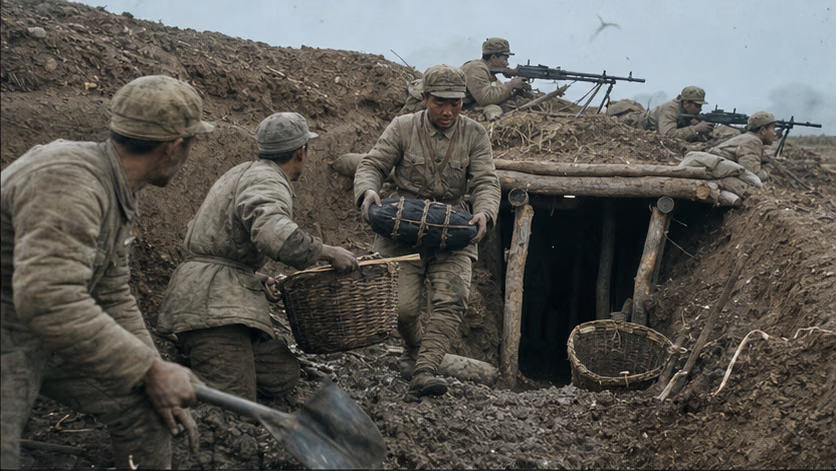
| Approach trenches and counter-tunnels | mid-April – mid-May | The main body of this engagement was not charging, but earthwork: the attackers dug approach trenches and communication trenches all the way to the foot of the city wall; the defenders countered with counter-tunnels, listening jars, flooding, and poison (details of the defenders' counter-tunnel methods unrecorded), and the fighting continued both above and below ground. When one main tunnel was destroyed by the defenders, another was dug; engineer and infantry casualties were very heavy |
| Demolition and wall collapse | Evening of 5.17 | Two main tunnels had been packed with explosives (more than 10,000 jin of black powder in all--the figure of 12,400 jin remains unverified); on the 17th at 19:00 (time unverified), they were ignited, blowing two breaches of several dozen meters each in the wall (breach dimensions unverified); assault troops poured in, street fighting continued deep into the night, and the garrison was annihilated |
Casualties and Losses
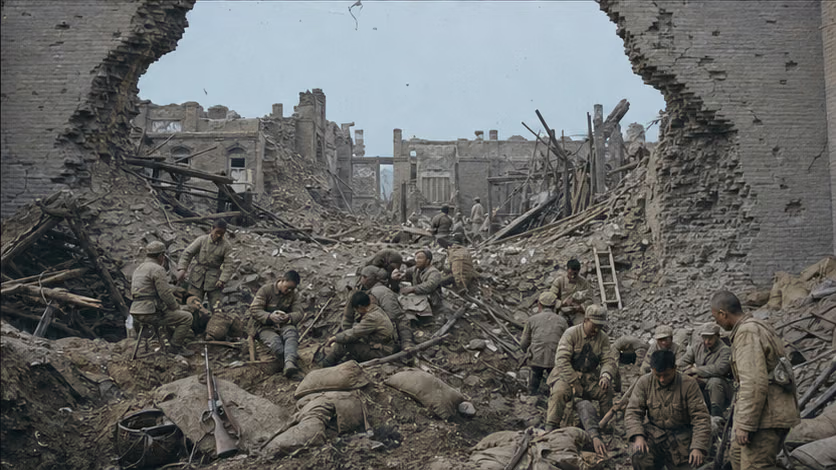
- Attacker: about 15,000 casualties (statistical bases vary by account; including the perimeter, Dongguan, and earthwork phases)--a battle in which 50,000 attacked 20,000 and still suffered casualties this heavy, because there were no guns.
- Defender: most of the roughly 25,000-man garrison was destroyed, and part was captured (Liang Peihuang was captured; details unverified).
- City and civilians: the seventy-two-day siege and street fighting caused severe damage to the urban area (damage list and civilian casualties unverified).
Aftermath
- All of southern Shanxi was liberated, and the interior of the Shanxi-Hebei-Shandong-Henan base area was joined into one piece; Xu Xiangqian's corps then moved north, and one month later opened the Battle of Jinzhong (see *Battle of Jinzhong*).
- The Eighth Column's 23rd Brigade received the title "Linfen Brigade"--one of the honor-unit designation lines used by the People's Liberation Army down to the present (the brigade is now a certain Army brigade; details of the honor title's transmission remain unverified).
- The experience of tunnel assault was systematically summarized and reported upward, becoming important teaching material for the later Battle of Taiyuan (1948–49) and for assault training across the army (Mao Zedong once introduced the Linfen experience to the whole army--original telegram text unverified).
- Xu Xiangqian's "secondary force" was thereby recognized as a main force--the army-building sample of "turning local forces into main forces" was confirmed in this engagement.
Accounts of Those Present
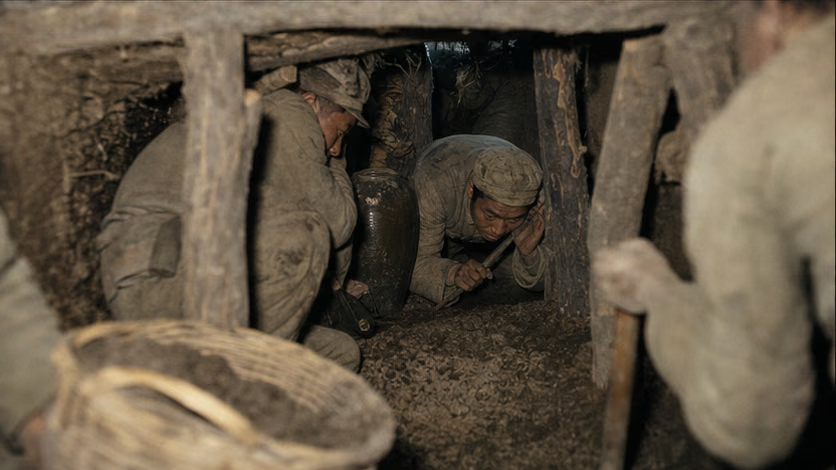
- The war beneath the ground: in the tunnels, men could not straighten their backs; they knelt to load soil and pass baskets of earth, with oxygen shortage, cave-ins, groundwater, and instant death at a touch. Once the defenders' counter-tunnel broke through, the two sides fought with bayonets and spades inside underground passages only a few meters wide (specific battle examples come from participant recollections, unverified).
- Listening jars: the defenders buried water jars along the city wall to listen for the sound of digging and determine direction--earth methods against earth methods, a miniature of the whole engagement.
- Xu Xiangqian's resolve: because casualties were heavy and the attack had long failed to break through, there was discussion during the campaign about "whether to withdraw first" (unverified here); the gist of Xu Xiangqian's answer was that "Linfen must be taken; once it is taken, the troops will have been tempered" (original wording unverified). Zhu De once sent a telegram to ask about the battle and remind the commanders to cherish the troops (corresponding telegrams unverified).
- The night of ignition: at the mouth of a tunnel packed with ten thousand jin of explosives, after detonation "the earth shook," and defenders still alive on the wall amid smoke and dust were dug out of the earth and captured by follow-on troops (the scene description comes from the memoir layer, unverified).
The Ground
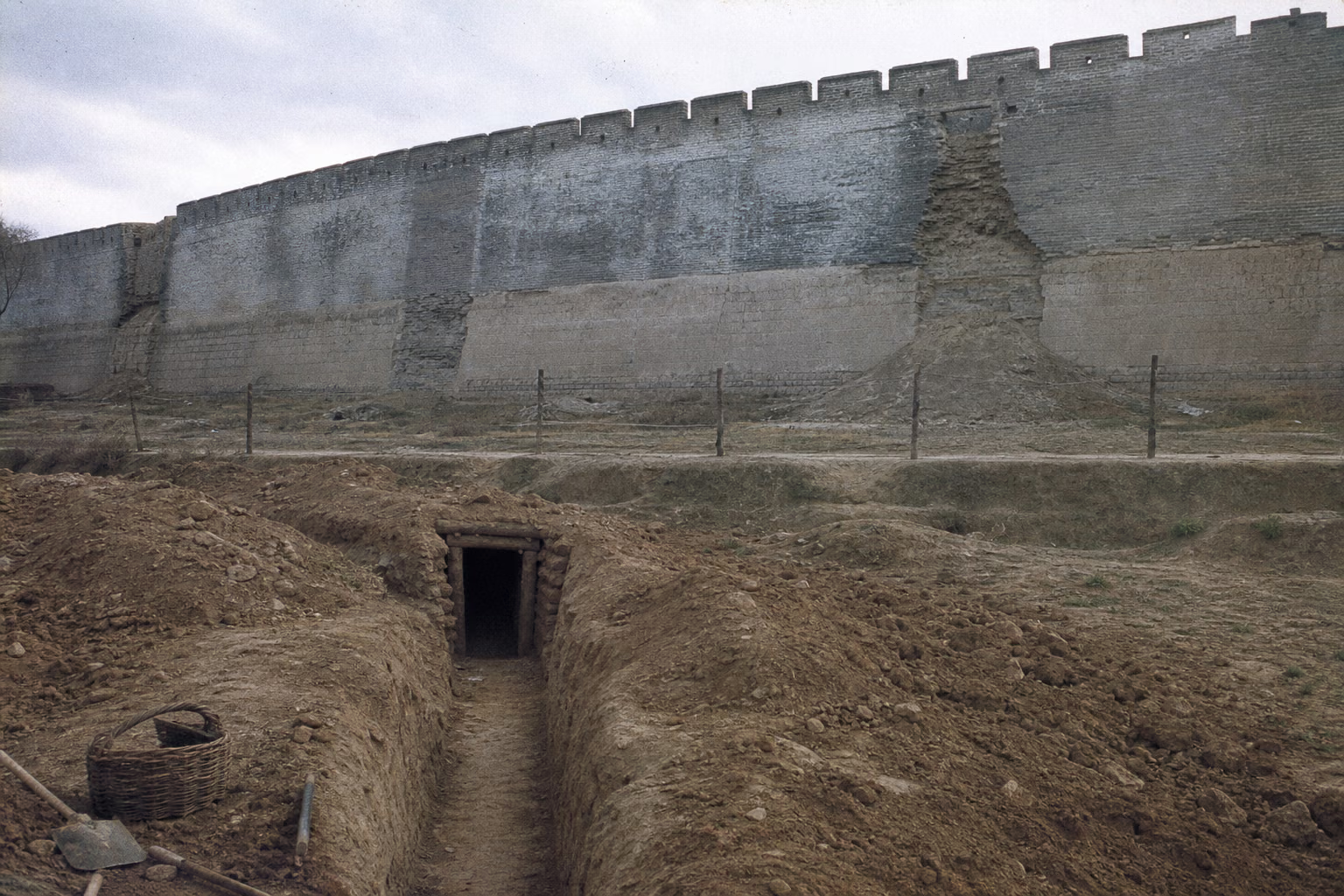
- Three-layer city defense: outer pillbox groups (village strongpoints) -> outer ditch and electric wire -> ten-meter-class ancient city wall--an assault line that peeled away the layers one by one.
- Dongguan: a forward fortress independent of the main city, the first piece to be gnawed off.
- Underground battlefield: approach-trench networks, tunnels, and counter-tunnels--the decisive hand of the whole battle lay under invisible layers of earth, an extremely rare space of "two-way digging."
- Demolition breaches: the two wall breaches, each several dozen meters wide, were the final assault passages and also the visual climax of the whole engagement.
How Each Side Records It
- Mainland: treated as a classic case of urban assault in the Chinese Civil War; the spirit of the "Linfen Brigade" ("assault on fortified positions" and "earthwork") was written into military history and unit-tradition education; Xu Xiangqian's "turning local forces into main forces" is the common evaluation.
- Taiwan: recorded as one link in the loss of southern Shanxi in the war-history literature on pacification, with Liang Peihuang's defense of the city for more than seventy days generally receiving affirmative treatment (specific Taiwan-side wording unverified).
- Third-party/scholarship: specialized attention has been paid to the military-technical history significance of tunnel tactics (specific literature to be added).
Disputes and Sensitivities
- Casualty statistical basis: 15,000 attacker casualties is the commonly used figure, but the breakdown by phase and whether civilian-laborer casualties are included remain unverified; the account that "without heavy artillery, lives were exchanged for it" stands, but the concrete exchange ratio should not exceed archival support.
- Records of the defenders using "flooding and poison" against tunnels, and of forcibly conscripting civilian laborers to repair the city defenses, come from attacker-side materials and require cross-checking with Taiwan-side and Yan Xishan-side archives (unverified here).
- Materials on food inside the city and the condition of civilians during the siege are scarce (unverified here)--the civilian side of siege warfare is currently a blank in this article and should be supplemented by later verification.
- Tunnel excavation included concrete operational links such as resources, cave-ins, and counter-tunnel confrontation, but the ledger of "explosives in exchange for lives" must not be romanticized.
Sources and Open Questions
Known main sources:
- *Xu Xiangqian Memoirs* (firsthand recollections on assault decisions and command)
- *Linfen Brigade* battle history and the unit history of the Eighth Column's 23rd Brigade (unit-level materials)
- Academy of Military Science, *History of the Chinese People's Liberation Army* (official account)
- Statements and memoir materials by Liang Peihuang and other defender-side personnel (to be checked)
Open questions: concrete data on Linfen's defensive works (wall height, ditch depth, number of pillboxes); Dongguan demolition date and explosive charge; number and length of main tunnels and final explosive charge (source of the 12,400-jin account); demolition time and breach dimensions; statistical bases for both sides' casualties by category; details and later fate of Liang Peihuang's capture; details of defender counter-tunnel methods; telegrams between Xu Xiangqian and Zhu De; original order granting the "Linfen Brigade" title and the transmission of the honor title; civilian conditions during the siege; corresponding Taiwan-side war-history entries.
All images on this site are AI-generated depictions. They are not historical photographs, not primary sources, and do not depict any real individual.