Engagement Archive · Battle of Taiyuan (1948–49)
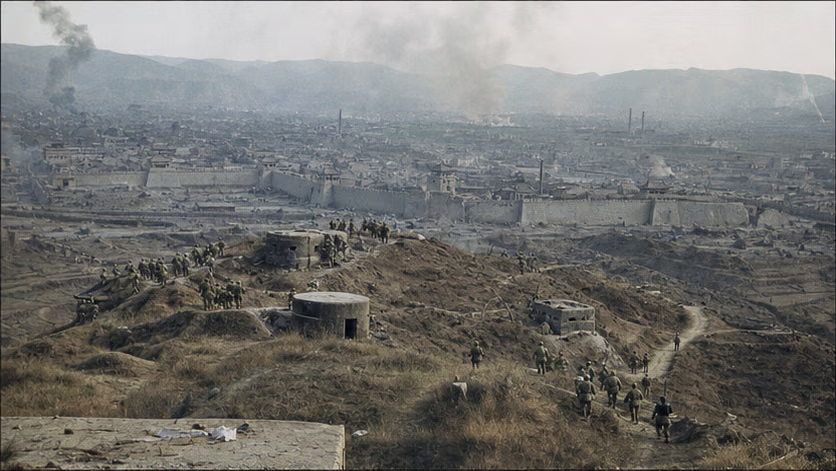
Yan Xishan spent thirty-eight years turning Taiyuan into a city of pillboxes; the People's Liberation Army spent six months and twenty days, and paid 45,000 casualties, to take it--the longest siege of the Chinese Civil War, its costliest assault on fortified positions, and the end point of "pillboxism."
Engagement Data
| Item | Content |
|---|---|
| Time | 1948.10.5 – 1949.4.24, more than half a year--the longest urban assault of the Chinese Civil War |
| Place | Taiyuan, Shanxi, and its perimeter (the Dongshan fortress group formed the core of the struggle) |
| Part of | Chinese Civil War · North China Theater (linked in the middle and late stages with the Pingjin Campaign) |
| Defender | Taiyuan Pacification Headquarters: Yan Xishan (left the city in 1949.3); inside the city, Liang Huazhi, Wang Jingguo, Sun Chu, and others directed affairs |
| Attacker | First Corps of the North China Military Region (Xu Xiangqian, commanding while ill); in spring 1949 reinforced by the 18th Corps, 19th Corps, and 20th Corps, plus part of the Fourth Field Army artillery |
| Result | On the morning of 4.24 the city was breached in four hours; 138,000 defenders were destroyed (mainland military-history statistical basis, unverified), and the overall situation in Shanxi was thereby settled |
Belligerents
| Item | Defender | Attacker |
|---|---|---|
| Strength | About 100,000 in the early stage (figures vary by account) | Xu Xiangqian's corps had about 80,000 in the early stage (figures vary by account); before the general assault, strength rose to 320,000 |
| Works | A "pillbox city" built over 38 years: more than five thousand pillboxes, large and small (figures vary by account), with the outer fortress group and city-wall works forming a single system | Artillery for assaulting fortified positions: about 1,300 guns at the time of the general assault (figures vary by account), including the artillery group brought into Shanxi by the Fourth Field Army |
| Supply | A lone city, supplied by air; the later the siege went, the less that supply could connect | Backed by the liberated areas, besieging while stockpiling; the longer the siege lasted, the thicker the attacking side became |
| Command | Yan Xishan directed remotely after flying out in March; inside the city were Liang Huazhi, Wang Jingguo, and Sun Chu | Xu Xiangqian commanded from a stretcher while ill (pleurisy / tuberculous pleurisy, diagnosis unverified) |
| Special | Retained Japanese-nationality military personnel fought to the end (Imamura Hosaku and others, unit personnel count unverified) | -- |
Terrain and Conditions
(The larger situation in one sentence: from autumn 1948 to spring 1949, the three great campaigns unfolded in succession, and KMT rule on the mainland reached its end--see *Chinese Civil War · Overview*; this article covers only Shanxi and Taiyuan.)
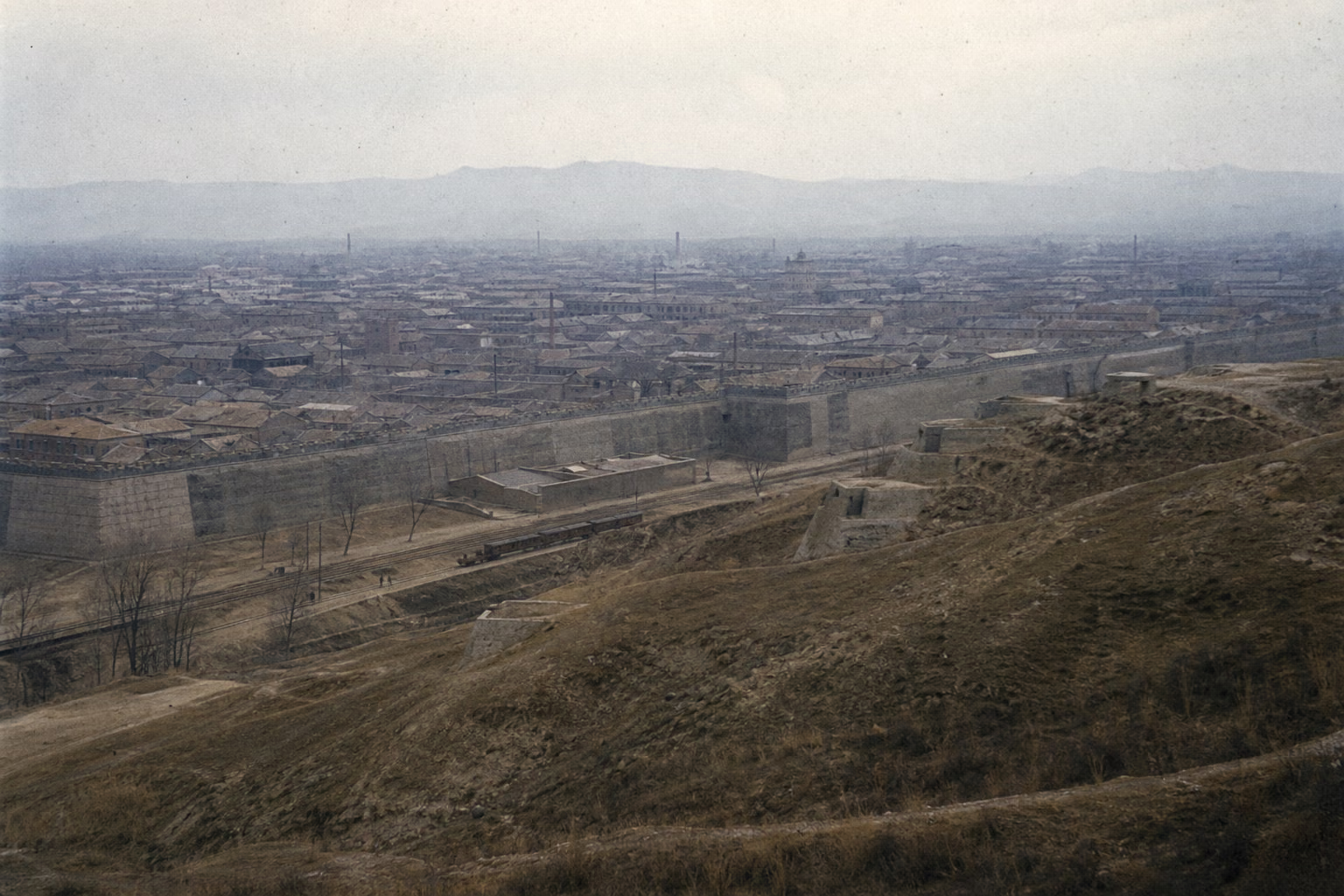
Shanxi: Yan Xishan's independent kingdom. Yan had governed Shanxi since 1912 and managed it for 38 years--narrow-gauge railways, arsenals, pillboxes, and a self-contained military-political machine. In the Battle of Jinzhong in June-July 1948, Yan's main force was destroyed in the field (the Battle of Jinzhong is treated separately, unverified here), leaving Shanxi with only the isolated city of Taiyuan and the isolated point of Datong.
This city: Taiyuan was one of North China's few major industrial centers, and the Taiyuan Arsenal ranked among the significant arsenals of North China (details unrecorded). After the defeat in Jinzhong, Yan Xishan drew the remnants of his forces into the city and resolved to hold it to the death behind fixed works; through half a year of siege, civilians and defenders were trapped in the same city--for the civilian account, see the casualties section ※.
Why It Was Fought
Eleven days after Jinan fell, the war returned to Shanxi. By the close of the Battle of Jinzhong, Xu Xiangqian's spearhead had already reached the near outskirts of Taiyuan: Yan Xishan's main force had been used up in the field, Shanxi had only the isolated city of Taiyuan and the isolated point of Datong left, and Taiyuan had only the work of defending the city left to it.
For the People's Liberation Army, if Taiyuan was not taken, a nail would remain in North China's flank and rear, and Yan's forces were the most intact surviving force among the old warlord armies; Taiyuan was also one of North China's few major industrial centers, and the arsenal inside the city was still making guns and ammunition for the defenders. For Yan Xishan, Taiyuan was all the capital he had accumulated over 38 years: since he began governing Shanxi in 1912, he had built the province into a self-contained independent kingdom--narrow-gauge railways, arsenals, pillboxes--and after the defeat in Jinzhong, that whole system contracted into one city, with more than five thousand pillboxes, large and small (figures vary by account), and fortress groups joined to the city walls as one. His military philosophy put fixed works above mobility, and "pillboxism" answered every change with the same unchanged form--the city was his life. His public posture was to "live or die with Taiyuan" (original wording of the pledge unverified).
Xu Xiangqian wanted to strike while the iron was hot: the remnants newly defeated at Jinzhong had just been pulled into the city and were still unsettled; the lone city's supply depended only on air transport, and every added day made it thinner. In the early stage he had about 80,000 men (figures vary by account), fewer than the defenders--about 100,000 on the defending side (figures vary by account), whose organization also included retained Japanese-nationality military personnel (Imamura Hosaku and others, unit personnel count unverified). The attacking side's capital was the craft of assaulting fortified positions and the momentum of victory accumulated at Linfen and Jinzhong. The defending side's calculation was to make five thousand pillboxes take lives one by one, and to drag a quick decision into stalemate. This was a collision between two conceptions of war: one side believed that soldiers were made by fighting and that assault on fortified positions could be learned; the other believed that fixed works were superior to mobility, and that concrete could answer every change without changing. Later military histories would call the latter "the bankruptcy of pillboxism," but in October 1948 that account had not yet begun to be reckoned. This battle could not be avoided: Yan Xishan had nowhere to go, and outside Shanxi he was nothing; the People's Liberation Army could not go around it either. If North China was to be brought to a close, Taiyuan was the last nail, and the hardest one.
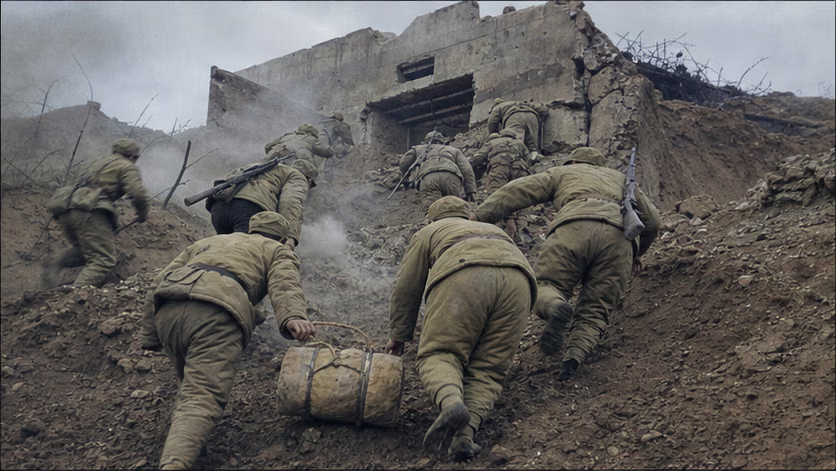
How the battle would be fought was being decided for both sides by the arsenal inside Taiyuan and the hills outside the city. In the early stage the attacker had 80,000 men and insufficient heavy artillery, so shells had to be used where they mattered most; the troops therefore used again the skills learned at Linfen and Jinzhong: dig tunnels, send in explosives, and trade for each pillbox one by one. Grain and ammunition were carried over the mountains from the old base areas of Jinzhong and Luliang; through the half-year siege, the grain-transport and stretcher teams supporting the front were always more numerous than the troops themselves (front-support scale details pending verification). The defender's boundary lay in the sky: the lone city's supply depended only on air transport, the airdrop field inside the encirclement kept shrinking, and the arsenal could make bullets but not food. The original date for opening the attack was later, but in early October the defenders came out of the city to seize grain, and Xu Xiangqian decided to begin ahead of schedule (the decision process for the early opening and the original planned date remain unverified)--the first shot was fired at the door of the granary. By December, a telegram from the center held the tempo down: to stabilize Fu Zuoyi at Pingjin, Taiyuan was to be attacked slowly (original text of the slow-attack order unverified)--the nail was left in place first so that the 500,000 men at the other end of North China would not dare move. On the defender's side there had been another road on the table: Huang Qiaosong, commander of the 30th Army, secretly made contact about an uprising, but the matter was exposed, he was arrested, and he was taken to Nanjing and executed (the informant and contact details pending verification). After that, no one in the city spoke again of peace. Whether the attacking side had objections to the slow attack is not seen in public records.
On October 5, Xu Xiangqian's corps moved north on the strength of victory at Jinzhong, and the fighting began along the Xiaodian Town line south of the city. From that day to the city's fall, six months and twenty days remained.
Course of the Engagement
| Phase | Time | Key Points |
|---|---|---|
| Initial fighting on the perimeter | From 10.5 | Xu Xiangqian's corps moved north on the strength of victory at Jinzhong; the fighting began along the Xiaodian Town line south of the city, and the perimeter was cleared (details unrecorded) |
| Bloody fight for the four great forts | Mid-October – mid-November | High ground on Dongshan: Niutuozhai, Xiaoyaotou, Naoma, and Shantou--explosive-charge assaults from pillbox to pillbox and fort to fort, with positions changing hands repeatedly; casualties on both sides were heavy (details unrecorded); Xu Xiangqian commanded at the front while lying on a stretcher |
| Long siege and prolonged encirclement | 1948.12–1949.3 | The Central Military Commission, in order to stabilize Fu Zuoyi's group at Pingjin, ordered Taiyuan to be attacked slowly (part of the same move as "besieging without attacking" at Pingjin--see *Pingjin Campaign · Overview*); the operation shifted to siege, trench and tunnel work, and political offensives (details of defenders coming over and disintegration unrecorded) |
| Reinforcement and general assault | 1949.4 | The North China 19th Corps and 20th Corps and the Fourth Field Army artillery entered Shanxi; total strength rose to 320,000 and artillery to about 1,300 guns (figures vary by account); on 4.20 the perimeter was cleared |
| Breach of the city | 4.24 | Before dawn, a thousand guns bombarded the city walls at once; infantry scaled the walls from all sides, and the city was breached in about four hours (specific sequence unverified); Wang Jingguo and Sun Chu were captured; Liang Huazhi and others killed themselves (see the disputes section) |
Casualties and Losses
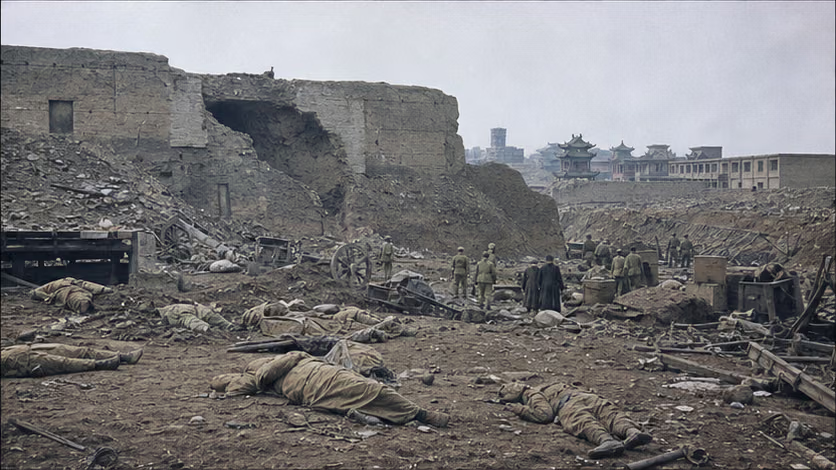
- Attacker: the People's Liberation Army suffered 45,000 casualties (mainland military-history statistical basis, unverified; no corresponding Taiwan-side statistic)--the highest cost of any single assault on fortified positions in the Chinese Civil War, with more than half spent among the pillbox groups of the four great forts.
- Defender: 138,000 were destroyed (mainland military-history statistical basis; the breakdown of killed, wounded, and captured, and the statistical boundary, remain unverified). The Yan-line Shanxi Army, as an independent warlord force, ended here.
- ※ Civilians: during the half-year siege, grain prices inside the city soared, civilians were hungry and trapped, and there is no settled figure for those who starved to death (figures vary by account); much of Yan-side airdropped grain and ammunition went to the army, and civilian rationing details are unrecorded. The first sufferers were the ordinary civilians trapped inside the city; this is not a matter for satisfaction.
Aftermath
- Except for the isolated point of Datong (soon resolved peacefully, sequence unverified), all of Shanxi changed hands; fighting in the North China Theater was basically brought to a close.
- After Yan Xishan left, he moved through Nanjing and Guangzhou, and for a time served as president of the Executive Yuan (his later mountain residence and writing after going to Taiwan are one further note, unverified); the pledge to "live or die with Taiyuan" remained in the city.
- Xu Xiangqian entered a long period of convalescence after this battle--from the forty-eight-day siege at Sujiabu in 1932 to the half-year assault on Taiyuan in 1949, his command genealogy began with siege and ended in assault on fortified positions.
- Taiyuan was a city taken purely by fighting, and at extremely heavy cost--precisely the opposite example to the contemporary "Beiping method": both were isolated cities, but one was negotiated for sixty-four days, while the other was fought over for half a year (see also *Pingjin Campaign · Overview*).
- The Taiwan-side narrative of the "Five Hundred Perfect Men of Taiyuan" was later commemorated with a stele and enshrinement (1950s, details pending verification), becoming a foremost example of the loyal-martyr discourse of the Pacification period (see the next two sections).
Accounts of Those Present
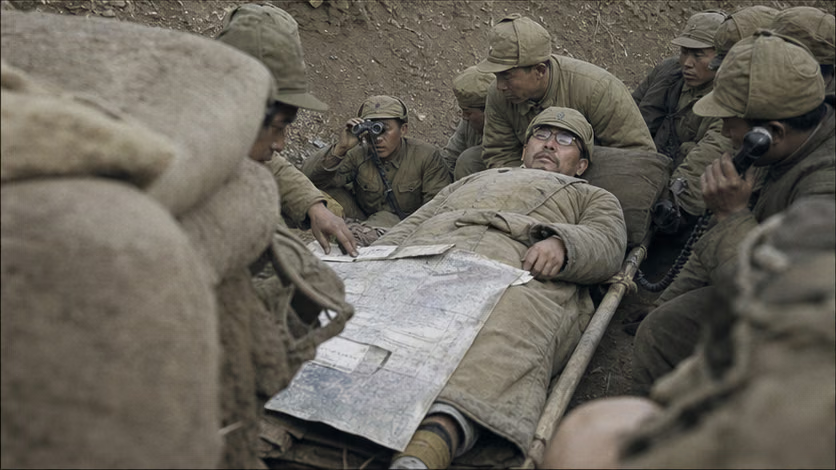
- The commander on the stretcher: Xu Xiangqian's pleurisy fever did not break, and he lay on a stretcher to study the terrain at Dongshan; before the city's fall, he held on through illness to reach the city approaches (original wartime telegrams during illness pending verification).
- Niutuozhai: the first of the four great key points on Dongshan; the main temple pillbox had to be chewed through by a heavy demolition charge (charge size and pillbox-by-pillbox details unrecorded)--the lesson "pillboxism" taught the attacker was learned gun by gun, and the tuition was paid in human lives.
- Liang Huazhi and Yan Huiqing: on the night before the city fell, they took poison in the underground room of the Pacification Headquarters and left instructions for their bodies to be burned (details unrecorded)--Yan Xishan's cousin, "Fifth Sister," failed to leave, and died in the city in place of the man who did leave.
- Imamura Hosaku: a retained former Japanese Army officer, who killed himself when the city fell (details unrecorded)--the final scene in which Japanese soldiers appeared in the Chinese Civil War; Yan Xishan's retention of former Japanese troops for combat is a layer of this battle that is seldom mentioned.
- Soldiers leaving the city: under the political offensive during the siege, defenders came out and surrendered by whole squads and platoons (figure disputed)--pillboxes could stop infantry, but they could not stop hunger and radio broadcasts.
The Ground
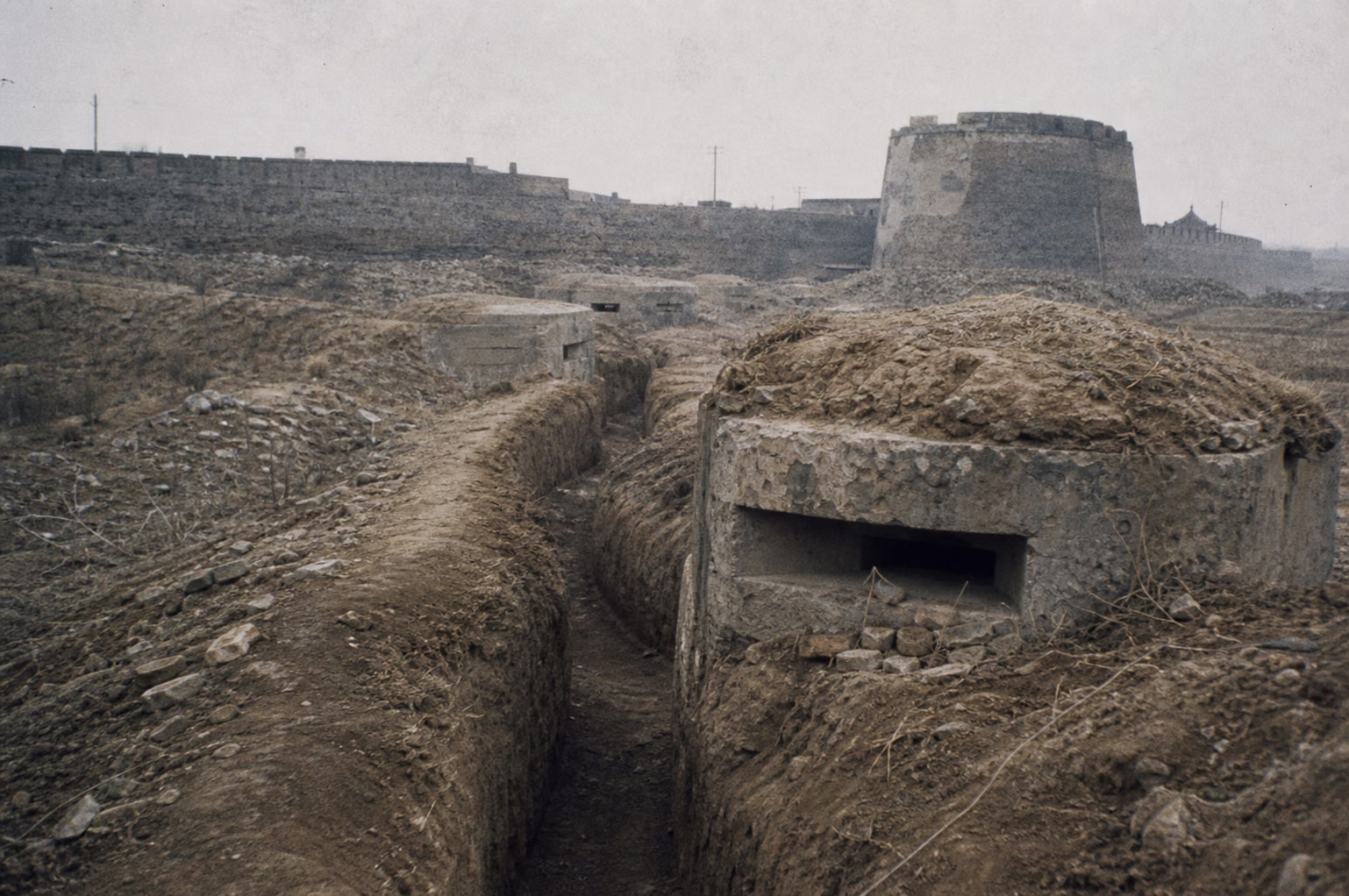
- The Taiyuan Basin, with Dongshan overlooking the whole city--whoever held Dongshan held Taiyuan: the four key points of Niutuozhai, Xiaoyaotou, Naoma, and Shantou controlled the routes through Dongshan and the positions for plunging fire.
- Pillbox system: plum-blossom pillboxes, mother-and-child pillboxes, and ground-hugging pillboxes, connected to one another by communication trenches, with depth of several kilometers (form and construction details unrecorded)--the "grammar of fortification" for an entire city, which the attacker could only dismantle one pillbox at a time.
- City walls: modern reinforced concrete had been added atop the old city base, with pillboxes inside and outside the walls; breaching the city depended on artillery opening gaps plus scaling from all sides.
- Siege space: on a half-year timescale, the city interior was a civilian society of hunger--like Changchun in being a siege, but sharply different in intensity (see the Liaoshen overview for details), and like Tianjin in being an assault on fortified positions, but sharply different in duration (see *Pingjin Campaign · Overview*).
How Each Side Records It
- Mainland: a "textbook of assaulting fortified positions" and the closing battle in North China's liberation; "the bankruptcy of pillboxism" is the standard comment on Yan Xishan's military philosophy.
- Taiwan side: the "Five Hundred Perfect Men of Taiyuan"--the narrative that five hundred civil and military officials collectively killed themselves for the state on the day the city fell, commemorated in Taipei with a stele and enshrinement in the 1950s (site of the stele and enshrinement details pending verification), long entered into textbooks, and became a foremost example of the loyal-martyr discourse of the Pacification period.
- Later textual criticism: the number and identities on the list, and the question of "voluntary / forced"--the list includes people who did not kill themselves, as well as people later confirmed to have still been alive (critical literature pending verification). Two memories on the two sides of the Strait for the same group of dead are themselves a sample of narrative war.
Disputes and Sensitivities
- "Five Hundred Perfect Men": the Taiwan-side loyal-martyr narrative conflicts with later textual criticism of the list; in the collective suicides, the proportions of voluntariness and coercion remain subject to two accounts. This concerns the characterization of individual dead, and is highly sensitive.
- Yan Xishan's departure: in 1949.3 he flew south with gold under the name of "going to the capital to discuss affairs of state together," after previously pledging to "live or die with Taiyuan" (original wording of the pledge unverified). The contrast needs no moral verdict--the fact itself is the verdict.
- Retained Japanese-nationality military personnel: just after the War of Resistance ended, Yan Xishan retained several thousand former Japanese military personnel to fight the civil war (personnel count and organization pending verification)--this layer is rarely mentioned by either side; it is where the ethics of national war and civil war overlap.
- The account of civilian hunger: the dual causality of defender stockpiling, insufficient airdrops, and the attacker's prolonged siege--not to be assigned to one side alone.
- Two sets of casualty figures coexist.
Sources and Open Questions
Known main sources:
- *Xu Xiangqian's Memoirs* (attacking-side commander perspective)
- Taiwan-side stele inscriptions and commemorative literature on the "Five Hundred Perfect Men of Taiyuan" (specific archival items pending verification)
- Biographical materials on Yan Xishan from both sides of the Strait (specific bibliography pending verification)
Open questions: statistical boundaries for the defenders' early strength and the figure of 138,000 destroyed; the statistical basis and source for the People's Liberation Army's 45,000 casualties; total number of pillboxes and details of their forms; point-by-point assault-and-defense sequence and casualties at the four great forts; original text of the slow-attack order; statistical basis for the general-assault strength of 320,000 and 1,300 guns; specific sequence of the city's breach; source records for the deaths of Liang Huazhi and Yan Huiqing; Imamura Hosaku and the organization and number of retained Japanese troops; critical literature on the "Five Hundred Perfect Men" list; figures and sources for civilian hunger during the siege; original wording of Yan Xishan's pledge to "live or die with Taiyuan"; original wartime telegrams from Xu Xiangqian during illness; sequence of the peaceful resolution of Datong; cross-reference relationship with the *Battle of Jinzhong*.
All images on this site are AI-generated depictions. They are not historical photographs, not primary sources, and do not depict any real individual.