Engagement Archive · Yangtze Crossing Campaign (incl. the Amethyst Incident)
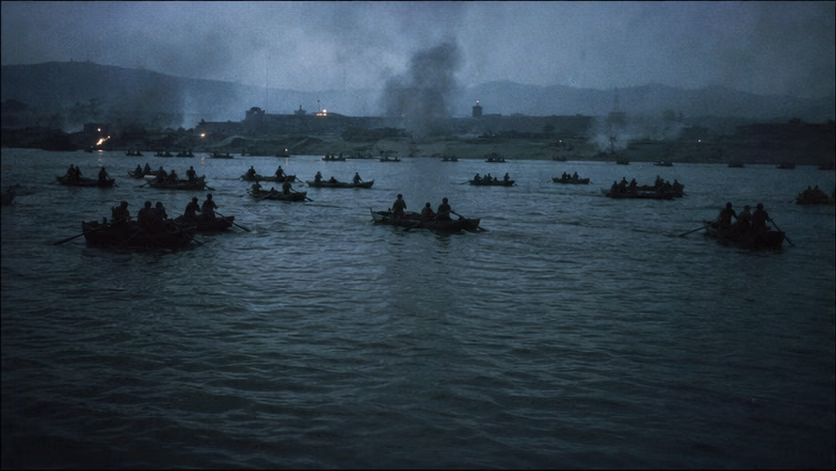
On the night the peace talks broke down, a million troops launched from a thousand-li river front at once -- the river defense was broken in three days, Nanjing was entered on the twenty-third, and the calendar in the Presidential Palace stopped in April. The uprising before the lines at Jiangyin Fortress opened the eastern sector; a British warship that had intruded into the war zone was hit by artillery: from Humen to the Amethyst, one hundred and nine years had passed, and the direction of the gun muzzles had finally changed.
Engagement Data
| Item | Content |
|---|---|
| Time | Night of 1949.4.20 – 4.23 (Nanjing taken); pursuit phase continued into early May (Langxi-Guangde encirclement and destruction) |
| Place | A thousand-li stretch of the lower Yangtze: three sectors from Hukou to Jiangyin (western, central, and eastern groups); Nanjing |
| Part of | Chinese Civil War (for the overall war, see *Chinese Civil War · War Overview*) |
| Attacker | One million men of the Second and Third Field Armies (five-member General Front Committee including Deng Xiaoping); Fourth Field Army advance elements made feints toward Wuhan |
| Defender | Tang Enbo group, 450,000 (Nanjing-Shanghai-Hangzhou), plus Bai Chongxi group, 250,000 (Central China); Second Fleet of the navy and Jiangyin Fortress |
| Result | Yangtze defense collapsed in three days; Nanjing changed hands on 4.23; on the Zhenjiang river reach, Lin Zun led 25 ships of the Second Fleet in uprising (another 23 fled east -- details of the fleet split unrecorded) |
Belligerents
| Item | People's Liberation Army | Nationalist Army |
|---|---|---|
| Strength | One-million-man crossing force plus hundreds of thousands of boatmen and civilian laborers (more than 10,000 wooden boats requisitioned -- the asymmetry of wooden boats crossing the river against warships) | 700,000 strung out along a thousand-li river line, thinning troop density |
| On the water | No navy -- relying on sail, oar, and a small number of motorized sailing craft | More than 100 warships cruising the river surface, with air force overhead |
| Variable | Jiangyin Fortress underground CPC operation (Tang Binglin and others -- the 7,000-man fortress rose before the lines and turned its guns around, instantly securing the eastern crossing sector -- the closing work of the intelligence front, level marked) | Wartime slackness during the peace talks and internal disintegration |
Terrain and Conditions
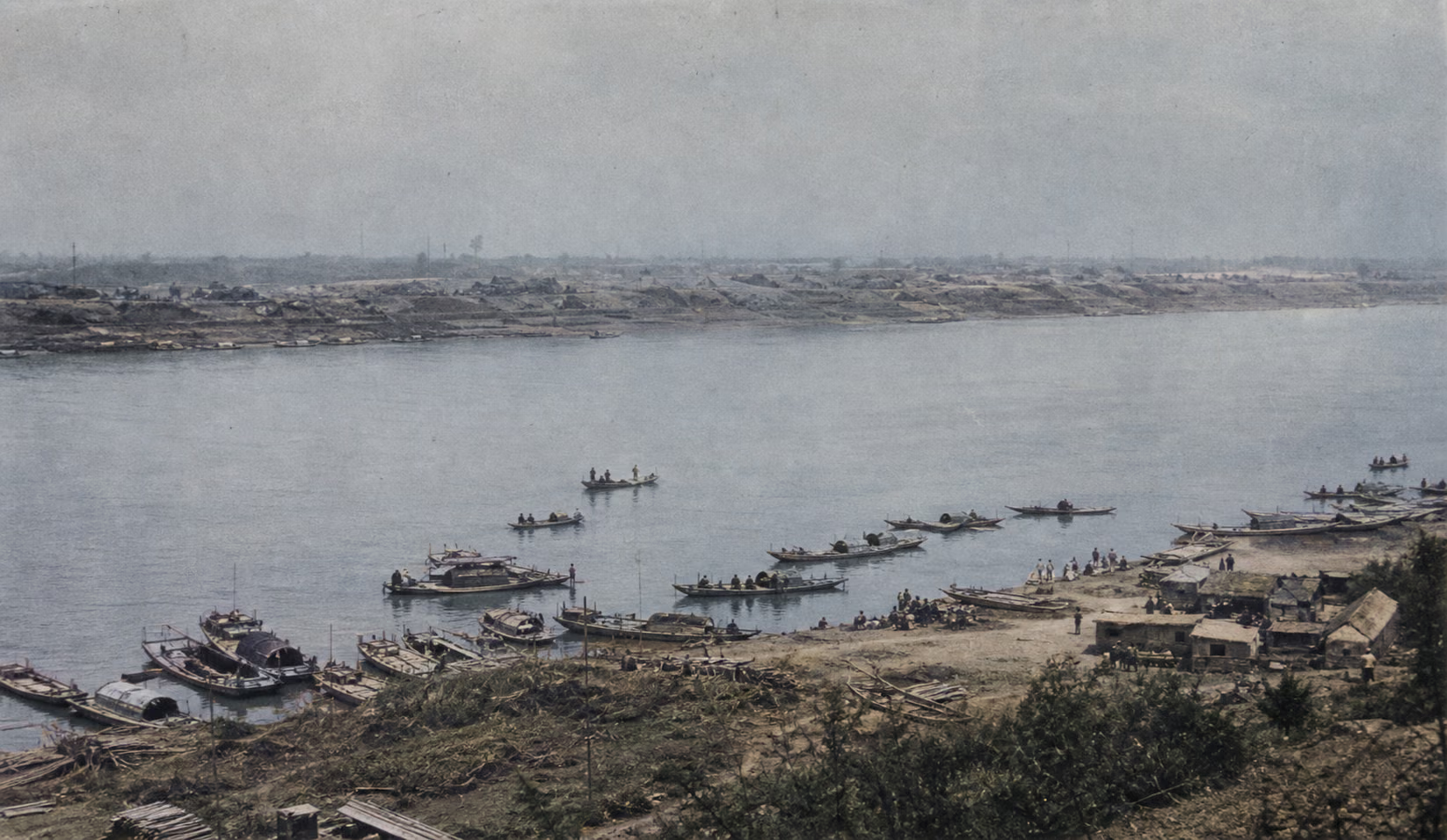
April 1949: the Beiping peace talks (Zhang Zhizhong delegation) and the final version of the *Domestic Peace Agreement* -- on 4.20 Nanjing refused to sign, and that night the order to cross the river was issued (the negotiation timetable meshed with the river crossing: refusal to sign meant launching the boats). Water conditions on the Yangtze before the spring flood, and the choice of crossing points along a thousand-li river surface; the reality and appearance of Nationalist river-defense works on the southern bank (records of inspection as mere formality remain to be checked); front-support mobilization in the liberated areas north of the river: boatmen joining the army with their boats (the casualty and award records of the "river-crossing boatmen" group remain to be checked).
Why It Was Fought
On the day Huaihai ended at Chenguanzhuang, the situation north of the Yangtze was already decided: on January 10, Du Yuming's group was destroyed; eleven days later Chiang Kai-shek announced that he was stepping down; on January 31, Beiping accepted peaceful reorganization, and Pingjin was settled. After the three great campaigns were finished, the Nationalist Army had no main force left north of the Yangtze. Nanjing held only one river, and 700,000 men strung out along a thousand-li line -- Tang Enbo's 450,000 defending Nanjing, Shanghai, and Hangzhou, and Bai Chongxi's 250,000 defending Central China.
So in the first months of 1949, the main battlefield moved to the negotiating table. Chiang Kai-shek stepped down, Acting President Li Zongren sought peace, Zhang Zhizhong's delegation went north, and talks opened in Beiping. Beneath the table, all sides knew what was being negotiated: there had been discussion of "rule divided by the river" (international background: rumors of Soviet advice for peace, level marking remains to be checked), and the CPC's answer had already been written in its 1949 New Year's message -- "carry the revolution through to the end"; Nanjing, meanwhile, used the peace talks to buy time, reorganize its forces, and lay out the river defense. Both sides treated negotiation as part of the war: if it succeeded, the army would cross the river without bloodshed; if it failed, breakdown would mean general assault.
If the fight was really to happen, it had to be in April. The Yangtze spring flood was approaching, and the crossing equipment for a million-man army consisted of more than 10,000 requisitioned wooden boats and hundreds of thousands of boatmen. Across the river, more than 100 warships cruised the water, with an air force overhead -- an asymmetrical river crossing of sail and oar against naval guns, and the window of water conditions could not be missed. The attackers also held a hidden card: the underground CPC organization inside Jiangyin Fortress had already completed its work. The 7,000-man fortress could turn its guns around at any moment; the gateway to the eastern sector hinged on this single move.
On April 20, the final version of the *Domestic Peace Agreement* was placed on Nanjing's table, and Nanjing refused to sign. That night, the order to cross the river was issued, and the central group launched its first boats along the Yuxikou-Zongyang sector -- refusal to sign meant launching the boats, and the timetables of negotiation and general assault meshed without a single day's gap.
In fact, "rule divided by the river" was another road once placed on the table. But to the CPC, that meant stopping halfway; to Nanjing, it was only a delaying tactic. Neither side truly believed in it -- the river could only be crossed by boat.
Course of the Engagement
| Phase | Time | Key Points |
|---|---|---|
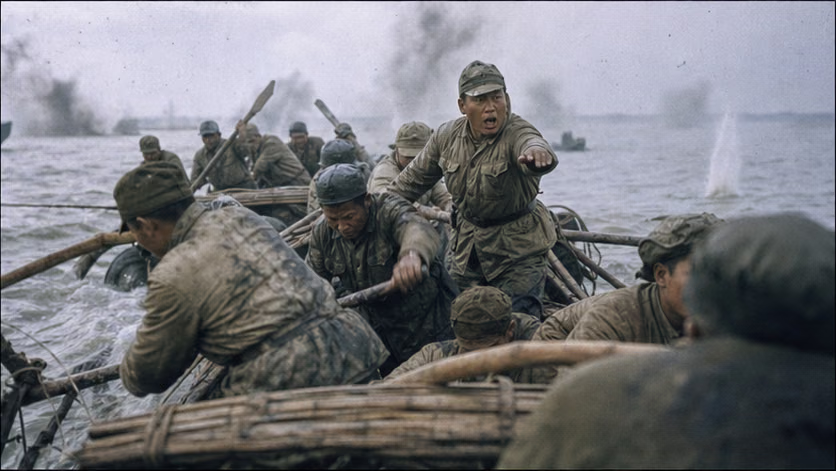
| Central group first crossing | Night of 4.20 | Tan Zhenlin's group set out first along the Yuxikou-Zongyang sector (the night of the refusal to sign -- the moment of the first boat) and broke the defense in one night |
| East and west advancing together | Night of 4.21 | The eastern (Su Yu) and western (Liu Bocheng) groups began the crossing simultaneously across a thousand-li front; the Jiangyin Fortress uprising turned its guns around, opening the eastern gateway wide; the western sector broke through along the Hukou-Anqing line |
| ※ Amethyst Incident | 4.20–21 | The British warship HMS Amethyst ignored warnings and intruded into the war-zone reach of the river, exchanging fire with PLA artillery: Amethyst was heavily damaged and grounded (her captain was wounded and later died), and the British reinforcing vessels Consort and London fought again and were damaged again -- more than 100 British troops killed or wounded (figures vary by statistical basis); PLA artillery casualties (figures vary by statistical basis); the century-long reversal of "a foreign warship being hit on China's inland river": Mao Zedong and Zhu De's statement and negotiations with Britain (Churchill's anger over "sending an aircraft carrier" and the Attlee government's restraint -- reactions in British politics remain to be checked); at the end of July, Amethyst escaped from the Yangtze by night (its "escape" narrative was honorable on the British side -- the misalignment of the two countries' narratives) |
| General collapse of the river defense | 4.22–23 | Tang Enbo ordered a retreat along the whole line; on the morning of 4.23, the Third Field Army's 35th Army (Wu Huawen's reorganized unit -- for the irony of an uprising unit entering the Presidential Palace first, see *Battle of Jinan*) entered Nanjing, and the flag over the Presidential Palace changed (the timing of 4.23/24 varies by account) |
| Langxi-Guangde encirclement and destruction | 4.26–5.1 | Five enemy armies, 80,000 men, withdrawing south were encircled and destroyed in the Langxi-Guangde mountain area -- the annihilation-battle ending of the river crossing (figures vary by statistical basis) |
Casualties and Losses
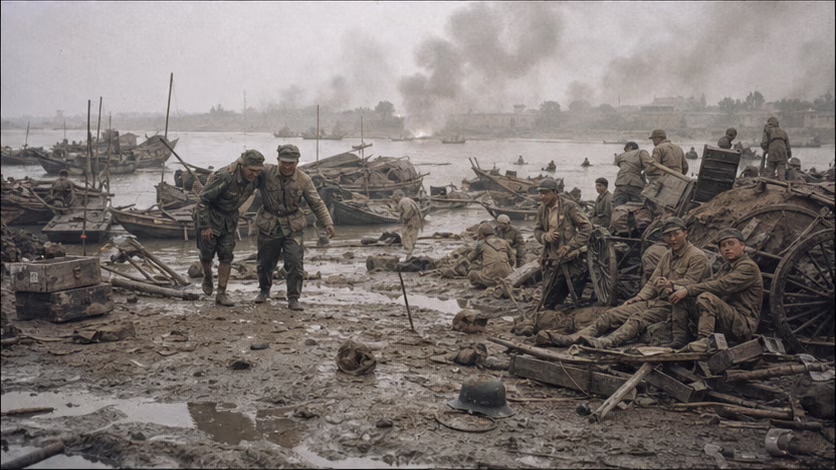
- Nationalist Army: the river-defense line collapsed, 80,000 were destroyed at Langxi-Guangde, and hundreds of thousands along the line scattered or surrendered (composition remains to be checked); the Second Fleet of the navy split.
- People's Liberation Army: casualties in the river-crossing fighting were relatively light (figures vary by statistical basis); boatman casualties ※ (the civilian-labor account of front support for the crossing, figures vary by statistical basis).
- ※ Civilians: the prior account of forced requisition of civilian boats and dismantling houses to build works in the river-defense zone (this point remains to be checked); looting by routed soldiers on the eve of Nanjing's change of hands ※ (records of Xiaguan and other places on the night before 4.23 remain to be checked) -- "the forty-eight hours of power vacuum."
Aftermath
- Nanjing: the Nationalist government moved to Guangzhou, then to Chongqing and Chengdu -- the image of "the Presidential Palace calendar" (historical verification of the April-calendar photograph remains to be checked); the citation line for the phrase "Wind and rain over Zhongshan rise pale-yellow" (original wording must be checked).
- The Battle of Shanghai followed (from 5.12); provinces south of the Yangtze changed hands in succession.
- The Amethyst Incident became a marker case in Sino-British relations and in the "end of gunboat diplomacy" (one stroke for the accelerator effect on Britain's recognition of China -- the connection line to Britain's recognition of New China in 1950.1, level marked).
- Lin Zun's uprising fleet became one founding line of the People's Navy (the origin of 4.23 as Navy Day -- the same day as the river crossing).
Accounts of Those Present
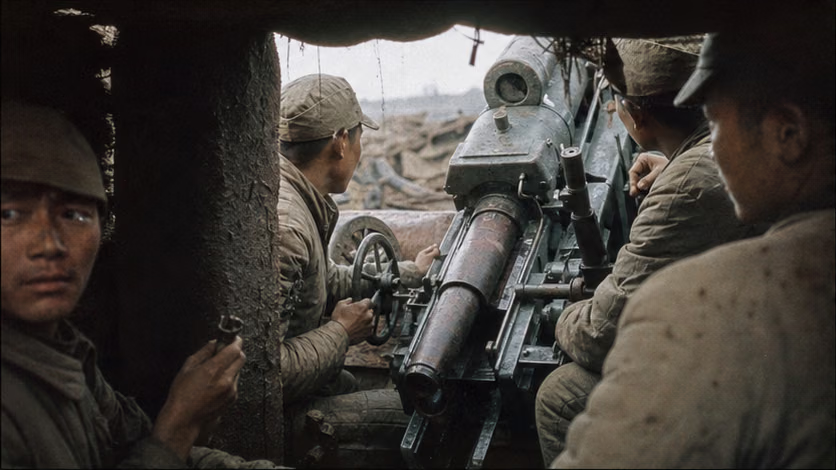
- The boatmen's oars: tens of thousands of boatmen rowed and sculled troops across the river -- rosters of boatmen who kept rowing after being hit (lists of those awarded as "river-crossing heroes" remain to be checked); "the last scull" placed beside "the wheelbarrow": the waterborne version of the popular-labor narrative.
- The guns of Jiangyin Fortress: the same gunners had been laying fire the previous night on targets along the northern bank -- one night of turning the muzzles around (details of uprising organization remain to be checked); the moment when fortress commander Dai Rongguang was detained (details remain to be checked).
- The sailors of HMS Amethyst: Captain Skinner died of his wounds on the bridge -- one life at the twilight of empire: foreign-warship casualties were casualties too.
- The guards at the Presidential Palace: where the last guard shift went (oral-history level remains to be checked) -- a micro perspective on dynastic change.
- The small steamer "Jingdian": a civilian launch that carried the first PLA troops into Nanjing (the line of preservation and commemoration for this vessel remains to be checked) -- a material anchor for memory of the river crossing.
The Ground
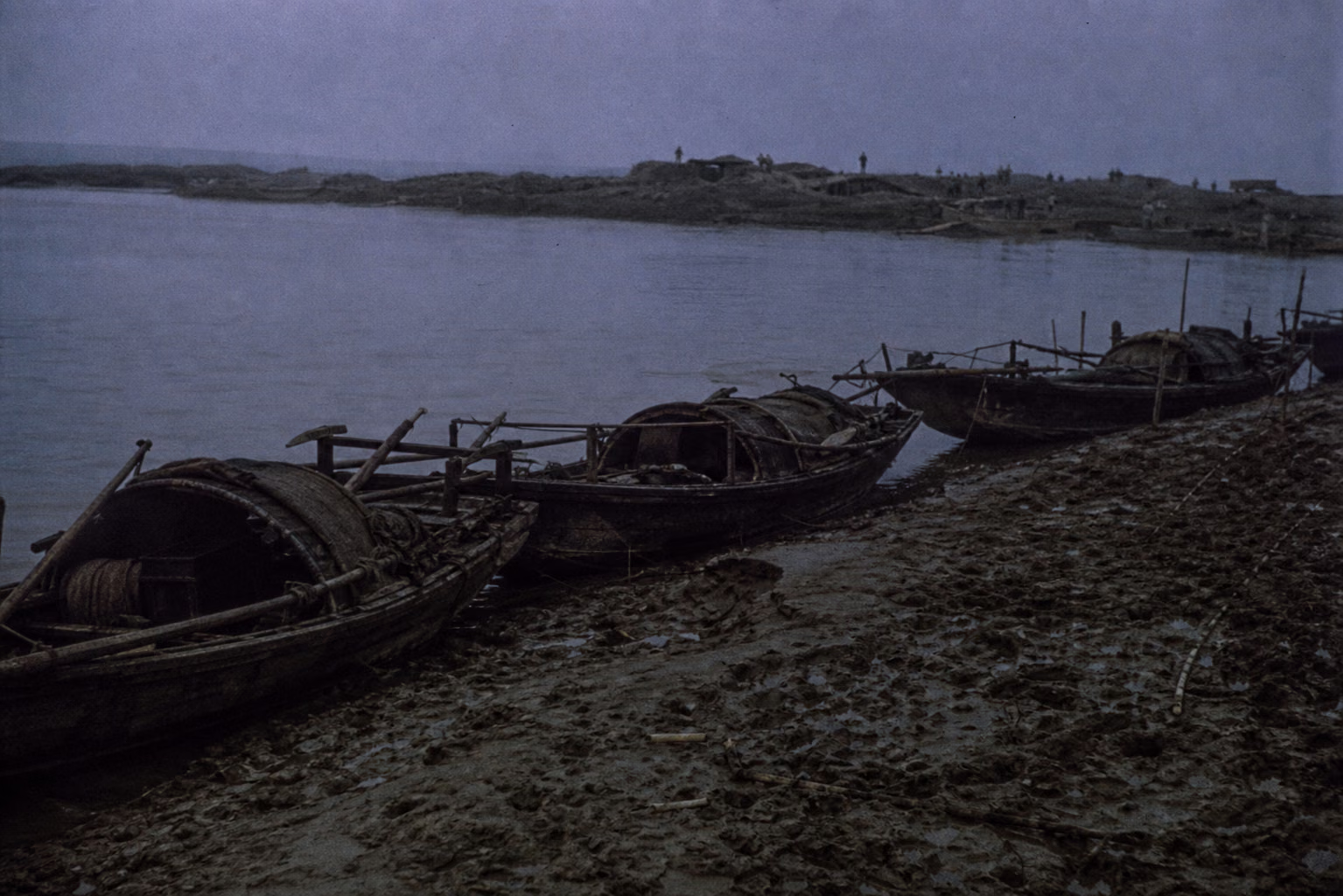
- The simultaneity of a thousand-li river surface: three sector groups, hundreds of crossing points, all launched in one night -- the largest-scale "simultaneous space" in this series (structurally similar to the night of sabotage in the Hundred Regiments Offensive, but on a larger scale).
- The surface mismatch of wooden boats against warships: the vulnerability and numerical advantage of sail-and-oar flotillas crossing through a fire net of naval guns.
- Jiangyin Fortress: the direction of the gun muzzles as the spatial device that turns the narrative on or off (turning them around meant changing flags).
- The reach where Amethyst grounded: the site of an international incident on an inland river -- the three-party space of war zone, foreign warship, and negotiation.
- The Presidential Palace: the symbolic building at the campaign's endpoint -- the route of entry from Yijiang Gate to the Presidential Palace was itself the spatial narrative line of "a change of dynasty."
How Each Side Records It
- CPC canon: "a million mighty troops crossing the great river" -- a complete symbolic system of poetry, oil painting (*Occupying the Presidential Palace*), and memorial halls; 4.23 Navy Day.
- Taiwan side: review of the collapse of the Yangtze defense (Tang Enbo's deployment and responsibility for the retreat order); the review formula "to defend the Yangtze one must defend the Huai" -- a causal narrative in which the loss at Huaihai had already doomed the river defense.
- British side: the "heroic escape" narrative of the Amethyst Incident (the 1957 film *Yangtse Incident* -- they filmed being hit as a triumph, an extreme sample of memory misalignment).
Disputes and Sensitivities
- The dispute over who fired first in the Amethyst Incident (both sides' accounts coexist); British and Chinese casualties are both recorded.
- The level of rumors about "rule divided by the river"; differing accounts of the Soviet attitude.
- The order of Nanjing's vacuum period ※ placed beside the narrative of discipline upon entering the city.
- The voluntary/apportioned-levy composition of civilian-boat requisition is part of the Yangtze Crossing Campaign's civilian-labor account.
Sources and Open Questions
Sources: *Yangtze Crossing Campaign* (book series); documents and telegrams of the General Front Committee; firsthand materials from the uprisings by Lin Zun, Tang Binglin, and others; British archives and studies on the Amethyst Incident (Yangtse Incident literature); Nanjing local gazetteers.
Open questions: numbers of crossing boats and boatmen; casualties on both sides and the firing sequence in the Amethyst Incident; details of the Jiangyin uprising; results at Langxi-Guangde; timing at the Presidential Palace; the Jingdian line.
All images on this site are AI-generated depictions. They are not historical photographs, not primary sources, and do not depict any real individual.