Engagement Archive · Battle of Jinan (1948)
In eight days, a fortified provincial capital defended by 100,000 men fell; Du Yuming's 170,000 relief troops still had not dared to move, and the city had already changed hands--the "attack Jinan and strike the relief force" plan received no relief force to strike, but the assault on fortified positions revealed its full measure. From the day Jinan was taken, no heavy Nationalist army group ever again held a major city; the gate to the decisive battles was pushed open at Jinan.
Engagement Data
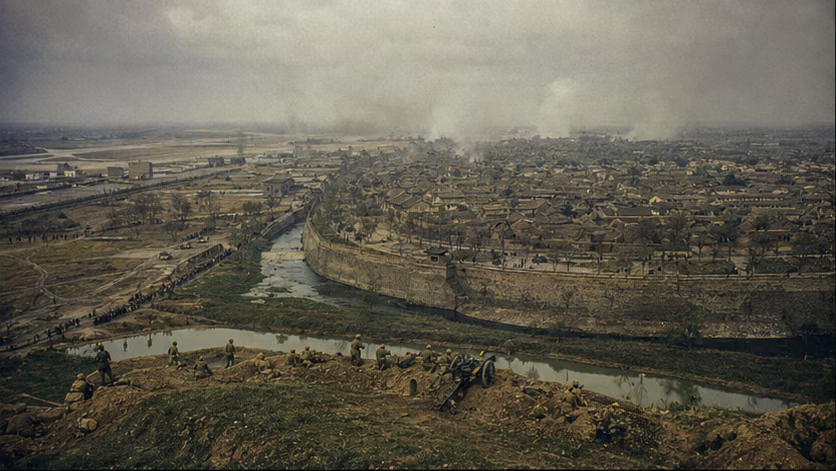
| Item | Content |
|---|---|
| Time | 1948.9.16 – 9.24, eight days and nights |
| Place | Jinan, Shandong (outer city - commercial district - inner city) |
| Part of | Chinese Civil War (for the larger picture, see *Chinese Civil War · Overview*) |
| Attacker | East China Field Army: city-assault corps, 140,000 men (Xu Shiyou and Tan Zhenlin); relief-blocking corps, 180,000 men (Su Yu in overall command)--the "attack Jinan and strike the relief force" arrangement, with sixty percent of the force assigned to deal with relief troops |
| Defender | Wang Yaowu's forces under the Second Pacification Zone, about 104,000 men (statistical bases vary by account) |
| Result | On 9.24 the inner city was breached; Wang Yaowu fled in disguise and was later captured; Du Yuming's relief corps never arrived |
Belligerents
| Item | East China Field Army | Garrison |
|---|---|---|
| Strength | Overall strength 320,000: 140,000 for the assault and 180,000 for blocking--a force-allocation philosophy of "relief-blocking first" | 104,000, including rebuilt elements of the Reorganized 74th Division and others; three defensive lines (outer city, commercial district, inner city) |
| Assault | A synthesis of assault knowledge accumulated since Siping and the Assault on Linfen: concentrated artillery, tunnel demolitions, and continuous attacks in depth | A permanent defensive-works system that Wang Yaowu had maintained for two years |
| Variable | -- | Wu Huawen's 20,000 men held the western-line airfield--their front-line uprising (9.19) tore open the western line (the course of the uprising and Wu's earlier history, including one note on his puppet-army background, are unverified) |
Terrain and Conditions
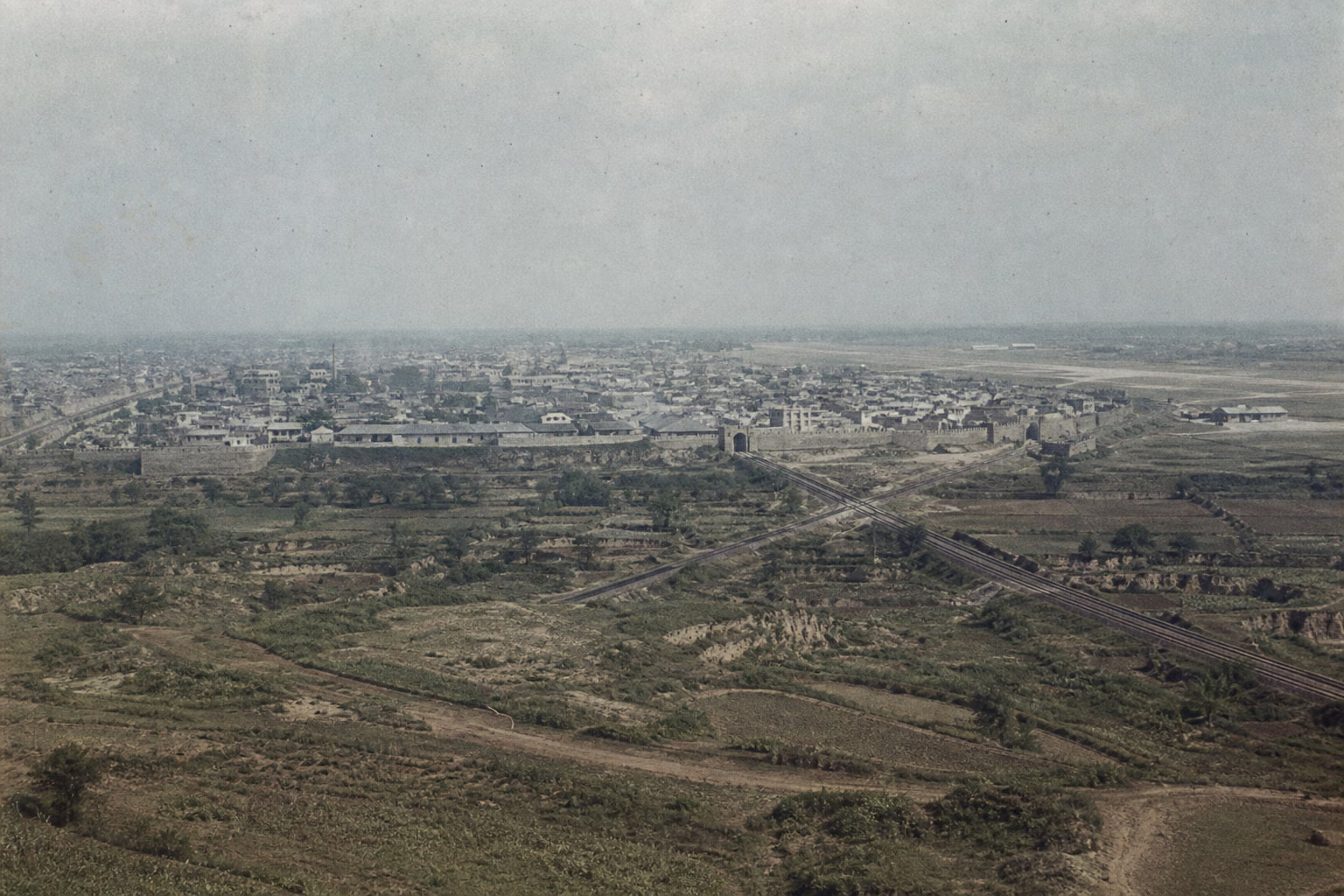
Jinan: the junction of the Tianjin-Pukou and Qingdao-Jinan railways, and the provincial capital of Shandong. After the East China Field Army took Yanzhou and other cities in succession in the summer of 1948, Jinan had become an island suspended inside the liberated areas--the garrison depended on air transport for supply (the airfield was therefore its lifeline, and Wu Huawen's defense sector was therefore the key point). Wang Yaowu--a famous general from the War of Resistance, with his record at Shanggao, Changde, and the Xuefeng Mountains treated in the relevant articles--understood at this point that a lone city was hard to hold, and repeatedly requested permission to withdraw, without approval (Chiang's order to "hold firm" and Wang's pessimistic telegrams remain unverified): another famous general ordered to be nailed down inside a city (to be read against Fang Xianjue's situation at Defense of Hengyang).
Why It Was Fought
Only two months had passed since the Battle of Yudong ended. The lesson those twenty days left Nanjing was this: on the open ground of the Central Plains, one corps acting alone could be eaten in its entirety--from then on, the Nationalist Army no longer dared to let a single corps operate by itself, and heavy forces from different routes clustered together. Su Yu saw the reverse side of this pattern: once the enemy clustered, relief would be slow; to relieve, they had to assemble a large force, and a large relief force advancing across open country was precisely the best target for an annihilation battle.
Jinan hung at the center of this pattern. The Tianjin-Pukou and Qingdao-Jinan railways met there, at the provincial capital of Shandong. After the East China Field Army took Yanzhou and other cities in succession in the summer of 1948, it had become an island inside the liberated areas. Wang Yaowu's roughly 104,000 men (statistical bases vary by account) held three lines of works--outer city, commercial district, and inner city--and depended entirely on air transport for supply; the airfield was the lifeline. Yet the airfield sector had been assigned to Wu Huawen's 20,000 men, a commander who had changed flags from the Northwestern Army to the puppet army to the Nationalist Army (his earlier history and the course of the uprising are unverified). For the East China Field Army, taking Jinan meant opening all of Shandong; the craft of assaulting fortified positions accumulated since Siping and the Assault on Linfen also needed a fortified provincial capital defended by 100,000 men as its test.
The Military Commission's formula was "attack Jinan and strike the relief force": use the assault on the city to draw Du Yuming's group north from Xuzhou, then annihilate it in the field. The deployment of the East China Field Army's 320,000 men shows that the true object lay with the relief troops--140,000 for the city assault and 180,000 for blocking relief, sixty percent of the force facing relief troops that had not yet appeared. The defenders' calculation was delay: rely on Wang Yaowu's two-year-old permanent works to withstand the attack, wait for 170,000 relief troops from Xuzhou to move north, and then strike from inside and outside at once. But both ends of this game were hollow: Wang Yaowu himself knew a lone city was hard to hold and repeatedly requested permission to withdraw, without approval (Chiang's order to "hold firm" and Wang's pessimistic telegrams remain unverified); Du Yuming's group, meanwhile, never dared to advance north from beginning to end (the decision line behind Xuzhou's hesitation to send relief remains unverified)--"striking relief" came to nothing, while "attacking Jinan" became a success on its own. That belongs to what followed.
The road Wang Yaowu wanted--withdrawing 100,000 men from the island and preserving them for field warfare--was never approved by Nanjing. Another famous general was ordered to be nailed down inside a city; four years earlier, at Hengyang, Fang Xianjue had gone through the same situation. On the night of September 16, the East China Field Army's eastern and western groups attacked simultaneously.
Course of the Engagement
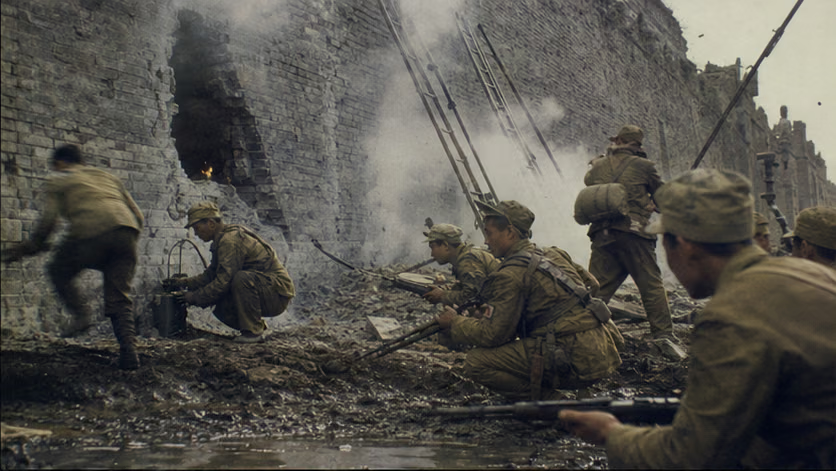
| Phase | Time | Key Points |
|---|---|---|
| Eastern and western advance | Night of 9.16 | The eastern and western groups attacked simultaneously; on the western line, Nie Fengzhi's Ninth Column turned a "supporting attack" into the main assault (the command anecdote that "the main assault on a city is won by fighting for it" needs source-level marking) |
| Wu Huawen uprising | 9.19 | The 20,000-man western-line garrison rose in front of the battle line, and the airfield was lost--air transport was cut, and the western gate opened |
| Fight for the commercial district | 9.20–22 | The commercial district was taken street by street; urban damage under artillery fire and street fighting ※ (civilian casualties and commercial-area losses vary by account) |
| General assault on the inner city | 9.23–24 | Continuous demolitions and scaling from moat to wall (details for the Ninth and Thirteenth Columns' scaling actions unrecorded); on the 24th the whole city was taken |
| Wang Yaowu captured | Around 9.28 | He fled in disguise and was identified and captured at Shouguang (the account that toilet paper exposed his identity is widely circulated; source level unverified)--the famous general's end led to the Gongdelin War Criminals Management Center (one note on his later amnesty line) |
Casualties and Losses
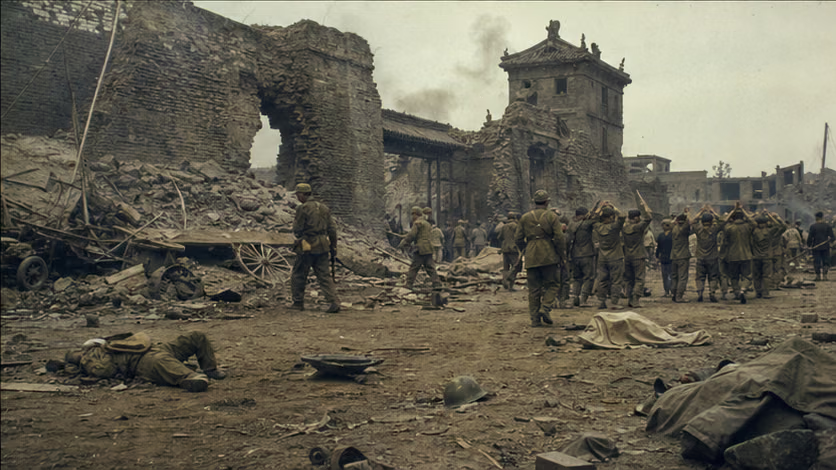
- East China Field Army: more than 26,000 casualties (statistical bases vary by account)--the eight-day ledger of an assault on fortified positions.
- Garrison: 84,000 destroyed (22,000 killed and wounded, 61,000 captured, with statistical bases varying by account) + Wu Huawen's 20,000-man uprising.
- ※ Civilians: a provincial capital under eight days of artillery fire (figures for deaths, injuries, and damage vary by account); pre-battle evacuation and civilian life under siege (record unverified).
Aftermath
- "The gate to the decisive battles": Jinan proved that even a heavily defended provincial capital could not be held--two weeks later, the Liaoshen Campaign began; the Associated Press commented at the time that "from now on, the Communists can go wherever they want to go" (quotation source unverified)--the opposing camp and third parties felt the same shock.
- Wang Yaowu entered the War Criminals Management Center (among the first group amnestied in 1959--a complete personal arc: famous general of the War of Resistance, civil-war prisoner, and sample case of amnesty, to be closed across articles).
- Wu Huawen's unit was reorganized into the People's Liberation Army (it later took part in the Yangtze Crossing Campaign and entered Nanjing--one note of historical irony, "the predecessor of the first unit to enter the Presidential Palace was an uprising unit," with the sequence unverified).
- Xu Shiyou as "tiger of assaults on fortified positions" and the Nie Fengzhi main-assault case entered military-history anecdote (level marking).
Accounts of Those Present
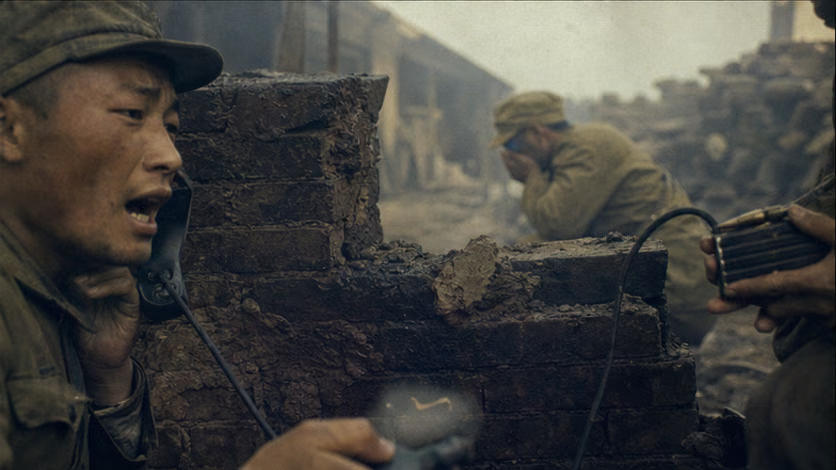
- Wang Yaowu's telegrams: from the victory report from the Xuefeng Mountains to the telegram requesting withdrawal from Jinan--two kinds of telegrams by the same man across eight years, placed opposite each other; after capture, the sentence "I did my utmost" (testimony level unverified).
- Wu Huawen's three changes of side: Northwestern Army - puppet army - Nationalist Army - People's Liberation Army (his experience explains his case)--a sample survival curve for a soldier in a time of disorder, and a comparison with Gao Shuxun's "uprising" (a difference in memory between one case that received respect and one that remained contested).
- The first flag on the wall: the red flag of the unit that scaled the southeastern corner of the inner city (flag presentation and unit-honor line unverified)--the title "Jinan First Regiment" is still used today.
- Gongdelin class roster: Wang Yaowu's years as a "classmate" of Du Yuming and others in the War Criminals Management Center (recollection level)--the second life after victory and defeat is the long tail unique to civil-war narratives.
The Ground
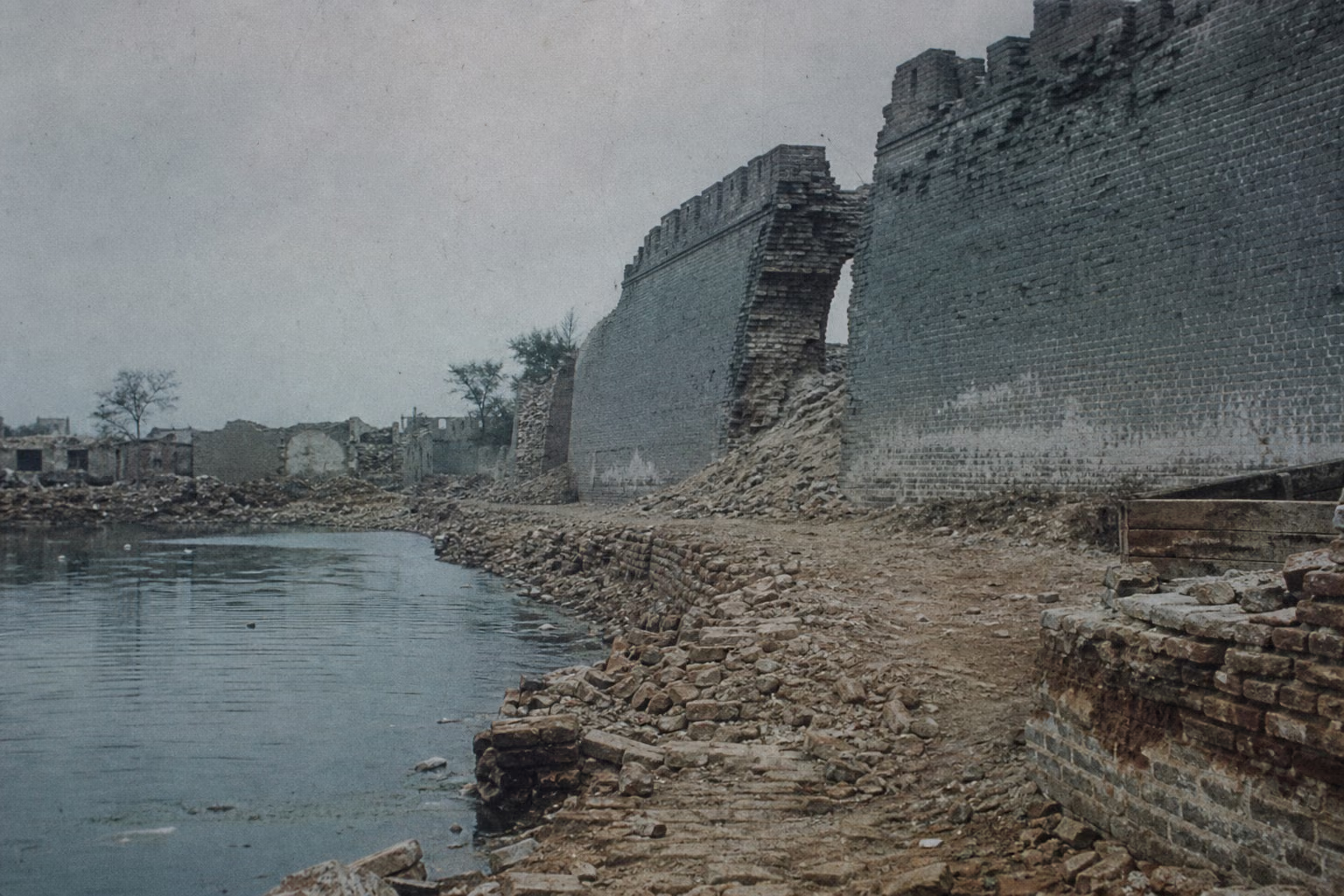
- Three-line city-defense profile: the continuous assault through outer city - commercial district - inner city (one method for each line: field fighting, street fighting, wall-scaling).
- The airfield as the vital point: the supply node of a lone city by air transport - Wu Huawen's defense sector - the chain reaction of the uprising (a spatial sample of "a logistical point is also a political point").
- Moat and Ming city wall: the "ancient-modern overlay" of Chinese Civil War assault space--modern artillery against Ming-period city defenses (intertext with the stone city at Tengchong).
- The large chessboard of assault and blocking: the three hundred li "relief-force vacuum" between Jinan and Xuzhou--a battlefield that did not exist (relief-blocking positions waiting in vain) is also spatial narrative.
How Each Side Records It
- Communist canonical narrative: a milestone in assaults on fortified positions and the prologue to the decisive battles; the peak of the Xu Shiyou narrative.
- Taiwan side: the fall of Jinan as the pain of a turning point in "pacification" (recollections by Wang Yaowu's son's generation and Taiwan-side reviews coexist); Wu Huawen's uprising is a "betrayal" in that narrative--two verbs for the same action reappear.
- Scholarship: the force-allocation philosophy of attacking Jinan and striking relief, the maturation of urban assault tactics, and biographical study of the Wang Yaowu case.
Disputes and Sensitivities
- The source level of the main-assault/supporting-attack case; the legendary elements in the details of Wang Yaowu's capture.
- The statistical bases for civilian casualties in the urban area--the ※ within a civil-war urban assault.
- Divergent evaluations of Wu Huawen across the Taiwan Strait and among the public (his puppet-army history).
Sources and Open Questions
Sources: *History of the East China Field Army*; recollection materials by Xu Shiyou and Nie Fengzhi; biographies and Gongdelin materials related to Wang Yaowu; the Jinan section of Taiwan-side *War History of the Pacification Campaign*.
Open questions: statistical bases for the strength and casualties of both sides; the course of Wu Huawen's uprising; details and telegrams regarding Wang Yaowu's capture; source of the Associated Press comment; the honor sequence for scaling the wall.
All images on this site are AI-generated depictions. They are not historical photographs, not primary sources, and do not depict any real individual.