Campaign Overview · Huaihai Campaign (1948–49)
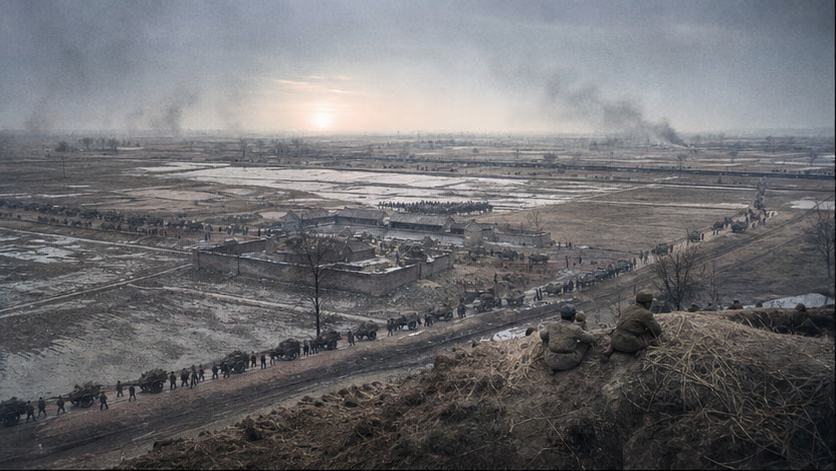
Sixty-six days, 600,000 against 800,000, 555,000 destroyed or incorporated -- the greatest corps-level decisive campaign in world military history in which the smaller force defeated the larger. Its other side was just as unprecedented: the wheelbarrows of 5.43 million civilian laborers. On the Xu-Beng Plain, two wars were in fact being fought: one between army and army, and one between a mobilization system and a supply system -- the second one decided the outcome first.
Engagement Data
| Item | Content |
|---|---|
| Time | 1948.11.6 – 1949.1.10, sixty-six days (Taiwan side calls it the "Xu-Beng Campaign" -- the name itself reproduces the position) |
| Place | Centered on Xuzhou: the Longhai-Jinpu railway crossing, from Haizhou in the east to Shangqiu in the west, and from Lincheng in the north to the Huai River in the south |
| Part of | Chinese Civil War (for the overall war, see *Chinese Civil War · War Overview*) |
| Attacker | East China Field Army, 16 columns, plus Central Plains Field Army, 7 columns, roughly 600,000 (General Front Committee: Liu Bocheng, Chen Yi, Deng Xiaoping, Su Yu, Tan Zhenlin) |
| Defender | Liu Zhi's Xuzhou "Bandit Suppression Headquarters" (Du Yuming in actual command), with seven corps under its authority, roughly 800,000 |
| Result | 555,000 destroyed or incorporated (figures vary by statistical basis): the three groups of Huang Baitao, Huang Wei, and Du Yuming were destroyed in succession -- the elite forces north of the Yangtze were all lost |
Belligerents
| Item | People's Liberation Army | Nationalist Army |
|---|---|---|
| Strength | 600,000 field troops plus 400,000 local troops | 800,000 -- the only decisive campaign fought by the smaller side against the larger |
| Equipment | East China Field Army artillery was already strong; the Central Plains Field Army was extremely weak after crossing the mountains (see also the Shuangduiji case of making up equipment from trenches) | The Xuzhou group included the Fifth Army and 18th Army, two great crack units, and groups of rapid columns |
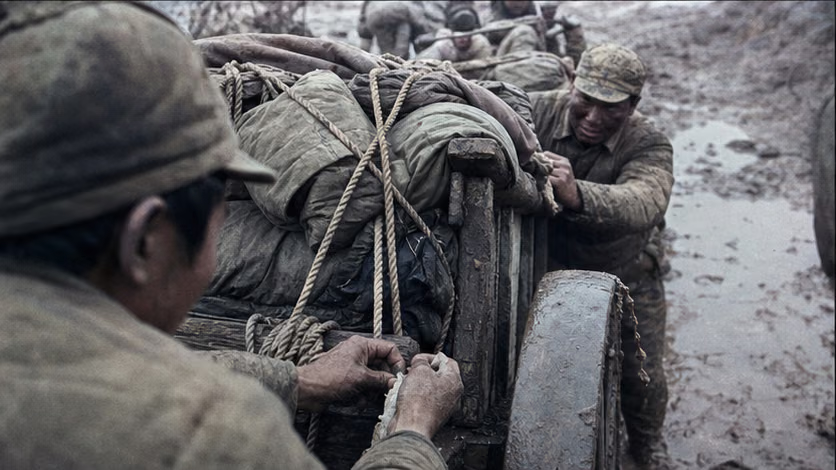
| Supply | 5.43 million civilian laborers plus 880,000 carts (figures vary by statistical basis): a "mobile rear" carried on shoulders and pushed by hand | Railways and airlift -- once the lines were cut, paralysis followed (the fragility of the Xu-Beng line) |
| Command | Unified under the General Front Committee (authority to act according to circumstances -- telegram authorizing "independent action" remains to be checked) | Bandit Suppression Headquarters, Ministry of National Defense, and Chiang Kai-shek formed three layers of remote control; Du Yuming was "a general in the field," yet orders kept issuing from above (a command disaster) |
Terrain and Conditions
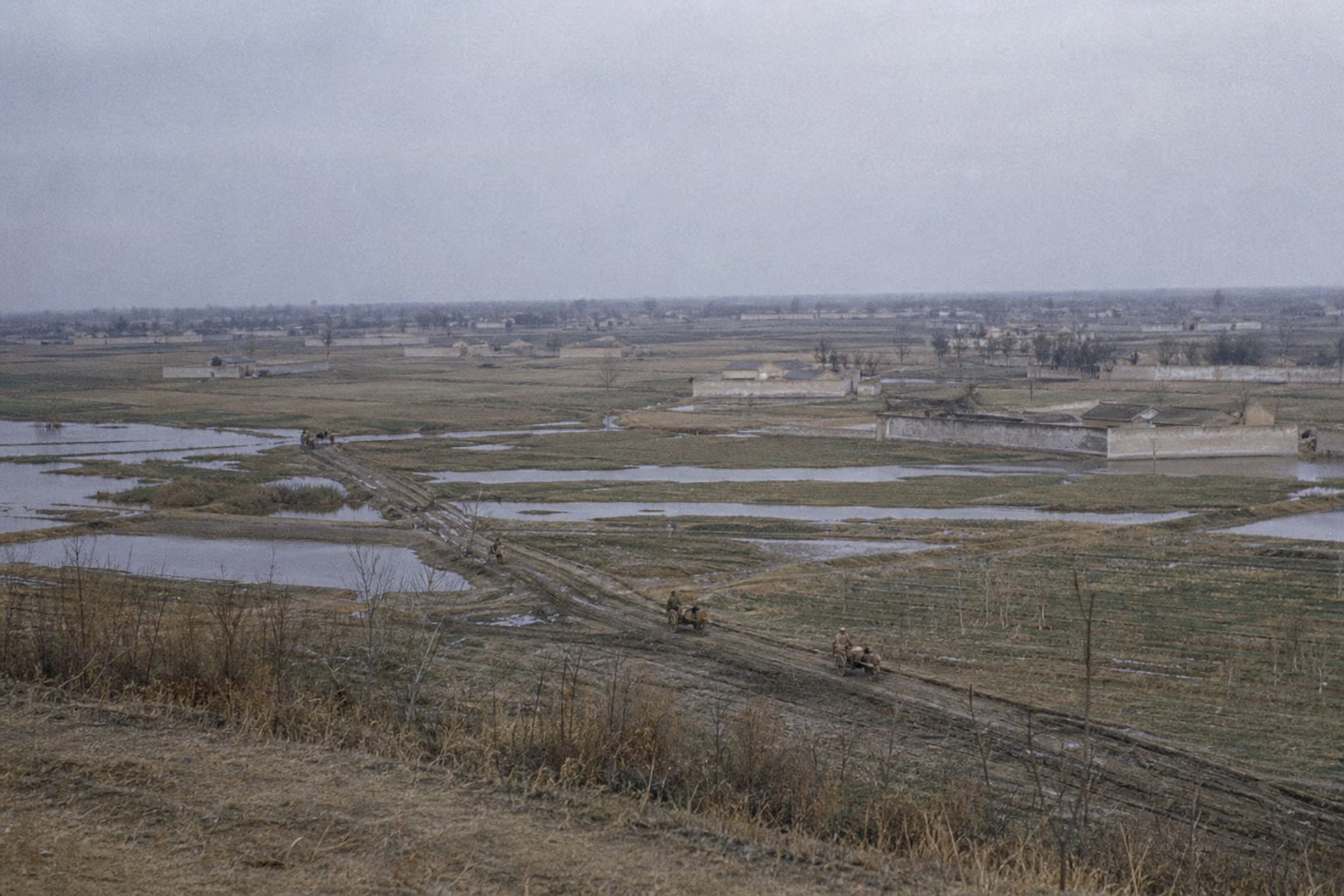
The Xu-Beng Plain: watercourses and dry fields after the Yellow River flood zone changed course, with villages and walled settlements scattered across it -- a battlefield where maneuver by large formations and assaults on villages existed side by side. Social base: the land-reform mobilization system of the liberated areas in Shandong, northern Jiangsu, and Henan-Anhui -- the folk song of "sending the last bowl of rice as military grain" and the exhaustion of popular labor are written on both sides of the same page (the composition of voluntary front support and apportioned levies remains to be checked); on the Nationalist-controlled side: Xuzhou city on the eve of rout and the gold yuan turning into waste paper (urban society collapsing).
Why It Was Fought
The Liaoshen Campaign ended only four days before Huaihai began. On November 2, Shenyang and Yingkou were taken, the entire Northeast changed hands, 470,000 elite Nationalist troops vanished, and the nationwide balance of forces reversed for the first time -- the great victory held out by Tashan had just settled when the center of decisive battle pressed into the area inside the Pass. In Shandong, meanwhile, the door had already been pushed open two months earlier: in September, Jinan fell after eight days, and the provincial capital defended by 100,000 men did not receive reinforcements. After Jinan was taken, the East China Field Army looked south, and what lay before it was Xu-Beng.
What was Xuzhou worth? The map made it clear at a glance: the Longhai and Jinpu railways crossed here, making it Nanjing's gateway north of the Yangtze and the station of the Nationalist Army's last heavy group north of the river -- Liu Zhi's seven corps, roughly 800,000 men, were arrayed around this crossing. Hold Xuzhou, and Jiang-Huai had depth; lose Xuzhou, and only the Yangtze remained before Nanjing.
Time, too, pressed on this November. Once the Northeast was decided, the Northeast Field Army's entry inside the Pass was only a matter of time; if the Xuzhou group contracted southward to Bengbu and withdrew to defend the Huai River according to the logic of "to defend the Yangtze one must defend the Huai," it would be hard for the People's Liberation Army to destroy it as an organized formation north of the Yangtze. If the battle was to be fought, it had to be before the group pulled back.
Su Yu's original plan was not large: a "small Huaihai," destroying Huang Baitao's corps around Xin'anzhen and opening northern Jiangsu. The center approved this plan. But after Jinan, the battlefield was not static: Huang Baitao was going to contract toward Xuzhou, and once the Xu-Beng line was cut, Liu Zhi's group would be split into several parts. Su Yu recommended expansion as the situation developed, and the chain of telegrams among the Central Military Commission, the East China Field Army, and the Central Plains Field Army pushed the "small Huaihai" into the decisive campaign north of the Yangtze (the specific evolution of the telegrams remains to be checked). Huaihai was not drawn in full on a single paper plan; it grew as it was fought.
This decision rested on a material base. The People's Liberation Army's 600,000 against 800,000 did not look good on paper; the Central Plains Field Army was especially thin in equipment after the Dabie Mountains, and the East China Field Army could not wear itself down indefinitely. What held the battle up was the front-support system of the liberated areas in Shandong, northern Jiangsu, and Henan-Anhui: grain, stretchers, civilian laborers, and carts pushed the rear up to the front. This system allowed the People's Liberation Army to cut railways, encircle corps, and shift forces continuously; it did not allow prolonged attacks on major cities or an endless war of attrition. Su County therefore became the key: once the Xu-Beng line was cut, Nationalist railway supply became a series of broken lines.
Nanjing was not confused. The Xuzhou group had crack units such as the Fifth Army and 18th Army, and its firepower and rapid columns remained strong. The problem was that it wanted too many things: it wanted to hold Xuzhou and also preserve the Huai River; it wanted to rescue Huang Baitao but feared drawing out its main force; Bandit Suppression Headquarters, the Ministry of National Defense, and Chiang Kai-shek formed three layers of remote control, leaving front-line commanders limited room to act according to circumstances. If Xuzhou had been abandoned one step earlier and the army withdrawn to the south bank of the Huai River, 800,000 men with the Yangtze at their back would still have been an intact group; but that would have meant admitting that the gateway north of the Yangtze was being given up. That decision had still not been made on the day the battle began.
Nor did the People's Liberation Army know from the beginning that it could swallow the entire situation. In the records so far seen, what is clear is that Su Yu proposed expanding the operation and the center adopted it as the situation developed; no clear record has been seen of open opposition within the decision-making level to expanding it into a Xu-Beng decisive campaign (no record of dissent seen; unverified). The real opposition came from grain and ammunition, casualties, and distance itself: once popular labor could no longer keep up, the encirclement would turn into a counter-encirclement. On November 6, the columns of the East China Field Army moved south and struck straight at Huang Baitao's corps, which was contracting from Xin'anzhen toward Xuzhou; two days later, the Jiawang uprising opened the canal defense line from within. The first ring closed in this way.
Course of the Engagement (Three Phases)
| Phase | Time | Key points | Separate article |
|---|---|---|---|
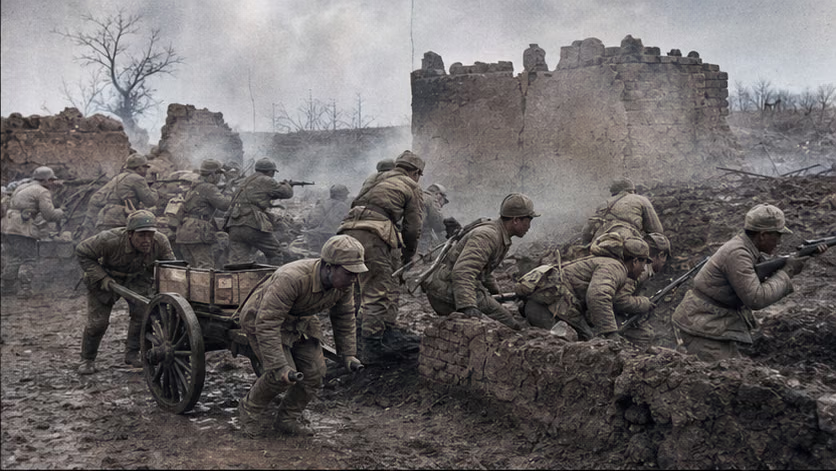
| First phase | 11.6–22 | The Jiawang uprising opened the way -> Huang Baitao was pursued and destroyed at Nianzhuang (120,000 wiped out, Huang killed); at the same time, the Central Plains Field Army took Su County -- cutting the Xu-Beng line: the hardest move on the great chessboard (the strategic weight of taking Su County) | Battle of Nianzhuang |
| Second phase | 11.23–12.15 | Huang Wei's 120,000-man corps was encircled and destroyed at Shuangduiji; Du Yuming's 300,000-man Xuzhou group abandoned the city and withdrew westward (11.30 -- Chiang's air-dropped handwritten order redirecting it toward Chenguanzhuang, the "death-warrant order," remains to be checked), and was encircled at Yongcheng-Chenguanzhuang | Battle of Shuangduiji |
| Third phase | 12.16–1.10 | Twenty days of encircling without attacking (to coordinate with Pingjin and avoid alarming Fu Zuoyi -- the linkage of the two great campaigns) plus political offensive (surrender-persuasion broadcasts and a wave of defections); general assault on 1.6, complete destruction of Du's 300,000-man group on 1.10: Du Yuming captured, Qiu Qingquan killed (suicide / killed in the chaos, both accounts coexist), Li Mi escaped in disguise (one stroke for his later escape line) | Battle of Chenguanzhuang |
Casualties and Losses
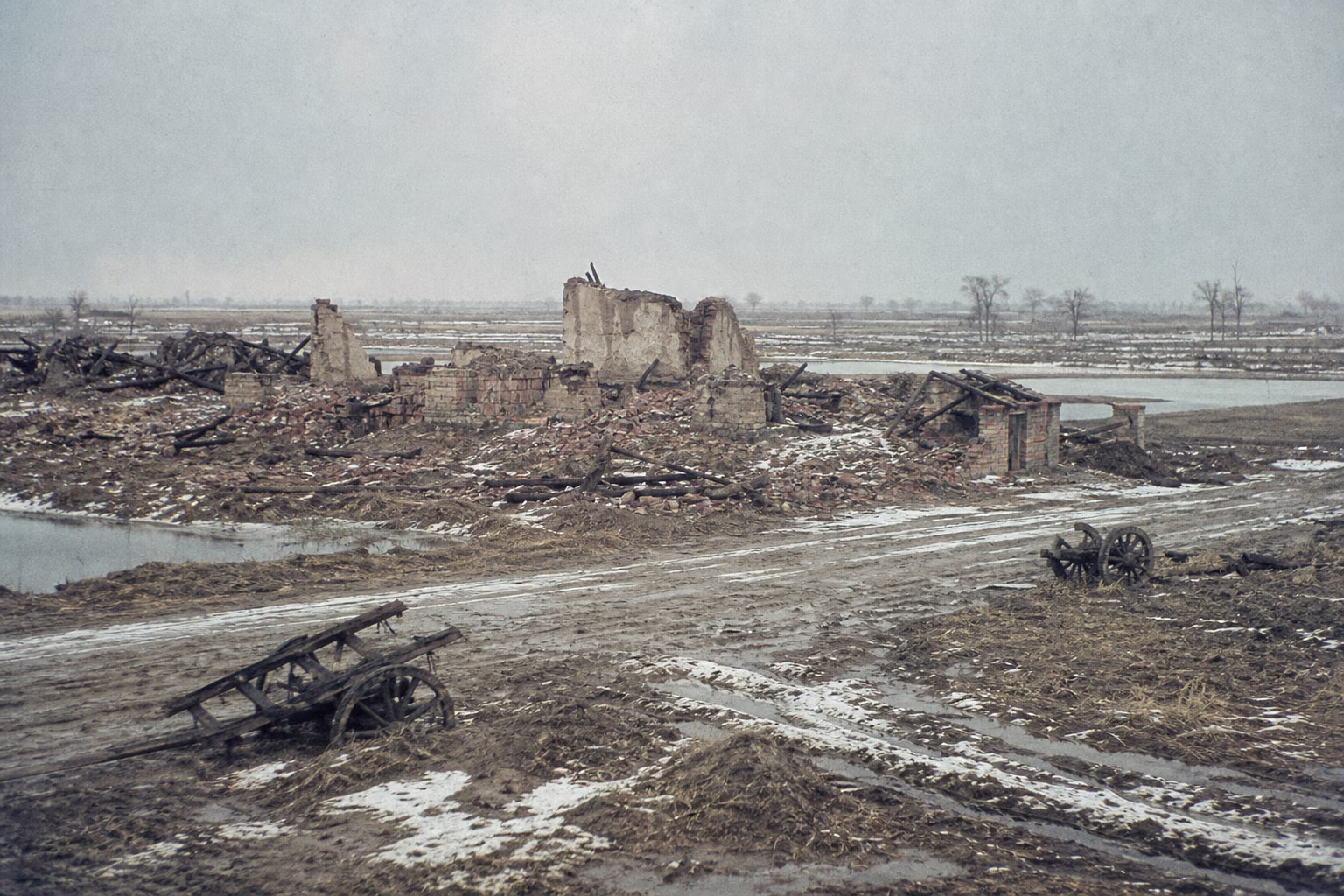
- Nationalist Army: 555,000 (170,000 killed and wounded, 320,000 captured, 64,000 rose in revolt or were incorporated -- composition basis pending verification); among the five major forces, both the Fifth Army and the 18th Army were destroyed.
- People's Liberation Army: 134,000 casualties (figures vary by statistical basis) -- the costliest of the three great campaigns; the backbone of the East China and Central Plains Field Armies was consumed.
- ※ Civilians: villages in the battle zone burned down (villages at Nianzhuang, Shuangduiji, and Chenguanzhuang were razed by artillery fire -- records of villagers returning after the war to "no home" remain to be checked); casualties among front-support civilian laborers (figures vary by statistical basis); the two-way account of requisitions by both armies.
- Severe cold: rain and snow from December to January -- Nationalist troops inside the Chenguanzhuang encirclement froze and starved (killing horses, digging up wheat seed, burning coffin wood -- brief account of the misery in the late siege, records remain to be checked)※ -- the hunger of encirclement reproduced (structurally similar to Changchun but vastly different in duration; see also the Liaoshen overview).
Aftermath
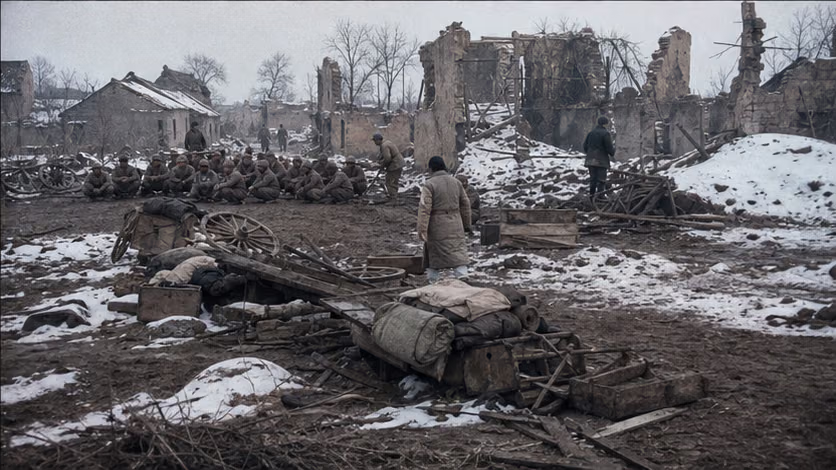
- North of the Yangtze, the Nationalist Army had no main force left -- crossing the Yangtze was only a matter of time; Chiang Kai-shek stepped down on 1.21 (one stroke for the direct causal link between Huaihai's endgame and his resignation).
- Du Yuming entered Gongdelin (his war-criminal -> amnesty -> memoir line closes a cross-article character arc: from Burma to Liaoshen to Huaihai -- the defeated commander who appears most often in this series, the highest mark in the archival character line).
- The "wheelbarrow" entered political discourse (Chen Yi's saying that it was "pushed out by the people with wheelbarrows" -- source unverified) -- the canonization of the popular-labor narrative and its placement beside the historical fact of the exhaustion of popular labor (this article's position: both are true).
- A core case in Taiwan-side review literature (the Xu-Beng review corpus -- Bai Chongxi holding his troops back; the leak case in the Operations Department of the Ministry of National Defense (the Guo Rugui line -- the head of the Operations Department of the Ministry of National Defense was an underground CPC member: a top-level sample marker of the Huaihai intelligence war).
How Each Side Records It
- CPC canon: the peak of the three great campaigns, the ultimate proof of "people's war"; the visual canon of *The Great Decisive Battle: Huaihai Campaign*.
- Taiwan side: the "Xu-Beng Campaign" as the most painful chapter of pacification; analysis of the causes of defeat has continued for decades (command, intelligence, allied troops failing to rescue one another -- the "watching from across the river" case over the Qiu-Li corps' ineffective rescue of Huang Baitao remains to be checked).
- Scholarship: three research lines -- the history of how the plan formed (telegram chain), the social history of front-support mobilization (voluntary action and apportioned levies), and intelligence war (the Guo Rugui and Liu Fei cases); one stroke for international military scholarship's case studies of "corps-level decisive battle in which the smaller defeated the larger."
Disputes and Sensitivities
- The dispute over first credit for Huaihai (the narrative weight of Su Yu's "proposal" and the General Front Committee's "command" -- two accounts placed side by side; the authenticity and contextual level of the phrase "I commanded the Huaihai Campaign" remain to be checked).
- The voluntary/apportioned-levy composition of front support is part of the popular-labor narrative.
- The evidentiary level of the Guo Rugui and Liu Fei cases; the two accounts of Qiu Qingquan's death.
- The hunger and cold suffered by Nationalist soldiers in the late Chenguanzhuang encirclement ※ -- the sufferers were individual soldiers.
Contents
The Jiawang uprising and the taking of Su County are incorporated into the phases of this article.
Sources and Open Questions
Sources: *Huaihai Campaign* (collected series); paired reading of memoirs by Su Yu and Du Yuming; Taiwan-side *Review of the Xu-Beng Campaign* corpus; Guo Rugui's memoirs; front-support archives (front-support statistics for Shandong and northern Jiangsu).
Open questions: the composition of both sides' troop strengths and casualties; statistical bases for civilian laborers and carts; the telegram evolution chain from Su Yu's proposal of the "small Huaihai" through his later recommendation to expand the operation; the back-and-forth telegrams among the Central Military Commission, the East China Field Army, and the Central Plains Field Army over the objectives of Su County and the Xu-Beng line; whether there is a clear record of opposition within the People's Liberation Army decision-making level to expanding the operation into a Xu-Beng decisive campaign; decision telegrams, correspondence, and handwritten orders by Chiang Kai-shek, Liu Zhi, and Du Yuming over defending Xuzhou or withdrawing to the Huai River; the Guo Rugui evidence set; late Chenguanzhuang records; the source of the "wheelbarrow" saying.
All images on this site are AI-generated depictions. They are not historical photographs, not primary sources, and do not depict any real individual.