Engagement Archive · Battles of Northern Suqian and Southern Shandong (combined account)
The first two battles after the Shandong and Central Jiangsu field armies joined forces: first the Reorganized 69th Division was annihilated, then the Reorganized 26th Division and the First Fast Column were taken in one sweep; for the first time, the People's Liberation Army destroyed an entire Nationalist American-equipped fast column, and from this came the artillery and tank foundation of the East China Field Army.
Engagement Data
| Item | Details |
|---|---|
| Time | Northern Suqian: 1946.12.13–19; Southern Shandong: 1947.1.2–20 |
| Place | Northern Suqian: north of Suqian, Jiangsu (around Fengshan, Xiaodianzi, and Renhewei); Southern Shandong: the Yixian, Zaozhuang, and Lanling line in Shandong |
| Part of | Chinese Civil War · phase of the Nationalist Army's general offensive (offensive toward the Shandong Liberated Area) |
| Shandong and Central Jiangsu Field Armies | Commanded by Chen Yi and Su Yu (the first large-scale coordination after the two forces joined; the process by which command responsibilities took shape is unverified) |
| Nationalist Army | Northern Suqian: Reorganized 69th Division (division commander Dai Zhiqi) and other units; Southern Shandong: Reorganized 26th Division (division commander Ma Liwu), First Fast Column, and Reorganized 51st Division (division commander Zhou Yuying) |
| Result | At Northern Suqian, the Reorganized 69th Division, over 20,000 men, was annihilated, and Dai Zhiqi killed himself after defeat; at Southern Shandong, the Reorganized 26th Division and the fast column were destroyed, then Yixian and Zaozhuang were taken and the Reorganized 51st Division was annihilated; Communist sources put total enemy losses inflicted in the two battles at over 53,000 (statistical bases vary by account) |
Belligerents
| Item | Shandong and Central Jiangsu Field Armies | Nationalist Army |
|---|---|---|
| Strength | Northern Suqian committed about 20-plus regiments (combined forces from Central Jiangsu and Shandong; the exact order of battle is unverified); Southern Shandong committed around 27 regiments (unverified here) | Northern Suqian: over 20,000 men of the Reorganized 69th Division and the Reorganized Eleventh Division (not committed to the main battlefield); Southern Shandong: Reorganized 26th Division, First Fast Column, and Reorganized 51st Division, totaling over 50,000 men |
| Equipment | Mainly infantry small arms, with weak heavy firepower; at Southern Shandong this changed rapidly through captured equipment | The Reorganized 26th Division was partly American-equipped; First Fast Column: tank battalion (American M3A3 and others; vehicle models unverified), howitzer battalion, and motor regiment: the Nationalist Army's model mechanized force |
| Weather and Terrain | Rain, snow, and mud in Southern Shandong trapped mechanized units in the mire | Once the Fast Column left the road, it was immobilized: time and terrain were on the infantry's side |
| Coordination | Two field armies joined for the first time and went into battle while still adjusting to each other | The various attacking forces came from different factions (Dai Zhiqi, commander of the Reorganized 69th Division, was at odds with Hu Lian, commander of the Reorganized Eleventh Division, affecting relief efforts; this section is unverified) |
Terrain and Conditions
(For the broader situation, including the height of the general offensive and the Nationalist advance into the various liberated areas, see Chinese Civil War: Overview; here only Northern Jiangsu and Southern Shandong are covered.)
Why the two field armies joined forces: After Seven Battles, Seven Victories in Central Jiangsu, Lianghuai fell, and the Central Jiangsu Field Army moved north; the Shandong Field Army also returned after fighting in Huaibei. In the autumn of 1946 the two forces drew closer together, and the CPC Central Committee instructed them to conduct joint operations under unified command. The later East China Field Army took shape here (its formal organization came around the Battle of Laiwu in early 1947; the timeline is unverified).
The Nationalist Army's offensive deployment: At the end of 1946, the Nationalist Army attacked Northern Jiangsu and Southern Shandong along several routes. In the Northern Suqian direction, the Reorganized 69th Division was a newly formed reorganized division; after being transferred out of the Reorganized Eleventh Division system, it advanced alone and opened a gap with neighboring units. This was the first opportunity seized.
Why It Was Fought
The seven battles in Central Jiangsu were won at the points of contact, but the line was lost: the Nationalist Army shifted to a steadier, step-by-step method; in September 1946 Lianghuai fell, the core area of the Central Jiangsu base area changed hands, and the Central Jiangsu Field Army moved north. The Shandong Field Army also returned after fighting in Huaibei. That autumn, the two field armies drew together in Northern Jiangsu, and the CPC Central Committee instructed them to fight jointly under unified command. Chen Yi and Su Yu now had more than twenty regiments in hand, but the two forces came from different paths and fought in different ways. At the beginning of their merger, they had to enter combat while still learning to work together. They needed one battle both to repel the attack before them and to make the newly combined force cohere under fire.
The other side gave them the chance. One of the main tasks of the Nationalist general offensive was to open Northern Jiangsu and press toward Shandong. At the end of 1946, Nationalist forces advanced along several routes. In the Northern Suqian direction, the Reorganized 69th Division was a newly formed reorganized division; after being transferred out of the Reorganized Eleventh Division system, it advanced alone and left a gap with neighboring forces. The fact that its commander Dai Zhiqi was at odds with Hu Lian, commander of the Reorganized Eleventh Division, also planted the cause of ineffective relief (this section is unverified). Overextended and isolated, it fit exactly the principle of "attack the weaker and the isolated." The Reorganized 69th Division became the first chosen target after the two armies joined forces.
From December 13, all units moved in under concealment and completed the division and encirclement of the Reorganized 69th Division, which had advanced to the Fengshan, Xiaodianzi, and Renhewei line north of Suqian. The first battle after the merger had begun.
After Northern Suqian was over, the Reorganized 26th Division and the First Fast Column in the Southern Shandong direction, the Nationalist Army's model mechanized force with tank battalion, howitzer battalion, and motor regiment all present, were still halted around Mazhuang, watching and hesitating. It was deep winter; Southern Shandong was rain-snow mud, and once tanks left the road, they were immobilized. Time and terrain stood with the infantry. So Southern Shandong was fought next. The two battles were fought in succession as two applications of the same principle: attack the weak, attack the isolated, and do not stop after one victory.
Course of the Engagement
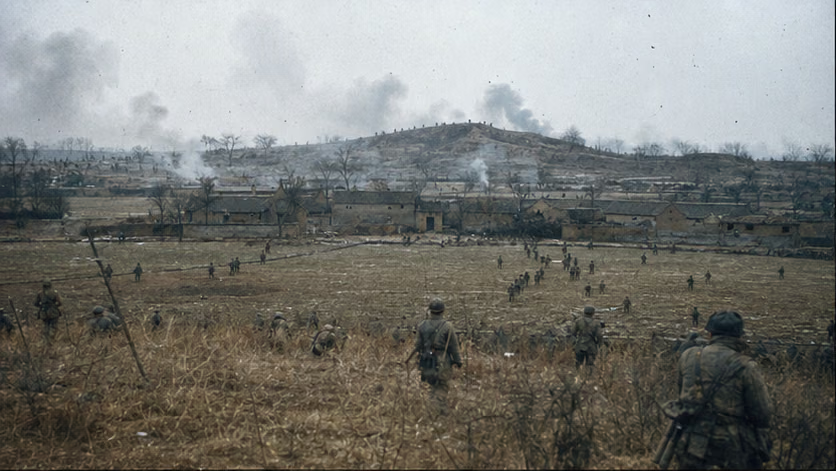
Northern Suqian (1946.12.13–19):
| Phase | Main Points |
|---|---|
| Encirclement | 12.13–15, all units moved in under concealment and completed the division and encirclement of the Reorganized 69th Division, which had advanced to the Fengshan, Xiaodianzi, and Renhewei line |
| Assault and destruction | 12.15–18, strongpoints were attacked hill by hill and village by village; the commanding height at Fengshan changed hands repeatedly |
| Resolution | On the morning of 12.19, the headquarters of the Reorganized 69th Division and its three and a half subordinate brigades, over 20,000 men in all, were annihilated (statistical bases vary by account); division commander Dai Zhiqi killed himself before his command post was overrun (he died by shooting himself; the precise circumstances are unverified) |
Southern Shandong (1947.1.2–20):
| Phase | Main Points |
|---|---|
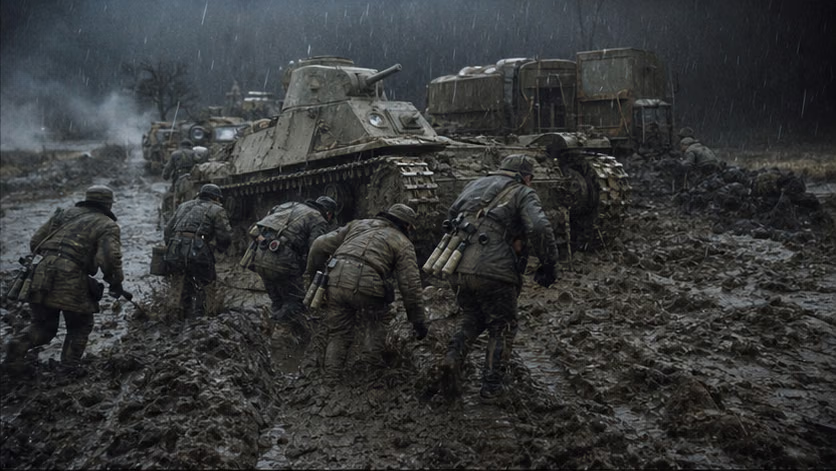
| Encirclement and destruction of the Fast Column | 1.2–4, the attack was launched suddenly on a night of rain and snow, encircling and destroying the headquarters of the Reorganized 26th Division and the First Fast Column along the Mazhuang line; tanks and motor vehicles could not deploy in the mud and were dealt with one by one by infantry closing in (details of anti-tank methods unrecorded) |
| Taking Yixian | 1.10–11, Yixian was taken and Ma Liwu was captured (Ma had entered Yixian city early in the battle; the process of his capture is unverified) |
| Taking Zaozhuang | 1.19–20, Zaozhuang was taken, the Reorganized 51st Division was annihilated, and division commander Zhou Yuying was captured |
Captured materiel: about 24 tanks, over 200 artillery pieces (including American 105 mm howitzers), and over 470 motor vehicles (itemized statistical bases vary by account). From this was established the Special Arms Column of the East China Field Army, the foundation of its artillery, armor, and engineer arms. Captured tankers and gunners were retained in large numbers after political education, driving the same tanks and firing the same guns as before.
Casualties and Losses
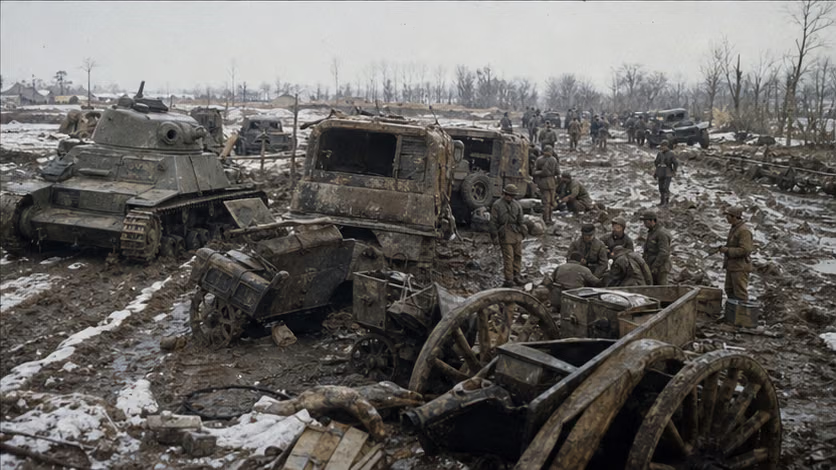
- Nationalist Army: Communist sources state that the two battles inflicted total losses of over 53,000 (over 20,000 at Northern Suqian and over 30,000 in Southern Shandong; statistical bases vary by account); the First Fast Column was wiped out as an entire formation, and all heavy equipment was lost.
- People's Liberation Army: about 8,000 casualties at Northern Suqian and about 8,000 at Southern Shandong (both Communist figures, unverified).
- Dai Zhiqi's death: the suicide of a reorganized division commander made him one of the highest-ranking Nationalist commanders to die since the civil war began (Peng Yubin and others had died earlier; the ranking is unverified).
Aftermath
- The East China theater command system took shape: the division of labor in which Chen Yi held overall command and Su Yu led the fighting was basically fixed after these two battles (the process of formation and the exchange of telegrams are unverified).
- The East China Field Army's Special Arms Column began with the materiel captured in Southern Shandong; the People's Liberation Army's artillery and armor development moved from "picking up Japanese equipment" to "driving American equipment."
- On the Nationalist side, the Xuzhou Pacification system was deeply shaken by the "total destruction of the Fast Column," and its use of mechanized units became more conservative; the "Southern Shandong Campaign" plan led by Chen Cheng was already being prepared. The next round would be Laiwu (see Battle of Laiwu).
- The captured Ma Liwu and Zhou Yuying later each followed different paths (after receiving a special pardon, Ma Liwu held posts in the CPPCC system; the details of Zhou Yuying's later whereabouts and treatment are unverified).
Accounts of Those Present
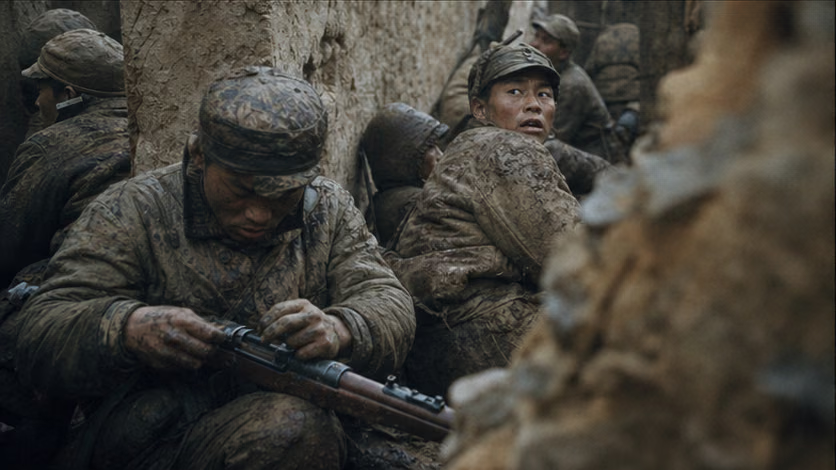
- Dai Zhiqi's suicide: before the division headquarters was overrun, Dai Zhiqi shot himself at the Renhewei command post. He was a Whampoa-trained young commander associated with Chiang Ching-kuo's network (his factional background is unverified), and his suicide after defeat shocked Nationalist commanders at the time. In the first winter of the civil war, men at the level of "reorganized division commander" began to die.
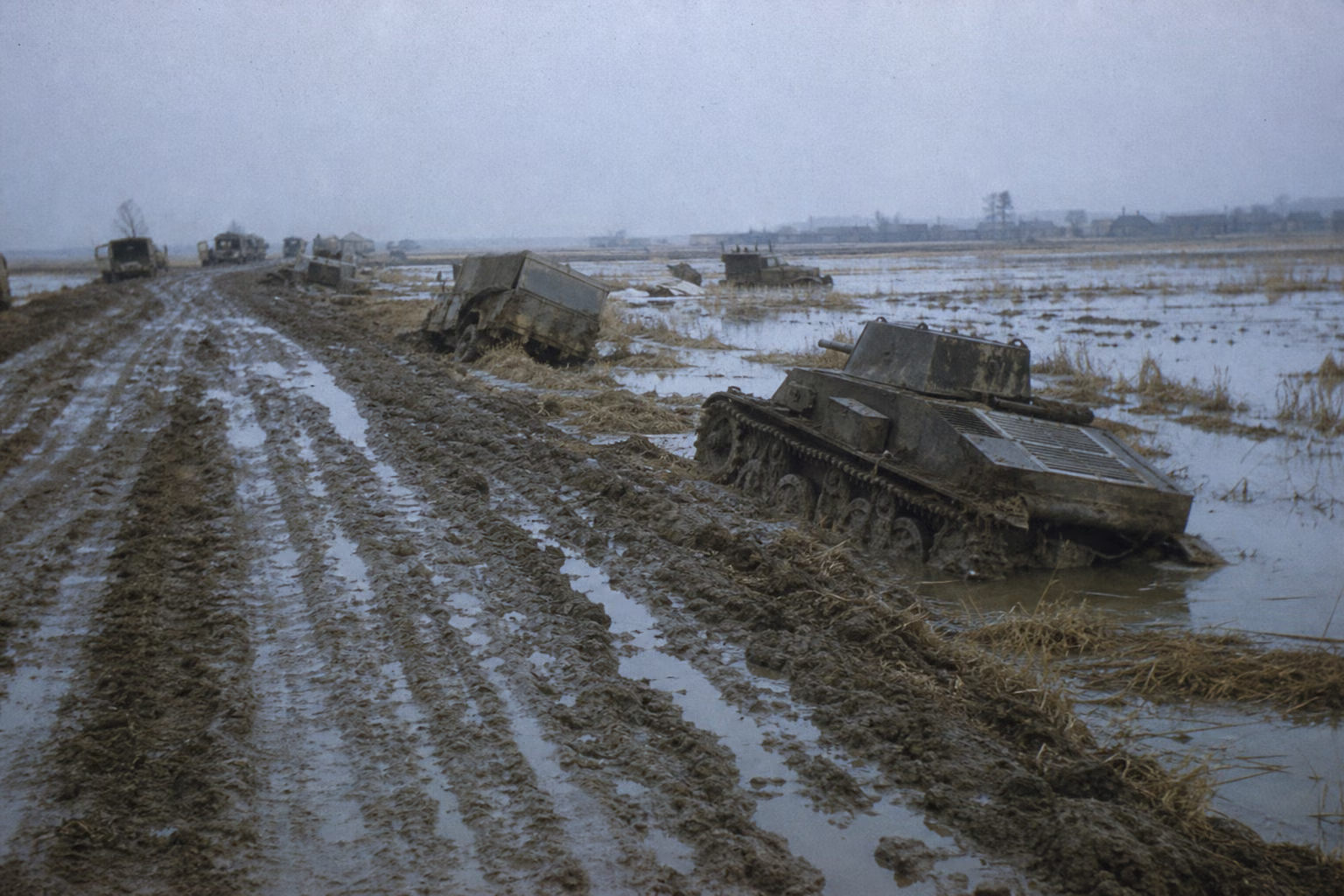
- Fighting tanks on a snowy night: on the night of 1.2 in Southern Shandong, rain and snow fell, and the Fast Column's tanks were stuck in the mud around Louzhi Lake (place name unverified). Infantrymen closed in with satchel charges and bundled grenades. The mechanized advantage over infantry was erased by the weather in a single night.
- "Liberated soldiers" driving tanks: there was no one to drive the captured tanks, so large numbers of former Fast Column tank troops were retained after grievance-speaking education and turned the muzzles of American-equipped tanks around. A few months later, these tanks appeared on the battlefields of Jinan and Huaihai.
- Ma Liwu spending New Year in Yixian: when the battle began, it was New Year, and Ma Liwu was watching opera and celebrating in Yixian city (this detail circulates widely, but the source level is unverified), leaving the front without a commander.
- Chen Yi's poem: after the battle, Chen Yi wrote a line about "tanks becoming scrap iron" to record Southern Shandong (the original line of the poem is unverified).
The Ground
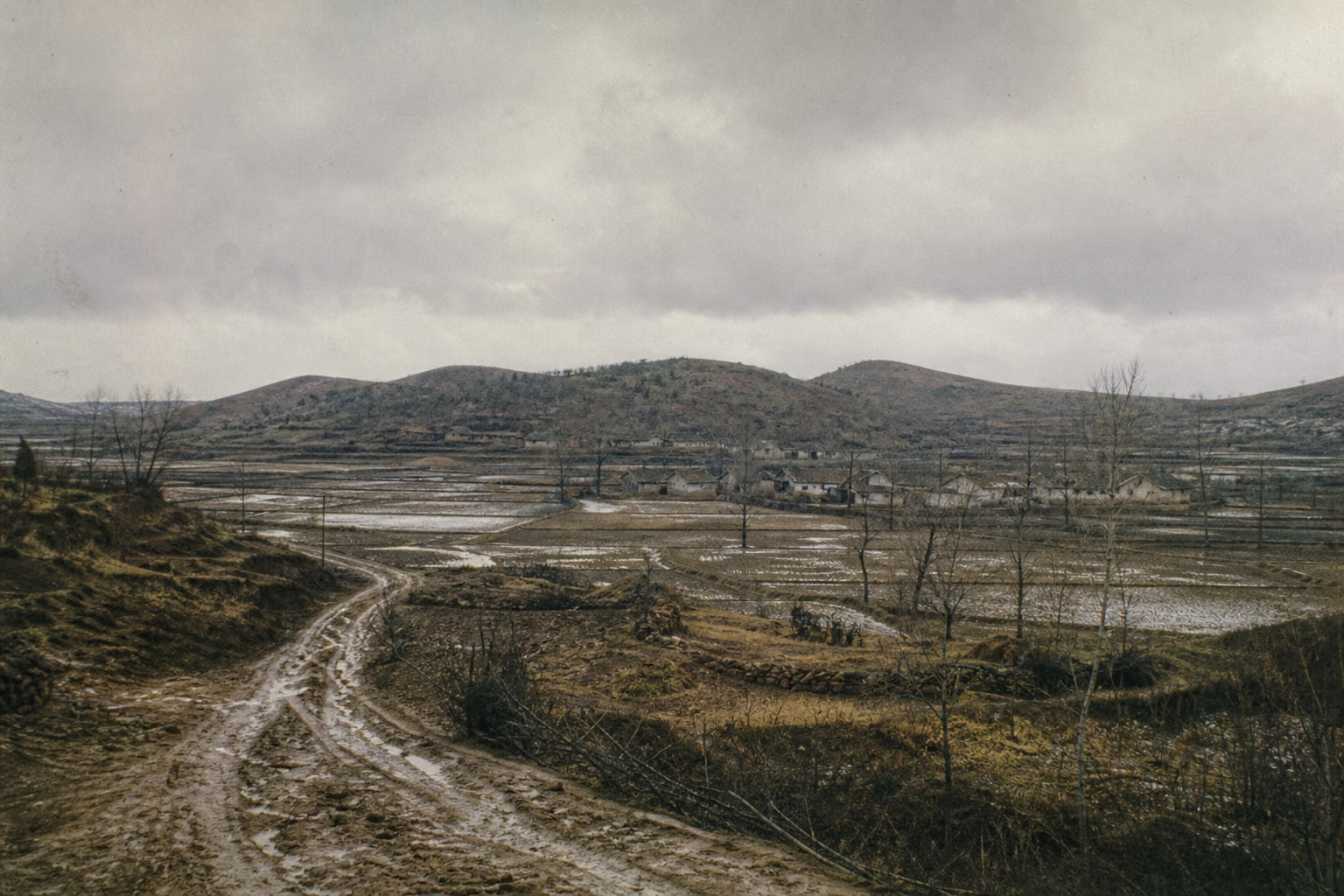
- Northern Suqian: low hills along the Fengshan and Zhangshan line mixed with villages on the plain; commanding heights determined artillery observation and attack and defense. This was a typical assault space of "villages plus high ground."
- Southern Shandong: a rain-snow, muddy plain road network. The mechanized column was pinned to the road, while the muddy ground on both sides became its burial ground. "Road-mire" formed the core spatial grammar of this battle.
- Yixian and Zaozhuang: coal cities and canal water networks in Southern Shandong, with street-fighting assaults (details of the mines and aboveground industrial buildings of the Zaozhuang coal mines are unverified).
- Scale: from division-level encirclement to fighting village by village and house by house, with a small combat radius and rapid tempo.
How Each Side Records It
- CPC canonical account: Northern Suqian and Southern Shandong are paired as the two key battles in the East China theater's shift "from passivity to initiative"; they are the starting point in the sequence of "our army in East China's first major battle of annihilation," and the destruction of the Fast Column is the emblematic event.
- Taiwan-side "pacification" narrative: Nationalist war histories include a dedicated review of the destruction of the Fast Column, attributing it to weather, coordination, and command errors (specific wording unverified); Dai Zhiqi's death is written as "dying for a righteous cause" (Taiwan-side wording unverified).
- Later scholarship: points of attention include the command adjustment in the merger of the two field armies, the practical role of captured equipment in building the People's Liberation Army's service arms, and the transformation mechanism by which "liberated soldiers" entered technical arms (representative studies unverified).
Disputes and Sensitivities
- "Liberated soldiers": large numbers of prisoners from the two battles were incorporated as replacements, especially the Fast Column's tankers, gunners, and drivers. Nationalist technical personnel were transformed in organized groups into technical backbone personnel for the People's Liberation Army. Communist sources record this as "captured, incorporated, and sent into battle at once"; Nationalist sources record it as "coercion." This article only describes the phenomenon itself.
- How to characterize Dai Zhiqi's death: suicide after defeat is usually passed over briefly in mainland narratives and written as "dying for a righteous cause" in Taiwan-side narratives. This article records only the facts: defeat, suicide, and an age of around forty at death (birth year unverified).
- Statistical bases for annihilation figures: separate sets of figures for the two battles, including Communist battle reports, Nationalist war histories, and later studies, coexist.
- Command attribution: in the Battle of Northern Suqian, who actually presided over operational command, Chen Yi or Su Yu, appears in memoir materials in two versions (unverified here). This is also why the section on "the Chen-Su division of labor taking shape" is listed as an open question.
Sources and Open Questions
Known major sources:
- Su Yu's War Memoirs (relevant chapters)
- Biography of Chen Yi, Biography of Su Yu, and their chronological biographies
- History of the Chinese People's Liberation Army in the National Liberation War
- Nationalist side: relevant volumes of pacification war history, memoirs of survivors of the First Fast Column (to be checked)
Open questions: the various statistical bases for enemy losses inflicted in the two battles; People's Liberation Army casualty figures; the telegram process by which the two field armies joined and unified command; the actual division of command in the Battle of Northern Suqian; Dai Zhiqi's birth year, factional background, and precise circumstances of suicide; itemized equipment of the Fast Column (tank models, artillery types and calibers, vehicle count); the concrete process by which captured equipment was used to form the Special Arms Column; the details of Ma Liwu's capture and the source for "watching opera during New Year"; Zhou Yuying's later circumstances; details of the Zaozhuang assault; Taiwan-side war histories' wording on the two battles.
All images on this site are AI-generated depictions. They are not historical photographs, not primary sources, and do not depict any real individual.