Engagement Archive · Southwest Shandong and the Advance into the Dabie Mountains
In the summer of 1947, Liu and Deng's 120,000-man army crossed the Yellow River by night, destroyed nine and a half Nationalist brigades in Southwest Shandong within a month, then threw away its heavy equipment, dispensed with a rear area, and inserted itself a thousand li into the Dabie Mountains--the strategic offensive of the Chinese Civil War began with the almost "self-wounding" wedge of a main force.
Engagement Data
| Item | Content |
|---|---|
| Time | 1947.6.30 – late August (the Southwest Shandong Campaign was mainly in July; the thousand-li advance was 8.7 – late August) |
| Place | Southwest Shandong (around Yuncheng, Dingtao, and Jinxiang) → the Yellow River flood zone, Henan-Anhui-Jiangsu → the Dabie Mountains |
| Part of | Chinese Civil War · opening of the strategic offensive phase (for the larger situation, see *Chinese Civil War · Overview*) |
| Maneuvering side | Main force of the Shanxi-Hebei-Shandong-Henan Field Army (commander Liu Bocheng, political commissar Deng Xiaoping), four columns, about 120,000 men (another account says 124,000; statistical bases vary by account) |
| Pursuing and blocking side | Multiple reorganized divisions under the Nationalist Army's Zhengzhou Pacification Headquarters and the Xuzhou Headquarters of the Army General Command (front-line commanders included Wang Jingjiu and Wang Zhonglian at different times; order of battle pending verification) |
| Result | In Southwest Shandong, nine and a half enemy brigades, about 56,000 men, were destroyed; by late August the force entered the Dabie Mountains, realizing the Central Committee's first step of "bringing the war into the Nationalist-controlled areas" |
Belligerents
| Item | Maneuvering side | Pursuing and blocking side |
|---|---|---|
| Strength | About 120,000 (First, Second, Third, and Sixth Columns) | Around 10 reorganized divisions were committed in succession on the Southwest Shandong battlefield (blocking in separate routes and defeated in detail) |
| Firepower | Mainly infantry small arms, with small numbers of mountain guns and mortars; most of the artillery captured in Southwest Shandong was abandoned during the southward advance | Mixed American and Japanese equipment, with artillery and some tanks; limited air support (details unrecorded) |
| Supply | Once across the Yellow River, the force was cut off from the rear; after the advance, it fought entirely without a rear area, raising grain and ammunition locally | Based on railways and towns; supply lines were intact, but command coordination was poor |
| Mobility | Entirely on foot, with daily forced marches | A higher mechanized component, but the Yellow River flood zone and the rainy season discounted that advantage |
Terrain and Conditions
(For the larger situation in mid-1947--the Nationalist focused offensives against Northern Shaanxi and Shandong, the emptiness of the Central Plains, and the deepening crisis in the Nationalist-controlled areas--see *Chinese Civil War · Overview*. This entry writes only about the route.)
Southwest Shandong: a plain and water-network area south of the Yellow River and north of the Longhai Railway, with dense villages. During the War of Resistance Against Japan it had been the edge of the Hebei-Shandong-Henan base area, and the mass foundation was relatively good. In 1947 the Yellow River had only just returned to its old course for one year (the Huayuankou closure was completed in 1947.3), and both the riverbed and the levees were new landforms (details pending verification).
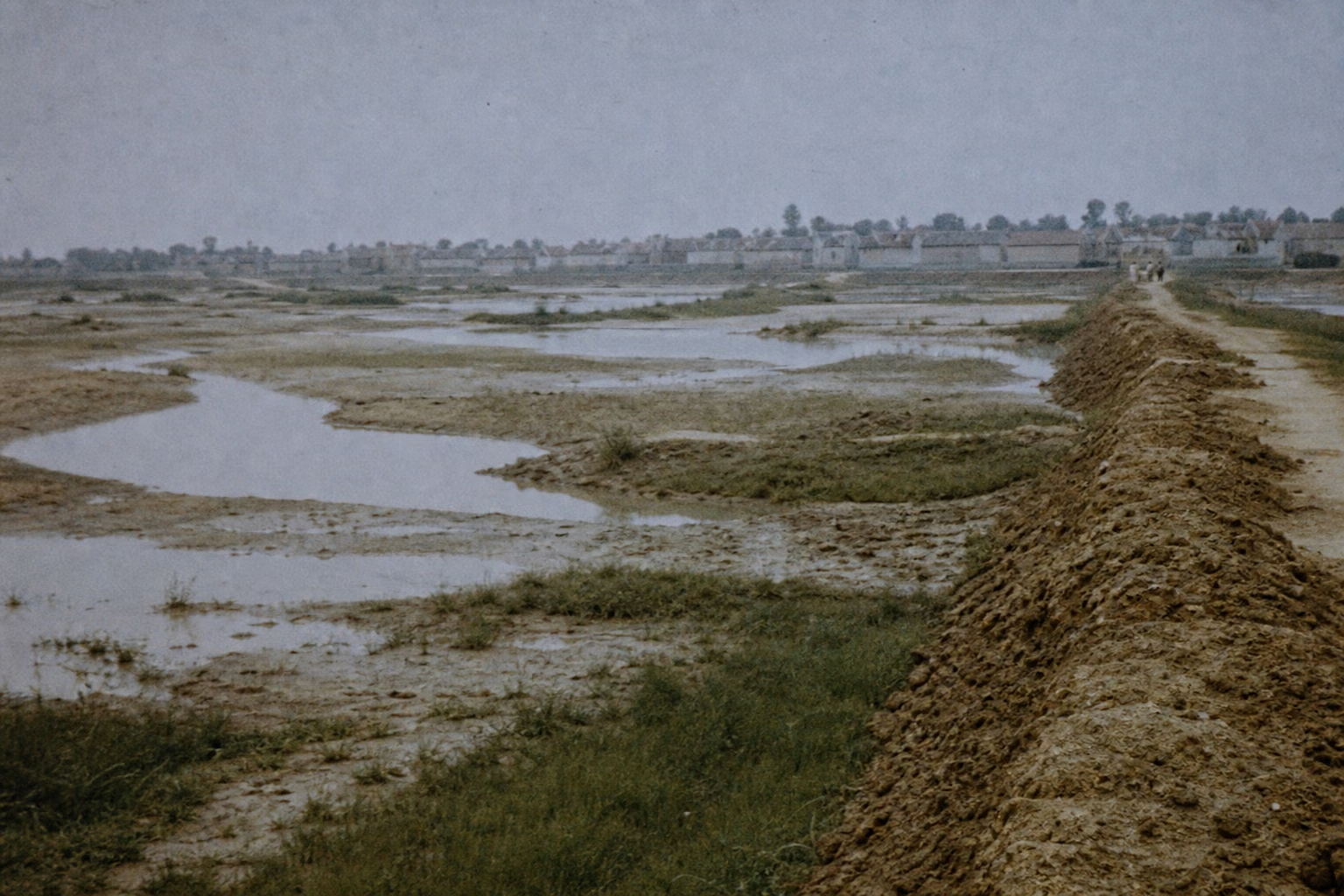
Yellow River flood zone: the broad belt of rotten mud, sand, and wasteland created by the 1938 Huayuankou breach. Although the Yellow River had by now returned to its old course, the old flood zone was still a band of mud several dozen li wide, with "no roads, no water (drinking water), and no human settlement"--crossing the flood zone became one of the repeatedly written episodes of this advance.
Dabie Mountains: an old soviet area at the border of Hubei, Henan, and Anhui, home ground of the Fourth Front Army and the Twenty-fifth Red Army. But the Dabie Mountains of 1947 were no longer the Dabie Mountains of those earlier years: after the Agrarian Revolutionary War they had changed hands repeatedly, grassroots regimes had risen and fallen several times, and popular reservations were heavy (the deviations in land-reform policy and their consequences pending verification)--"returning to the old area" was not the same as "going home."
Why It Was Fought
The Battle of Menglianggu had broken the spearhead of the focused offensive, but it had not changed the shape of the map: the Nationalist main forces still pressed heavily on both wings--450,000 in Shandong and 250,000 in Northern Shaanxi. Interior-line annihilation had been fought for a year, and many of the battles were victories; but the fighting took place inside the liberated areas, and the liberated areas bore all the consumption: Yan'an was lost, Linyi was lost, and the two Huai cities were lost. At that rate, victories and lost ground would continue side by side.
There was another opening on the map. With the main forces pressing on both wings, the Yellow River line in the Central Plains was instead thinly held--heavy at the two ends, light in the middle. The Central Committee's judgment came from this: rather than continue consuming strength on interior lines, bring the war into the Nationalist-controlled areas and force the enemy forces on the two wings to return in relief. At the end of June, the Central Committee telegraphed Liu and Deng: resolve to dispense with the rear and go directly out to the Dabie Mountains (wording of the telegram pending verification). The destination chosen was extremely distant and extremely hard: the Dabie Mountains, an old soviet area at the Hubei-Henan-Anhui border and the home ground of the Fourth Front Army, sat between Wuhan and Nanjing--for a main force to insert itself here was to press a blade-tip into the heartland of the Nationalist-controlled areas. But the Dabie Mountains of 1947 were no longer the Dabie Mountains of those earlier years; after repeated seesawing, grassroots regimes had risen and fallen several times, and popular reservations were heavy--"returning to the old area" was not the same as "going home."
The first step was to gain a foothold south of the Yellow River. From this came the task of the Southwest Shandong Campaign: seize a space in which to stand, draw the enemy forces into motion, and then shake them off and move south. Opposite them, the defenses rested on the Yellow River, which had only just returned to its old course for one year--Huayuankou had not been closed until March 1947, and this new riverbed was treated as the "Yellow River defense line."
The decision was then taken one layer further down, into the exchange of telegrams. Before the fighting in Southwest Shandong had fully ended, the Central Committee and Liu-Deng exchanged telegrams several times: what Liu and Deng reported was the state of their household--the troops had fought continuously for more than a month; casualties needed replacement, prisoners had not yet been digested, ammunition had to be transported, and they requested a short rest before moving; the Central Committee laid out in the telegrams the pressure on both the Northern Shaanxi and Shandong fronts and pressed them to move south earlier (dates and wording of the exchanged telegrams pending verification). The final itinerary set was half a month, directly out to the Dabie Mountains (source for the original sentence in the telegram pending verification). This was not an objection being overruled; it was difficulty being counted in and the march still being taken. Having no rear did not mean not knowing the price of a rear. Nanjing calculated that price into a different conclusion for them: this was a force fleeing south after being beaten. The Nationalist high command judged Liu-Deng to be "fleeing south" and responded by tailing, pursuing, and blocking them; only after the army had crossed the Ruhe and Huaihe in succession did it reweigh the significance of this insertion (original record for the characterization of the misjudgment pending verification). The pursuers and blockers did not lack troops--brigades that could be transferred in succession numbered by the dozens--what they lacked was mobility beyond the railways: the rainy-season Yellow River flood zone turned automobiles and heavy artillery into burdens, and when two legs chased two legs, equipment did not have the final say. No public record has been found of whether there was dissent within the Nationalist Army over the pursuing and blocking deployment itself.
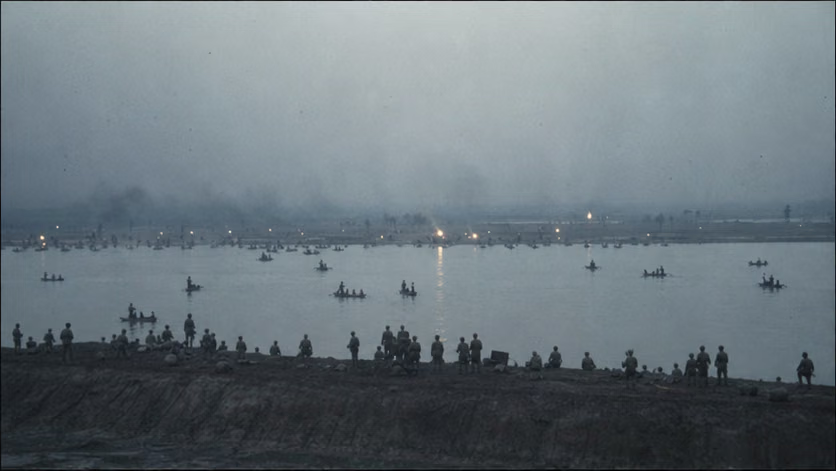
On the night of June 30, the Shanxi-Hebei-Shandong-Henan Field Army's four columns, about 120,000 men, forced crossings in several routes along a roughly 150-kilometer stretch of the river between Dong'e and Puxian; the "Yellow River defense line" was torn open in a single night.
The other route visible on the table was to keep fighting on interior lines: stable, with a rear area, somewhere to place the wounded, and a return to the base area for the winter once the battle was over. The Central Committee did not choose it. What the four words "dispense with the rear" meant was something the 120,000 men crossing the river that summer did not yet fully know--when this force moved out of the Dabie Mountains half a year later, it numbered just over 60,000.
Course of the Engagement
| Phase | Time | Key Points |
|---|---|---|
| Forcing the Yellow River crossing | Night of 6.30 | Forced crossings in several routes along about 150 kilometers of river (between Dong'e and Puxian; details of the crossings unrecorded); the Nationalist Army's "Yellow River defense line" was torn open overnight |
| Yuncheng and Dingtao | 7.7 – 7.10 | First Column took Yuncheng, destroying the headquarters and two brigades of the Reorganized 55th Division; Sixth Column took Dingtao and destroyed the 153rd Brigade (unit designation details unrecorded) |
| Liuyingji | Around 7.14 | The Reorganized 32nd and 70th Divisions were encircled and destroyed at Liuyingji, and Chen Yiding, commander of the Reorganized 70th Division, was captured (the two divisions were crowded into one market town and encircled and destroyed; details pending verification) |
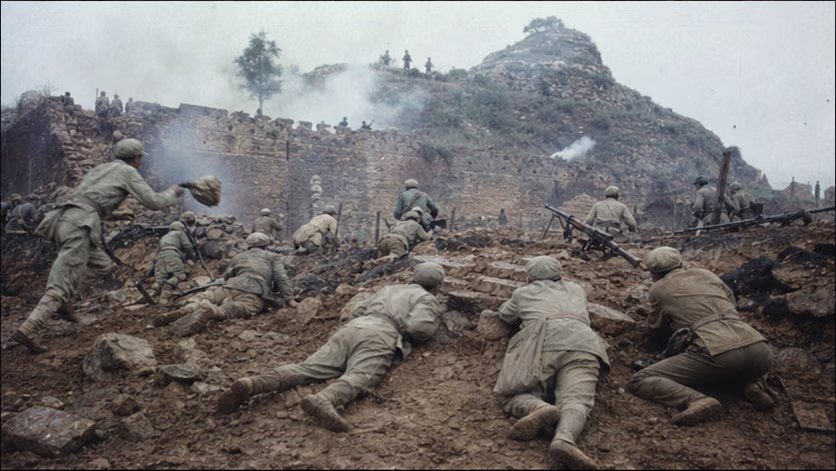
| Yangshanji | 7.14 – 7.28 | The Reorganized 66th Division (Song Ruike's force) was encircled and destroyed. Relying on the high ground of Yangshan and the walled-stockade defenses, it held out stubbornly; the Liberation Army assaulted for days and suffered heavy casualties, not taking the position until 7.28, when Song Ruike was captured. Details of the hard fighting in this battle are unrecorded--it was the costliest battle in Southwest Shandong, and also the focus of debate over "whether it was worth gnawing through this hard mouthful before leaving" |
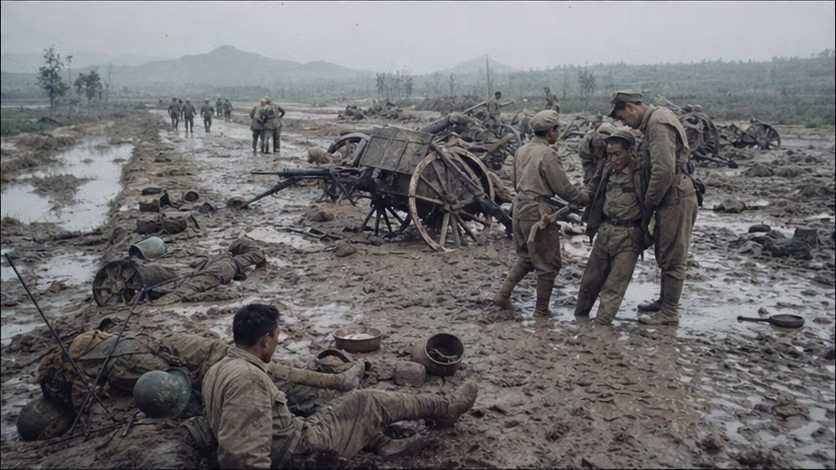
| Southward advance in separate routes | 8.7 – 8.17 | Disregarding the rear and without leaving behind organized arrangements for the wounded, the force inserted directly in three routes; after crossing the Longhai Railway it entered the Yellow River flood zone and abandoned heavy equipment: the newly captured artillery was blown up or sunk into the mire, and all vehicles were left behind (this was exchanging equipment for time) |
| Three successive river crossings | 8.18 – 8.27 | Shahe (8.18–19, unverified) → Ruhe (8.23–24, with blocking divisions ahead and pursuers behind; "on a narrow road, the brave prevail"--the original context of Liu Bocheng's words remains unverified) → Huaihe (8.26–27, just as the water was shallow, the army waded across, and afterward the water rose--this "help from heaven" legend circulates very widely, belongs to the level of oral memory, and its source remains unverified) |
| Entering the Dabie Mountains | Late August | Around 8.27 the main force entered the Dabie Mountains (the Central Committee's congratulatory telegram and the phrase "we have finally endured our way through" below both remain unverified) |
Casualties and Losses
- The Southwest Shandong Campaign itself caused about 13,000 casualties (statistical bases vary by account; the battle at Yangshanji accounted for the largest share).
- The price of the advance was equipment and stragglers: artillery and transport were almost entirely lost, and few heavy weapons remained beyond heavy machine guns; public statistics are lacking for stragglers and non-combat attrition in the Yellow River flood zone and along the three rivers (unverified here).
- The overall account: half a year later (when the army moved out of the Dabie Mountains in spring 1948), the force that came out of the mountains had fallen from 120,000 to just over 60,000. The composition of the losses--battle casualties, stragglers, desertions, and those left locally to persist--has no complete public figures (composition pending verification). The hunger and cold of fighting without a rear: winter clothing depended on cutting and sewing locally on one's own, medicines were desperately scarce, and placing the sick was extremely difficult (details of the winter clothing matter in winter 1947 pending verification). The Central Committee's reissuance in 1947.10 of the "Three Main Rules of Discipline and Eight Points for Attention" had, as one background, a renewed statement of discipline under the no-rear conditions of the new areas (causal wording pending verification).
Aftermath
- Together with Chen-Su's army (Henan-Anhui-Jiangsu) and the Chen-Xie Group (western Henan), it formed a pin-shaped set of horns, turning the Central Plains war situation onto a new page--from this point, the main battlefield of the war was pushed into the heartland of the Nationalist-controlled areas north of the Yangtze.
- Holding on in the Dabie Mountains was extremely hard: the Nationalist Army transferred heavy forces to "mop up"; the partial popular alienation caused by overhasty land reform was later corrected through policy adjustment ("acute land reform" correction, early 1948, pending verification). In February-March 1948 the main force moved out of the Dabie Mountains and entered the Central Plains battlefield.
- Mao Zedong has a widely circulated summary statement about the gains from this strategic action--"we have finally endured our way through" (context and original source pending verification; there are also expressions of the type "reaching the Dabie Mountains is victory," at the same unverified evidentiary level).
- A two-sided account: strategically, the insertion of a main force levered the whole Central Plains and brought the war into the Nationalist-controlled areas, and the return on this step was cashed out by the subsequent Central Plains campaigns; operationally, Liu and Deng's army paid for it with nearly half its strength and almost all its heavy equipment, and for the following year it was no longer the main force for destroying the enemy in the Central Plains--the main-attack role passed to the East China Field Army. Both accounts hold, and each is the premise of the other.
Accounts of Those Present
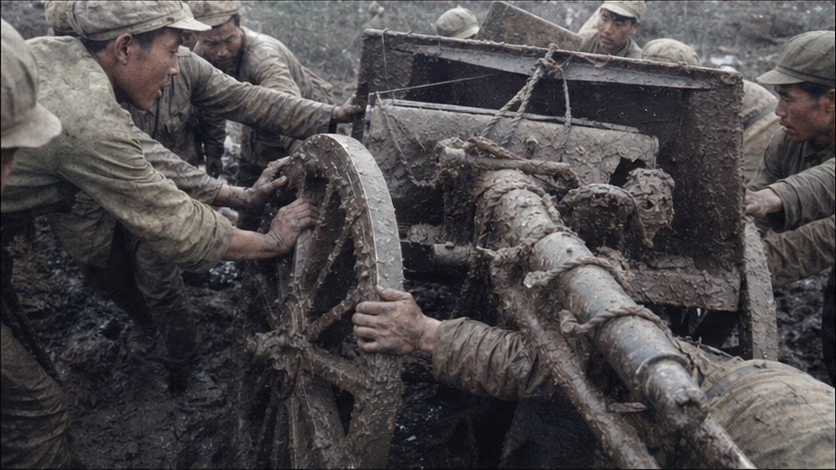
- Sinking the guns: in the mud of the Yellow River flood zone, artillerymen with their own hands pushed the bright, newly polished American howitzers just captured from Yangshanji into the mire, or blew them up on the spot. The guns had been bought with lives, and when they were thrown away no one spoke (the specific scene comes from the memoir level, pending verification).
- Ruhe: ahead were reorganized divisions blocking the crossing points, and behind the pursuers were only a few dozen li away. The sentence Liu Bocheng spoke at the crossing--"on a narrow road, the brave prevail"--was later written into military-history textbooks; but accounts differ on whether the sentence was shouted by the riverside or spoken at an operational meeting (context pending verification).
- Huaihe: when the force reached the riverside, boats had all been searched out; reconnaissance found that wading was possible. After tens of thousands crossed, the water level rose sharply, and the pursuers were blocked on the north bank. Details of Liu Bocheng personally testing the water (such as entering the water with a bamboo pole) circulate very widely and belong to a mixed layer of recollection and legend (unverified here).
- How to fight a battle with no rear: the wounded were carried along; those who could no longer move were "hidden and secured" locally in civilians' homes, with money and letters left behind; many people were separated from the force from that point. Each southbound soldier carried full kit plus grain and ammunition, and covered seventy or eighty li in a day (this specific marching-load figure is disputed).
- "Liberated fighters": Nationalist soldiers captured in the Southwest Shandong battles were in large numbers "captured and replenished at once"--they took off their cap badges, were incorporated into companies, and turned around to join the southward advance. These men went through the Yellow River flood zone and the three rivers; a considerable share later became backbone personnel in the Dabie Mountains holding phase, while some again fled during the bitter days without a rear. This method of manpower replenishment ran through the entire civil war, and this entry is a typical sample (the proportion of captured-and-immediately-replenished troops and the policy details pending verification).
The Ground
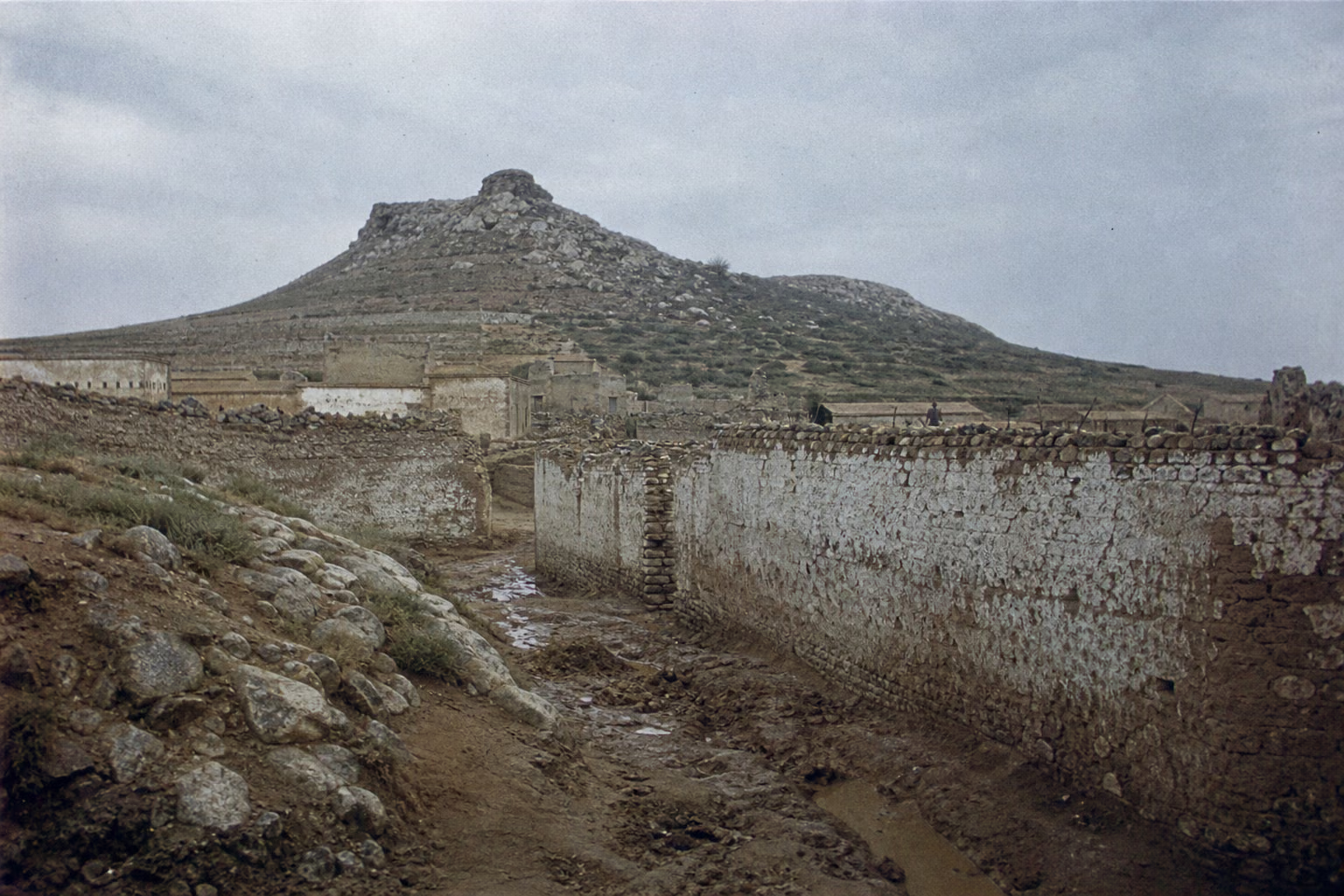
- Yellow River crossing clusters: night crossings, wooden boats, simultaneous crossings in several routes--a broad-front forced crossing as the opening.
- Yangshanji: a market town plus one stone hill (Yangshan), where the defending side relied on the walled stockade and commanding ground to resist for two weeks--a miniature fortress on the plain.
- Yellow River flood zone: several dozen li of coordinate-less mud belt, where artillery and vehicles were all rendered useless and mobility returned to pure infantry--a forced terrain of "demodernization."
- Shahe-Ruhe-Huaihe: a continuous obstacle course of three bodies of water, each crossed in a different way (boat crossing, forced crossing, wading), with an escalating tempo.
- Dabie Mountains: low mountains and hills, with scattered villages; suitable for guerrilla warfare but not for supplying large formations--the destination itself was the entrance to a test of survival.
How Each Side Records It
- Mainland: it is defined as the landmark action that "opened the prelude to the strategic offensive," and "the thousand-li advance into the Dabie Mountains" is a textbook expression; the stubbornness at Yangshanji and the price of the advance are recorded in military-history works, but the narrative center of gravity lies in the strategic gains.
- Taiwan: generally placed within the framework of "pacification operations," describing Liu-Deng's forces as "fleeing into and harassing" the Dabie Mountains, emphasizing that they were later driven out by "mopping-up" and that heavy-force encirclement and suppression caused them severe losses (specific wording pending verification); the destruction of the various divisions in Southwest Shandong is also recorded as defeat in Taiwan-side war histories (Taiwan-side unit designations and statistical bases vary by account).
- Third-party/academic: Western studies mostly view it as the turning point in the CPC's shift from defense to offense, while also noting its military cost and significance for political mobilization (specific literature to be added).
Disputes and Sensitivities
- The evaluation of a "self-wounding wedge": within military-history circles, discussions of the gains and losses of the advance into the Dabie Mountains have always differed in degree--strategically necessary, but whether its operational cost was too high, and whether overhasty land reform worsened the difficulties. The "two-sided account written together" comes from this debate itself, not from a single-line conclusion.
- The composition of the attrition figure (120,000 → just over 60,000) has long lacked decomposed statistics and remains "composition pending verification."
- Classic narratives such as wading the Huaihe and "on a narrow road, the brave prevail" contain legendary elements; this entry has already marked them by layer, and they should not be merged into settled historical fact when used.
- Abandoning artillery, leaving wounded behind, and the three instances of "hidden and secured" are the heaviest parts of the cost in the advance into the Dabie Mountains.
Sources and Open Questions
Known main sources:
- *Selected Military Writings of Liu Bocheng* and related telegrams (the Central Archives compilation *Selected Documents of the CPC Central Committee* includes some exchanged telegrams)
- Academy of Military Sciences, *History of the Chinese People's Liberation Army in War* (official military-history account)
- Recollections by captured generals such as Song Ruike (the *Selected Historical Materials* system)
- Recollections by participants such as Li Desheng and Xiao Yongyin (advance sections)
Open questions: details and sequence of the Yellow River crossing clusters; specific dates and unit designations for each Southwest Shandong battle (153rd Brigade, affiliations of the two divisions at Liuyingji); day-by-day details and casualties of the hard fighting at Yangshanji; the day-by-day timetable of Liu-Deng's force leaving the Longhai Railway, crossing the Yellow River flood zone, and crossing the three rivers; the original context of "on a narrow road, the brave prevail"; the Huaihe wading water conditions and the details of Liu Bocheng testing the water; the original source of "we have finally endured our way through"; the decomposed composition of the half-year attrition; concrete implementation of the captured-and-immediately-replenished policy in the Shanxi-Hebei-Shandong-Henan Field Army; the correction process for "acute land reform" in the Dabie Mountains; corresponding Taiwan-side war-history entries and their unit-designation statistics.
All images on this site are AI-generated depictions. They are not historical photographs, not primary sources, and do not depict any real individual.