Campaign Overview · Liaoshen Campaign (1948)
In fifty-two days, all of the Northeast changed hands, and 472,000 elite Nationalist troops vanished -- from this point onward, the balance of forces tipped in favor of the People's Liberation Army. The keys to this decisive campaign were one city (Jinzhou), one ridge (Tashan), and one city that had been starving for five months (Changchun): the brilliance of victory and the starved dead of a besieged city both belong to these fifty-two days.
Engagement Data
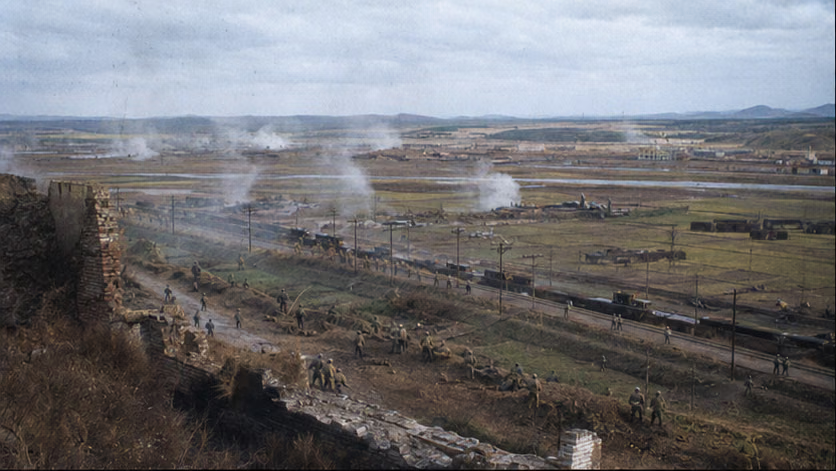
| Item | Content |
|---|---|
| Time | 1948.9.12 – 11.2, fifty-two days |
| Place | Northeast: Jinzhou--Tashan--Heishan--western Liaoning corridor--Changchun--Shenyang and Yingkou |
| Part of | Chinese Civil War (for the overall war, see *Chinese Civil War · War Overview*) |
| Attacker | Northeast Field Army (Lin Biao, Luo Ronghuan, Liu Yalou), roughly 700,000 plus 330,000 local troops |
| Defender | Wei Lihuang's Northeast "Bandit Suppression Headquarters," roughly 550,000 under its authority: Fan Hanjie at Jinzhou, Liao Yaoxiang's corps at Shenyang, Zheng Dongguo at Changchun |
| Result | 472,000 destroyed or incorporated (figures vary by statistical basis); the entire Northeast passed to the People's Liberation Army -- the national balance of forces reversed from this point |
Belligerents
| Item | Northeast Field Army | Nationalist Northeast Group |
|---|---|---|
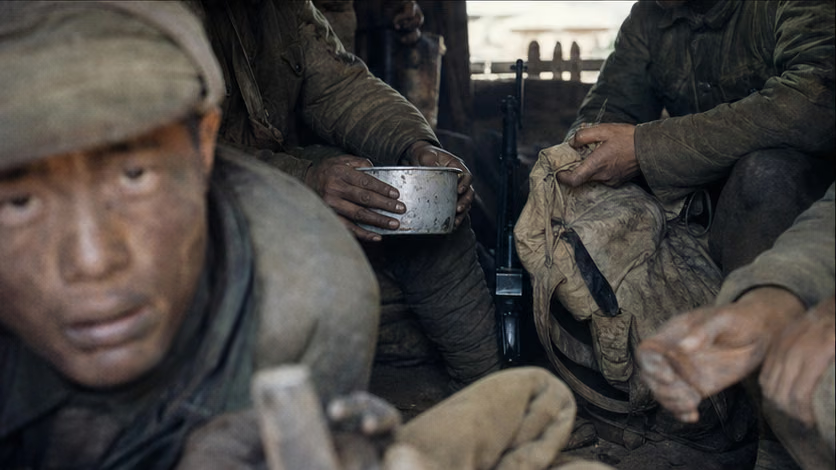
| Strength | Million-level, including local forces, with artillery already superior -- the first time in the civil war that the People's Liberation Army held overall superiority in the decisive direction | 550,000 trapped along the three-point line of Changchun, Shenyang, and Jinzhou, supplied by airlift and sea transport |
| Forces | Three years of building: land-reform manpower + Japanese weapons and Soviet aid handed over + the fortified-assault lessons paid for at Siping | Included the New First Army, New Sixth Army, and other descendants of the Chinese Army in India (the end of the glory units from northern Burma -- a thread running through multiple articles; see *North Burma Counteroffensive*) |
| Strategic situation | The situation of "shutting the gate to beat the dog" had already taken shape | The dispute over withdrawal or remaining had hung unresolved for a year (the Chiang-Wei dispute -- the decision history behind the long-existing but undecided Jinzhou withdrawal corridor remains to be checked) |
Terrain and Conditions
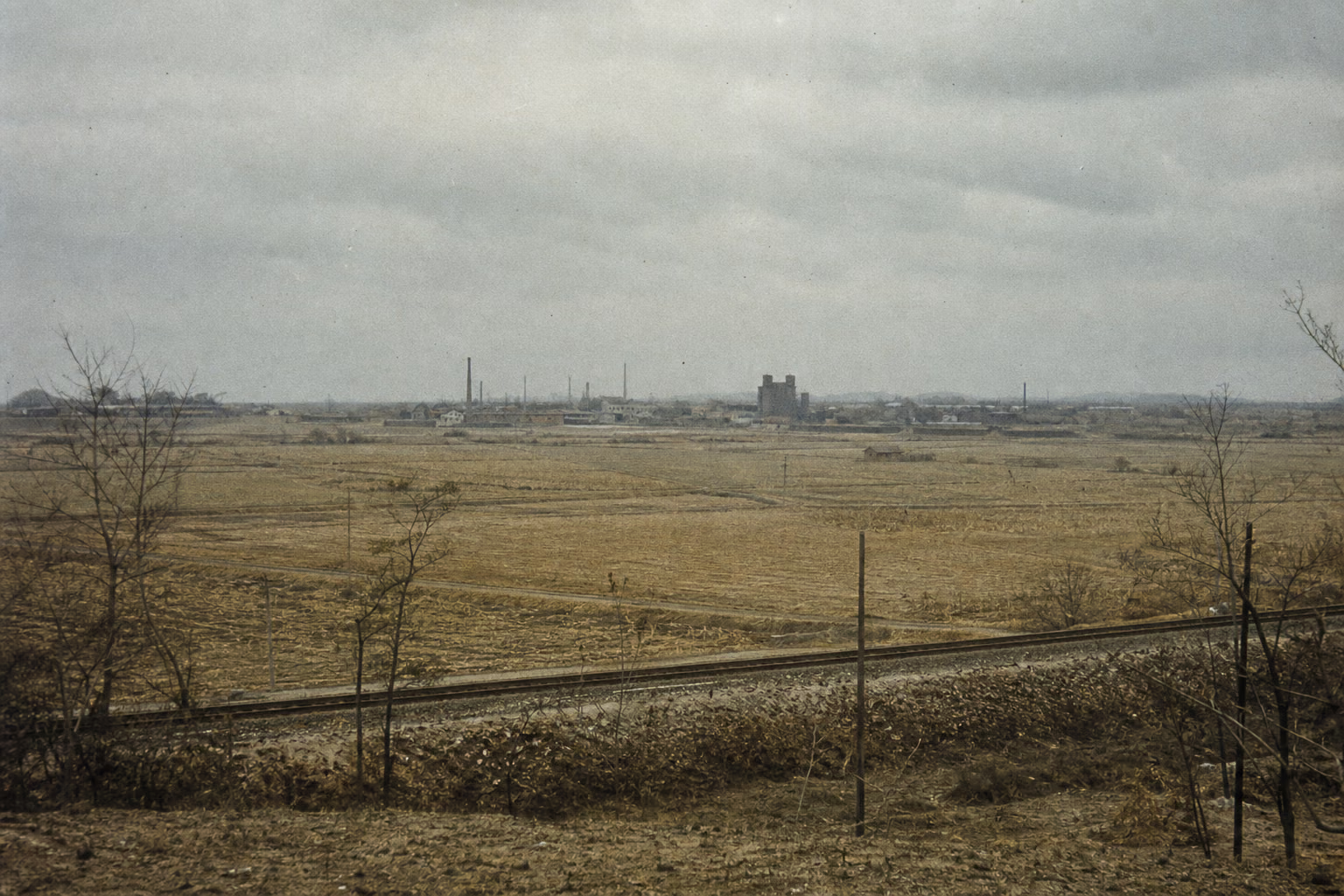
The Northeast in autumn 1948: liberated areas held 97% of the land and 86% of the population (figures vary by statistical basis); the Nationalist Army's three isolated major points survived on airlift. Why the decisive campaign came first in the Northeast: an industrial, grain, and manpower rear area capable of sustaining the war + the only theater where the balance between enemy and friendly forces had already reversed -- the back-and-forth between the Central Military Commission and Lin Biao over whether to strike Jinzhou first or Changchun first (telegram history remains to be checked: Lin Biao's hesitation, Mao's insistence, and the finalization of the Jinzhou plan in September) -- the dispute over the decisive direction is itself an important page in this article, and the record does not write with hindsight.
Why It Was Fought
After the battle at Siping, the Northeast kept fighting for more than two years. By autumn 1948, the situation had turned around: the liberated areas had spread across most of the countryside, and land reform, manpower, grain, and arsenals had turned the Northeast into a battlefield capable of supplying its own blood; the Nationalist Army had contracted into the three-point line of Changchun, Shenyang, and Jinzhou, surviving on air transport, sea transport, and the Beining Railway. Among the major theaters nationwide, only the Northeast had first developed the conditions for a decisive campaign.
Why Jinzhou first? The answer lies on the map. Jinzhou was the door bolt between the Northeast and North China. If the door was not bolted shut, the Shenyang group could withdraw inside the pass, and Nationalist forces inside the pass could also support it from Huludao and Jinxi; once the door was closed, the Nationalist forces in the Northeast would be left outside the pass. Changchun had been under siege for months, and Shenyang was also under pressure, but neither was the exit. Between the Central Military Commission and Lin Biao and Luo Ronghuan, telegrams went back and forth several times over whether to strike Jinzhou first or Changchun first (specific dates and full texts remain to be checked). The front line worried about going too far south, stretching supply, and being caught between Jinxi-Huludao reinforcements and the Jinzhou attack. The center insisted on sealing the door first, then turning back to destroy each point in turn. The dispute was not about bravery or timidity; it was about whether the door should be closed first or the city should be taken first.
For the Northeast Field Army, its hands were not empty for the first time: roughly 700,000 main-force troops, more than 300,000 local troops, and artillery and fortified-assault experience much thicker than in the Siping period. But thickness did not mean infinity. Jinzhou was far from the old base areas in northern Manchuria; moving grain and ammunition south, repairing railways, and shifting artillery all required time. Changchun's long encirclement was also tying down forces and pressing on the humanitarian cost. Precisely because the resources could support only one directional choice, the Jinzhou plan carried such weight.
Nanjing was not blind to the danger. Chiang Kai-shek wanted the Northeast in order to preserve the fruits of the takeover after victory and the industry beyond the pass; Wei Lihuang, holding Shenyang, was unwilling to throw his main force rashly into the western Liaoning corridor; Zheng Dongguo in Changchun was trapped in an isolated city, Fan Hanjie held the door bolt at Jinzhou, and Huludao still offered seaborne support. The Nationalist misjudgment lay in believing that Jinzhou could still be rescued from the outside and patched through Chiang and Wei's ad hoc coordination; it did not reckon that the Northeast Field Army would press down the attack on Jinzhou, the blocking of reinforcements, and the encirclement of Shenyang all at once.
This side was not unanimous from the beginning. Lin Biao's hesitation over going south to strike Jinzhou is an acknowledged decision-making back-and-forth; the center did not adopt the direction of Changchun first because even if Changchun were taken, the Northeast's door would still remain open. For the Nationalist Army, the debate over withdrawing from the Northeast or holding out for relief had dragged on for a year; once Jinzhou was chosen as the first cut, the debate had become a countdown. On September 12, the Northeast Field Army launched its offensive along the Beining Railway, and the Liaoshen Campaign began.
Course of the Engagement (Three Phases)
| Phase | Time | Key points | Separate article |
|---|---|---|---|
| Closing the gate: Jinzhou | 9.12–10.15 | The Beining Railway was opened first; Yixian was taken (Zhu Rui was killed -- the artillery commander died after stepping on a mine, one of the highest-ranking People's Liberation Army commanders killed in action); on 10.14 the general assault on Jinzhou took the city in 31 hours and captured Fan Hanjie -- the Northeast's main door was bolted shut | Assault on Jinzhou |
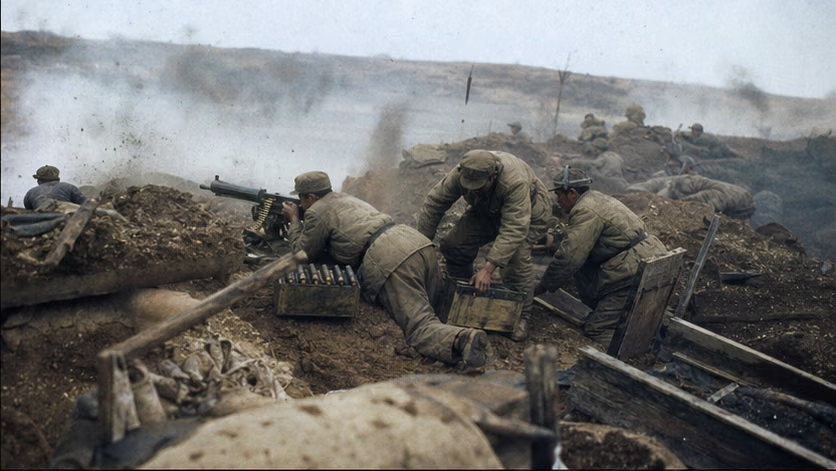
| The door bolt: Tashan | 10.10–15 | Hou Jingru's "Eastward Advance Corps," eleven divisions, attacked Tashan fiercely for six days and nights from Huludao -- not an inch of the position was lost; without Tashan, there would have been no Jinzhou | Battle of Tashan |
| Changchun falls | 10.17–19 | After Jinzhou was broken, Changchun lost hope: Zeng Zesheng's 60th Army rose in revolt (10.17), the New Seventh Army laid down its weapons, and Zheng Dongguo was "liberated" (his telegram saying he would "resist to the last" and the dignified arrangement by which resistance actually ceased -- unverified) -- the city besieged for five months fell without a battle; ※ see the next section | |
| Annihilation in western Liaoning | 10.21–28 | Liao Yaoxiang's 100,000-man corps advanced west and then broke east, wavering between Zhangwu and Heishan; the blocking action at Heishan (including Liang Shiying's self-sacrifice in blowing up a bunker, 10.23–25) pinned its head in place; the main force of the Northeast Field Army turned back from Jinzhou and completed the encirclement, destroying Liao's 100,000-man corps in two days and nights on the open ground of western Liaoning (the accident and necessity of striking the headquarters at Hujiawopeng -- level marking) -- the New First Army and New Sixth Army vanished | |
| Coda | 10.30–11.2 | Shenyang and Yingkou were taken; Wei Lihuang flew out first; the entire Northeast was settled |
※ Siege of Changchun (1948.5–10)
- Factual frame: from May, the Northeast Field Army imposed a "long encirclement and prolonged siege" on Changchun: military blockade + economic blockade, forbidding grain from entering the city; Zheng Dongguo's 100,000 defenders requisitioned grain from civilians inside the city; the transmission of hunger between defenders and residents -- the structure in which civilians ran out of grain while army granaries still had grain.
- "Checkpoint zone": defenders drove starving civilians out of the city to reduce grain consumption, while the besieging troops at first barred entry to hasten internal collapse -- the vacuum zone between the two armies gathered tens of thousands of starving civilians who could neither advance nor retreat (the misery of the "empty checkpoint" -- death in the intermediate zone is the heaviest stroke in this section); the timing of the later policy adjustment by which the besieging army allowed passage and provided relief (release criteria from September vary by statistical basis).
- Death figures: starvation deaths range from tens of thousands to several hundred thousand, with sharply divergent bases (Changchun's population curve before and after the siege: roughly 500,000 down to 170,000 -- the debate over how much of the difference was flight and how much was death, with two accounts coexisting in different studies); the Taiwan side and some studies say "more than 100,000," while mainland archival studies use other bases.
- Recorders: memoirs by defending-army officers (Duan Kewen and others), letters home and memoirs by soldiers in the besieging army (the existence of records of "could not bear it"), oral accounts by surviving residents (collections remain to be checked), and the public discussion sparked by Lung Ying-tai's *Big River, Big Sea* and the dispute over its verification (contemporary memory link, level marking).
- Position sentence: whichever set of figures one adopts, the main bearers of the siege famine were civilians; the military success of "subduing the enemy's troops without fighting" and the humanitarian disaster both belong to these five months.
Casualties and Losses
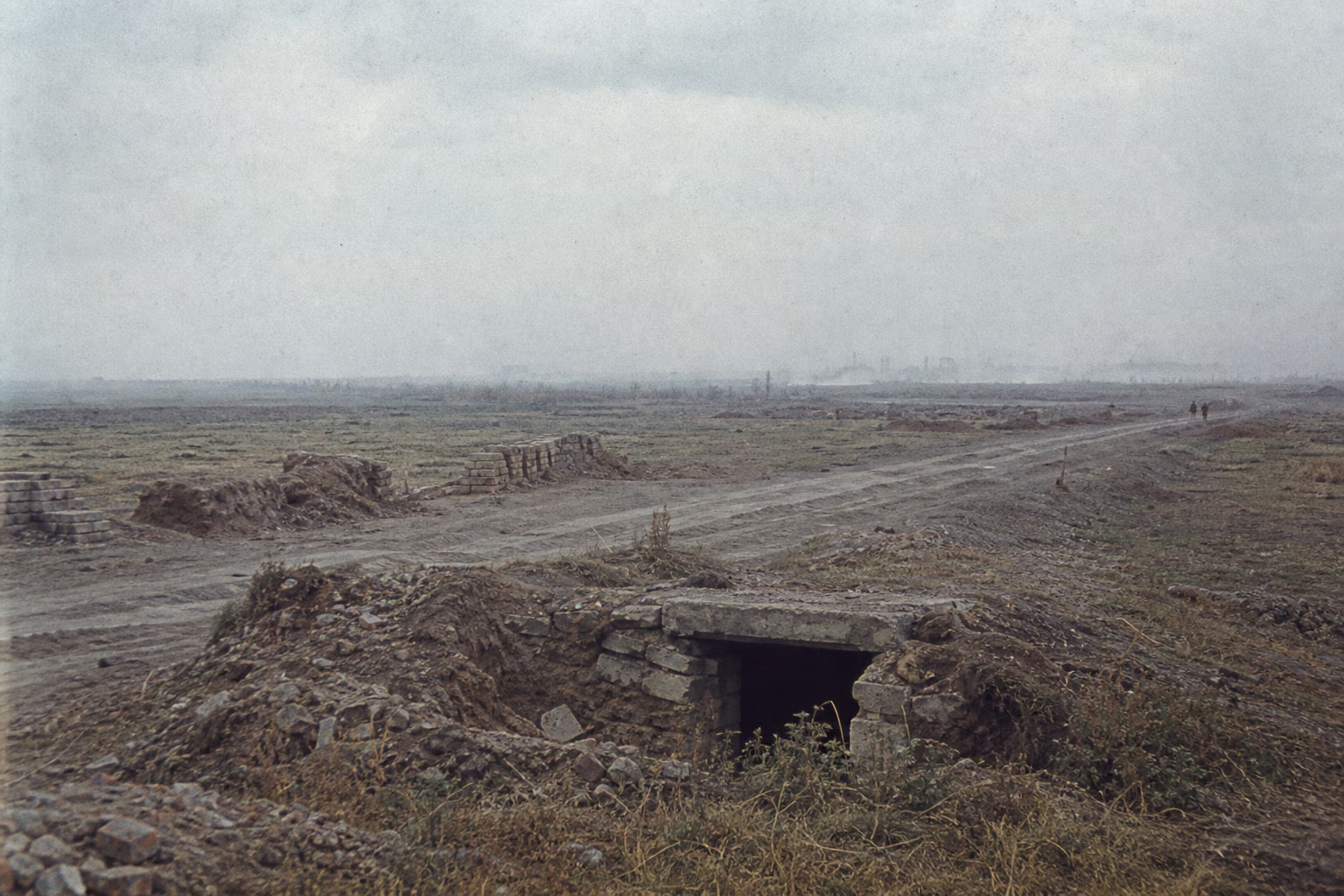
- Nationalist Army: 472,000 (57,000 killed and wounded, 320,000 captured, more than 90,000 rose in revolt or were incorporated -- composition basis pending verification); the Northeast elites, including the lineage of the Chinese Army in India, were all gone.
- Northeast Field Army: 69,000 casualties (figures vary by statistical basis); officers and soldiers from Zhu Rui downward (roster unverified).
- ※ Civilians: Siege of Changchun (separate section); front support and spillover effects in the theater (Northeast front-support mobilization figures pending verification).
Aftermath
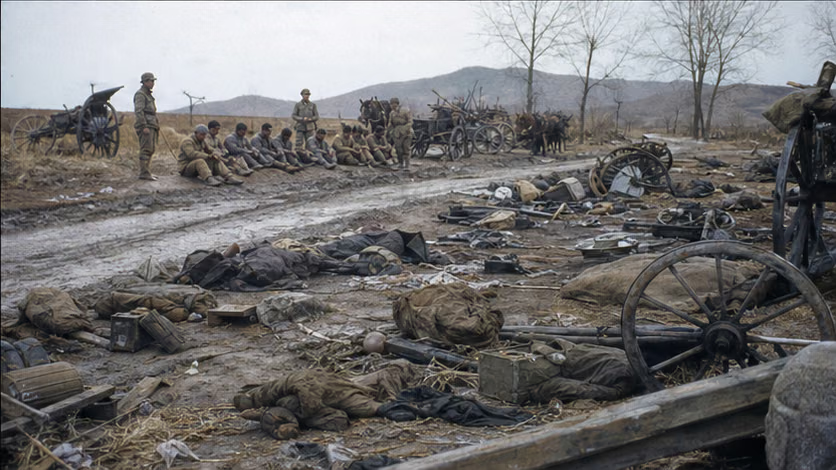
- The national balance of forces reversed (People's Liberation Army 3,000,000 against Nationalist Army 2,900,000 -- figures vary by statistical basis): Mao Zedong's timetable for "fundamentally overthrowing the Kuomintang" changed from "five years" to "around one year" (telegram text unverified).
- The Northeast Field Army's million-man force entered the pass -- the first move in the Pingjin Campaign (the covert entry routes cross-reference the Pingjin overview).
- The Shenyang arsenal and Northeast industry supplied blood for the subsequent war; the "Northeast Liberated Area" became the industrial foundation of the new regime.
- Liao Yaoxiang, Fan Hanjie, Zheng Dongguo, and others entered war-criminal management centers or were placed after surrender -- the Gongdelin list added more names (cross-article closing thread).
How Each Side Records It
- CPC canon: first victory among the three great campaigns, the narrative of the "Liaoshen decisive campaign" (the canonizing stroke of the film series *The Great Decisive Battle*); the Changchun section long remained low-key, with archives and oral accounts gradually opening in recent years.
- Taiwan side: the loss of the Northeast marks the beginning of the collapse of "pacification," with review focused on the Chiang-Wei decision dispute and the stalling of U.S. aid; the Changchun siege is a central accusation in its narrative -- the selectivity of the two sides' narratives mirrors each other: one side tells the annihilation in western Liaoning and passes over Changchun, while the other tells the starving dead of Changchun and passes over decision-making errors -- placing the two archival pages side by side is the answer to both forms of selectivity.
- Scholarship: three research lines -- the history of decision-making telegrams (the Mao-Lin exchanges), Changchun population history, and the unit history of the Chinese Army in India lineage.
Disputes and Sensitivities
- The telegram history of the dispute over Jinzhou first and Changchun afterward -- record the back-and-forth on both sides, without writing an "always correct" narrative.
- The figures and responsibility for the Siege of Changchun.
- The old case over Wei Lihuang's "passivity" (various accounts of his relationship with the CPC -- level marking pending verification).
- The level of the Hujiawopeng accident narrative.
Contents
Heishan blocking action, Siege of Changchun, and Annihilation in western Liaoning are incorporated into the sections of this article.
Sources and Open Questions
Sources: *History of the Northeast Liberation War*; *Liaoshen Campaign* (collected series); collections of related telegrams by Lin Biao and Luo Ronghuan; memoirs by Zheng Dongguo and Du Yuming; the Taiwan-side *Military History of the War of Pacification*, Northeast section; studies of the Changchun siege (mainland archival studies placed alongside the discussion literature prompted by Lung Ying-tai); Duan Kewen, *Self-Accounts by War Criminals*.
Open questions: the statistical basis for both sides' troop strengths and casualty composition; the set of back-and-forth telegrams between the Central Military Commission and Lin Biao and Luo Ronghuan over whether to strike Jinzhou first or Changchun first; the sources for Lin Biao's specific judgments on southward supply, Jinxi-Huludao enemy reinforcements, and the risks of attacking Jinzhou; telegrams and correspondence between Chiang Kai-shek and Wei Lihuang over withdrawal or defense in the Northeast and reinforcements into western Liaoning; Changchun population curve and death-figure bases; timing of passage and relief; details of Zhu Rui's death; verification of Hujiawopeng.
All images on this site are AI-generated depictions. They are not historical photographs, not primary sources, and do not depict any real individual.