Engagement Archive · Mobile Warfare in Northern Shaanxi (Qinghuabian, Yangmahe, Panlong, Shajiadian — combined account)
Hu Zongnan's 250,000 men entered Yan'an, but the city they attacked had been deliberately left empty; Peng Dehuai's 26,000 men used "mushroom tactics" on the Loess Plateau to bite four times in succession--Qinghuabian, Yangmahe, Panlong, and Shajiadian--and half a year later, the northwestern war situation had turned over.
Engagement Data
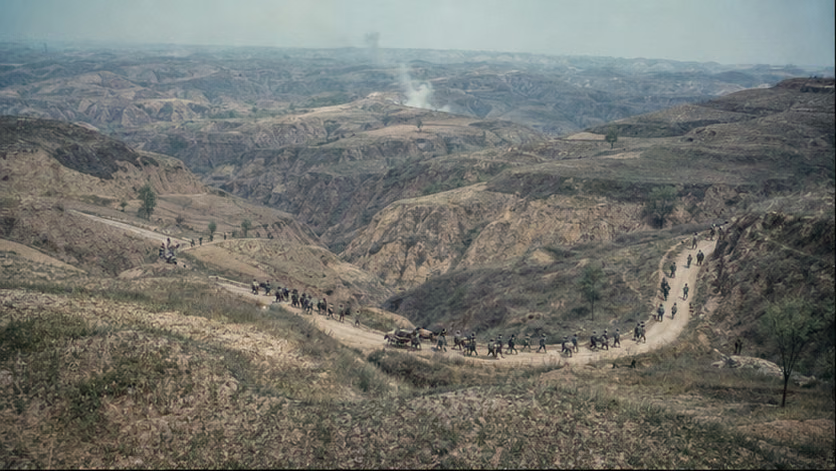
| Item | Content |
|---|---|
| Time | 1947.3–8: evacuation of Yan'an, 3.18–19; Qinghuabian, 3.25; Yangmahe, 4.14; Panlong, 5.2–4; Shajiadian, 8.20 |
| Place | Northern Shaanxi: north of Yan'an and the Wuding River basin (the Qinghuabian, Yangmahe, Panlong Town, and Mizhi-Shajiadian line) |
| Part of | Chinese Civil War · Nationalist Army phase of focused offensives (the two focuses: northern Shaanxi and Shandong) |
| Northwest Field Corps | Commander and political commissar Peng Dehuai, with roughly 26,000 troops |
| Nationalist Army | Xi'an Pacification Headquarters (director Hu Zongnan), with roughly 250,000 troops committed to the Shaanxi offensive |
| Result | The Nationalist Army occupied the empty city of Yan'an; after the Northwest Field Corps won three engagements in succession, the Shajiadian engagement destroyed the main force of the Reorganized 36th Division, Hu Zongnan's offensive momentum ended, and the Northwest entered the eve of counteroffensive |
Belligerents
| Item | Northwest Field Corps | Nationalist Army, Hu Zongnan's forces |
|---|---|---|
| Strength | Roughly 26,000 (including the Training Brigade, New Fourth Brigade, Security Brigade, and other units, later reinforced in stages; order of battle pending verification) | Roughly 250,000 (two major groups, the Reorganized First Army and Reorganized 29th Army, including the Reorganized First, 27th, 36th, and 90th Divisions; order of battle pending verification) |
| Equipment | Mainly light weapons; ammunition was extremely scarce, and supply depended on the rear area at Suide | American- and semi-American-equipped, with artillery, motor transport, and air support |
| Logistics | Northern Shaanxi was poor and barren, making grain procurement extremely difficult; it relied on people in the old base area hiding grain and supporting the front | Long supply lines; Panlong was the main supply base |
| Intelligence | The people sealed off information, leaving Hu Zongnan's forces "deaf and blind"; the CPC had a relatively clear grasp of enemy movements (including sources from the covert front--the Xiong Xianghui case; see "Disputes and Sensitivities") | Reconnaissance depended on the air force and search operations, and often came up empty |
Terrain and Conditions
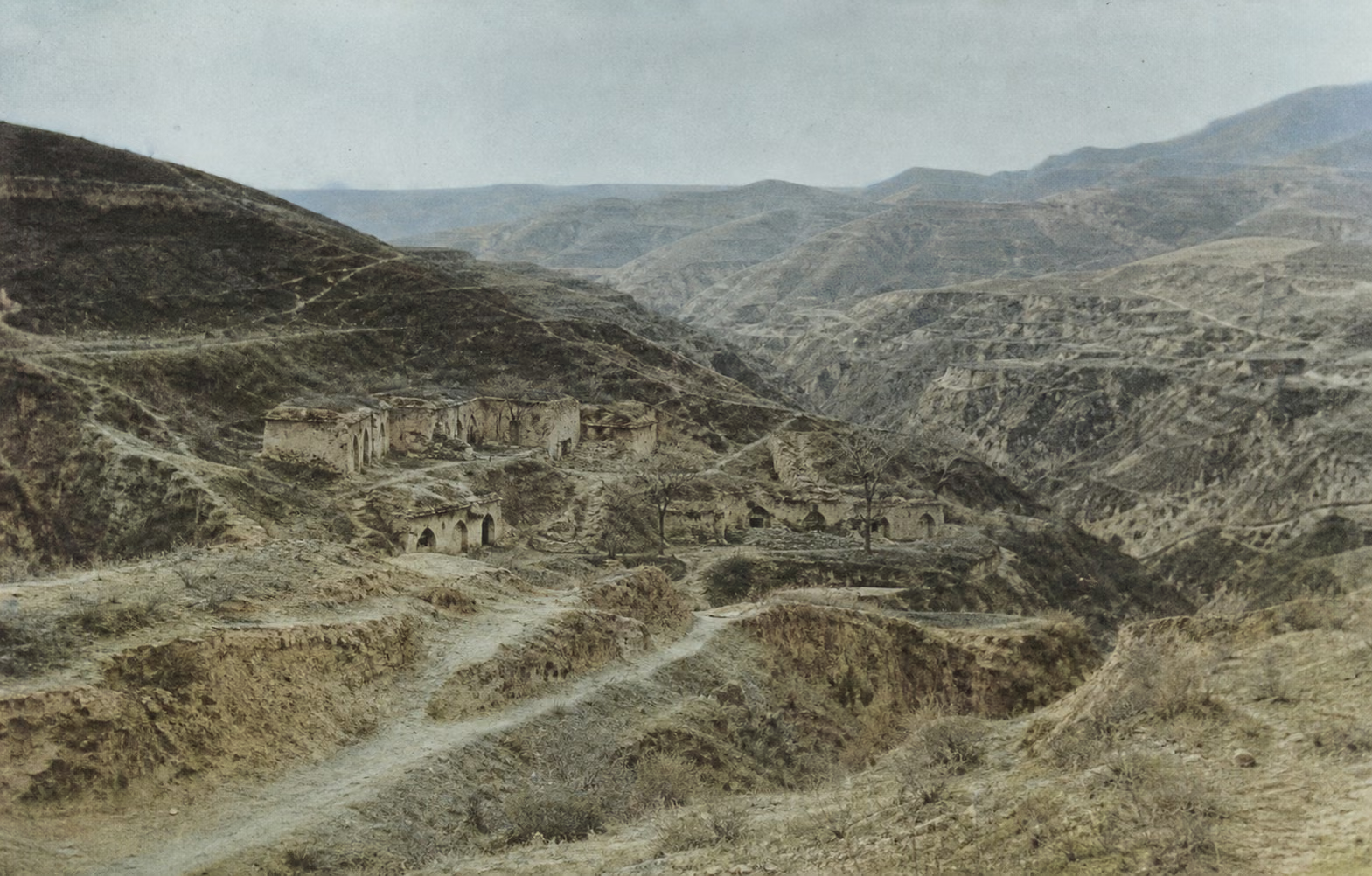
(For the wider situation--the shift from full-scale offensive to focused offensive, the complete breakdown of KMT-CPC negotiations, and the CPC delegation's withdrawal from Nanjing--see *Chinese Civil War · Overview*. This section covers only northern Shaanxi.)
Yan'an: the seat of the CPC Central Committee for the full decade from 1937 to 1947, the "red capital." In early March 1947, Hu Zongnan, following Chiang Kai-shek's intent to "plow the court and sweep the lair," assembled a large force to attack northern Shaanxi (level of source for the phrase "plow the court and sweep the lair" pending verification). Yan'an itself had no defensible terrain, and the troop ratio was ten to one.
Northern Shaanxi: the Loess Plateau, cut through by gullies, where roads were narrow paths between ridges and mounds; the land was poor and barren, and when an army of 200,000 entered, eating became a problem before fighting did. This was an old base area the CPC had worked for more than ten years: every village had its government, and everyone knew secrecy--large forces entering the area could not find guides, buy grain, or ask the way.
Why It Was Fought
At Laiwu, 56,000 men were lost in three days, and the north-south advance in Shandong came to nothing. On the national ledger it looked still worse: after eight months of full-scale offensive, many cities had been taken, but mobile strength had been spread ever thinner. In the spring of 1947, the Nationalist Army contracted its front and shifted to focused offensives, pressing its forces toward two ends--Shandong at one end, northern Shaanxi at the other.
Shift the line of sight to the Northwest. The attack on northern Shaanxi was more political than military: Yan'an was the "red capital," the seat of the CPC Central Committee for ten full years, and taking Yan'an and uprooting the CPC Central Committee would be the most symbolic result of "pacification" both at home and abroad--all the more so because KMT-CPC negotiations had now completely broken down, the CPC delegation had withdrawn from Nanjing, the table was gone, and only the battlefield remained. In early March, Hu Zongnan, following Chiang Kai-shek's intent to "plow the court and sweep the lair" (level of source for the phrase pending verification), assembled roughly 250,000 men to attack northern Shaanxi; opposite him, the Northwest Field Corps had 26,000 men, ten to one, and Yan'an itself had no defensible terrain.
If it could not be held, the answer split into two layers. The layer of the city: it could be given up--Yan'an was a symbol, and a symbol could temporarily be handed over. The layer of the people: they would not leave--the CPC Central Committee would stay in northern Shaanxi and not cross the Yellow River, using the smallest force to hold down Hu Zongnan, the largest strategic group, and ease pressure on the battlefields in Shandong and the Central Plains. This policy was later summarized in sixteen Chinese characters: "If people are preserved while land is lost, both people and land will be preserved; if land is preserved while people are lost, both people and land will be lost" (level at which the phrase was fixed and its original source pending verification). There was also a card invisible to the other side: Hu Zongnan's confidential secretary Xiong Xianghui was a CPC intelligence agent, and the plan to attack Yan'an had already reached Yan'an in advance (publicly disclosed at this level; details pending verification)--Hu Zongnan was about to attack a city that knew the day he would arrive.
The other end of the offensive order lay in Nanjing. The full-scale offensive had been changed into focused offensives, with northern Shaanxi and Shandong listed as the two focuses; on the Yan'an front, Chiang Kai-shek's instruction to Hu Zongnan was to go straight for the seat of the CPC Central Committee (the formal process and date by which this decision was made are unclear in public records; pending verification). In mid-March, the large army pressed in, with the air force bombing first. Yet this order carried its own limits: food and ammunition for 250,000 men had to be hauled from Guanzhong into the Loess Plateau, and the few roads were like a few thin tubes. Supplies could only be piled in towns along the route--that was how Panlong Town became Hu Zongnan's lifeline (supply-line details pending verification). The army he was trying to find, by contrast, did not need to defend any city.
On the Yan'an side, the decision rested on two arrangements on paper. On March 16, the Central Military Commission ordered the Shaanxi-Gansu-Ningxia field forces to form the Northwest Field Corps, with Peng Dehuai as commander and political commissar--26,000 men now had unified command (original text of the formation order pending verification). In late March, at the meeting in Zaolingou, Qingjian, the Central Committee finalized the division of labor: Mao Zedong, Zhou Enlai, and Ren Bishi would stay in northern Shaanxi, while Liu Shaoqi and Zhu De crossed the river to organize the Central Working Committee (meeting-date details pending verification). What could be mobilized was thin to the bottom: no arsenal, every bullet fired meant one bullet fewer, and replenishment came basically from captures; manpower came from incorporating prisoners and young people from the old base area; grain came from the stores that the people had hidden in cellars behind strengthened walls. None of these limits was written into any order, yet they determined the next half year's method of fighting--do not occupy ground, do not defend points, and choose the stragglers to bite. On Hu Zongnan's side, public records show no internal objections to the move against Yan'an.
Inside the Central Committee there had been another proposal: cross east over the Yellow River into Jin-Sui, which would be safe. Mao Zedong insisted on not crossing the river (details of the decision-making process pending verification)--the several hundred people of the Central organs were organized as the "Kunlun Column" (designation details pending verification), remaining inside the search circle of a 250,000-man army and commanding a national war from cave dwellings.
From March 18 to 19, the Central organs and the people completed their evacuation and withdrew from Yan'an; on March 19, Hu Zongnan's forces entered the empty city and announced to the outside world a "great victory at Yan'an." He had obtained the city. There was no one in it.
Course of the Engagement
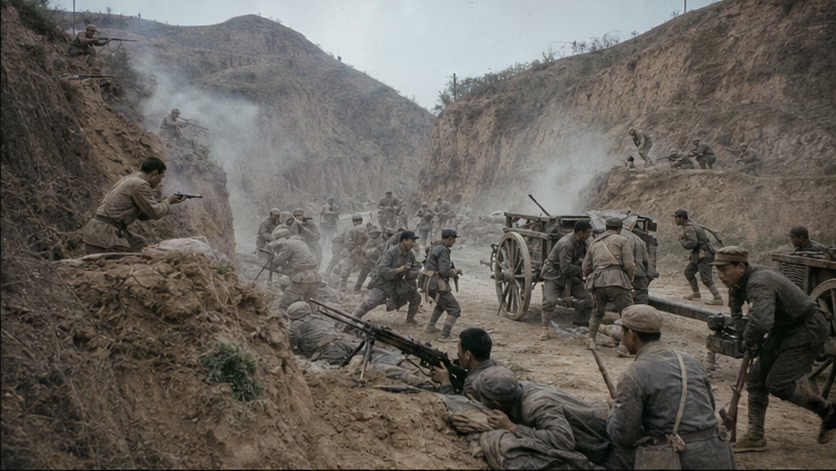
| Engagement | Time | Main points |
|---|---|---|
| Evacuation of Yan'an | 3.18–19 | The Central organs and the people completed their evacuation; on 3.19 Hu Zongnan's forces entered the empty city. The Nationalist side immediately announced a "great victory at Yan'an" and publicized it heavily |
| Qinghuabian | 3.25 | Peng Dehuai used his main force to ambush at Qinghuabian northeast of Yan'an, destroying the headquarters of the Reorganized 31st Brigade and one regiment, and capturing brigade commander Li Jiyun--the first bite after the evacuation of Yan'an, steadying morale |
| Yangmahe | 4.14 | An ambush was set at Yangmahe south of Wayaobao, destroying the Reorganized 135th Brigade and capturing acting brigade commander Mai Zongyu--while Hu's main force was being "mushroomed" back and forth into empty searches, one of its columns was eaten |
| Panlong | 5.2–4 | Taking advantage of Hu's main force moving north toward Suide, the Northwest Field Corps assaulted the Panlong supply base, destroyed the defending force (including the Reorganized 167th Brigade and other units; designations unrecorded), captured brigade commander Li Kungang, and seized large quantities of grain, ammunition, and clothing--knocking out the supply point was like stabbing Hu Zongnan in the soft ribs |
| Xiaohe Meeting | July | The Central Front Committee met at Xiaohe Village in Jingbian and deployed strategic counteroffensive; Liu and Deng's army had already crossed the Yellow River (meeting-decision details appear in later related articles) |
| Shajiadian | 8.20 | At Shajiadian northeast of Mizhi, the Northwest Field Corps ambushed the Reorganized 36th Division, destroying its main force, over 6,000 men (figures vary by account); division commander Zhong Song broke out with remnants (breakout details pending verification)--the turning point on the northwestern battlefield, after which Hu Zongnan's forces shifted from offense to defense |
"Mushroom tactics": do not fight a decisive battle with you; lead you around the mountain gullies, drag you until you are tired, scattered, and hungry, and then bite an isolated brigade that has fallen behind. Three bites in four months, a rest after each bite, with troop strength growing the more it fought (prisoners incorporated) and food and ammunition increasing the more it fought (captures at Panlong).
The Central Committee's mobile line (another line running in parallel with the battlefield): Mao Zedong, Zhou Enlai, and Ren Bishi led the several hundred people of the Kunlun Column through the gullies of northern Shaanxi: Wangjiawan in Ansai, Xiaohe in Jingbian, Wulongpu in Jiaxian... At the closest point they were separated from Hu's search troops by only one hill (details of these episodes and their levels of danger vary in memoir materials, with differing degrees of embellishment; sources pending verification). Telegrams to every battlefield in the country were sent from cave dwellings--a high command directing a national war from inside the search circle of heavy enemy forces is rare in world military history (comparative-historical level pending verification).
Casualties and Losses
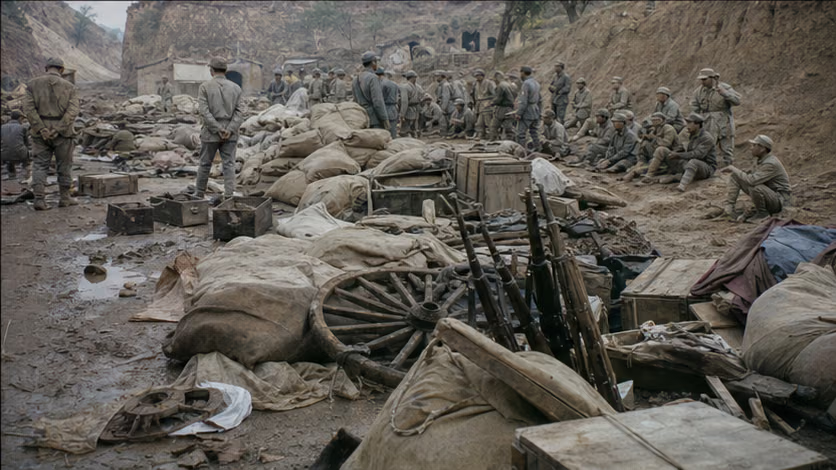
- Nationalist Army: the four engagements destroyed a total of roughly over 14,000 men (Qinghuabian roughly 3,000; Yangmahe over 4,700; Panlong over 6,700; Shajiadian over 6,000; figures vary by account for each engagement); the greater cost was that a 250,000-man army was pinned in northern Shaanxi and could not be redeployed elsewhere within 1947.
- Northwest Field Corps: casualties across the four engagements totaled roughly 2,000–3,000 (figures vary by account); noncombat attrition and grain shortages were severe (the troops at one point filled their stomachs with black beans and wild vegetables; details pending verification).
- Civilians in northern Shaanxi: the people of the old base area bore the main cost of the seesaw war--reprisals in Nationalist-occupied areas (the killing of village cadres and land-reform activists during "pacification and suppression"; systematic materials pending verification), the burden of supporting the front, and the sacrifice involved in hiding stores and clearing the fields. This layer is thin in both sides' narratives, and this article notes that absence.
Aftermath
- After Shajiadian, Hu Zongnan's forces contracted to defensive points along the Yan'an-Suide line, and the Northwest Field Corps shifted to counteroffensive. In April 1948, Yan'an was recovered (see later related articles such as the Yichuan Campaign).
- In March 1948 the Central Committee crossed east over the Yellow River, and in May it reached Xibaipo--through one year of mobile warfare in northern Shaanxi, the high command never left the war zone.
- The Nationalist side's "great victory at Yan'an": the propaganda value of occupying an empty city rapidly depreciated within months after the three defeats at Qinghuabian, Yangmahe, and Panlong; Chiang Kai-shek flew to Yan'an for an inspection in August 1947 (inspection details pending verification), the last high point of the "great victory" narrative.
- Xiong Xianghui: Hu Zongnan's confidential secretary and a CPC intelligence agent; the plan to attack Yan'an was already in the hands of the CPC Central Committee in advance (for his level and contribution, see "Disputes and Sensitivities").
Accounts of Those Present
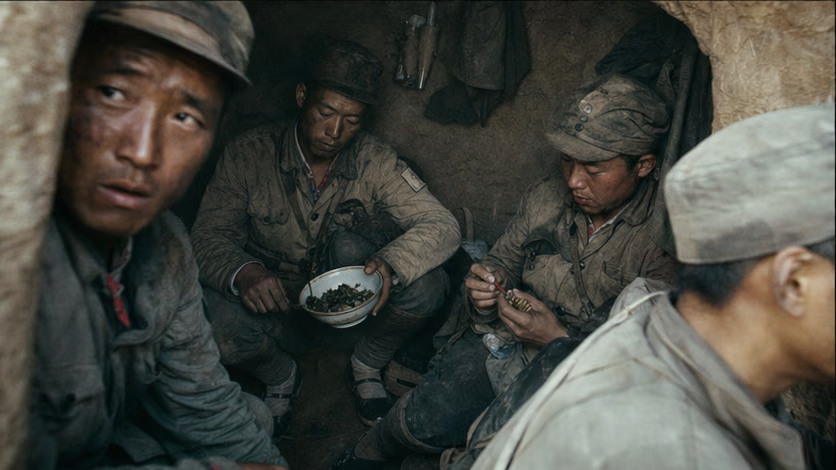
- "If people are preserved while land is lost": the explanation given to cadres and the people before the evacuation of Yan'an--exchange one Yan'an for all of China (level of source for the phrase pending verification). Old cadres could not make sense of it, and ordinary people could not bear to leave; the evacuation mobilization itself was difficult.
- Mao Zedong not crossing the Yellow River: the Central Committee had discussed crossing east, but Mao insisted on staying in northern Shaanxi. "Not crossing the Yellow River" later became the emblematic wording for this decision (details of the decision-making process pending verification). A column of several hundred maneuvered for a year in mountain gullies against an army of 200,000.
- The danger at Wulongpu: on the mobile route, there was one close-range near miss with Hu's search troops (dates and distances vary across memoir versions; level pending verification)--this is the danger most often recounted in the experience of the "Kunlun Column."
- Three brigade commanders captured: Li Jiyun, Mai Zongyu, and Li Kungang--within four months Hu Zongnan lost three reorganized brigade commanders, all captured alive. Li Jiyun's postwar experience (remolding and special-pardon details pending verification).
- Peng Dehuai's command post: 26,000 against 250,000; Peng Dehuai's headquarters kept moving near the front line, and he personally reconnoitered the terrain for the Qinghuabian ambush (reconnaissance details pending verification).
- Hu Zongnan's diary/mindset: after occupying the empty city, he reported victory outwardly and felt anxious inwardly; recollections by his subordinates often record the exhaustion of "not being able to find the enemy main force" (materials pending verification).
The Ground
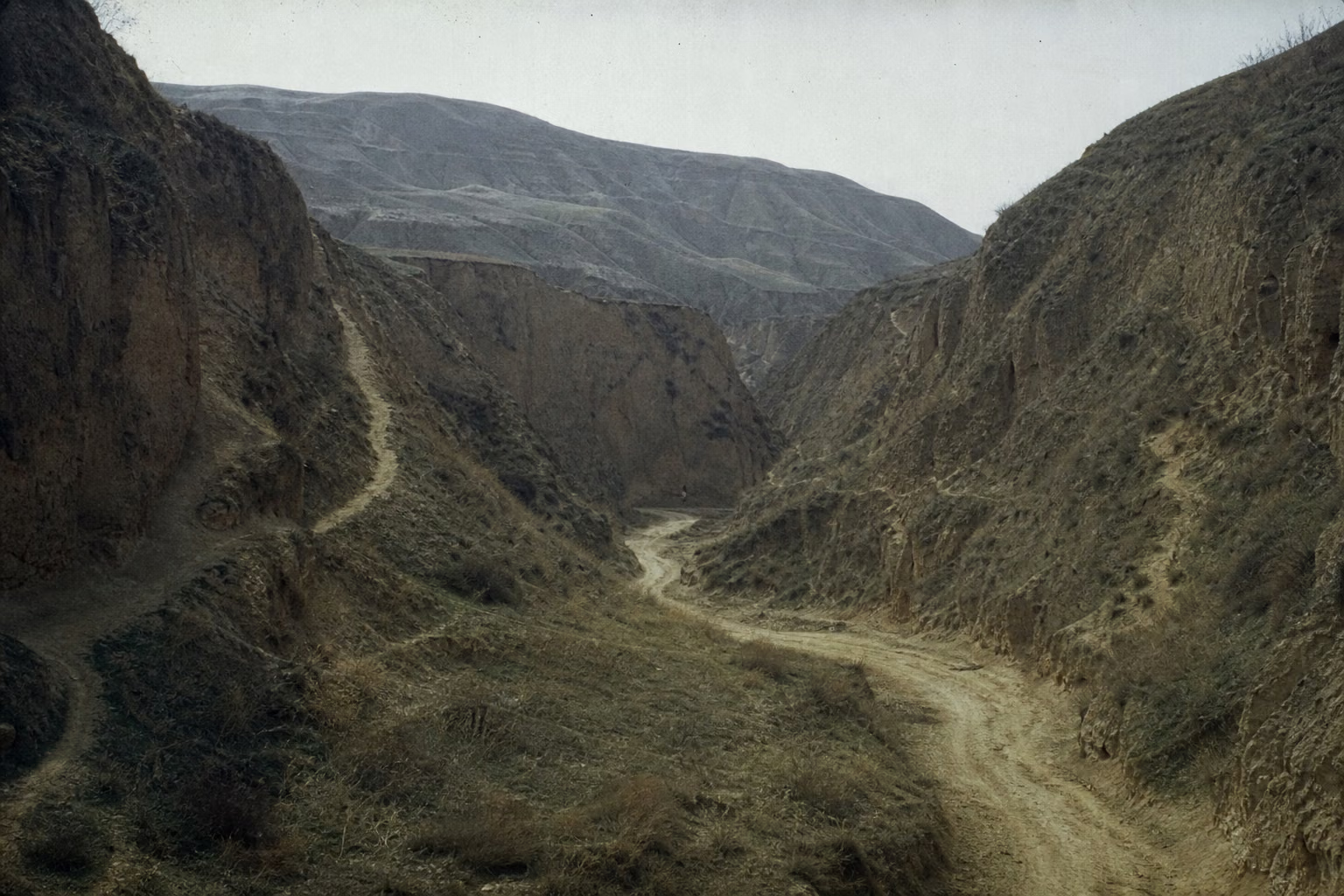
- Loess gullies: ridges, mounds, and gullies formed a natural maze; large forces could only move along river valleys and main roads, while ambush points were set on both sides of gullies--Qinghuabian, Yangmahe, and Shajiadian were all "gully-pocket" spaces.
- Panlong: a supply base on the mountain ridge; the assault space was "encircle the mountain and attack the stockade."
- Yan'an: the empty city itself became a narrative space--the occupier's trophy was a city that had been moved out.
- Mobile route: the Wangjiawan-Xiaohe-Wulongpu line, where cave dwellings, hilltops, and ferries formed the space of a moving high command.
- Scale: ambush engagements with a radius of several dozen kilometers versus a high command moving several hundred kilometers over one year--two scales laid over the same plateau.
How Each Side Records It
- CPC canon: the evacuation of Yan'an is a "model of strategic initiative"; the three victories and the Shajiadian turning point are listed as the main line of the northwestern battlefield; Mao Zedong's stay in northern Shaanxi is the narrative peak of "the high command living or dying with the front."
- Taiwan-side "Counterinsurgency" narrative: the capture of Yan'an was long listed as a major "result" of the War of Pacification, and official propaganda reached a peak for a time; but the military failures after the occupation (three brigades destroyed, Panlong taken, and the Reorganized 36th Division damaged) were separately reviewed in military histories--the gap between the "great victory" propaganda and the actual war situation is difficult even for Taiwan-side materials themselves to square (specific wording pending verification). The two sides read the "fall of Yan'an" in completely opposite ways: for one side, it was "plowing the court and sweeping the lair"; for the other, a "voluntary evacuation"--this article places the two readings side by side.
- Later scholarship: the first focus is strategic assessment of the focused offensive (the political gain from taking Yan'an vs. the opportunity cost of tying down 250,000 troops); the second is the actual degree to which Xiong Xianghui and others on the covert front contributed to the northern Shaanxi war situation; the third is military analysis of "mushroom tactics" as the fighting method of a weaker army (representative studies pending verification).
Disputes and Sensitivities
- The Xiong Xianghui case (mark the level): Xiong Xianghui, Hu Zongnan's confidential secretary and a CPC intelligence agent, delivered the plan to attack Yan'an and subsequent operational plans to Yan'an in advance--that much is publicly disclosed (his transmission channels and the degree of his contribution to specific engagements are limited in public materials; details pending verification). The Taiwan side characterized the Xiong case as "a Communist spy stealing into a key post," and Hu Zongnan bore pressure from it for a long time afterward (details of Hu's fate pending verification).
- Two readings of the "fall of Yan'an": occupation was a fact, the empty city was a fact, and the tying down of 250,000 men was also a fact.
- The degree of embellishment around the dangers faced by the "Kunlun Column": accounts of the dangers during mobile warfare tend to escalate gradually in memoirs and film and television, with differences among versions (level markings are noted in each section's pending verification entries).
- The absence of civilian costs: systematic materials are insufficient on the reprisals suffered by people in the seesaw zone during "pacification and suppression"; this article notes that absence to avoid writing only the military line.
- "Liberated soldiers": the Northwest Field Corps grew the more it fought, and incorporated prisoners were one of the main sources--northern Shaanxi had a deep mass base, and "liberated soldiers" were mixed with young people from the old base area (details of conversion pending verification).
- Enemy-loss figures by engagement: the Communist-side statistical basis is primary, corresponding Nationalist-side figures are absent, and both situations are kept side by side.
Sources and Open Questions
Known main sources:
- *Peng Dehuai's Autobiography* and *Biography of Peng Dehuai*
- *Chronology of Mao Zedong* and *Chronology of Zhou Enlai* (the mobile warfare in northern Shaanxi sections)
- Xiong Xianghui, *My Career in Intelligence and Diplomacy* (firsthand memoir from the covert front)
- Memoirs by Wang Dongxing and other Kunlun Column personnel (source level requires discrimination)
- Nationalist side: Hu Zongnan-related archives and subordinate memoirs, and histories of the War of Pacification (to be checked)
Open questions: the original source and process by which the phrase "If people are preserved while land is lost" was fixed; the source of the phrase "plow the court and sweep the lair"; Hu Zongnan's offensive order of battle and engagement-by-engagement strength; the statistical bases for enemy losses and friendly losses in the four engagements; the concrete contribution of Xiong Xianghui's intelligence to Qinghuabian, Yangmahe, Panlong, and Shajiadian; details of the Kunlun Column's designation and a day-by-day reconstruction of its mobile route; details of Wangjiawan, Xiaohe, Wulongpu, and related episodes, and differences among versions of the dangers; details of Zhong Song's breakout at Shajiadian; details of Chiang Kai-shek's August 1947 inspection of Yan'an; Hu Zongnan's fate after being held responsible for the Xiong case; materials on civilian victims of "pacification and suppression" in the northern Shaanxi seesaw zone; the postwar experiences of the three captured brigade commanders.
All images on this site are AI-generated depictions. They are not historical photographs, not primary sources, and do not depict any real individual.