Engagement Archive · Battle of Yudong
In the summer of 1948, over twenty days in the Central Plains, Su Yu first took Kaifeng, then destroyed the Ou Shounian Corps, and finally held against Huang Baitao before withdrawing from the field--with more than 90,000 enemy troops destroyed or captured and over 30,000 casualties of his own, he verified that "large annihilation battles could be fought in the Central Plains," and rehearsed the Huaihai Campaign half a year ahead of time.
Engagement Data
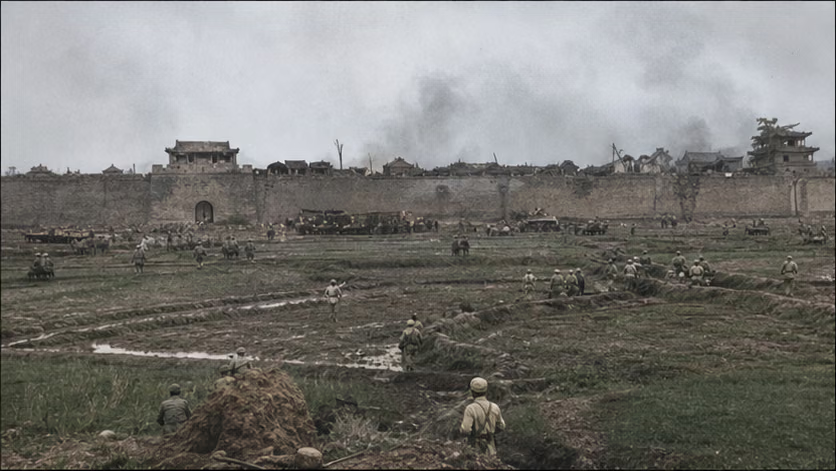
| Item | Content |
|---|---|
| Time | 1948.6.17 – 7.6, about 20 days |
| Place | Kaifeng, Suixian, and Qixian area, Henan (Yudong plain) |
| Part of | Chinese Civil War · Central Plains front in the strategic offensive phase (for the larger situation, see *Chinese Civil War · Overview*) |
| People's Liberation Army | Outer-line Corps of the East China Field Army + elements of the Central Plains Field Army (campaign command: Su Yu; participating forces included the East China Field Army's First, Third, Fourth, Sixth, Eighth, and Tenth Columns, the Guangdong-Guangxi Column, and the Central Plains Field Army's Ninth and Eleventh Columns, among others; detailed order of battle unrecorded) |
| Nationalist Army | Kaifeng garrison (including the Reorganized 66th Division), Ou Shounian Corps, Qiu Qingquan Corps, Huang Baitao Corps, and other relief forces on several routes |
| Result | Kaifeng was taken (the first provincial capital captured by the People's Liberation Army); in the Sui-Qi area, the Ou Shounian Corps headquarters, the Reorganized 75th Division, and other units were annihilated, and corps commander Ou Shounian was captured; after striking Huang Baitao's corps, the attackers voluntarily withdrew from combat |
Belligerents
| Item | People's Liberation Army | Nationalist Army |
|---|---|---|
| Strength | About 200,000 committed (including the groups for city assault, striking reinforcements, and blocking reinforcements; figures vary by statistical basis) | Kaifeng garrison about 30,000; Ou's corps about 50,000; Qiu, Huang, and other relief forces together around 250,000 (each statistical basis pending verification) |
| Firepower | Mainly mountain guns and mortars, with limited heavy weapons; the city assault relied chiefly on demolition and close approach work | More American equipment, with artillery, tanks, and air-force participation (bombing of Kaifeng and the Sui-Qi battlefield; for civilian casualties and responsibility for urban destruction, see "Disputes and Sensitivities," unverified) |
| Logistics | Supported nearby by the Henan-Anhui-Jiangsu base area; the civilian front-support system was beginning to take shape at scale | Based on the Longhai and Pinghan railways, but the corps belonged to different command systems, and coordination repeatedly went wrong |
Terrain and Conditions
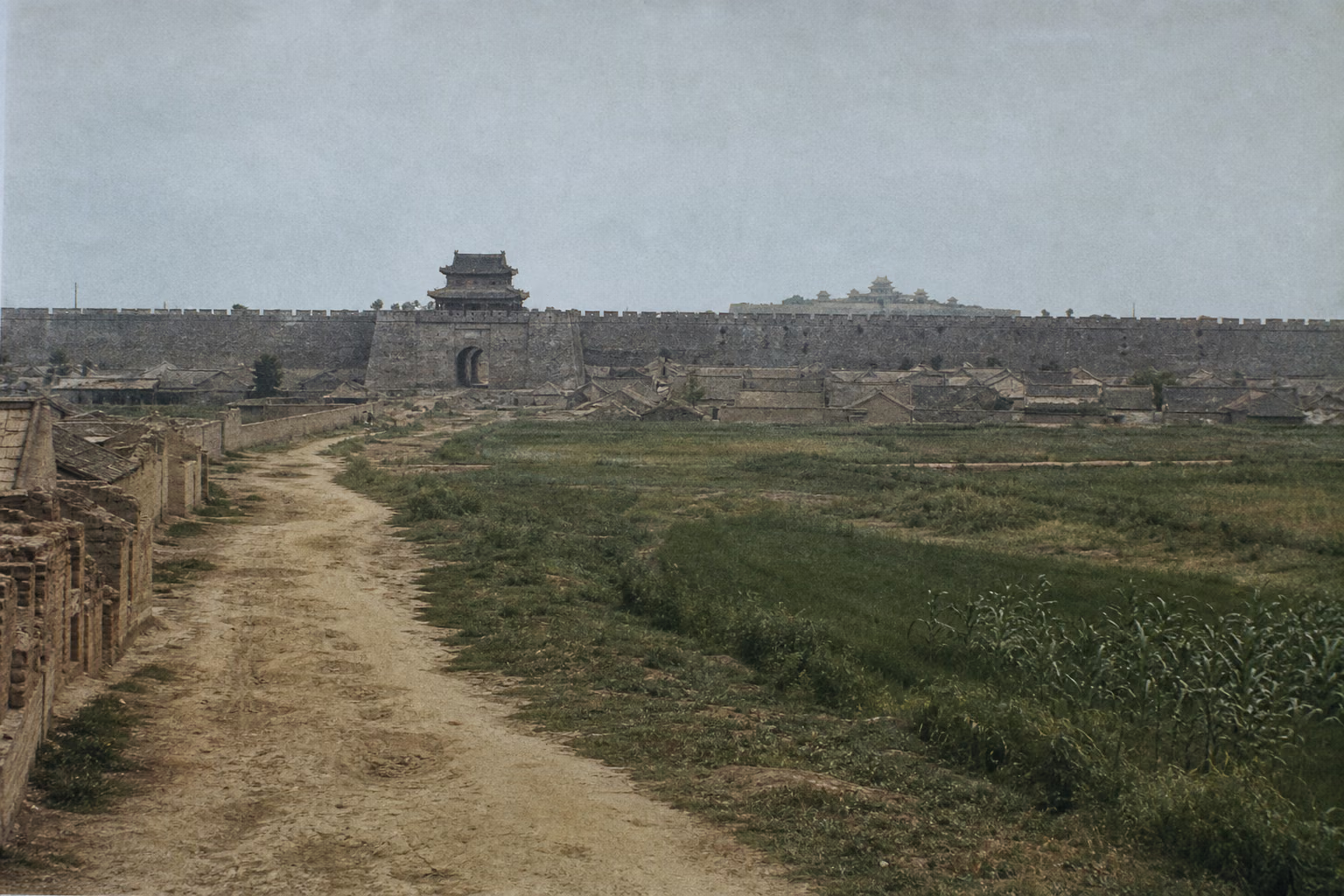
(For the larger situation in mid-1948--the Nationalist Army's turn to "defense by zones," the Central Plains tug-of-war, and the worsening economy in Nationalist-controlled areas--see *Chinese Civil War · Overview*; this section covers only Yudong.)
Yudong plain: the flat farming country east of Kaifeng and on both sides of the Longhai Railway, with dense villages and a web of roads. It suited the maneuver of large formations, and also being encircled--whoever first cut the other side into pieces would win. The Sui-Qi area was poor country repeatedly ravaged by the War of Resistance and by floods and droughts; many villages had earthen walls, and both attack and defense took villages as their nodes.
Kaifeng: the capital of Henan Province, with its old city wall intact. The garrison deployed on the city wall and commanding points such as Longting. For the People's Liberation Army, no present provincial capital had ever been captured before--the political shock of taking Kaifeng was no less than the military shock.
Why It Was Fought
Six days after Xu Xiangqian opened the Battle of Jinzhong, fighting also began in the Central Plains more than a thousand li away. In the same summer, two fronts were doing the same thing: drawing the opponent's heavy troop groups out of their strongpoints and destroying them in the open as organized formations. In Shanxi, what was drawn out was Yan Xishan's Jinzhong field group; in the Central Plains, Su Yu meant to test a larger appetite.
This battle was first decided at the conference table. The high command's original move was to have Su Yu lead three columns across the Yangtze and southward. At the April 1948 Chengnanzhuang Conference, Su Yu "ventured a frank statement": postpone the Yangtze crossing, concentrate strength, and fight large annihilation battles in the Central Plains. The Center accepted it--a continuation of the Central Jiangsu line in which "the front line changed the high command" (see *Seven Battles, Seven Victories in Central Jiangsu*), and also a written pledge under military order: if he did not cross the Yangtze, he had to produce an annihilation battle large enough in the Central Plains. The Battle of Yudong was the first fulfillment of that pledge.
That pledge did not come easily. The Yangtze crossing was a deployment formally set by the Military Commission at the beginning of 1948: Su Yu would lead three columns across the river first and carry the war into Jiangnan. Su Yu first raised his objection by telegram, and in late April went to Chengnanzhuang to state it again in person before several members of the Central Secretariat (the date of the in-person statement and the details of the talks remain unverified). He laid out the account: if three columns crossed the Yangtze, heavy equipment could not be taken, the wounded would have nowhere to be placed, and the force would grow smaller the more it fought; north of the Yangtze there were the Henan-Anhui-Jiangsu and Hebei-Shandong-Henan base areas, where grain, civilian laborers, and stretcher teams could be connected, and concentrated strength could destroy the opponent as organized formations in the Central Plains. The Center accepted this accounting, and at the same time set the target and deadline for enemy losses inflicted (target details unverified)--if one dared change the high command's move, one had to pay for it with results. The material boundary was thus drawn on the map: how large a battle could be fought depended on how much grain and how many stretchers the base areas could send out, and on how many heavy guns could be replaced by explosive charges. On Nanjing's side, there was no room for dispute over whether to rescue Kaifeng; no internal records have been seen for its review of the relief deployment and abandonment.
The ground chosen was the Yudong plain. This flat farming country east of Kaifeng and on both sides of the Longhai Railway had dense villages and a web of roads. It could hold large formations, and it could also hold them inside an encirclement--whoever first cut the other side into pieces would win. In mid-June, Su Yu settled on his basic plan: first open Kaifeng, then destroy the enemy coming to its relief. Kaifeng was the capital of Henan, with a garrison of about 30,000 and relatively isolated defenses; and because the People's Liberation Army had never before captured any provincial capital, Nanjing could not afford to lose it. If Kaifeng was attacked, Qiu Qingquan and other units would have to come to its relief. The city assault was the bait; striking the relief forces was the real battle.
Chiang Kai-shek had no option not to rescue it: the political shock of losing a provincial capital was far greater than the loss of 30,000 defenders. The strength that could be drawn was indeed substantial: Qiu Qingquan, Ou Shounian, Huang Baitao, and the various other corps together numbered around 250,000 (each statistical basis pending verification). The disease lay in command. The relief corps belonged to different command systems, and coordination repeatedly went wrong. Later, when Qiu Qingquan advanced rashly and Ou Shounian hesitated, leaving a gap of several dozen kilometers between the two corps, the East China Field Army's main force drove a wedge into it in one stroke. That was this old problem breaking out again.
On June 17, the East China Field Army's Third and Eighth Columns approached under concealment and suddenly appeared below the walls of Kaifeng. Only after the city assault did the battle truly begin.
Course of the Engagement
| Phase | Time | Key Points |
|---|---|---|
| Surprise attack on Kaifeng | 6.17 – 6.22 | The Third and Eighth Columns approached under concealment and suddenly attacked the city; the general assault began on the evening of 6.21, and by the morning of the 22nd the whole city had been cleared, destroying or capturing about 30,000 defenders (Reorganized 66th Division commander Li Zhongxin was killed, unverified). First provincial capital taken, shaking the whole country |
| Encirclement and annihilation in the Sui-Qi area | 6.27 – 7.2 | Kaifeng was voluntarily abandoned to lure the enemy; Qiu Qingquan's corps advanced rashly while Ou Shounian's corps hesitated, opening a gap of several dozen kilometers between the two corps--the East China Field Army's main force wedged in and divided and encircled Ou's corps around Longwangdian; the general assault began on the evening of 7.1, and on 7.2 the corps headquarters and most of the Reorganized 75th Division were destroyed; Lieutenant General corps commander Ou Shounian was captured (captured while breaking out by tank, details unverified); the Reorganized 72nd Division was encircled at Tiefosi but not taken (unverified here) |
| Blocking Huang Baitao and withdrawal | 7.2 – 7.6 | Huang Baitao's corps forced its way in from the east to relieve the field, and the East China Field Army turned to meet it. Along the Diqiudian line (now in Ningling, Henan; place-name form unverified), the fighting repeatedly became close combat; Huang Baitao personally led troops in breakout and stubborn defense, and casualties on both sides were heavy. On 7.6 the People's Liberation Army voluntarily withdrew from combat at night, ending the campaign. Huang Baitao received the Order of Blue Sky and White Sun for this battle (unverified here)--a year and a half later this same man was encircled at Nianzhuang and killed himself, **a Huaihai foreshadowing; see also *Huaihai Campaign · Overview*** |
Casualties and Losses
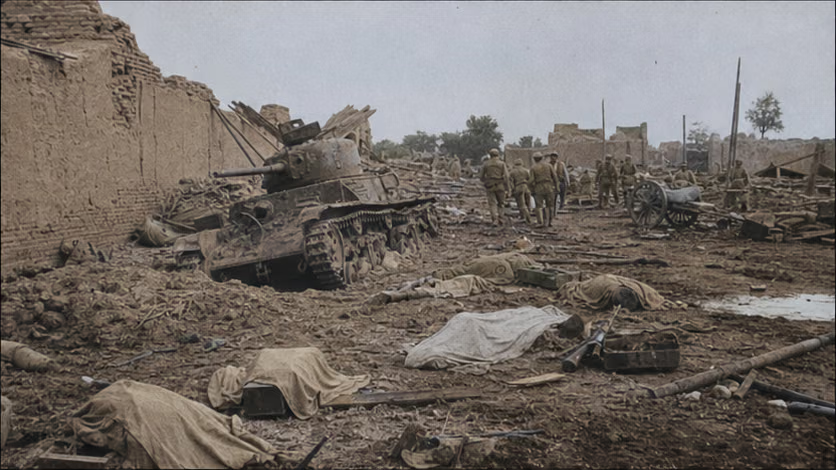
- Nationalist Army: more than 90,000 destroyed or captured in all (officially compiled mainland military-history statistical basis: about 94,000; about 30,000 at Kaifeng, more than 50,000 in the Sui-Qi area, and some in the blocking and pursuit phases--the breakdown basis and whether the total includes attached security units both remain unverified).
- People's Liberation Army: 33,000 casualties of its own (figures vary by statistical basis; including the city assault, encirclement-annihilation, and blocking-relief phases). The cost of victory: this was a "victory" with a casualty ratio of roughly 1:3, but the 33,000 casualties fell within twenty days on the front-line infantry, and several columns needed rest and replenishment immediately after the battle--a considerable part of that replenishment came from "liberated soldiers" (captives from Ou's corps) (scale of immediate capture-and-replenishment unverified).
- Civilians and the old city: Nationalist air-force bombing of Kaifeng's urban area caused civilian casualties and damage to housing (the two sides' records blame each other; responsibility and scale unverified); the list of losses to Kaifeng's cultural relics and historic buildings in the fighting remains to be checked.
Aftermath
- The Central Plains military situation was thoroughly reversed: from then on, the Nationalist Army did not dare move a corps alone--"too few and it would not dare move." This created the enemy situation for the Battle of Jinan (1948) two months later and the Huaihai Campaign half a year later.
- The Center evaluated it extremely highly (telegrams in the "great victory" category; original text unverified); Su Yu's "military-order pledge" was fulfilled, and the concept of large annihilation battles in the Central Plains was verified.
- On the Nationalist side: after Ou Shounian was captured, was he released and returned to Taiwan? (his postwar experience remains unverified); Huang Baitao received the Order of Blue Sky and White Sun, his reputation rose, and he became one of the most stubborn opponents on the Xubeng battlefield.
- As a rehearsal for Huaihai: city assault--striking reinforcements--village encirclement and annihilation--tank breakout--night withdrawal: every element at Yudong was repeated and enlarged at Huaihai. Military historians generally regard it as the direct rehearsal for Huaihai (this characterization is the common view; source unverified).
Accounts of Those Present
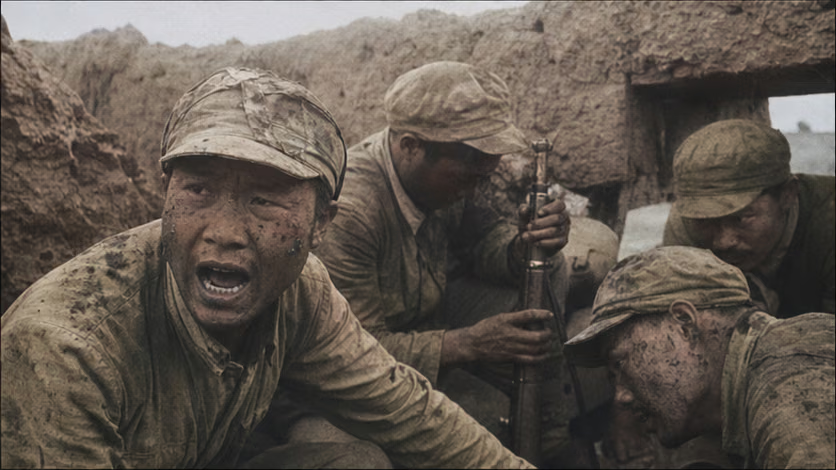
- Ou Shounian's capture: after Longwangdian was encircled, this corps commander tried to break out by tank; the tank stalled and was surrounded, and People's Liberation Army soldiers called him out of the turret. It is said that his first words were, "Take me to see Su Yu quickly" (details belong to the memoir layer, unverified).
- Huang Baitao's fight to the end: when Diqiudian had been compressed down to the last few villages, Huang Baitao moved his command post into a village and personally supervised counterattacks, even intending to burn documents and prepare to "die for righteousness" (details unverified). In the Nationalist Army, this man, though of miscellaneous-line origins, fought battles that even direct-line commanders dared not fight--that is how the Order of Blue Sky and White Sun came to him. The person in the opposing archives, and the ending at Nianzhuang a year and a half later, are one line.
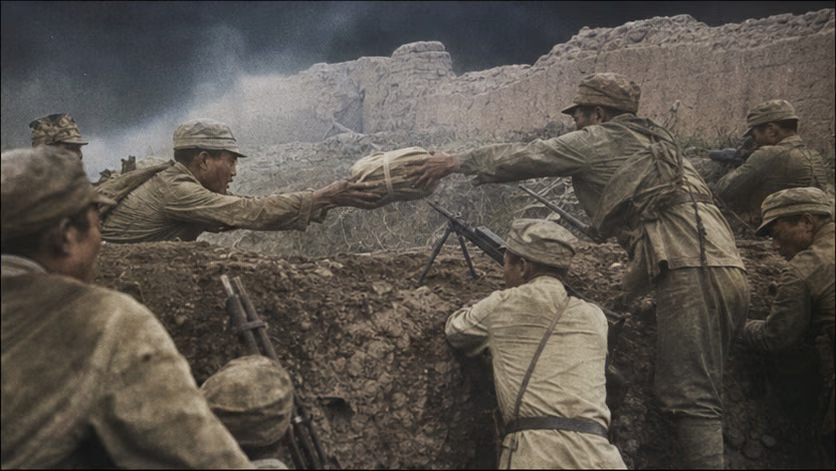
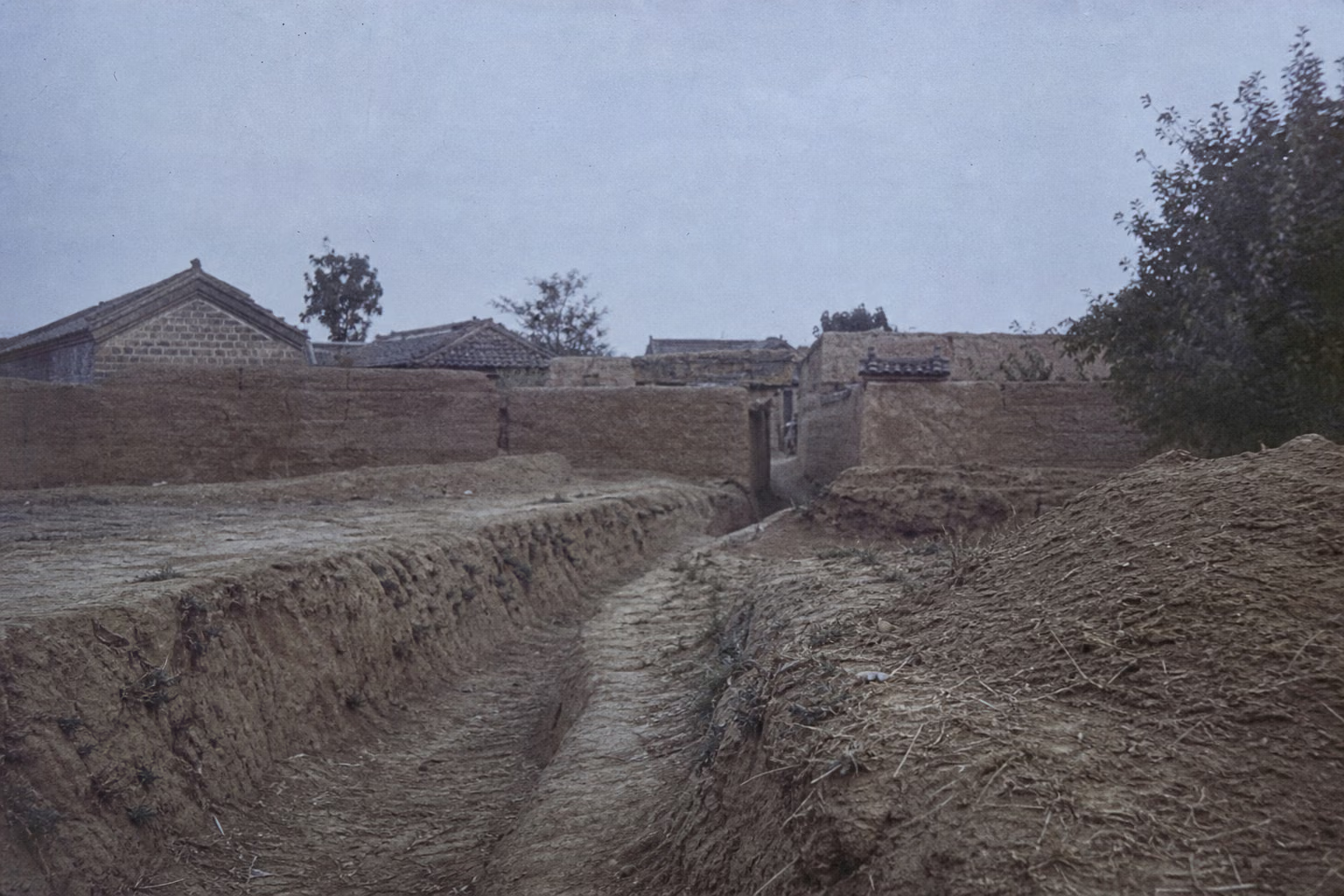
- Night fighting and close approach work: the Sui-Qi encirclement and annihilation unfolded among villages on the plain. The People's Liberation Army dug communication trenches all the way to the foot of earthen village walls, endured aircraft bombing by day, and fought house by house at night--"dig close, then fight" is the standard image of this battle.
- "Liberated soldiers" turned around and fought again: many Nationalist soldiers captured at Kaifeng changed out of their uniforms, were issued ammunition, and took part in the Sui-Qi encirclement and annihilation a few days later. Many shells fired from the opposite side came from troops who had still been on their own side half a month earlier. This manpower cycle distinctive to civil war appeared with great density at Yudong (specific replenishment scale unverified).
The Ground
- Kaifeng city: intact old city wall + barbicans at the gates + Longting commanding point--one of the last complete stagings of classical siege warfare, overlaid with bombers and incendiary bombs.
- Sui-Qi village clusters: each village had an earthen enclosure, with networks of communication trenches between the enclosures--the plain was remade into a trench maze.
- Longwangdian: the small town where the corps headquarters was located, a miniature stage for the tank breakout and capture.
- Diqiudian: a stubborn stand inside a cluster of villages only a few square kilometers in size--blocking-action terrain, with only a few roads to the front.
How Each Side Records It
- Mainland: calls it the "Battle of Yudong" (including the Battle of Kaifeng and the Sui-Qi engagement), and defines it as one of the turning-point battles by which the Chinese Civil War moved from strategic offensive toward strategic decision; it is a representative work of Su Yu's military career.
- Taiwan: generally calls it the "Yudong Campaign" or the "Kaifeng Campaign" (designation unverified), focusing on Huang Baitao's "turning defeat into victory" at Diqiudian and the People's Liberation Army's "voluntary retreat." The award of the decoration is one of the centers of the Taiwan-side narrative; the fall of Kaifeng and the destruction of Ou's corps are recorded as major defeats (specific Taiwan-side military-history wording unverified).
- Third-party/scholarship: often treats it as a landmark battle in the 1948 turn of the war situation, emphasizing its significance as a rehearsal for the Huaihai Campaign (specific literature to be added).
Disputes and Sensitivities
- "The cost of victory" and two sets of numbers: more than 90,000 enemy troops destroyed or captured and 33,000 casualties of one's own are both officially compiled mainland statistical bases; Nationalist-side statistics differ (Taiwan-side figures to be checked); the two sides' numbers come from different sources.
- Responsibility for the bombing of Kaifeng: People's Liberation Army-side records state that Nationalist aircraft bombed the city heavily and caused large civilian casualties; Nationalist-side accounts include counter-statements such as "the attacking troops used civilian residences as cover" (original records from both sides to be checked). ※ When the civilian-casualty section is included in this article, it should only place the two sides' accounts side by side, not make a one-sided determination.
- Evaluation of abandoning Kaifeng: occupying and then abandoning a provincial capital allowed Nationalist propaganda at the time to claim the "recovery of Kaifeng"; military historians generally accept that the abandonment was part of the intended plan, but the propaganda-level tug-of-war did in fact exist at the time (original reports to be checked).
- Street fighting in an old city under bombers, together with "personally giving up the city again after assaulting it," forms the internal contrast of this battle; the civilian perspective cannot be omitted.
Sources and Open Questions
Known main sources:
- Su Yu, *Su Yu's Memoirs of War* (firsthand recollections on the Yudong decision and command)
- Academy of Military Science, *History of the Chinese People's Liberation Army*, and relevant volumes of East China Field Army history (officially compiled statistical basis)
- *Selected Historical Materials* includes memoirs by Ou Shounian and other Nationalist generals
- Taiwan-side "Historical and Political Bureau of the Ministry of National Defense" relevant volumes on the Counterinsurgency War (to be checked)
Open questions: complete orders of battle for both sides; day-by-day chronology of the Kaifeng assault and Li Zhongxin's fate; details of Ou Shounian's capture and his postwar experience; the place-name form and combat details for Diqiudian; the exact date and archival record of Huang Baitao's Order of Blue Sky and White Sun; each statistical basis for casualties on both sides and Taiwan-side figures; civilian casualties and responsibility determination in the Kaifeng air raid; scale of immediate capture-and-replenishment; original source for the "Huaihai rehearsal" characterization; Taiwan-side campaign designation and military-history wording.
All images on this site are AI-generated depictions. They are not historical photographs, not primary sources, and do not depict any real individual.