Engagement Archive · Battle of Handan
Forty-five thousand Nationalist troops advanced north along the Pinghan line to "receive" territory, only to be stopped north of the Zhang River by sixty thousand troops of the Shanxi-Hebei-Shandong-Henan Military Region; by the seventh day of fighting, Gao Shuxun, commander of the New Eighth Army, brought more than ten thousand men over under fire, changing banners before the line--what the old warlord era had called "turning coat" would from then on be called "uprising."
Engagement Data
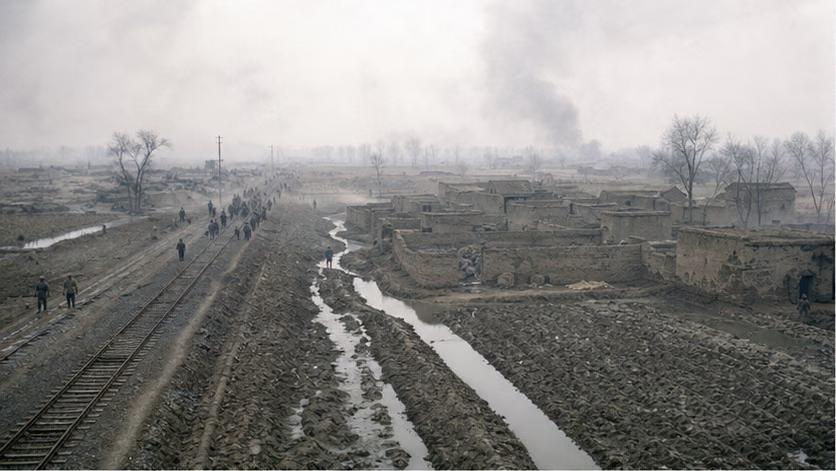
| Item | Details |
|---|---|
| Time | 1945.10.24 - 11.2 |
| Place | Southern Hebei, south of Handan and north of Cixian, around Matou Town (along the Pinghan Railway) |
| Part of | Chinese Civil War · the period of fighting while negotiating before the outbreak of full-scale civil war (for the broader situation, see Chinese Civil War · Overview) |
| Blocking side | Troops of the Shanxi-Hebei-Shandong-Henan Military Region (Liu Bocheng, Deng Xiaoping), about 60,000 |
| Northward-advancing side | Nationalist Eleventh War Area (commander-in-chief Sun Lianzhong): the 30th Army, 40th Army, and New Eighth Army, about 45,000 in all, divided into two columns under deputy commander-in-chief Ma Fawu (concurrently commander of the 40th Army) and New Eighth Army commander Gao Shuxun |
| Result | On 10.30, Gao Shuxun led the New Eighth Army and Hebei People's Army, more than ten thousand men in all, in a battlefield uprising; most of Ma Fawu's force was destroyed while breaking out, and Ma Fawu was captured; the Nationalist attempt to open the Pinghan line was frustrated |
Belligerents
| Item | Shanxi-Hebei-Shandong-Henan Military Region | Nationalist Eleventh War Area northward-advancing group |
|---|---|---|
| Strength | About 60,000 (the First, Second, and Third Columns, plus troops from the Southern Hebei, Taihang, and Hebei-Shandong-Henan Military Regions), with the Battle of Shangdang just ended and no time yet to rest and reorganize | About 45,000 (three armies), advancing north along the railway line, with Anyang and Xinxiang supporting their flank and rear |
| Equipment | Mainly Japanese equipment, supplemented by weapons newly captured from Yan Xishan's army in the Battle of Shangdang | A mixture of partly American and Japanese-pattern equipment, with superior firepower; the 30th Army and 40th Army were centralized units reorganized from the old Northwest Army lineage |
| Situation | Waiting at leisure for an exhausted enemy, prepared in advance, and closing an encirclement from east and west | Isolated forces penetrating deep along the edge of a base area; the three armies belonged to different factions and had different intentions |
| Morale | Fresh from victory at Shangdang, morale was high | War-weariness was widespread among officers and men; Gao Shuxun's force came from Feng Yuxiang's old Northwest Army, and its grievances against the Central Army's direct-line units had long accumulated |
Terrain and Conditions
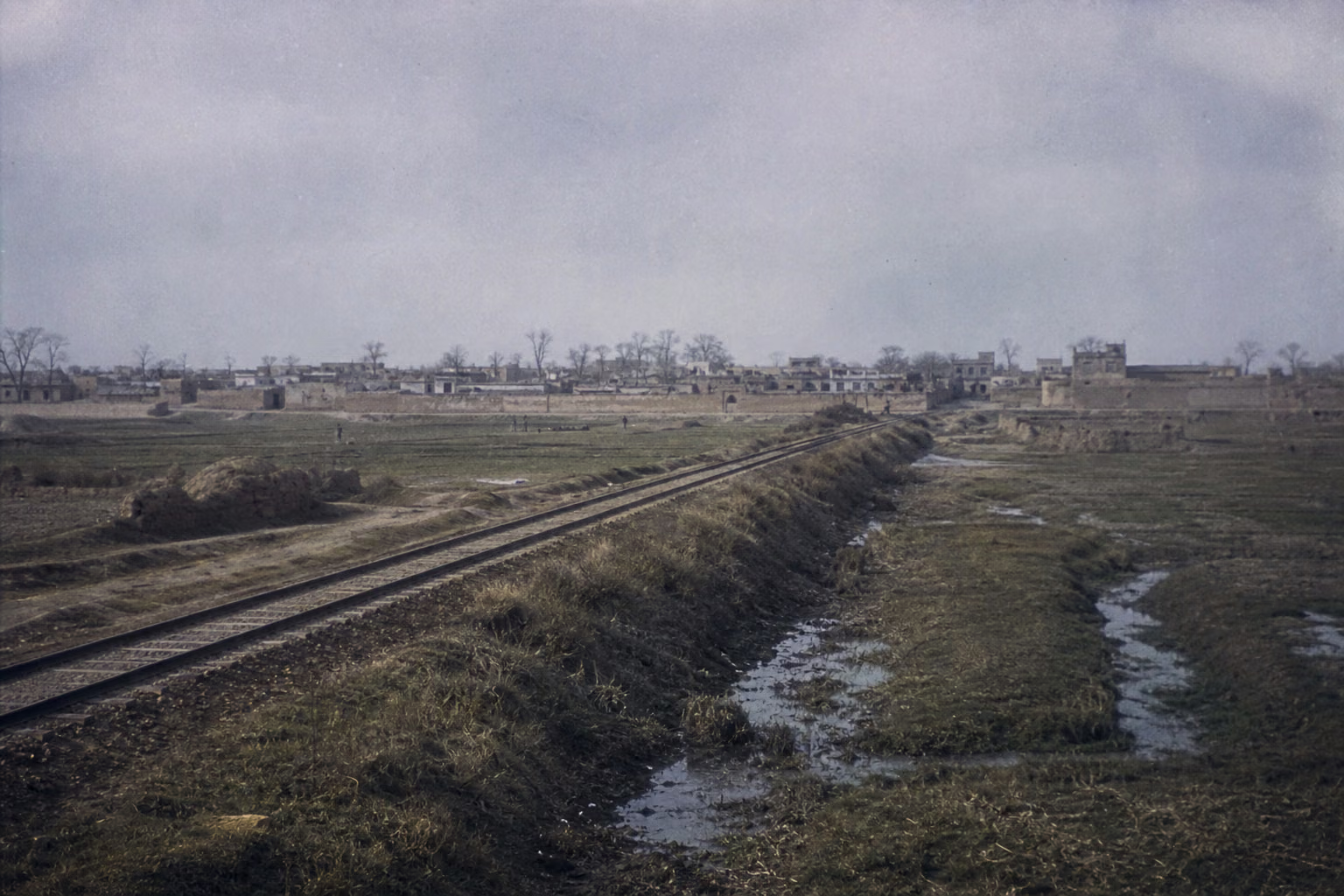
(For the larger situation in autumn and winter 1945--the ink barely dry on the Double Tenth Agreement, and the KMT and CPC racing for North China and the Northeast--see Chinese Civil War · Overview. This entry focuses only on southern Hebei.)
The ground around Handan: An ancient city on the southern Hebei plain, crossed north-south by the Pinghan Railway, with Shimen (Shijiazhuang) and Beiping-Tianjin to the north and northern Henan to the south. The leading organs of the Shanxi-Hebei-Shandong-Henan Border Region would later be based here; at the time of this battle, it was already one of the border region's heartland areas (the date when the border-region government moved into Handan remains unverified).
The Zhang River line: Nationalist troops advanced north from Xinxiang and Anyang; the Zhang River was the natural boundary between northern Henan and southern Hebei. Once across it, they entered the depth of the liberated area. In late October, Ma Fawu's and Gao Shuxun's two columns crossed the Zhang River, their spearhead aimed at Handan, and walked directly into the battlefield Liu and Deng had prepared.
Why It Was Fought
The gunfire at Shangdang had stopped less than two weeks earlier. On October 10, the Double Tenth Agreement was signed in Chongqing; on October 12, Shi Zebo was captured east of the Qin River--ink and gunsmoke belonged almost to the same moment. The agreement wrote down the words "peaceful nation-building," but it did not answer the deadliest questions: where the armies would go, and who would hold the ground. Chiang Kai-shek continued, in the name of "receiving" territory, to move large forces north along the four railway lines of Pinghan, Jinpu, Tongpu, and Pingsui. The Pinghan line was the main axis: once this railway running through North China was opened, receiving North China and advancing into the Northeast would become one continuous line.
The account in Yan'an ran in the opposite direction. The Central Committee of the Communist Party of China's policy was to "develop to the north, defend to the south," and its troops were streaming out through the passes to seize the Northeast. Every extra day that enemy troops were held on the Pinghan line gave one more day to build the position in the Northeast. This road had to be blocked, and the blocking point fell in the heartland of Shanxi-Hebei-Shandong-Henan: the southern Hebei plain south of Handan and north of the Zhang River. As soon as the Battle of Shangdang ended, Liu and Deng's main force, before it could rest and reorganize, was shifted east to the Pinghan line. One part fought delaying actions step by step against the enemy, while the main force hurried toward the prepared battlefield south of Handan; among the marching column were Yan-army prisoners just absorbed after Shangdang.
Moving north were about forty-five thousand men in three armies of the Eleventh War Area: the 30th Army, the 40th Army, and the New Eighth Army. Deputy commander-in-chief Ma Fawu and New Eighth Army commander Gao Shuxun led two columns along the railway line, with Anyang and Xinxiang supporting their flank and rear. The cracks in this force existed before it set out: the Thirtieth and Fortieth Armies were centralized units reorganized from the old Northwest Army lineage, while Gao Shuxun's New Eighth Army was even more plainly a miscellaneous force squeezed by the Central Army's direct-line units, and its officers and men were weary of civil war. Chongqing tied three armies of differing minds to a single railway and sent them into an encirclement where the other side's sixty thousand men were waiting in preparation. Liu and Deng wanted more than to annihilate the enemy: this battle was also meant for Chongqing to see, and for the intermediate forces still hesitating and watching.
On both sides, resolve had already been put on paper. To block the Pinghan line, Yan'an directly set the deployment for Shanxi-Hebei-Shandong-Henan (the dates and document numbers of the exchanged instructions remain unverified), and Liu and Deng pushed their command post close to the railway. When this decision was made, what Yan'an could see was the weight of the railway and the factional cracks among the three armies; what it could not fully see was the density of the other side's artillery and the ammunition base carried by the northward-advancing group (unverified). On Chongqing's side, the Eleventh War Area moved north under military orders (the original text of the order remains unverified). Sun Lianzhong did not fail to understand the danger of sending an isolated force deep forward, but the mobile troops in his hands were still divided between guarding Beiping and protecting Tianjin; the three armies moving north along the railway were already everything he could draw out (this claim remains unverified). The material limits were equally hard on both sides: Liu and Deng's troops had not rested after Shangdang, most of their ammunition came from Yan-army stocks captured at Shangdang, and each day of fighting consumed what could not be replaced; civilian laborers and stretcher teams had to be mobilized on the spot from counties across southern Hebei (scale unverified). Once the northward-advancing group left the railway, it had no supply; provisions and ammunition had to be sent forward station by station from Xinxiang and Anyang, and once it was encircled, that line would be cut (structural inference, unverified). The clearest trace of dissent was on the opposite side: Gao Shuxun's reluctance to fight a civil war was almost a semi-public feeling among the old Northwest Army men (seen only in CPC-side records; details unverified). Aside from this, no record has been seen of opposition at the Nationalist army level to the northward-advance deployment (no record of dissent found).
In late October, Ma Fawu's and Gao Shuxun's two columns crossed the Zhang River, their spearhead aimed at Handan. On October 24, the encirclement began to close.
There were other paths available on the surface: communications and garrisons were both on the negotiation agenda, and talks could have continued. But for Chongqing, if the railway did not open, both North China and the Northeast would be empty claims; for Yan'an, yielding the railway would cut the base areas through the waist. Fourteen days after the agreement was signed, the fighting went on.
Course of the Engagement
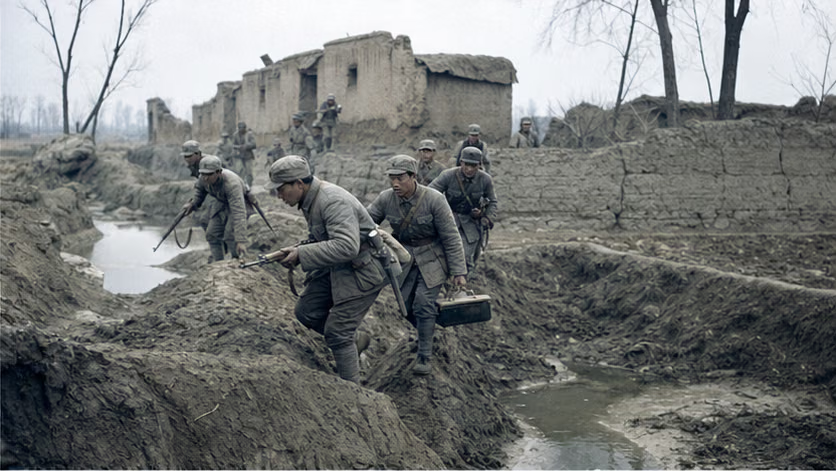
| Phase | Time | Key Points |
|---|---|---|
| Luring the enemy north | Mid-to-late October | Three Nationalist armies advanced north from Anyang and the Zhang River; Shanxi-Hebei-Shandong-Henan troops resisted step by step, drew them deeper in, and moved the main force at speed toward the Pinghan line (details of the eastward movement after Shangdang remain unverified) |
| Encirclement | 10.24 - 10.28 | The enemy vanguard reached the area between Matou Town and Cixian; the First Column held key points and stopped them frontally, while the main forces from east and west completed the encirclement, pressing the enemy into the narrow ground around the Fuyang River bends (the sequence in which each column reached position remains unverified) |
| Political work and annihilation in parallel | 10.28 - 10.30 | Militarily, the encirclement was tightened point by point; politically, Liu and Deng sent Wang Dingnan and others to make secret contact with Gao Shuxun's force (the course of contact remains unverified). Gao's force came from the old Northwest Army lineage, had long been squeezed, and was already inclined to leave |
| Gao Shuxun's uprising | 10.30 | Gao Shuxun led the New Eighth Army and Hebei People's Army, more than ten thousand men, to announce at Matou Town that they were leaving the civil war and staging a battlefield uprising. His force was later reorganized as the "Democratic Nation-Building Army" |
| Pursuit and destruction of Ma Fawu | 10.31 - 11.2 | Ma Fawu led the remnants of the Thirtieth and Fortieth Armies southward in flight; during the breakout they were intercepted layer after layer. Around 11.1 (sequence unverified), the main force was destroyed around Qiganzhang (place name unverified), and Ma Fawu and several senior officers were captured; remnants escaped back south of the Zhang River |
Casualties and Losses
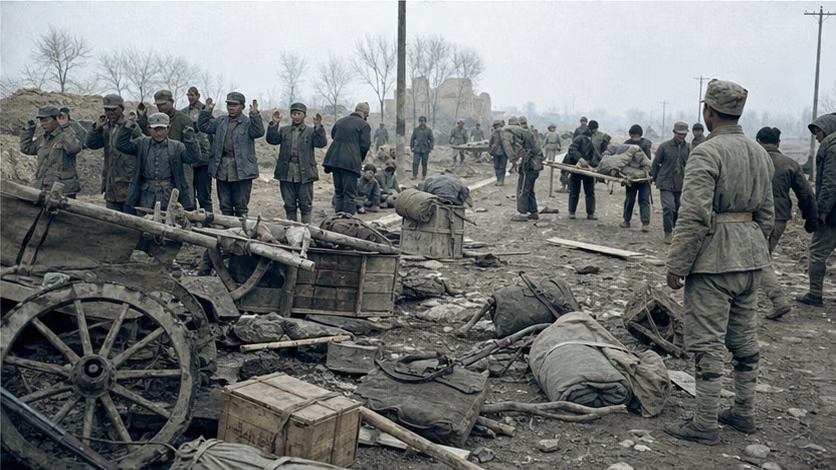
- Nationalist forces: more than 10,000 men joined the uprising (the New Eighth Army and Hebei People's Army; the statistical basis varies by account); about 14,000 were destroyed (including killed, wounded, and captured; the statistical basis varies by account). Added together, these two figures meant the northward-advancing group had basically collapsed.
- Shanxi-Hebei-Shandong-Henan Military Region: about 4,000 casualties (the statistical basis varies by account).
- ※ Prisoners and civilians: Senior officers such as Ma Fawu were treated leniently after capture and released in early 1946 (the course of exchange or release remains unverified); large numbers of ordinary prisoners, after education, were absorbed into the troops, making "liberated fighters" once again a major source after Shangdang. Southern Hebei civilians supported the front (the scale of civilian laborers and stretcher teams remains unverified); details remain to be checked on the calamities suffered by villages in the war zone during the encirclement and breakout, and on what both sides took from civilians when requisitioning grain locally.
Aftermath
- The northern section of the Pinghan line could not be opened, and Nationalist movement into and out of North China and the Northeast shifted to the Beiping-Tianjin line and to sea transport, costing time.
- On December 15, 1945, an internal directive of the Central Committee of the Communist Party of China (drafted by Mao and included in Selected Works under the title "The Policy for Work in the Liberated Areas for 1946") formally proposed launching the "Gao Shuxun Movement"--making the winning over of Nationalist officers and soldiers for uprisings a policy task across the army (quotation unverified). Over the next three years, "battlefield uprising" changed from an individual case into an institutional method for disintegrating enemy forces.
- Gao Shuxun later served as commander-in-chief of the Democratic Nation-Building Army; after 1949 he served as vice governor of Hebei Province and in other posts, and died of illness in 1972 (the twists in the reorganization of his uprising troops, and the rumored "Democratic Nation-Building Army Incident" of the 1950s, remain unverified; they are not written here without warrant).
- The captured Ma Fawu returned to the Nationalist side after release, and later went to Taiwan (subsequent experience unverified).
Accounts of Those Present
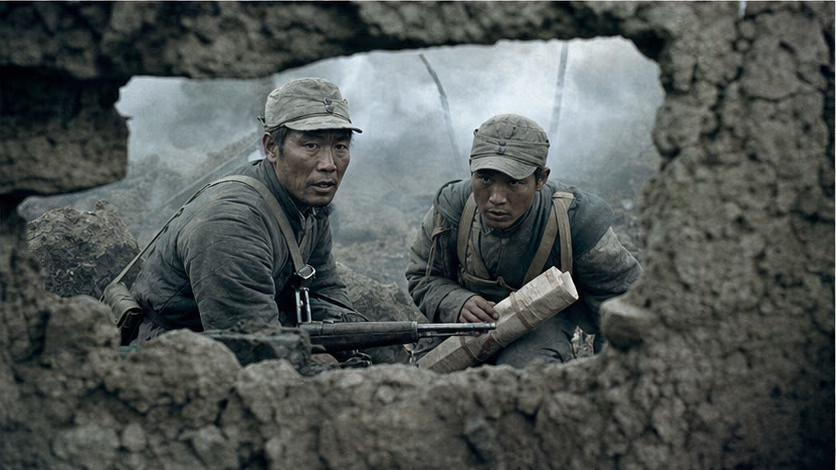
- Gao Shuxun himself: An old subordinate of Feng Yuxiang's Northwest Army. In 1940, his superior Shi Yousan secretly plotted to defect to Japan, and Gao Shuxun, acting under secret orders, lured him into capture and buried him alive (details of the execution vary by account). This man's understanding of the words "choosing sides" had been trained in the bloodiest logic of the old armies. Five years later he chose a side again, and chose uprising.
- Contact across the firing line: When the fighting was at its tightest, Liu and Deng's liaison personnel crossed the firing line into Gao's positions for negotiations (the deeds of Wang Dingnan and others, and the details, remain unverified). Secret talks amid gunfire were the first lesson of the "Gao Shuxun Movement."
- A change of words: In the era of warlord conflicts, "turning coat" was normal: it was a price and a choice of side, and in the wars of Zhili-Fengtian and Chiang-Feng-Yan, units that turned coat changed flags as easily as changing clothes. Gao Shuxun's step was named "uprising"--rewritten from "betrayal of one's superior" into "political choice." Once the word changed, the weight of the history changed with it. (See the section on "turning coat" in Warlord Era Conflicts · Overview.)
- The flag at Matou Town: The uprising troops raised the banner of the "Democratic Nation-Building Army"--a designation the CPC created specially for uprising troops in the early phase of the civil war. Such designations would change several times as the situation developed (evolution unverified).
The Ground
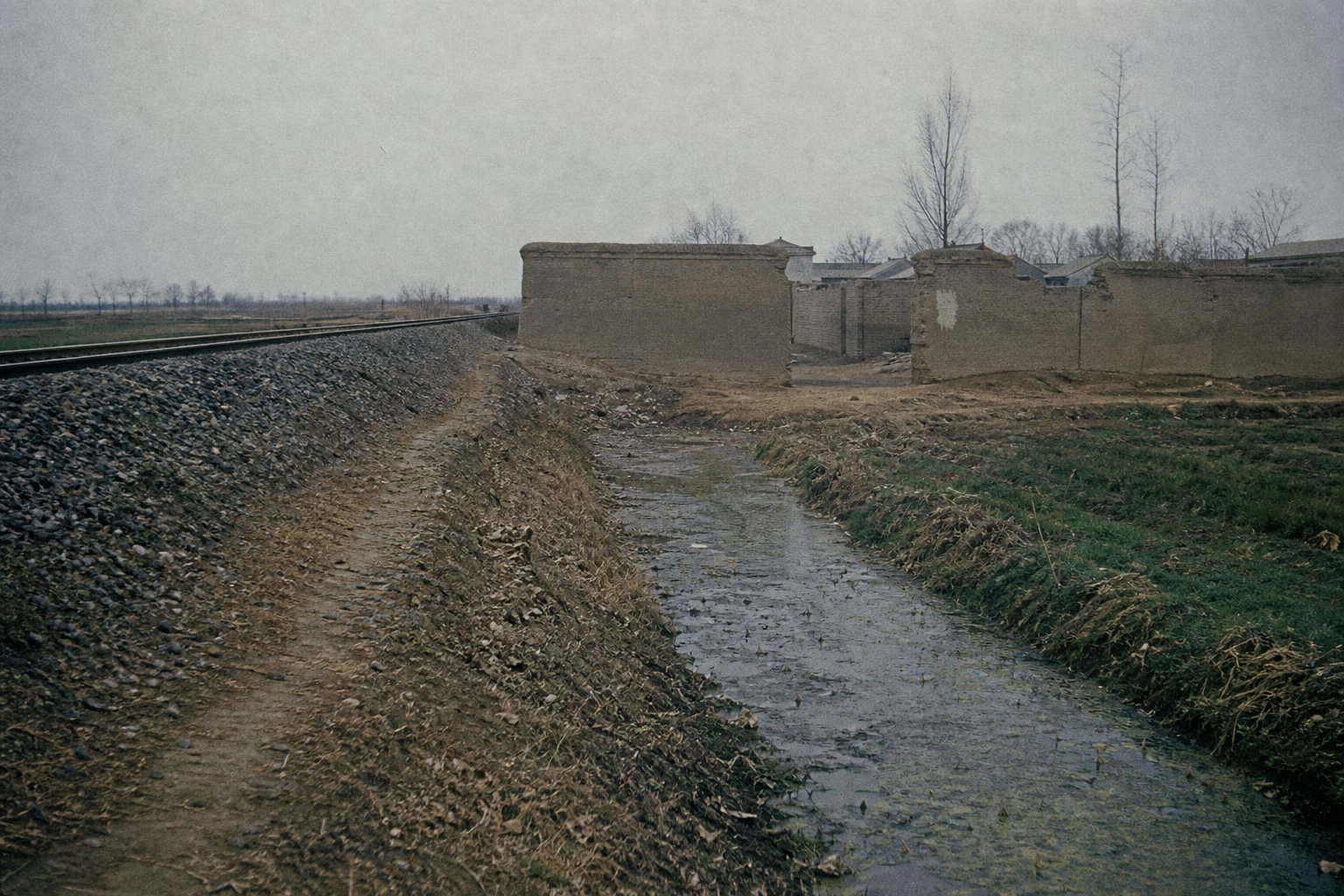
- The Pinghan Railway was the vertical axis, the Zhang River the southern boundary, and the Fuyang River bends and crisscrossing irrigation ditches filled the ground: the spatial frame of the encirclement battle was "railway corridor + low river-bend terrain."
- Matou Town: the station of Gao's force and the place where the uprising occurred, a large town on the plain, where earthen enclosures and village walls formed defensible settlement strongpoints.
- On the southern Hebei plain there were no mountains to rely on; villages were the fortifications. Enclosure fighting and village attack-and-defense formed the spatial grammar of this battle, in direct contrast to Shangdang's mountain ambushes.
How Each Side Records It
- CPC canon: the Battle of Handan (also called the Pinghan Campaign) is recorded as the second major victory in the early Chinese Civil War, and even more as "the first large-scale battlefield uprising by Nationalist troops"; the "Gao Shuxun Movement" took its name from this.
- Taiwan side: within the "pacification" narrative, it records this as the "Battle of Handan" or the "Zhang River Battle" (exact designation unverified), characterizing it as a setback for northward-moving receiving troops and as Gao Shuxun "rebelling and going over to the Communists"; the wording used for Gao in Taiwan-side military histories remains to be checked.
- Later generations and scholarship: attention falls on two points. First, read together with the Battle of Shangdang, this battle forms part of the evidentiary chain that "civil war did not stop after the Double Tenth Agreement." Second, it raises the construction of the "uprising" narrative: how the Northwest Army's tradition of turning coat was rewritten in a new political context as awakening and choice. The change in words and in history is itself an object of study.
Disputes and Sensitivities
- The substance of "uprising": How far the work of inducing defection went, and how voluntary the officers and men within Gao's force were, are points where official narrative and individual recollections do not fully meet (specific materials unverified); this entry includes that plainly and without embellishment.
- Words and standpoint: "Uprising" or "turning coat"--the name itself is a standpoint. This entry uses "uprising" according to the usage of this series, while also writing out the historical continuity of the "turning-coat tradition."
- The statistical basis for the number of people in Gao Shuxun's force who joined the uprising (whether the figure of more than ten thousand includes the Hebei People's Army) remains unverified.
- Sensitive passages in Gao's later experience (rumors and handling in the 1950s) are not written without reliable sources, and are listed as unverified.
Sources and Open Questions
Known main sources:
- Liu Bocheng zhuan, and relevant volumes of the military history of the Shanxi-Hebei-Shandong-Henan Military Region
- The internal directive drafted by Mao Zedong on 1945.12.15 ("The Policy for Work in the Liberated Areas for 1946," source of the "Gao Shuxun Movement")
- The original text of Gao Shuxun's public telegram announcing the uprising (1945.10.30/31, text remains to be checked)
- Taiwan-side official "pacification" military-history volumes (volumes to be checked)
Open questions: the exact organization and statistical basis for the strength of the three Nationalist armies; the statistical boundary for the number destroyed; the date and time of Ma Fawu's capture and the course of his release; the statistical basis for the number of uprising troops; the course of Wang Dingnan's contact work; the various accounts of Gao Shuxun's execution of Shi Yousan; the evolution of the "Democratic Nation-Building Army" and related events in the 1950s; the Taiwan-side military-history designation and original characterization; the scale of southern Hebei's support for the front and records of civilian calamities in the war zone; the dates and document numbers of the central authorities' deployment instructions for the Pinghan Campaign; the original text of the Eleventh War Area's order to advance north; records of the ammunition and provisions base of the northward-advancing group and its supply line; sources for Gao Shuxun's pre-battle war-weariness and contact with the CPC; and whether any Nationalist army-level dissent over the northward-advance deployment existed.
All images on this site are AI-generated depictions. They are not historical photographs, not primary sources, and do not depict any real individual.