Engagement Archive · Battle of Nianzhuang
Huang Baitao's Seventh Corps, 120,000 men, was ground down for twelve days among the walled villages and fortified hamlets of Nianzhuangwei, ground down to the last man: Huang Baitao, who had "made amends through merit" at Menglianggu, died at Nianzhuang.
Engagement Data
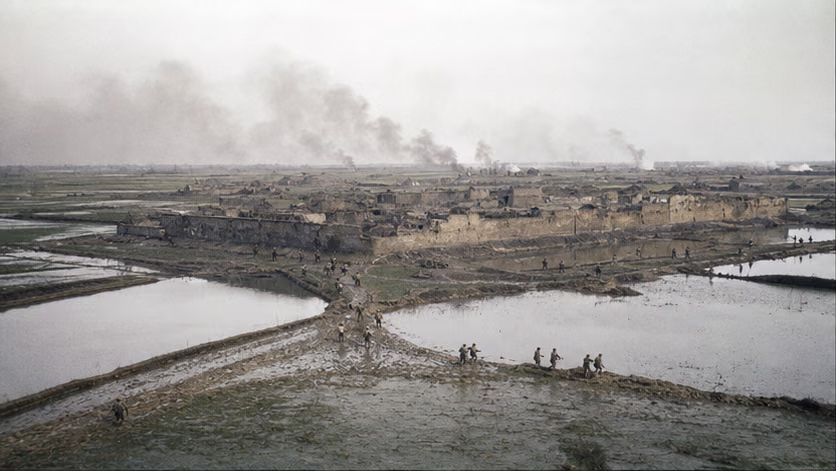
| Item | Content |
|---|---|
| Time | 1948.11.11 encirclement – 11.22 Nianzhuang taken, twelve days |
| Place | Around Nianzhuangwei, Pixian, Jiangsu (north of the Longhai Railway, an area of walled villages, fortified hamlets, water networks, ponds, and low-lying wet ground) |
| Part of | Chinese Civil War · first phase of the Huaihai Campaign |
| Encircling side | Main force of the East China Field Army (commanded by Su Yu, Tan Zhenlin, and others), committing multiple columns in succession to encirclement and annihilation |
| Encircled side | Nationalist Army Seventh Corps (commander Huang Baitao), about 120,000 men, including the 25th Corps, 44th Corps, 63rd Corps, 64th Corps, and 100th Corps, among others |
| Result | On 11.22 Nianzhuang was taken and the Seventh Corps was destroyed; Huang Baitao was killed (the suicide and killed-in-action accounts both stand). The East China Field Army suffered 49,000 casualties (statistical bases vary by account)--the most costly stretch of Huaihai |
Belligerents
| Item | Encircling side | Encircled side |
|---|---|---|
| Strength | East China Field Army main-force encirclement-and-annihilation group (while also using heavy forces east of Xuzhou to block the Qiu Qingquan and Li Mi corps from moving east to relieve the field) | About 120,000 men trapped in the Nianzhuangwei village cluster |
| Firepower | Infantry and artillery assaults from village to village; in village assaults, artillery fire was constrained by the fortified-hamlet terrain | American-equipped, with firepower superior to the encircling side's average level, but crowded inside villages and blocking one another's fields of fire |
| Terrain | Interlaced water networks, ponds, and low-lying wet ground; approach routes were restricted, and every village became a battle | Nianzhuangwei and the dozens of surrounding villages each had enclosure walls and water ditches, rebuilt into a cluster of strongpoints |
| Outside relief | Blocking action east of Xuzhou secured the encirclement (the Qiu and Li corps failed to advance east after more than ten days--see also *Huaihai Campaign · Overview*) | Airdropped supplies; the two corps moving east to relieve the field were blocked along the Daxujia line |
Terrain and Conditions
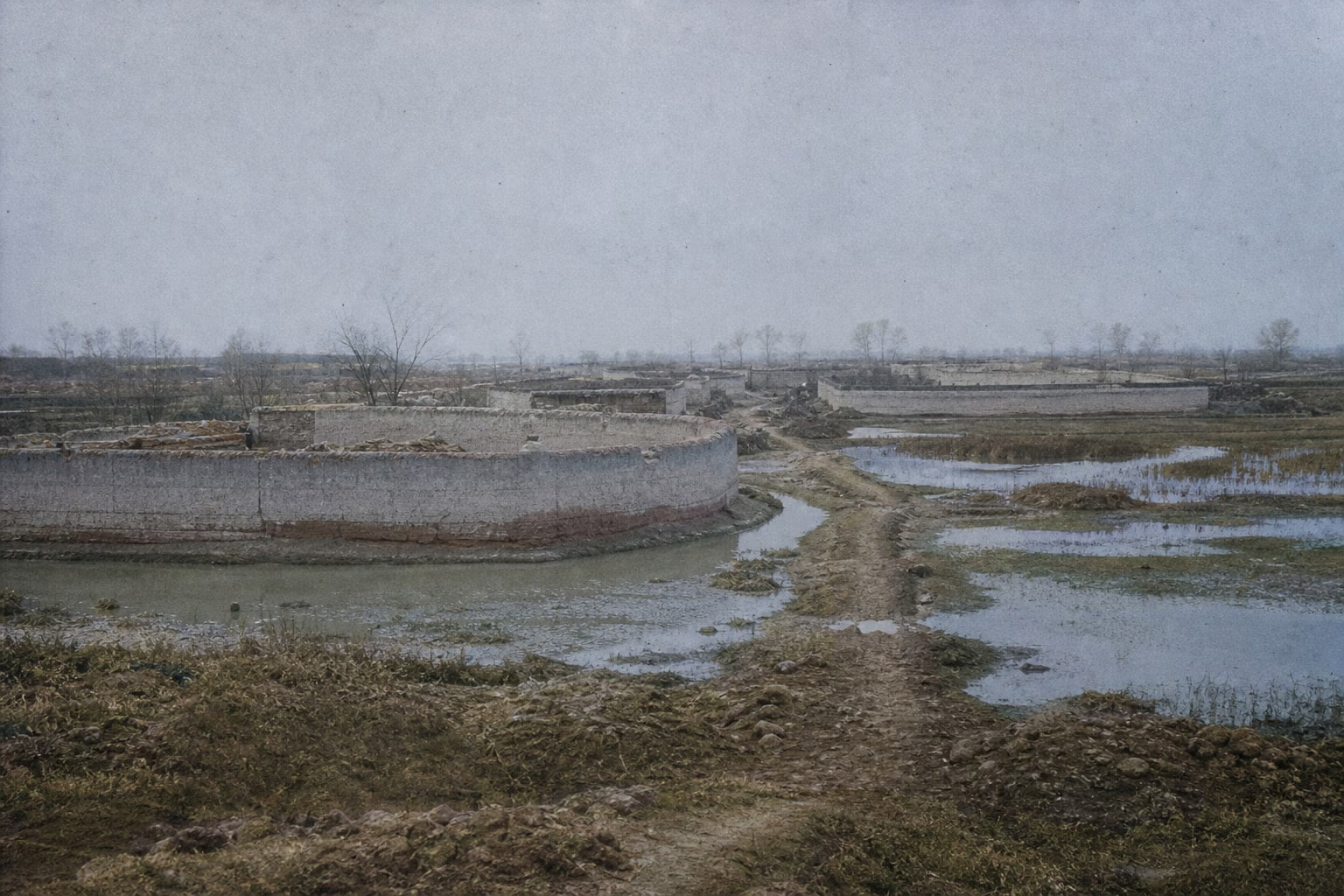
(For the larger situation, see *Huaihai Campaign · Overview*; this section covers only Nianzhuang.)
Nianzhuang lay near the old ground of the Battle of Tai'erzhuang--ten years earlier a famous battle of the War of Resistance had been fought here, and ten years later two Chinese armies faced each other on the same land (geographical overlay noted in one stroke). This was a walled-village zone in northern Huai: villages had enclosure walls and ring ditches, while outside them lay broad patches of ponds and low-lying wet ground; dry roads ran only from one village to the next. Li Mi's corps had previously been stationed here and had built ready-made fortifications (the Huang corps' use of old fortifications remains unverified). Civilians in the battle zone fled in large numbers before and after the fighting began, while those who stayed inside the fortified hamlets were caught amid the village assaults (record unverified).
Why It Was Fought
The first name on the list for this campaign was his. The target in Su Yu's original "small Huaihai" plan was to destroy Huang Baitao's corps around Xin'anzhen; on November 6 the Huaihai Campaign began, and the East China Field Army's columns moved south while the Seventh Corps, about 120,000 men, was ordered to contract from Xin'anzhen toward Xuzhou--he wanted to withdraw into Xuzhou's arms, and the East China Field Army wanted to catch him before he could get back.
There was a history above that name on the list. On the day Jinan fell, Su Yu telegraphed the Center and proposed taking advantage of the victory to launch the Huaihai Campaign; as telegrams went back and forth, the plate grew larger and larger, from the "small Huaihai" idea to making Huang Baitao the first target (the dates and wording of the telegram exchange remain unverified). The campaign had originally been set to begin on November 8; after learning of enemy movements, Su Yu made an on-the-spot decision to advance the date by two days and reported upward while moving. The Center replied by telegram, giving the front the authority to decide and act according to the situation (the evidentiary basis for the early launch and the exact wording of the telegram remain unverified). Nanjing's decision was not especially late: in early November the Ministry of National Defense had already resolved to abandon Haizhou and have each corps contract toward Xuzhou (meeting and plan details remain unverified). Beneath the frame, the people could not be arranged: Bai Chongxi had once been discussed as the unified commander of the Xuzhou and Central China armies; Bai first agreed and then refused (reasons for his refusal vary by account), and command remained with the Xuzhou "Pacification Headquarters." Before the battle was even fought, the two command structures had already separated in quality.
The Huang corps had only one road: west along the Longhai line, with a canal lying across the middle. Whoever crossed first and held the bridge had half the outcome in his legs.
Time was against Huang Baitao from the beginning. The 44th Corps withdrawing west from Haizhou was placed under his command, and he waited about two extra days at Xin'anzhen; once he finally moved, more than 100,000 men, mules, horses, and vehicles had only one iron bridge for crossing the canal. Men, horses, guns, and wagons jammed the bridge, and "the canal jam" became a sign of collapse before the fighting did; some who would not wait for the bridge swam across and froze or drowned. Of the three things he later bitterly regretted, two were here: why wait for the 44th Corps, and why not build a pontoon bridge (the wording of the various versions of the "three questions" last words remains unverified).
What truly brought the pursuers onto his back was that the defensive line opened its own gate. On November 8, He Jifeng and Zhang Kexia of the Third Pacification Area led 23,000 men in the Jiawang Uprising, opening the canal defense line--both men were underground CPC members who had long been concealed there (the level labels for their identity line and the timing of exposure remain unverified). The East China Field Army drove straight through the gap, pursuing day and night, overtaking and inserting, and cutting off the Huang corps' westward retreat.
By this point the calculations on both sides lay open: what the East China Field Army wanted was to intercept these 120,000 men while they were still in motion, preventing them from joining the Qiu Qingquan and Li Mi corps in Xuzhou; Huang Baitao's bet was that Xuzhou was not far away and that the large forces would have time to link up. He did not calculate that the defense line would open from within, nor that a single iron bridge would pin his corps to the east bank of the canal.
Around November 11, the East China Field Army encircled the Huang corps, which had just crossed the canal and had not yet found firm footing, at Nianzhuangwei--Li Mi's corps had previously been stationed here, leaving ready-made fortifications (the use of old fortifications remains unverified), and Huang Baitao turned in place to the defense. Nianzhuang was not a battlefield chosen by either side; it was where the clock of pursuit and flight stopped.
Course of the Engagement
| Phase | Time | Key Points |
|---|---|---|
| Pursuit and encirclement | 11.8–11 | The Jiawang Uprising threw open the defensive line; the East China Field Army overtook the retreat in pursuit, the 63rd Corps was intercepted and annihilated at Yaowan (separate matter, details unrecorded), and the main force fixed the encirclement around Nianzhuang |
| Initial fierce assault | 11.11–14 | The East China Field Army attacked urgently according to a deployment for striking an enemy in motion, and ran into the fortified-hamlet strongpoint cluster--the phase with the heaviest casualties: every village became a battle, approach routes were open between water networks and low-lying wet ground, and attacking troops fell in sheets before the forward edge (details unrecorded) |
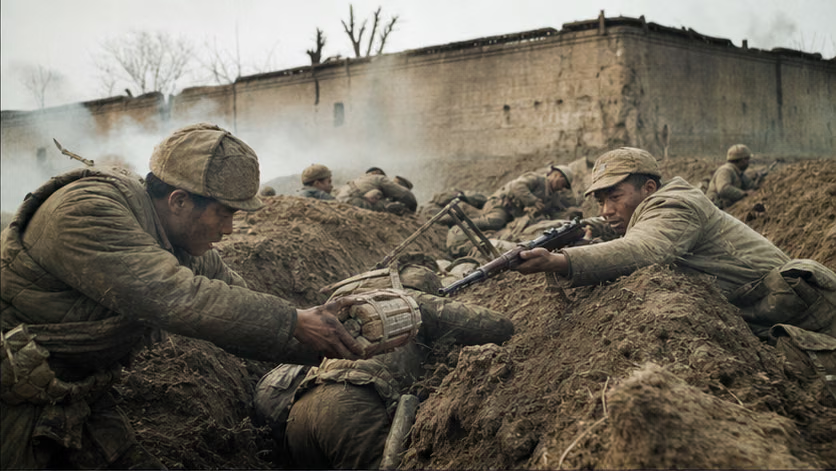
| Adjustment of method | Around 11.15 | The East China Field Army changed from rush assaults to close approach work plus village-by-village fighting: trenches were dug to the foot of enclosure walls, artillery destroyed strongpoints one by one, and each village was ground down in turn |
| Village-by-village blood grinding | 11.15–21 | The outer villages around Nianzhuang changed hands one after another; defenders relied on enclosure walls, ditches, and airdropped supplies, while the two armies repeatedly moved in and out of the same set of villages |
| General assault on Nianzhuang | 11.19–22 | Nianzhuangwei proper was broken through, and corps headquarters fell into disorder; Huang Baitao led remnants toward the Daxiaoyuanshang direction to continue holding out (route details remain unverified), and on 11.22 the remnants were destroyed and Huang Baitao died |
Casualties and Losses
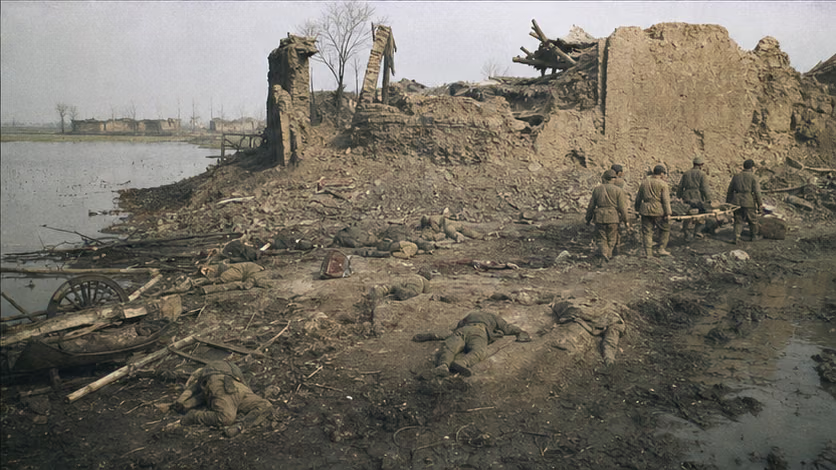
- Encircling side: East China Field Army casualties of 49,000 (statistical bases vary by account)--the stretch in which the East China Field Army suffered its heaviest casualties in the entire Huaihai Campaign, with the village assaults of the first several days accounting for the largest share.
- Encircled side: the Seventh Corps, 120,000 men, was destroyed (the breakdown of killed, wounded, and captured remains unverified); five corps commanders were either captured or killed (roster unverified).
- Civilians: the destruction of civilians and village property inside the fortified hamlets (record unverified).
Aftermath
- The first phase of Huaihai closed: Xuzhou's eastern wing was broken off, Liu Zhi's group lost an elite arm, and the Central Plains Field Army immediately encircled Huang Wei in the Shuangduiji direction--the campaign entered its second phase (see *Battle of Shuangduiji*).
- Xuzhou "Pacification Headquarters" fell into passivity from this point on; the Qiu and Li corps could not rescue Huang Baitao, and they themselves withdrew back into Xuzhou.
- Huang Baitao's death became one of the sample tragedies in the Nationalist Army generals' narrative (see the next section, "three questions").
Accounts of Those Present
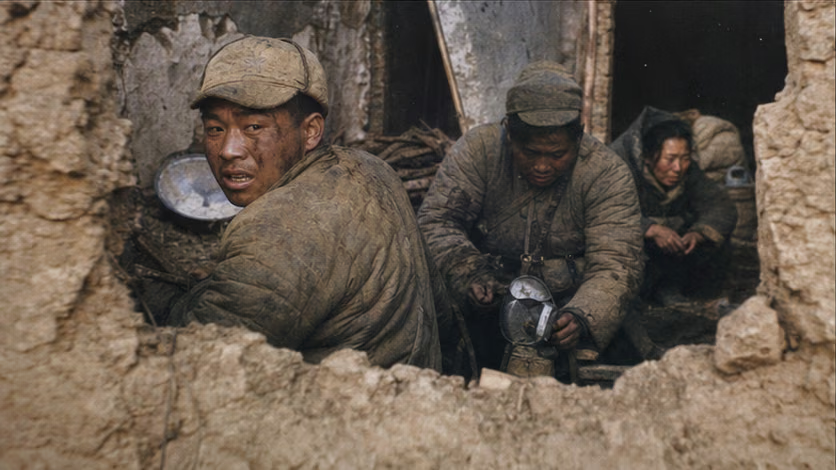
- The closing of a character arc: At Menglianggu, the entire Reorganized 74th Division was destroyed, and Huang Baitao nearly faced military-law punishment for "ineffective relief"; after he was spared, he "made amends through merit," and at Diqiudian in Yudong he held through bitter fighting (see *Battle of Menglianggu* and *Battle of Yudong*). This time no one came to rescue him, and he could not rescue himself--the arc closed at Nianzhuang.
- "The three questions on Huang Baitao's death": The most famous passage among the several versions of his last words is his self-reproach: "Why was I so foolish as to wait two days at Xin'anzhen for the 44th Corps"; "why did I not build a pontoon bridge"; "why did I not leave earlier" (wording differs across versions, level labels remain unverified)--the three "whys" correspond to the three links in the causal chain.
- Suicide / killed in action: On 11.22 Huang Baitao died while breaking out; the accounts of suicide and being hit by a stray bullet both stand (different sources belong to different evidentiary levels).
- One iron bridge for 100,000 men: On the canal's iron bridge, men, horses, carts, and guns would not yield to one another; some units did not wait for the bridge and swam across, with cases of freezing and drowning (record unverified)--before the corps had even made contact, it had already collapsed one layer inside its own retreat.
- Soldiers and civilians inside the fortified hamlets: As the village assaults went on, defenders fought house by house and attackers blasted house by house; civilians who remained inside the fortified hamlets had nowhere to hide (record unverified).
The Ground
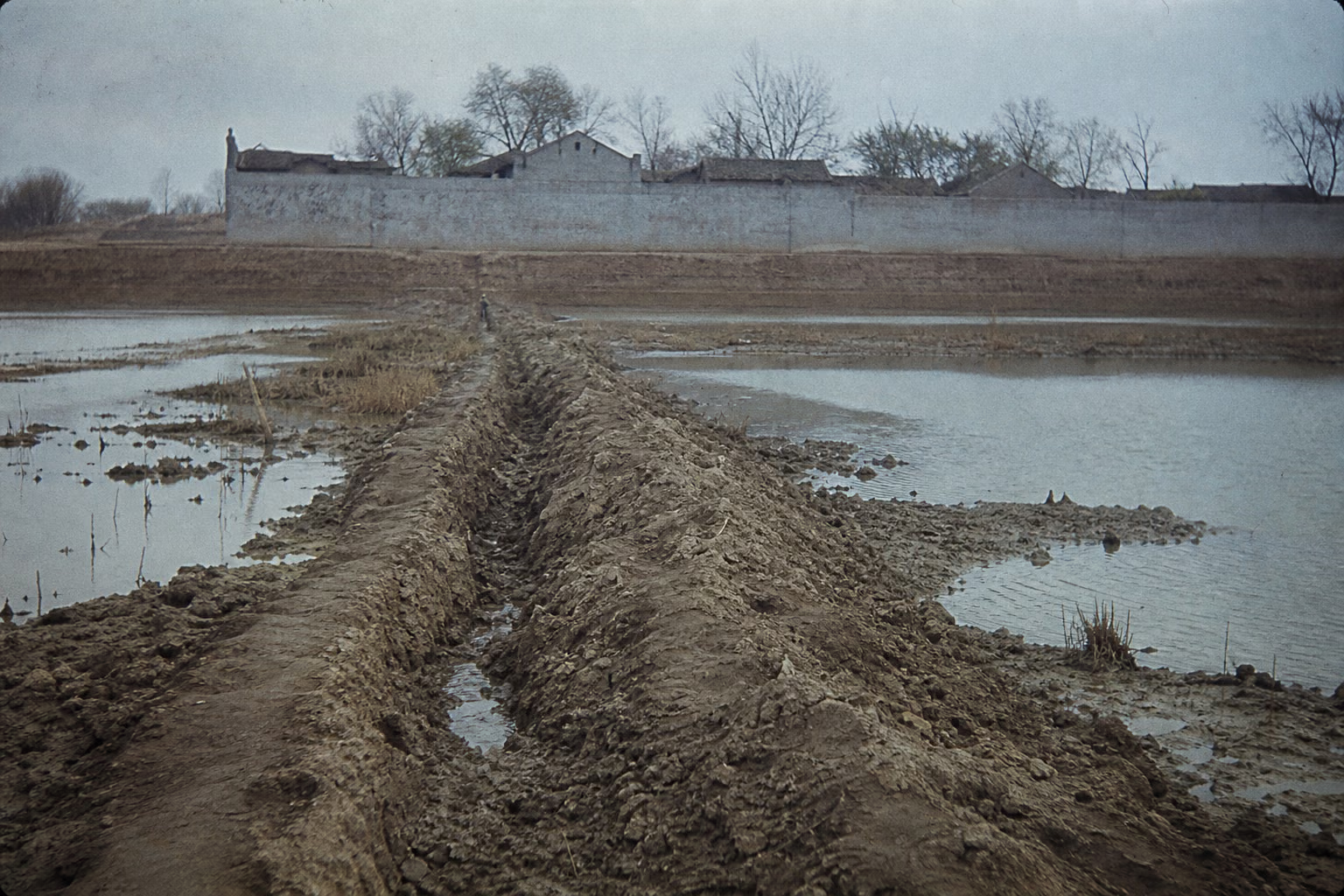
- Walled-village and fortified-hamlet cluster: each village was a small fortress with an enclosure wall and ring ditch, and between one enclosure and the next lay water networks and low-lying wet ground--the assault was not an attack on one city, but a succession of attacks on dozens of "little Hengyangs."
- Water networks, ponds, and low-lying wet ground: approach routes were pinned down by water surfaces and mud, and attackers were slow both to deploy and to close up--this explains the spatial cause of the "phase with the heaviest casualties."
- The overlay on the old ground of the Battle of Tai'erzhuang: the same northern Huai plain, two battles in ten years, with attack and defense, enemy and self, all changed (geographical overlay noted in one stroke).
- Several dozen kilometers away to the east of Xuzhou, another blocking action and this place determined each other's life and death (the spatial structure of "besiege a point to strike reinforcements").
How Each Side Records It
- CPC canon: the first victory of Huaihai, with "encircling and annihilating the Huang Baitao corps" as the rightful name of the first phase; the telegram history of Su Yu "proposing the launch of the Huaihai Campaign" and the evaluation of his command form the narrative main line (telegrams unverified).
- Taiwan side: Huang Baitao is a representative Nationalist general who died for the country in "pacification," and the narrative stresses that "the fault was not in the fighting"--each link in the chain (waiting for the 44th Corps, no pontoon bridge, the Jiawang Uprising) is written as an accretion of fate; the He-Zhang uprising is recorded in Taiwan-side narratives as "betrayal."
- Local memory: after the war, the villages around Nianzhuang were almost rebuilt, and the memory that "every village was fought over" continues in local oral accounts to this day (collection unverified).
Disputes and Sensitivities
- The two accounts of Huang Baitao's cause of death stand in parallel; the sources for the several versions of the last words "why was I so foolish" belong to different evidentiary levels.
- The underground-party identity line of He Jifeng and Zhang Kexia: both men's identities have long been public, but the details of their activity during the concealed period and the decision chain behind the timing of the uprising remain to be level-labeled (level labels remain unverified).
- The statistical basis for the East China Field Army's 49,000 casualties (whether it includes the blocking action east of Xuzhou and the pursuit phase)--two accounts both stand.
- The evaluation of the early village-assault "human-wave attack" and responsibility narratives around the adjustment of method--memoirs from the two sides have different emphases and stand in parallel.
Sources and Open Questions
Known main sources:
- The *Huaihai Campaign* series and East China Field Army war-history materials
- Recollections by surviving officers of the Huang Baitao corps (Taiwan-side collections)
- Documents and recollections related to the uprising by He Jifeng and Zhang Kexia
- Taiwan-side *War History of the Pacification Campaign*, Huaihai section
Open questions: the statistical basis for the East China Field Army's 49,000 casualties; the composition of the Huang corps' 120,000 men and the breakdown of killed, wounded, and captured; sources for the two accounts of Huang Baitao's cause of death; evidentiary levels for the versions of the "three questions" last words; details of the destruction of the 63rd Corps at Yaowan; the Huang corps' use of the old fortifications left by Li Mi's corps; firsthand records of the canal iron-bridge jam; the decision chain behind the Jiawang Uprising; records of civilians inside the fortified hamlets.
All images on this site are AI-generated depictions. They are not historical photographs, not primary sources, and do not depict any real individual.