Engagement Archive · Battle of Zhapu
For the first time on Chinese soil, a Banner garrison city was taken by storm. Nearly 300 Banner soldiers fought to the end from inside a temple; on the day the city fell, garrison families killed themselves in groups -- a hereditary military estate proved, in a brutal way, that it still had people, but no longer had a way.
Engagement Data
| Item | Details |
|---|---|
| Time | 1842.5.18 |
| Place | Zhapu, Pinghu, Zhejiang (a Banner garrison city on the north shore of Hangzhou Bay) |
| Defender | About 1,700 Zhapu garrison Eight Banner troops (Deputy Lieutenant-General Changxi? commanding officer unverified), together with Green Standard troops and local braves, several thousand in all |
| Attacker | More than 2,200 British landing troops (Gough), supported by naval guns |
| Result | The city fell; British forces took a Banner garrison city for the first time, then moved north toward Wusong |
Belligerents
| Item | Defender | Attacker |
|---|---|---|
| Troops | Garrison Banner soldiers lived there for generations with their families; when fighting came, whole households were inside the city | Professional expeditionary force |
| Firearms | Matchlock muskets and old cannon | Percussion firearms, field artillery, naval guns |
| State of mind | No retreat possible (their homes were 1 li behind the position) | Standard assault on a fortified point |
Terrain and Conditions
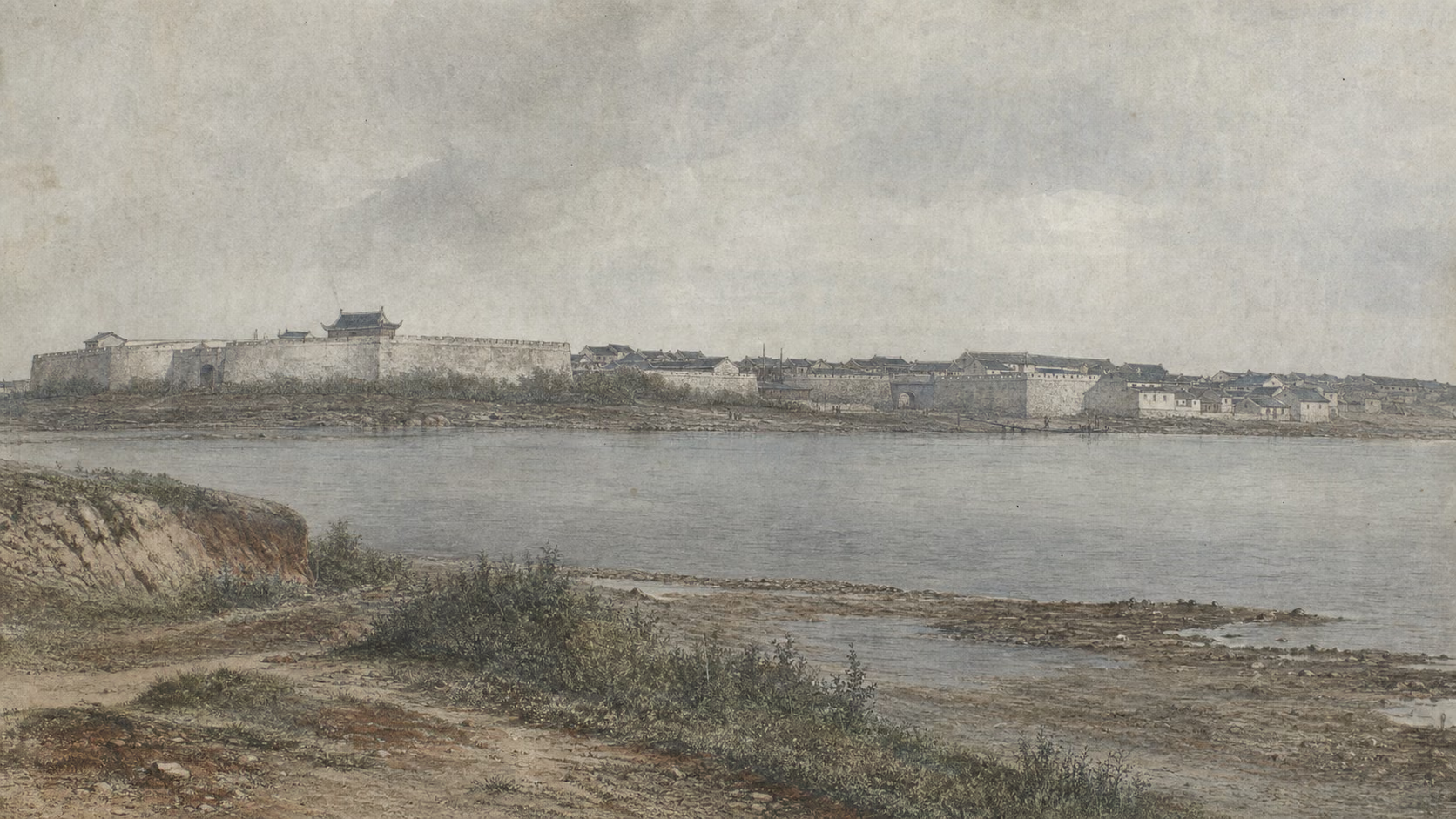
Zhapu was the Banner garrison city at the mouth of Hangzhou Bay: the Banner camp had been stationed there since the Kangxi reign, with military and civilian life fused together, Banner and Han quarters divided, and families living in the camp for generations. To the Banner soldiers, this was not a posting but a home place; to the British, it was an outpost at the gateway to Shanghai. By this point in the war, most of eastern Zhejiang had already been lost; Zhapu was unsettled, and the Banner camp had nowhere to retreat.
Why It Was Fought
In the March counteroffensive in eastern Zhejiang, all 3 routes failed, Yijing fled back to Hangzhou, and the Qing army no longer had an offensive posture against the British. What pushed the court to turn direction was a memorial by Liu Yunke, governor of Zhejiang -- he set out the difficulties of continuing the war in 10 items, cutting into troop morale, grain and pay, and popular unrest one by one (original text of the "Ten Concerns" memorial and date of submission unverified); Daoguang turned instead toward "conciliation," and the negotiating team of Qiying and Yilibu came onto the scene. This time, however, negotiations could not catch up with the fleet: reinforcements transferred from India had arrived by spring, and Pottinger reopened the offensive on a different scale. He abandoned Ningbo, whose occupation had little further use, concentrated his troops, and advanced along the Hangzhou Bay--Yangtze line straight toward the throat of the grain-transport system. The instructions London had given him had pointed from the start toward the Yangtze and Nanjing (text of the instructions unverified) -- no longer knocking at one city after another, but seizing the capital's grain route and forcing Beijing to sign a treaty under the walls.
The first cut along this route fell on Zhapu. This city at the mouth of Hangzhou Bay was an outpost at the gateway to Shanghai, and also a Banner garrison city: the Banner camp had been stationed there since the Kangxi reign, with military and civilian life fused together, Banner and Han quarters divided, and families living in the camp for generations. About 1,700 Banner soldiers, together with Green Standard troops and local braves, defended the city; in defending the city, they were also defending their own homes. By this point, most of eastern Zhejiang had already been lost, Zhapu was unsettled, and the Banner camp had nowhere to retreat: home was just 1 li behind the position.
The two sides did not expect the same kind of battle. For the British, it was a standard assault on a fortified point: landing, suppression, taking the city, then moving north toward Wusong -- Zhapu was only one stop on the sea route. What they did not know was that most of the cities taken in the previous 2 years had fallen after their defenders broke, while a garrison city was a different kind of city: hereditary soldiers defending hereditary homes, with whole households inside the city once fighting began. There was no option of "scattering back to the villages" -- the soldiers were already in their village, and the village was under the muzzles of the guns.
Material limits pinned each side to its own method. Zhejiang's troops and funds had already been spent through one round in the 3-route counteroffensive in March; the emptiness along the north shore of Hangzhou Bay was what that round of exhaustion left behind (connection unverified). Inside Zhapu were 1,700 Banner soldiers plus Green Standard troops and local braves, with only a few heavy guns. Pottinger, too, did not dare spread out: he abandoned Ningbo and moved toward Zhapu and Wusong precisely because the force in his hands was only large enough to clench into one fist. As for the defending side, existing records preserve no dissenting view -- for the officers of the Banner camp, "whether to defend" was not a question. Their homes were inside the city; to defend and to live were the same thing.
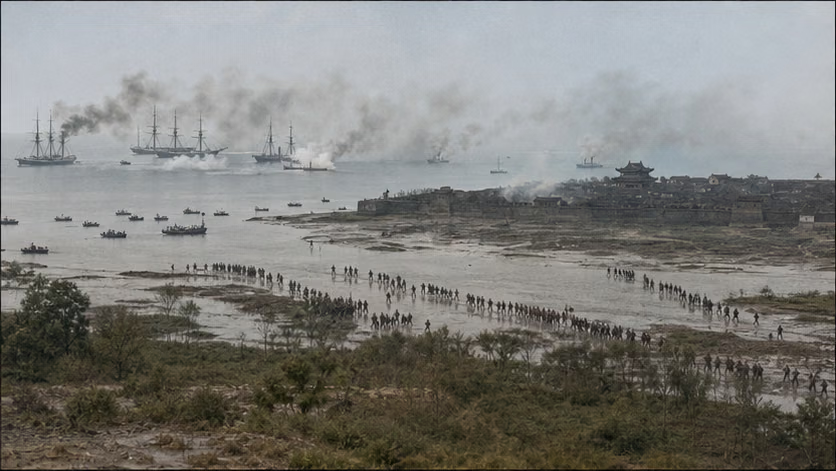
At dawn on May 18, naval guns suppressed the shoreline, and British landing troops came ashore in 3 columns.
Course of the Engagement
| Stage | Course |
|---|---|
| Morning | British troops landed in 3 columns, with naval guns suppressing the shoreline; the outer Green Standard troops and local braves broke first |
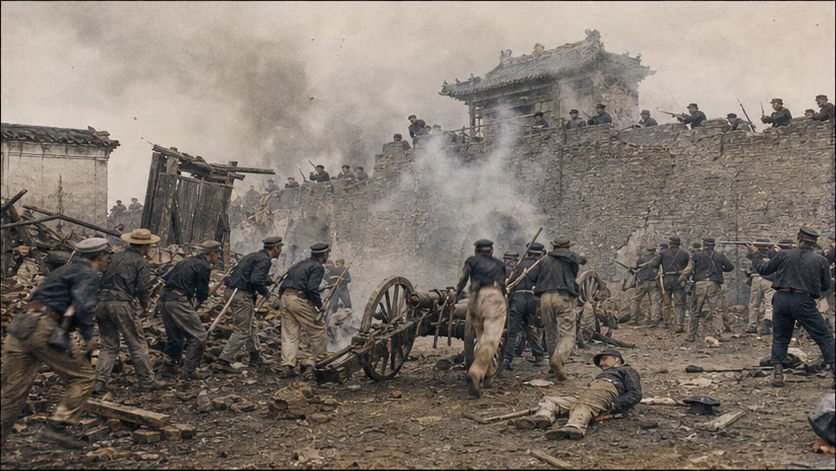
| Before noon | Banner soldiers resisted section by section; nearly 300 men (led by Captain Longfu, disputed) withdrew into Tianzun Temple and fired from behind its walls |
| Tianzun Temple | British troops attacked repeatedly without taking it; Lieutenant-Colonel Tomlinson was killed in front of the temple (the highest-ranking British officer killed in this engagement). In the end, artillery bombardment and blasting broke the temple, and almost none of the defenders surrendered alive (wording "not one surrendered alive" unverified) |
| Afternoon | The city fell; many Banner-camp family members killed themselves ※ (figure disputed) |
Casualties and Losses
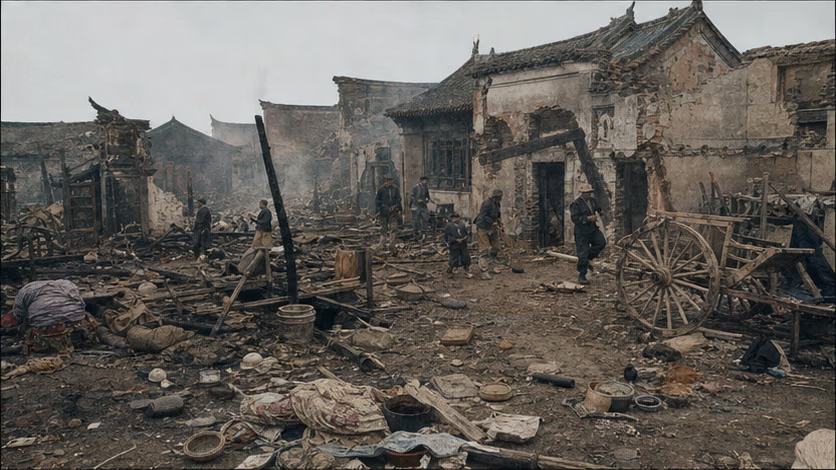
- Defender: nearly 300 Banner soldiers killed, plus several hundred casualties among Green Standard troops and local braves (figure disputed); garrison family members killed themselves in groups ※.
- Attacker: 9 to 13 killed, and more than 50 wounded (British figures vary by statistical basis, unverified) -- the heaviest single engagement of the whole war to this point, second only to the later Zhenjiang.
- ※ After the city fell, it was looted and burned; the Banner city of Zhapu was broken down from this point onward.
Aftermath
- The gateways to Wusong and Shanghai were opened (see Battle of Wusong one month later).
- The Battle of Zhapu, together with the Battle of Zhenjiang, showed everyone the dusk of the "garrison Eight Banners" system: individuals fought to the last man, while the whole had no method at all.
- The fighting at Tianzun Temple entered British military history (they had rarely before encountered a strongpoint held to the end).
Accounts of Those Present
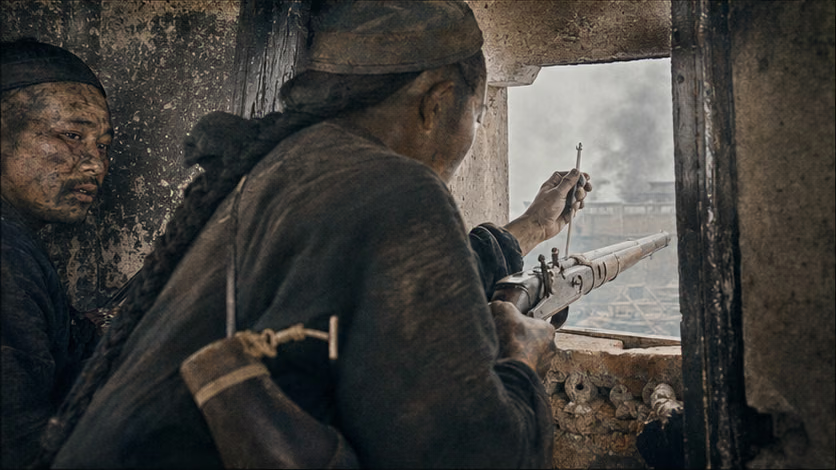
- The nearly 300 men inside Tianzun Temple: soldiers who knew that their own homes stood behind the city were the only Qing troops in this war who "fought for a concrete home" -- their fight to the death does not need a narrative of loyalty to the throne to explain it.
- Lieutenant-Colonel Tomlinson: the highest-ranking British life paid below the temple wall -- the value of the defense was certified for the defenders by the enemy's casualty list.
- Family members: collective suicides on the day the city fell ※ -- related records should be approached through facts and figures as clues (figure disputed).
The Ground
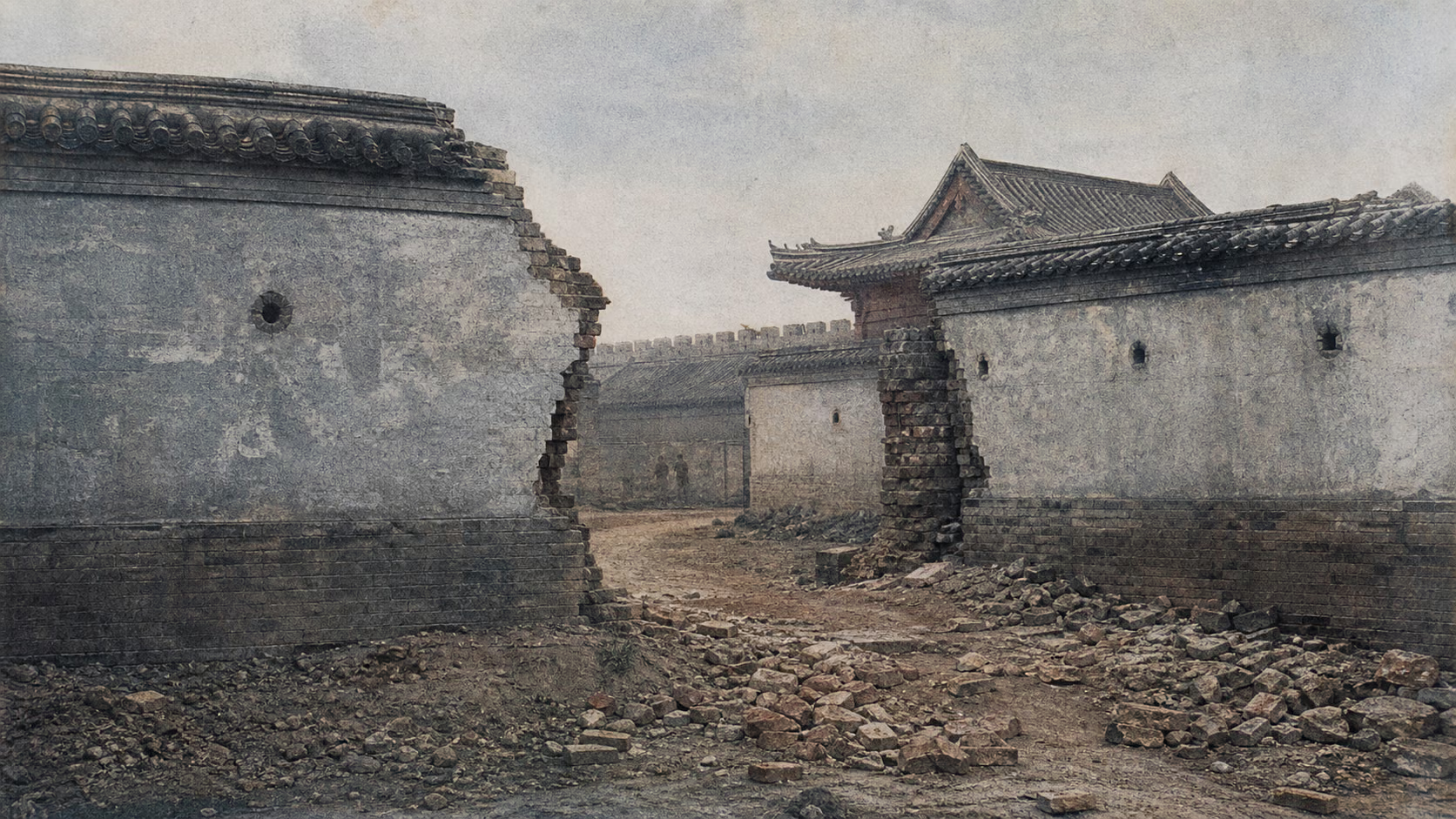
The double structure of the garrison city: outer city--Banner camp (the family quarter was also the depth of the position); the attack and defense of Tianzun Temple as an isolated strongpoint (walls, firing holes, blast opening) -- a micro-spatial specimen of "one temple holding up an army."
How Each Side Records It
- Chinese side: local gazetteers and the memories of Banner-camp descendants; in macro-narratives, Zhapu is often overshadowed by Zhenjiang.
- British side: military histories record in detail the assault on Tianzun Temple and Tomlinson's death -- what they remembered was precisely the hardest section of their opponent's defense.
Disputes and Sensitivities
- The suicides of Banner-camp family members: related records should be followed through names and numbers, while refusing spectacle.
- The complex relations among Banner, Han, and British groups in the same city (old resentments from the divided Banner and Han quarters, and shared suffering), not to be simplified.
Sources and Open Questions
Sources: local sources including *Zhapu Jiyong*; *Pinghu Xianzhi*; Mao Haijian, *The Collapse of the Celestial Empire*; British battle reports and campaign memoirs (Gough's report).
Open questions: garrison commander and troop strength; the number of defenders at Tianzun Temple and source for "not one surrendered alive"; records of the number of family members who killed themselves; British casualty figures by statistical basis; details of Tomlinson's death; original text and date of submission of Liu Yunke's "Ten Concerns" memorial; original text of the British government's instructions ordering Pottinger to advance on the Yangtze; timing and assignment of Qiying and Yilibu's appointment to Zhejiang; records connecting the expenditure of the eastern Zhejiang counteroffensive with the emptiness of defenses along the north shore of Hangzhou Bay.
All images on this site are AI-generated depictions. They are not historical photographs, not primary sources, and do not depict any real individual.