Engagement Archive · Battle of Pyongyang (1894)
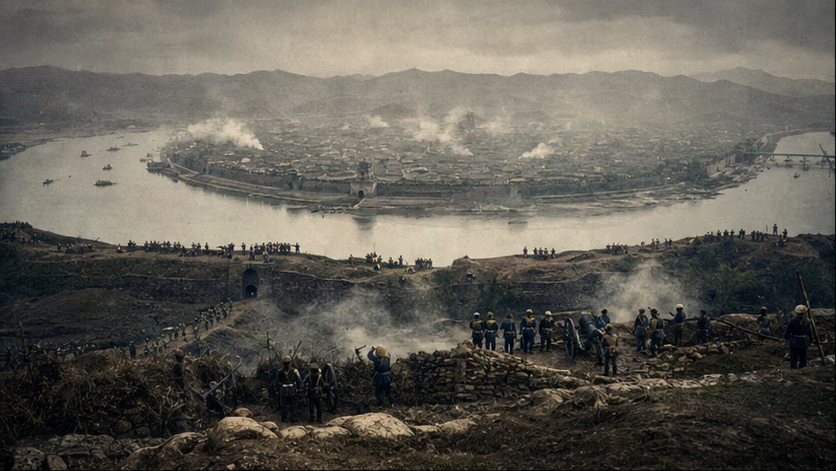
More than 13,000 Qing troops fought for one day at Pyongyang: the south of the city held, the northern heights were lost, the commander raised a white flag, and that night the whole army abandoned the city and fled north; after a six-day rush of more than 500 li, it withdrew west of the Yalu River, and all of Korea was thereby abandoned.
Engagement Data
| Item | Details |
|---|---|
| Time | 1894.9.15, one day (the Qing forces routed that night) |
| Place | Pyongyang city, Pyeongan Province, Korea, and both banks of the Taedong River |
| Belongs to | First Sino-Japanese War · Korean phase (see *First Sino-Japanese War: Overview*) |
| Defending side | The Qing army's four major forces: Yi Army (Ma Yukun), Sheng Army (Wei Rugui), Feng Army (Zuo Baogui), and Shengzi Trained Army (Fengsheng'a), with Ye Zhichao serving as commander over the armies |
| Attacking side | Japanese First Army (commander Yamagata Aritomo), encircling in four routes |
| Result | On the night of 9.15 the Qing forces abandoned the city and routed north; Japanese forces occupied Pyongyang; within roughly ten days the Qing forces had all withdrawn west of the Yalu River |
Belligerents
| Item | Defending side (Qing forces) | Attacking side (Japanese forces) |
|---|---|---|
| Strength | The four major forces together numbered more than about 13,000 (one account gives 15,000; measurement standards vary by account) | About 16,000 committed to the assault on the city, divided into four routes (figures for the First Army order of battle and numbers actually present vary by account) |
| Rifles | The armies carried a mixture of firearms, with Mausers, Hotchkiss rifles, Remingtons, and older weapons side by side (details unverified) | Murata rifles as a unified standard arm |
| Artillery | Several dozen Krupp field guns and other pieces, with shell reserves not abundant (number unverified) | Field guns and mountain guns advanced with the four routes, ammunition resupplied with the columns |
| Supply | Pyongyang held grain sufficient for more than a month (figure disputed); the rear route depended on the Uiju-Jiuliancheng line | |
| System | The four armies each formed their own system and were not subordinate to one another; Ye Zhichao's standing was insufficient to hold the field, and the title "commander over the armies" came from his charge over the rear grain depots | Army-division-brigade vertical command; the four routes were coordinated by army headquarters |
Terrain and Conditions
(For the larger situation of 1894 -- Meiji Japan's national mobilization and the struggle between emperor and empress dowager at the Qing court -- see *First Sino-Japanese War: Overview*.)
The Korean move on the board: on 7.23 Japanese forces had already occupied Gyeongbokgung in Hanseong and held the Korean court hostage; the Korean puppet government announced the abolition of its treaties with the Qing and "entrusted" Japanese forces with expelling the Qing army. In name, the Battle of Pyongyang (1894) was fought on land that Japan had already declared "entrusted" to it. Korean officials and common people were caught in the middle: Qing forces had been stationed in Pyongyang for more than a month, discipline varied from army to army, and the Sheng Army was especially disruptive to civilians (see the disputes section for details); Japanese forces entered the city under the name of "helping Korean independence." This battle decided Korea's possession on Korean soil, while Koreans themselves had no voice.
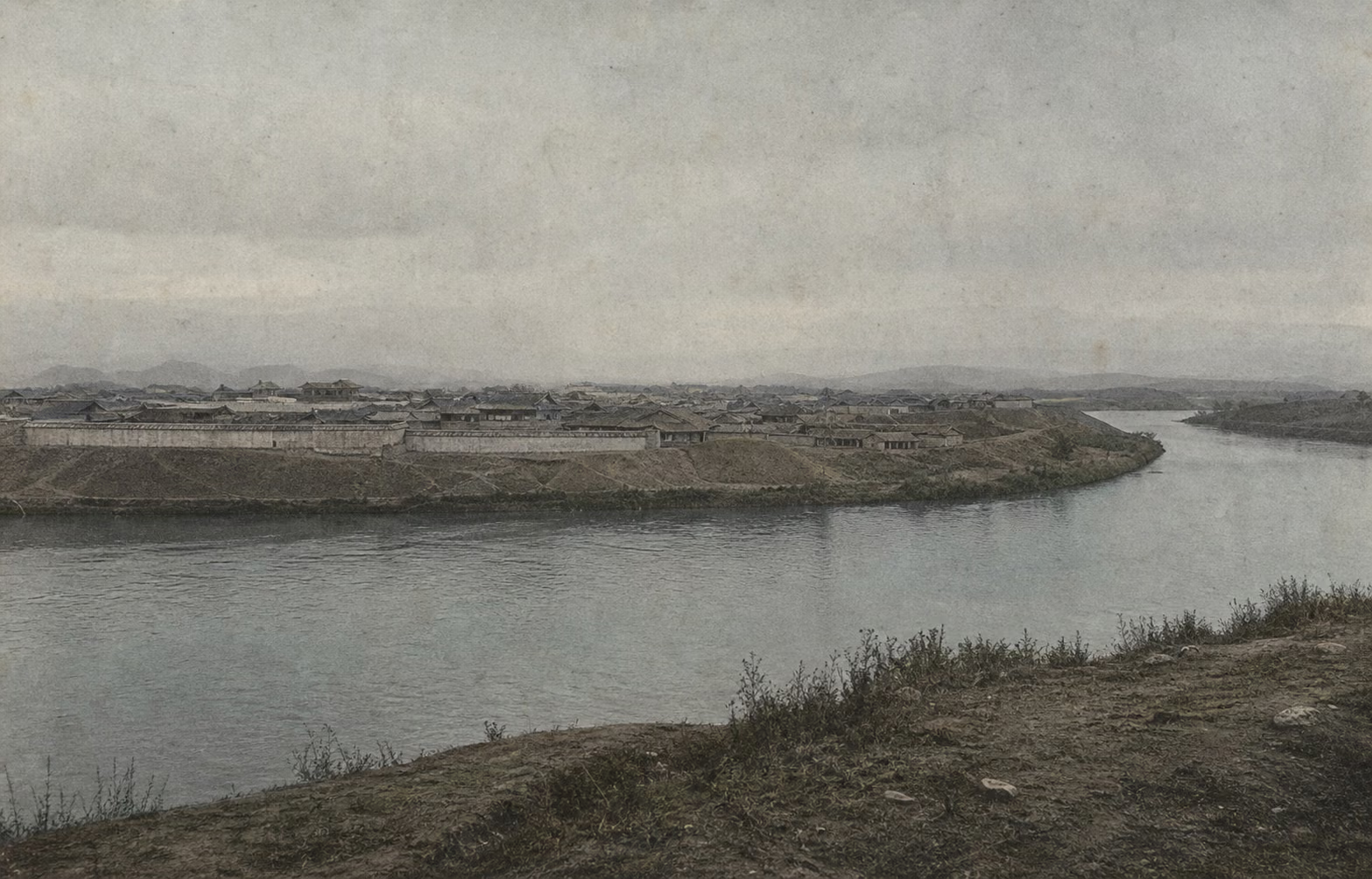
This city: Pyongyang was Korea's old capital and the foremost stronghold of its northern frontier. The Taedong River curved around the city's southeast, making it a contested place for armies since antiquity. Nearly 300 years earlier, during the Wanli Korean campaign, Ming and Japanese forces had fought beneath this same city. Qing forces entered in succession from early August, built fortifications around the city, and prepared its defenses for more than a month; it was therefore a prepared city awaiting the enemy.
Why It Was Fought
After the defeat at Seonghwan (see *Outbreak of War: Pungdo and Seonghwan*), Ye Zhichao led the defeated Asan troops around Hanseong, moved north for more than a month through the mountains of eastern Korea, and retreated to Pyongyang. Before the men had finished the march, the memorial had already reached Beijing: a retreat in defeat was written as "successive great victories, killing 2,000 enemy troops." The Qing court believed it, granted silver to reward the army, and in August ordered him to command the armies at Pyongyang. The Yi, Sheng, Feng, and Trained armies that had entered Korea one after another each formed their own system and did not accept one another's authority; the court needed someone to come forward and hold the field. Thus a man who had just lost a battle, and then reported the defeat as victory, received command of the next major battle.
Pyongyang was Korea's old capital and the foremost stronghold of its northern frontier. The Taedong River, curving around the city's southeast, was a natural outer moat; 300 years earlier, during the Wanli Korean campaign, Ming and Japanese forces had fought beneath this city. With Asan abandoned, all the Qing army's capital in Korea was gathered here: the four armies had entered the city from early August, built fortifications around it for more than a month, and held grain sufficient for more than a month (figure disputed). For Japan, Pyongyang was the final stop at which the paper order to "entrust the expulsion of Qing forces" had to be fulfilled. Once it was taken, all of Korea would be in hand.
After the imperial edict declaring war was issued on August 1, what the court wanted was an advance and punitive attack; court dispatches repeatedly contained language urging an advance on Hanseong (original wording unverified). Li Hongzhang kept another account book: the navy did not dare look south, and the army should gather strongly at Pyongyang, entrench itself steadily, and only then plan to move south. The arguments for advance and for caution contended at court. At the front, this became a stalemate in which the four armies remained in the city for more than a month, uncertain whether to advance or halt: no order to move south, and no name under which to abandon the position.
The boundaries of that stalemate were drawn by material realities. The four armies' firearms -- Mausers, Hotchkiss rifles, and Remingtons -- were mixed, and ammunition was not interchangeable (details unverified); grain and pay left Fengtian, crossed the Yalu River, and were carried south for several hundred li, supplied entirely by carts and pack animals. Yamagata Aritomo could see the same timetable: Qing follow-on reinforcements were still on the road north (unit details unverified), and the four-route rendezvous was therefore set for before those reinforcements could converge. He had reports from along both the Hanseong and Wonsan routes; inside the city, before the battle began, there were only fragmentary reconnaissance reports on the strength and timing of the four Japanese routes (records unverified).
After Pungdo, the Beiyang Navy no longer looked south; maritime transport along Korea's west coast passed to Japan, and the Japanese First Army could advance from Hanseong, Wonsan, and Saknyeong along multiple routes. Commander Yamagata Aritomo set the four-route rendezvous, and in mid-September the columns approached Pyongyang one after another. A four-route converging attack over long roads stretched supply lines very far, and favored a quick decision; the defenders' city works were already firm, and grain and fodder were prepared, favoring a long defense. Time originally stood on the side of those inside the city.
But the accounts inside the city never came together. Ye Zhichao had neither the standing nor the ability to command obedience; the generals argued over defensive plans without reaching a decision; the defense remained a patchwork in which each force held its own sector, while the commander-in-chief had already begun thinking of retreat. Several days before the battle, Ye Zhichao had already proposed abandoning the city and moving north; Zuo Baogui held that this was unacceptable, argued with him, and failed to change the result (this proposal appears in multiple Qing-side accounts; original source unverified). The Qing court's misjudgment had already been made two months earlier: it had believed that false victory report. The Japanese four routes advanced according to the timetable, drew near between September 12 and 14, and the encirclement took shape.
At dawn on September 15, the four routes opened fire at the same time. The grain inside the city would originally have been enough for another month.
Course of the Engagement
| Stage | Time | Key points |
|---|---|---|
| Four-route encirclement | 9.12–14 | The Japanese Oshima Mixed Brigade approached the south of the city along the main road from Hanseong, the main body of the Fifth Division approached the southwest, and the Saknyeong and Wonsan detachments struck around from the north and northeast (unit numbers and troop counts for each detachment unverified); Qing forces defended sectors around the city: Ma Yukun's Yi Army at Chuanqiaoli on the southern bank of the Taedong River, Wei Rugui's Sheng Army southwest of the city, and Zuo Baogui's Feng Army and Fengsheng'a's Trained Army on the northern line from Hyeonmu Gate to Moranbong |
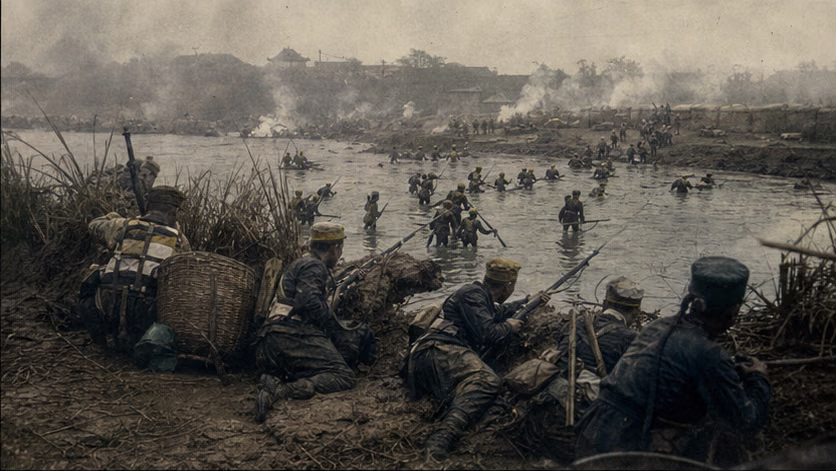
| Bloody fighting at Chuanqiaoli | Morning-afternoon, 9.15 | Oshima's brigade forced a crossing of the Taedong River and attacked Chuanqiaoli; Ma Yukun directed the Yi Army in hard fighting behind its works, repulsing repeated charges. Japanese casualties were heavy and the attack stalled (the Japanese official history itself recognized that this route's attack failed, unverified). This was the route on which Qing forces fought best that day |
| Moranbong-Hyeonmu Gate | Morning-late morning, 9.15 | The Japanese Saknyeong and Wonsan detachments attacked the northern height of Moranbong from both sides, and the forts fell one after another; knowing that Ye Zhichao intended retreat, Zuo Baogui put on the court-bestowed clothing and cap and climbed Hyeonmu Gate to direct the battle, personally firing cannon, and was killed by a shell; with Moranbong lost, Japanese artillery fire thereafter commanded the whole city from above |
| Southwestern diversion | All day, 9.15 | The main body of the Fifth Division's attack on the city's southwest was diversionary in nature, and pressure in the Sheng Army's direction was comparatively light (battle details unverified) |
| Raising the white flag | Afternoon, 9.15 | In afternoon heavy rain (record unverified), Ye Zhichao cited the loss of Moranbong and the danger that the grain route would be cut, hung a white flag from the city wall, and sent a letter to the Japanese forces asking for a ceasefire; the Japanese side set a time to receive surrender, while Qing forces left the city by night through Qixing Gate and Jinghai Gate |
| Night flight into ambush | Night, 9.15 | Qing forces abandoned the city and moved north; on the main road they encountered an ambush by Japanese units set in advance. In the darkness men and horses trampled one another; more than 2,000 died and several hundred were captured (figures vary by account); all arms, baggage, and supplies were abandoned |
| Headlong rush across the river | 9.16–21 | The routed army rushed for six days over more than 500 li, passing Anju, Jeongju, and Uiju, crossing the Yalu River and retreating into Jiuliancheng; all of Korea was abandoned |
Casualties and Losses
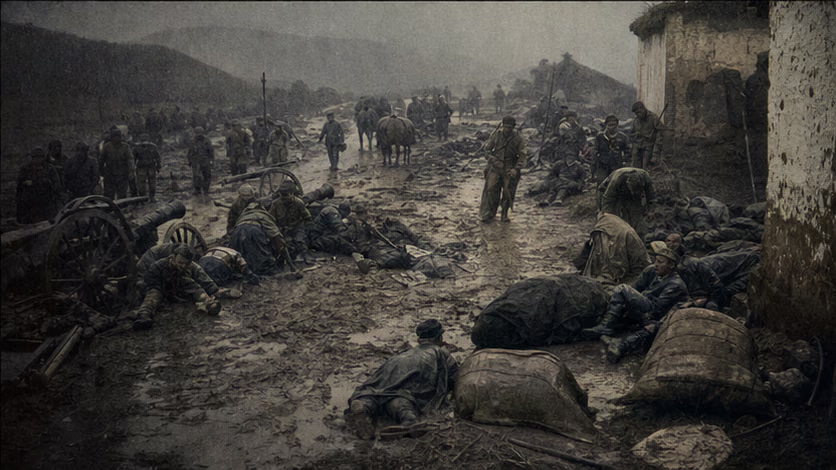
- Qing forces: killed and missing together numbered around 2,000, most of them dying during the rout on the night of 9.15 rather than in the daylight city fighting (the Japanese official history counted bodies abandoned on the battlefield; Qing memorials and later research use differing measurement standards, listed side by side here as unverified); about 500 to more than 600 were captured (Japanese basis, unverified). Forty cannon, more than 10,000 rifles, and all grain, ammunition, baggage, and supplies were lost (numbers unverified).
- Japanese forces: by the Japanese official-history basis, more than 100 killed and more than 500 wounded (specific figures unverified), with more than half the casualties concentrated on the Chuanqiaoli route. The attacker's total cost was not high, but on the route where the main attack was checked it paid a real price.
- Pyongyang city and residents: this article has found no reliable statistics for the effect of the assault and the rout on civilians in the city (figure disputed).
Aftermath
- There was no longer a single Qing soldier in all of Korea, and the war was led toward the Yalu River; one month later, the Japanese First Army bridged that same river and fought its way in (see *Defense of the Yalu River Line*).
- At the same time that command of the land changed hands, two days later (9.17) the naval battle at Dadonggou in the Yellow Sea began (see *Battle of the Yalu River (1894)*). After the defeat at Pyongyang, Beiyang's calculation of escorting troop transports fell through with it.
- Wei Rugui was arrested for "retreating before the enemy, allowing soldiers to disturb civilians, and withholding soldiers' pay," and was executed in the winter of 1894 (execution date varies by account); Ye Zhichao was arrested, sentenced to death after autumn review with the sentence suspended, did not die, and was later released home (reason for release and year of death unverified).
- The commander-in-chief was sentenced to death after review, and a subordinate general was executed, yet the chain by which "false reporting brought office" was never reckoned with. Accountability stopped at the front-line commanders.
Accounts of Those Present
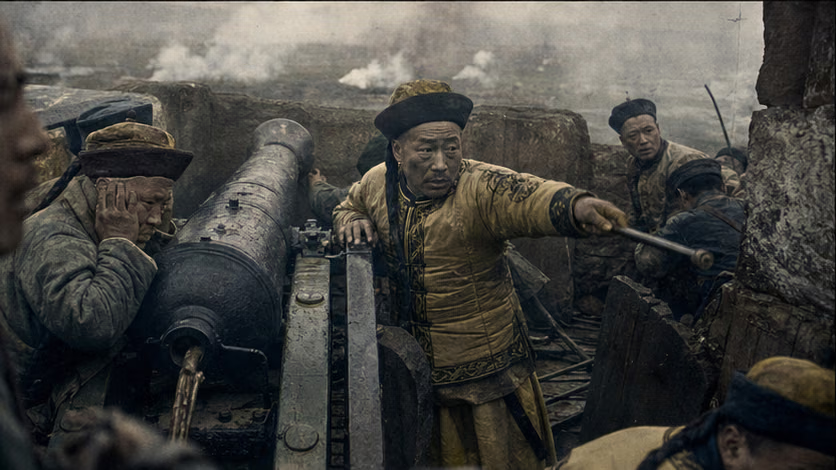
- Zuo Baogui's clothing and cap: on the night before the general assault, Ye Zhichao had already shown an intention to retreat, and Zuo Baogui angrily sent personal soldiers to watch Ye in case he fled first (record unverified). After the alarm at Moranbong, Zuo put on the court-bestowed yellow riding jacket and official cap, climbed Hyeonmu Gate to direct the battle, personally fired the cannon, fired several dozen rounds until the gun burst (record unverified), then climbed the parapet to command; a shell pierced his chest and killed him, and his body could not be recovered in time. His colleagues gathered his clothing and cap and buried them in his native Feixian, Shandong (cenotaph unverified). He was the highest-ranking commander to die for the country in this battle, a Hui from Feixian, Shandong; the narrative of his "putting on court-bestowed clothing and cap and dying for the altars of state" carries great weight in Hui memory, and to this day he is told as a typical patriotic Hui general (level of detail unverified).
- The other side of Chuanqiaoli: on the same day at the same city, the Yi Army south of the city fought one of the Qing army's rare hard battles in the entire war. Japanese records say this route's attack was checked and officers and men suffered heavy casualties (specific casualties and original official-history text unverified). Pyongyang did not collapse at a touch; after one point in the north of the city was lost, the commander-in-chief collapsed first.
- The white flag and ceasefire letter: Ye Zhichao's letter seeking peace was carried out by a Korean interpreter (record unverified); the Japanese reply set the time for surrender, but Qing forces left first under cover of night. The white flag was raised on the city wall; the men had already run out through the northern gates.
- The 500-li headlong rush: routed soldiers along the way "ran day and night, hungry, thirsty, stumbling and falling" (source of account unverified), covering more than 500 li in six days, cavalry and infantry mixed together, abandoning weapons all along the road. When counted afterward, most of the four armies had survived. The battle had lasted only one day; the rout took six.
The Ground
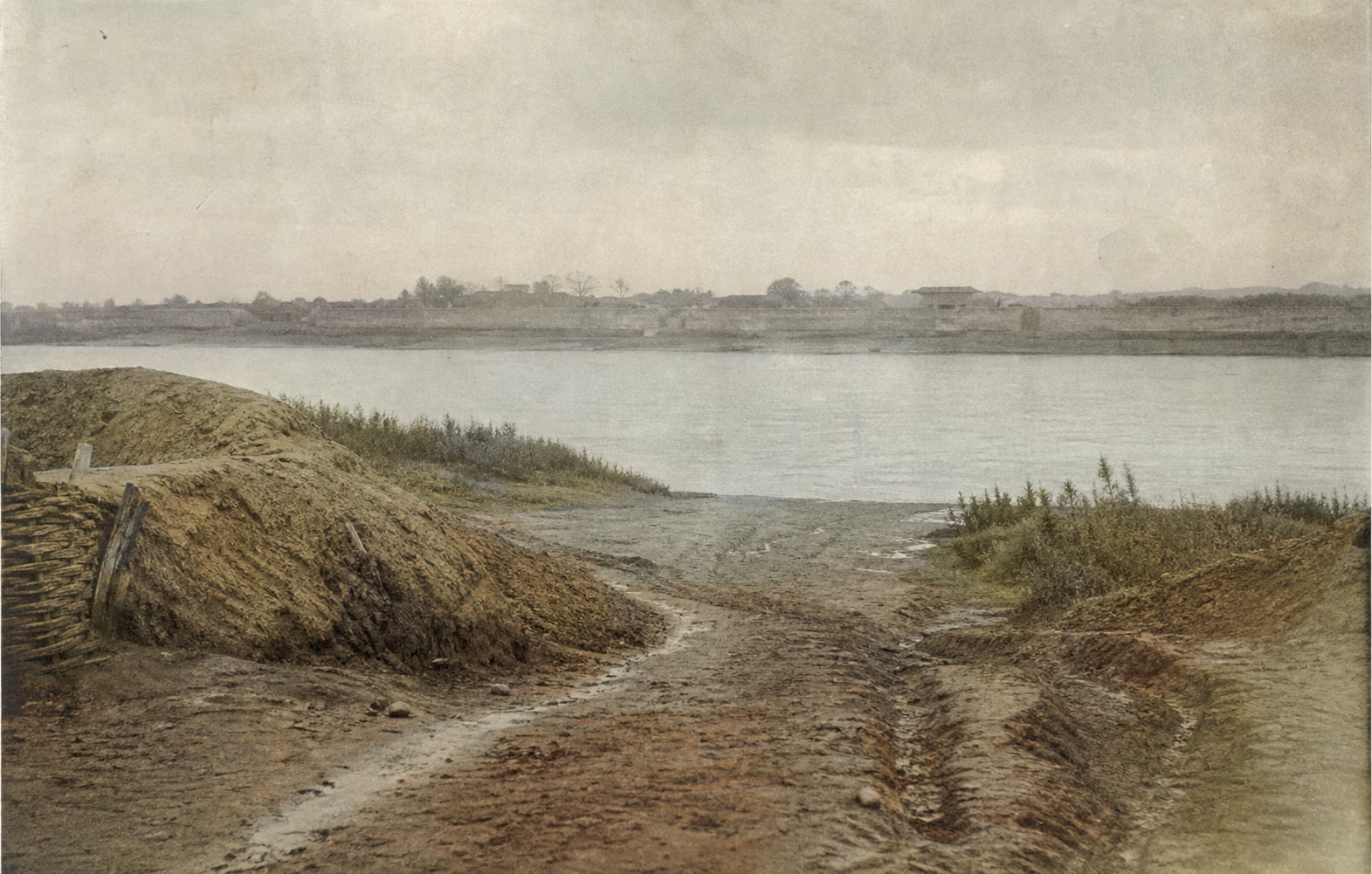
- The city stood on the western bank of the Taedong River, whose waters curved around its southeast as a natural outer moat; the defenders straddled both banks, and Chuanqiaoli, on the southern bank downstream, was the crossing point by which the main road from Hanseong entered the city.
- Moranbong outside the northern Hyeonmu Gate was the commanding height of the whole city, standing several dozen meters above the city wall (height difference unverified); once the hill was lost, the city interior had no cover. The decisive point of this battle was a hilltop, not the city wall.
- A patchwork defensive line in which each gate held its own sector: the southern gate and Taedong River, the Sheng Army camp works to the southwest, and the northern line from Moranbong to Hyeonmu Gate, on a scale ranging from several hundred meters of river surface to a several-kilometer ring around the city.
- The nighttime rout was another space: the main road north of Qixing Gate and Jinghai Gate, a narrow death corridor, with the ambushers in the dark and the routed troops exposed.
- The six-day, 500-li axis of retreat -- Pyongyang-Anju-Jeongju-Uiju-Yalu River -- was itself a spatial narrative: from a prepared city to the national gate.
How Each Side Records It
- Chinese side: the rout at Pyongyang is one of the prototypes of the "incompetent generals and commanders" narrative. Ye Zhichao's six-day, 500-li rush became a laughingstock and a symbol of shame in late Qing public opinion; set beside it are Zuo Baogui's death for the country and the hard fighting at Chuanqiaoli. Within one battle, loyal and treacherous figures are cleanly divided, making the story easy to tell, while also simplifying the structural illness of four armies not subordinate to one another.
- Japanese side: the First Army's first battle "captured Pyongyang" and was written as the first major victory of the "Nisshin War." Wartime Japan saw nationwide newspaper extras and lantern parades, and the mobilization of army and nation heated up from here. The Japanese official history is relatively direct in recording the setback at Chuanqiaoli (original text unverified), and among Japanese participants Chuanqiaoli is often remembered as hard fighting.
- Korean side: this battle decided Korea's possession on Korean territory, while Koreans were only bystanders and bearers of the consequences. After the battle, Japanese forces carried out occupation in the name of "independence." This article has not yet reached Korean-side records of Pyongyang after the disaster and of the occupation order inside the city (accounts vary by account).
Disputes and Sensitivities
- The Wei Rugui case: the Qing side convicted him of "retreating before the enemy, allowing soldiers to disturb civilians, and withholding soldiers' pay," and executed him; those who argue that he was wronged say that his southwestern defense sector did not fall that day, that the "retreat" began with the commander-in-chief while the subordinate general paid with his life, and that the Sheng Army's disturbance of civilians also had Korean-side testimony and the period background of wartime disciplinary disorder. Ye Zhichao was sentenced to death after review while Wei Rugui alone died, leaving suspicion that he bore another's fault (the two accounts are placed side by side, both unverified). ※ The charge of "allowing soldiers to disturb civilians" points to plunder and harassment of Korean civilians, the main recorded layer of atrocities against civilians in this battle. However the Wei case is classified, the fact that Qing troops stationed in Pyongyang disturbed civilians is recorded in multiple sources.
- The boundary of Ye Zhichao's responsibility: false reporting that brought office, a pre-battle intent to retreat, raising a white flag during the battle, and abandoning the army in a night flight leave almost no room for defense in Chinese narratives. But the institutional illness of a "commander over the armies" title that did not match reality, and of four armies not subordinate to one another, as well as the battlefield reality that once Moranbong was lost the whole city had no defensible obstacle, form another layer beyond his personal guilt. The two layers are placed side by side: structure does not excuse the individual, and the individual does not cover the structure.
- Composition of the death figures: most of the more than 2,000 Qing dead died during the night rout rather than in the city battle. This structure of "fewer battle deaths, more deaths in flight" should be separated in every statistical basis (statistical basis unverified).
- Zuo Baogui's death for the country and Ye Zhichao's rout occurred on the same day and in the same city; the hard fighting at Chuanqiaoli is another battlefield detail.
Sources and Open Questions
Known main sources:
- Japanese General Staff Office, *History of the Qing-Japanese War in Meiji Twenty-Seven and Twenty-Eight* (Japanese official history, Pyongyang campaign volume)
- Yao Xiguang, *A Brief Account of Military Affairs in the East* (early Qing-side war history)
- Qi Qizhang, *History of the First Sino-Japanese War* (later research, Chinese mainstream account)
- Li Hongzhang's and front-line generals' telegrams and memorial drafts (*Complete Works of Li Wenzhong* and other original documents)
Open questions: the different strength figures for the defending and attacking forces; unit numbers and troop counts for the four-route detachments; specific Japanese casualties at Chuanqiaoli and the original official-history text; details of Zuo Baogui's death (firing cannon, gun bursting, personal soldiers watching Ye, clothing-and-cap cenotaph); details of the afternoon heavy rain and the peace-seeking letter; the location of the ambush on the night of 9.15 and the differing figures for Qing dead and captured; Wei Rugui's execution date and case file; the reason for Ye Zhichao's release and his year of death; Pyongyang's grain reserves; Korean-side records of civilian effects and occupation order during the Battle of Pyongyang (1894); the documentary level of Zuo Baogui's narrative in Hui memory; the original court-dispatch language urging an advance and punitive attack; Li Hongzhang's memorials on a cautious strategy; details of the four armies' firearms and ammunition; unit numbers and itineraries of the reinforcing battalions moving north; original records of Ye Zhichao's proposal to abandon the city and Zuo Baogui's opposition; pre-battle Qing reconnaissance reports on the strength and timing of the four Japanese routes.
All images on this site are AI-generated depictions. They are not historical photographs, not primary sources, and do not depict any real individual.