Engagement Archive · Battles of Jinzhou and Port Arthur
For more than ten days after Japanese forces came ashore at Huayuankou, no one fired a shot at them; one month later, Port Arthur, built up over sixteen years and called the "foremost military port of the Far East," fell within a single day -- followed by four days of massacre.
Engagement Data
| Item | Details |
|---|---|
| Time | 1894.10.24 – 11.22 (the massacre continued until around 11.24) |
| Place | Liaodong Peninsula: Huayuankou -> Jinzhou -> Dalian Bay -> Port Arthur |
| Belongs to | First Sino-Japanese War (for the larger situation, see *First Sino-Japanese War: Overview*; cross-reference also the Defense of the Yalu River Line, which began the same day) |
| Defending side | Forces at Jinzhou, Dalian Bay, and Port Arthur: units under Xu Bangdao, Zhao Huaiye, Jiang Guiti, Cheng Yunhe, Wei Rucheng, Huang Shilin, and others; Gong Zhaoyu, civilian superintendent of the Port Arthur base |
| Attacking side | Japanese Second Army (commander Oyama Iwao), with the First Division (division commander Yamaji Motoharu) as its main force, among others |
| Result | Jinzhou fell on 11.6; Dalian Bay was abandoned without a fight on 11.7; Port Arthur was fully lost on 11.22; ※ 11.21–24 Port Arthur Massacre |
Belligerents
| Item | Defending side | Attacking side |
|---|---|---|
| Strength | The various commanders at Port Arthur each led their own units, totaling more than ten thousand (figures vary by account), and were not subordinate to one another | The Second Army numbered more than about twenty thousand (figures vary by account), with a unified organization |
| Defense | Port Arthur's forts ringed the area, its coastal guns were strong and sharp, and its dockyard machinery was complete; but the forts faced the sea, while the landward approach was the weak point | — |
| Firepower | The battalions' rifles and artillery were mixed between old and new, and field artillery was weak | Divisional field artillery was complete |
| Command | Six or seven commanders were not subordinate to one another, and the civilian superintendent fled first | The army-division-regiment system was complete, and deployment began as soon as the landing was made |
Terrain and Conditions
(For the larger situation in 1894 -- successive defeats by land and sea since the war began, and the Qing court's dispatching of forces -- see *First Sino-Japanese War: Overview*.)
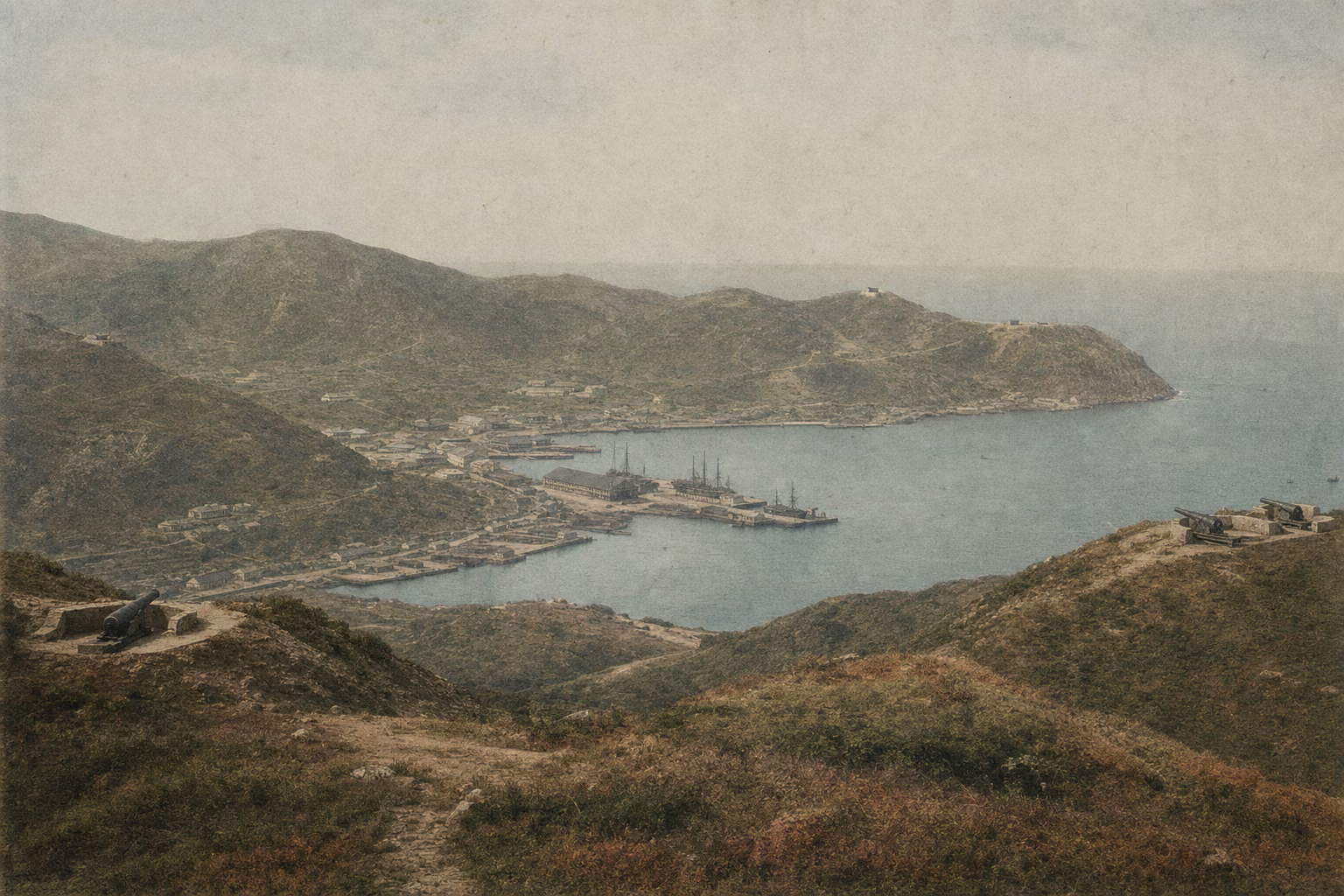
The Port Arthur base: Beiyang's fundamental naval base, built over sixteen years at a cost of tens of millions of taels of silver, with dockyards, forts, and ammunition depots all complete, and called the "foremost military port of the Far East." Its defenses were designed entirely against enemies arriving by sea. From behind, by land, lay precisely the route Japanese forces chose.
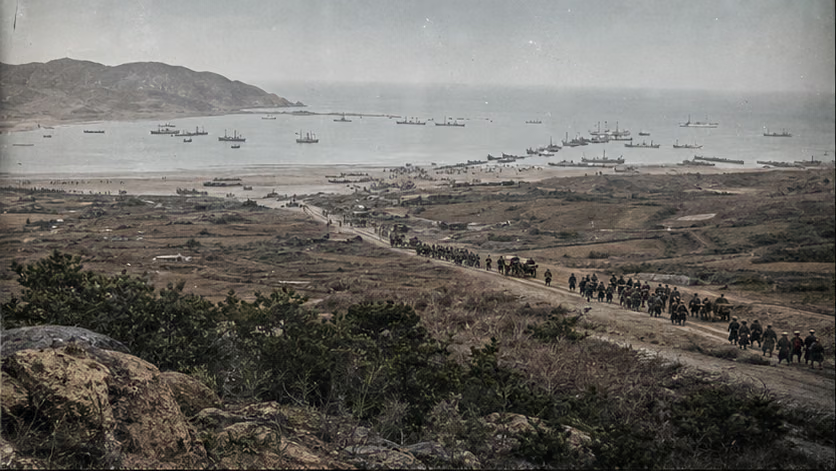
The landing point: Huayuankou lay on the eastern side of the Liaodong Peninsula, far beyond the range of the Port Arthur forts, with a gentle beach easy to climb. Japanese forces chose it because they were betting that Qing forces would not come to fight a decisive battle on the beachhead -- and they won that bet.
Why It Was Fought
The Yalu River defense line was pierced in a single day and night (see *Defense of the Yalu River Line*), the First Army stepped into Fengtian territory, and Qing attention in Liaodong was pulled northward. This was exactly the situation required by Imperial General Headquarters' two-route strategy: the First Army would pin forces in the north, while the Second Army would come by sea to seize the Liaodong Peninsula directly. After the naval battle in the Yellow Sea, the Beiyang Fleet had taken shelter in Weihaiwei and no longer put to sea; transport convoys came by sea with no one blocking them along the way.
The Second Army's target was Port Arthur. It was Beiyang's fundamental naval base, built over sixteen years at a cost of tens of millions of taels of silver, with dockyards, forts, and ammunition depots all complete, and called the "foremost military port of the Far East"; after Dadonggou, the damaged Beiyang ships returned here for repairs. Imperial General Headquarters' strategy was to take the two major bases of Port Arthur and Weihai, tearing out the foundations on which the Beiyang Fleet depended. The fleet could avoid battle; the bases could not.
The Second Army was assembled by Imperial General Headquarters specifically for this battle: it was built around the First Division, with Oyama Iwao as commander, and the transport convoy was escorted by the Combined Fleet (escort details unverified) -- after the Yellow Sea battle, Beiyang had withdrawn into Weihaiwei, and the sea route already belonged to Japan. From formation to landing, the operation required more than ten days and several hundred ship movements at sea; the wager was that there would be no one on the beachhead.
The court was not blind to the crisis on the Liaodong Peninsula: edicts repeatedly urged strict defense of the rear routes to Jinzhou and Port Arthur (original wording unverified), and Li Hongzhang also ordered the commanders to hold firm and await relief. But where reinforcements were to come from was another account book that could not be made to balance: the Yalu River line had just collapsed, Song Qing's forces were ordered back to reinforce, and Port Arthur had already fallen while they were still on the road (itinerary details unverified); many Port Arthur battalions were newly recruited and had long been in arrears of pay (records unverified), while the forts' heavy guns were fixed facing the sea. Sixteen years of military spending had built a fortress that could not turn around. Zhang Gaoyuan's force at Dengzhou had once received orders to reinforce Port Arthur by sea, but the order was changed before it arrived (source unverified).
Port Arthur's weakness was written into its plans: the forts ringed the area, the coastal guns were strong and sharp, and the defenses all faced enemies coming from the sea, leaving the landward rear empty. Huayuankou lay on the peninsula's eastern side, far beyond the forts' range, with a gentle beach easy to climb; Japanese forces chose it because they were betting that Qing forces would not come to fight a decisive battle on the beachhead. Inside the city, six or seven commanders were not subordinate to one another, and the more than ten thousand defenders in total (figures vary by account) had no unified commander-in-chief. The highest responsible official was the civilian superintendent Gong Zhaoyu. Sixteen years of construction had guarded against a fleet, not against infantry coming by land from the rear.
There were other voices on the defense: Xu Bangdao advocated holding Jinzhou's narrow waist and requested reinforcements, but the other forces watched and did not respond, and Jinzhou finally fell with his isolated force (details of the request for reinforcements unverified). After that, no settled decision is seen among the commanders on whether to hold or abandon Port Arthur -- six or seven commanders, and not one person able to make a unified decision for the whole city.
On 10.24, the very same day the First Army threw its pontoon bridge across the Yalu River, the Second Army began landing at Huayuankou. The landing proceeded in batches and lasted more than ten days. Not a single shot was fired on the beachhead -- Japanese forces had won their bet. The fortress's hardest side never came into use from beginning to end.
Course of the Engagement
| Stage | Time | Key points |
|---|---|---|
| Landing at Huayuankou | From 10.24, more than ten days | The Second Army came ashore in batches; the landing lasted more than ten days, and not a single Qing soldier resisted (the Yalu River line had already opened battle the same day; see the corresponding chapter in *First Sino-Japanese War: Overview*) |
| Battle of Jinzhou | 11.6 | Xu Bangdao, Lianshun, and other units resisted; outnumbered and overmatched, they lost Jinzhou (Lianshun's later whereabouts unverified) |
| Abandonment of Dalian Bay | 11.7 | The defenders withdrew without fighting, leaving the forts, ammunition, and military supplies intact to Japanese forces (details of "intact support to the enemy" unverified) |
| Blocking Action at Tuchengzi | 11.18 | Xu Bangdao's force set an ambush and blocked the Japanese vanguard, winning a small victory -- the only respectable fight by Qing forces on the Jinzhou-Port Arthur axis (results vary by account) |
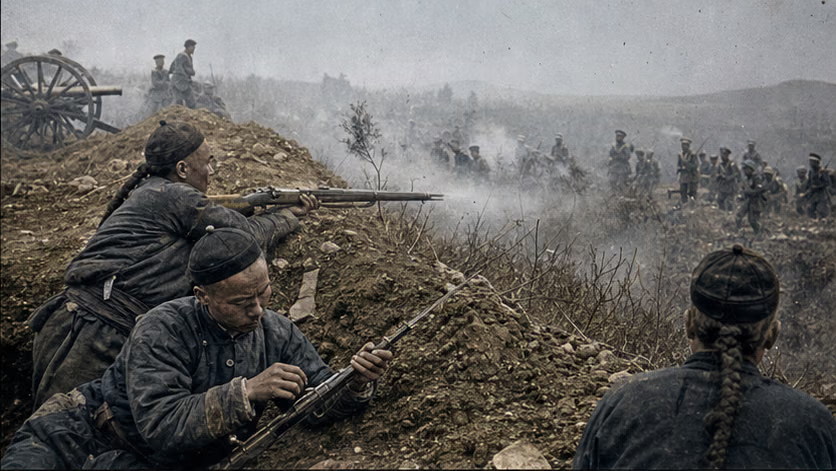
| General assault on Port Arthur | 11.21–22 | On 11.21 Japanese forces launched the general assault; within one day the landward forts fell one after another. On 11.22 Port Arthur was fully lost |
※ Port Arthur Massacre (11.21–24, roughly four days in all)
Before and after the city fell, the Japanese First Division slaughtered civilians and scattered soldiers in Port Arthur's streets and surrounding villages.
- Number of victims: Chinese records and most later studies give roughly twenty thousand; another measurement gives more than ten thousand. Both figures coexist (statistical scope and basis unverified).
- Survivors: a widely circulated account says that only a burial detail of thirty-six people in the whole city was spared (circulation level and source of the "thirty-six survivors" account unverified).
- Chain of recorders: James Creelman, an embedded correspondent for the American *New York World*, witnessed the events and sent back reports; diaries and letters by British sailors and Western officers corroborate them. The Japanese side publicly defended itself by calling the matter "collection of war dead," while the Foreign Ministry worked to put out the public-opinion fire (details of Mutsu Munemitsu's operations unverified).
- Remains: in 1896 the Qing government collected the remains and erected the "Wanzhong Tomb" at the eastern foot of Baiyu Mountain; it still exists today.
This was the first Japanese massacre reported in real time by international media -- that position needs to be written in full: as the massacre occurred, the telegrams of Western reporters reached the world before the Japanese military's defenses did.
Casualties and Losses
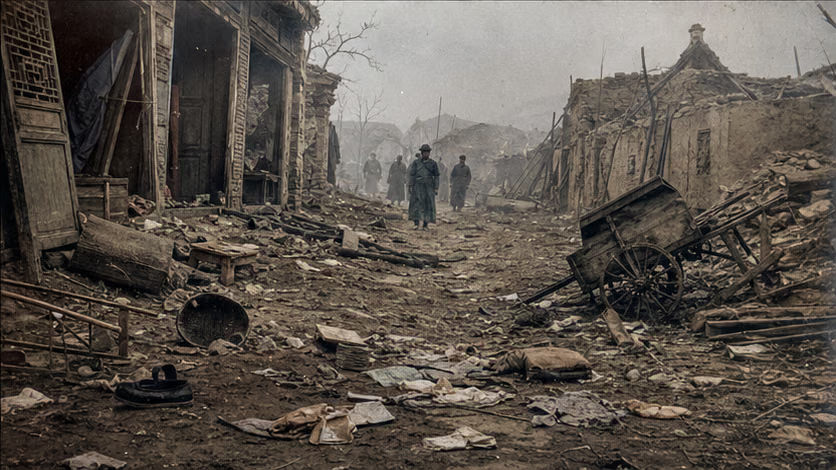
- Defending side: Qing casualties in the Jinzhou and Port Arthur battles numbered several thousand (figures vary by account), and the remaining forces scattered; the base, dockyards, and reserves all became support to the enemy.
- Attacking side: combat casualties were light (within several hundred by the Japanese count, unverified).
- Civilians: the Port Arthur dead are listed in two parallel figures, roughly twenty thousand and more than ten thousand (see above).
- The Beiyang Navy lost the repair base it had built over sixteen years, leaving only Weihaiwei as a place to stand.
Aftermath
- The Japanese Second Army turned north and coordinated with the First Army; the fighting in southern Liaodong entered the seesaw at Haicheng (see *Seesaw Battles for Haicheng*).
- International opinion was shocked by the reports of Creelman and others, and Japanese diplomacy was temporarily put on the defensive (actual effect on the Shimonoseki negotiations unverified).
- Gong Zhaoyu fled to Yantai by torpedo boat before the city fell and was later arrested and questioned (final disposition unverified).
Accounts of Those Present
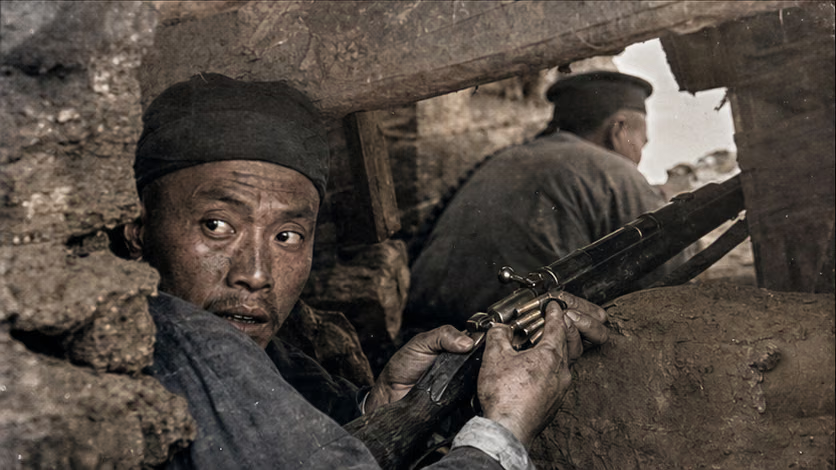
- Xu Bangdao: the only commander on the Jinzhou-Port Arthur line who fought from beginning to end -- he failed to hold Jinzhou, then turned back and fought at Tuchengzi, and even after he won, no one supplied him. Others were running; he was fighting.
- Gong Zhaoyu: the highest civilian official at Port Arthur, who took a torpedo boat and fled before the general assault had even begun. Sixteen years for the base, tens of millions of taels, and in the end the period was placed by a superintendent who fled first.
- The forts at Dalian Bay: when the defenders withdrew, they destroyed none of the forts, ammunition, or military supplies, and Japanese forces received them intact -- the four words "intact support to the enemy" are uglier than the rout itself.
- The burial detail: the legend of thirty-six people risking death to collect and bury bodies is the civilian entry point into the massacre narrative (level unverified).
The Ground
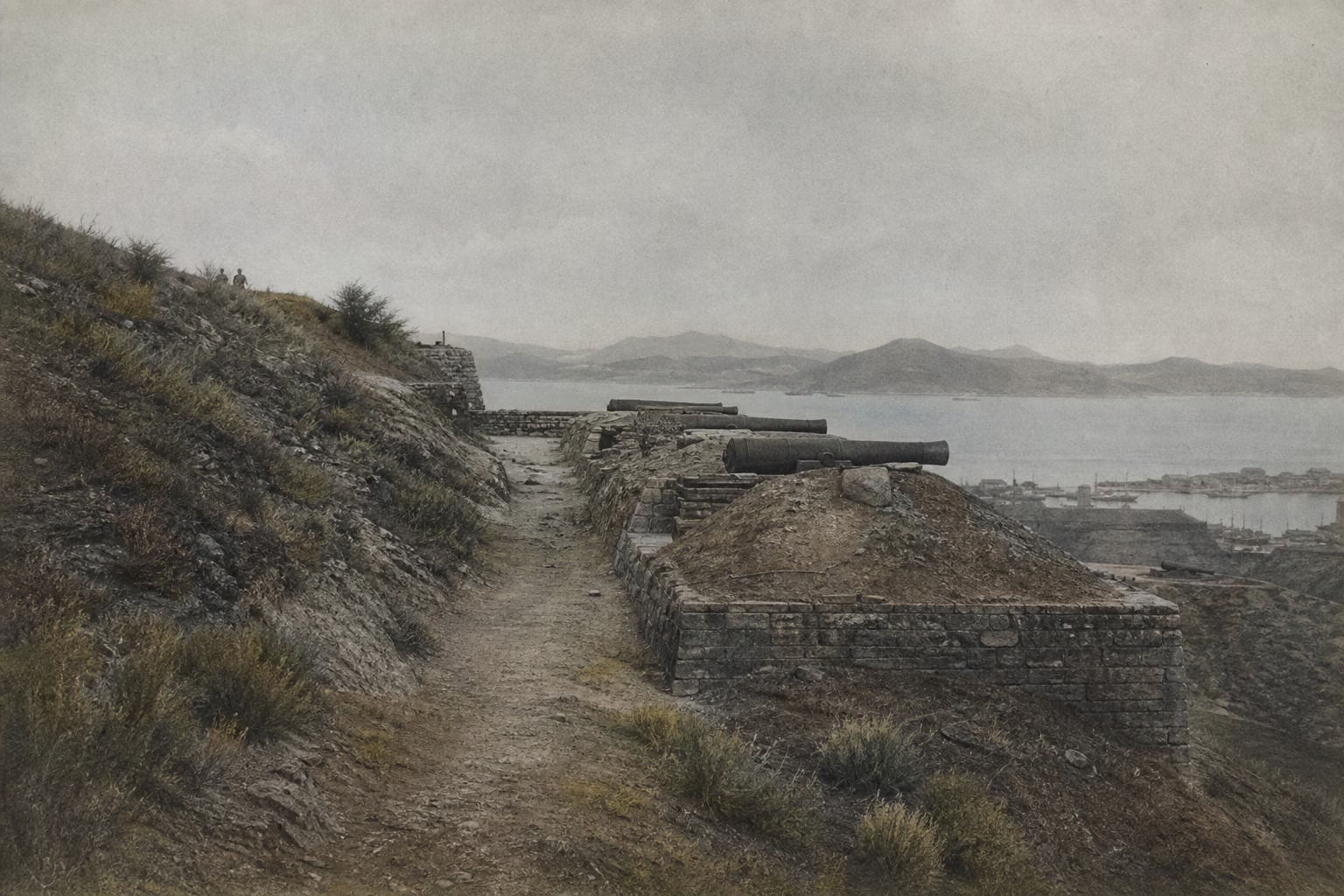
- The axis is clear: Huayuankou beachhead -> Jinzhou corridor (the peninsula's narrow waist) -> Dalian Bay -> Port Arthur Peninsula. Japanese forces moved by land throughout, and none of the forts could reach them.
- Port Arthur city was ringed by mountains on three sides and faced the sea on one; forts covered the ridges, while the dockyard lay tucked inside the harbor. Once the forts around the mountains were taken, the city and harbor fell into the net.
- A counterexample in fortress warfare: the strongest fortress was taken from behind by an infantry battle.
- The massacre space: the streets and surrounding villages, house by house, over four days -- fortress warfare and city massacre overlapped on the same coordinates.
How Each Side Records It
- Chinese side: the Port Arthur Massacre is the heaviest page in the memory of national humiliation from the First Sino-Japanese War, and the Wanzhong Tomb remains a place of mourning and commemoration; the "foremost military port of the Far East" lost in a single day is counterevidence to the Self-Strengthening narrative.
- Japanese side: during the war, Japan defended itself externally with the phrase "collection of war dead," while official war histories avoided speaking of the massacre; in modern Japan, narratives of the event's scale and nature have long evaded it (specific line of wording unverified).
- Western side: Creelman's reporting was a node in wartime news history -- for the first time, Japanese military atrocities were read by the world as they happened.
Disputes and Sensitivities
- Number of victims: two figures, twenty thousand and more than ten thousand, coexist and come from different sources.
- "Thirty-six survivors": extremely widely circulated, with the source level still unverified and no final conclusion.
- Japanese defensive wording: the original phrasing and later evolution of "collection of war dead" and "plainclothes soldiers" remain unverified; the account must not be softened because Japan denied it, and must not be intensified beyond the stated figures.
- Gong Zhaoyu's fate: accounts differ on the disposition after his arrest and questioning, and it remains unverified.
Sources and Open Questions
Known main sources:
- James Creelman's Port Arthur reports in the *New York World* (original newspaper unverified)
- Several diaries and letters by Western officers and sailors (collected editions unverified)
- Chinese archives and materials from the Wanzhong Tomb inscription
- Japanese war histories and Foreign Ministry documents (titles unverified)
Open questions: strength figures for the defending and Japanese forces; Lianshun's later whereabouts; details and responsibility attribution for the abandonment of Dalian Bay; result figures for the Blocking Action at Tuchengzi; the statistical basis for each figure for massacre victims; source level of the "thirty-six survivors" account; details of Mutsu Munemitsu's public-relations operation; the original phrasing of the Japanese defensive wording; the final disposition after Gong Zhaoyu's arrest and questioning; original newspaper date and full text of Creelman's report; Imperial General Headquarters' formation of the Second Army and escort details; Song Qing's reinforcement itinerary; records of arrears of pay among the Port Arthur defenders; the source for Zhang Gaoyuan's changed reinforcement order to Port Arthur; details of Xu Bangdao's request for reinforcements at Jinzhou; original text of court edicts demanding strict defense of the rear routes to Jinzhou and Port Arthur; records of whether Port Arthur's various commanders objected to abandonment.
All images on this site are AI-generated depictions. They are not historical photographs, not primary sources, and do not depict any real individual.