Engagement Archive · Resistance Against the Japanese Takeover of Taiwan (1895)
A single treaty signed at Shimonoseki ceded Taiwan away; gentry and officials on the island set up a "republic" that lasted only a few months and refused Japanese rule; after officials crossed back to the mainland, volunteer armies and local people kept fighting from Audi to Tainan--more than 4,000 Japanese soldiers died of disease in the Taiwan campaign, dozens of times the number killed in battle; and the memory of Taiwanese resistance has lived on to the present day.
Engagement Data
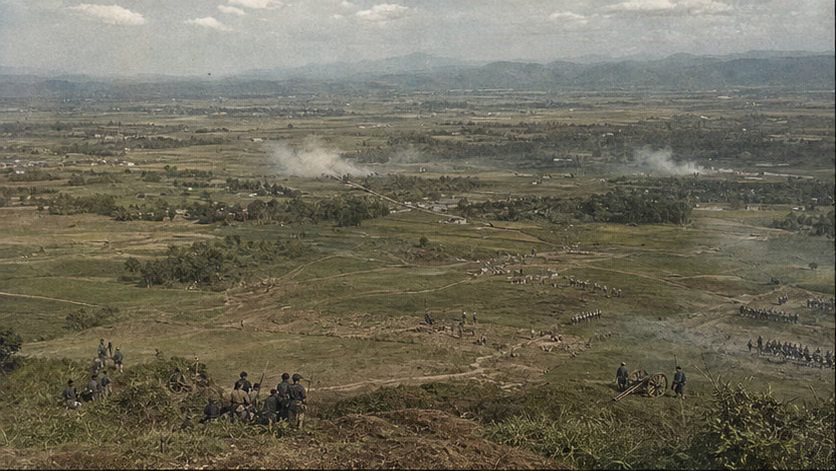
| Item | Details |
|---|---|
| Time | 1895.3 – 10 (Battle of Penghu 3.23–26; main island 5.29 landing – 10.21 fall of Tainan) |
| Place | Penghu Islands; the whole island of Taiwan (Audi → Taipei → Hsinchu and Miaoli → Changhua → Chiayi → Tainan) |
| Belongs to | The closing phase and extension of the First Sino-Japanese War (for the larger situation and the context of the Treaty of Shimonoseki, see *First Sino-Japanese War: Overview*) |
| Anti-Japanese side | Official troops of the "Republic of Formosa" (Tang Jingsong; Liu Yongfu's Black Flag Army) + local volunteer armies (Wu Tangxing, Jiang Shaozu, Xu Xiang, and others) |
| Japanese side | Imperial Guard Division (division commander Prince Kitashirakawa Yoshihisa), Hishijima Mixed Brigade (Penghu), Second Division (Nogi Maresuke), and others |
| Result | 10.21 Tainan fell, and large-scale resistance ended; guerrilla fighting and suppression continued for years afterward, entering the period of Japanese rule |
Belligerents
| Item | Anti-Japanese side | Japanese side |
|---|---|---|
| Strength | Official troops (including the Black Flag Army) and volunteer armies totaled in the tens of thousands; each locality fought on its own, without unified command | The Imperial Guard Division, Second Division, and mixed brigades were committed in succession, totaling tens of thousands (figures vary by accounting basis) |
| Firepower | A mix of old and new firearms and artillery, with few guns and little ammunition; volunteer armies mostly had fowling pieces and locally made muskets | Modernized divisions, infantry-artillery coordination, naval support |
| Weather and timing | Fighting on home ground, familiar with terrain and aided by local ties | Unfamiliar terrain; malaria, cholera, and other epidemics hit Japanese forces hard--more than 4,000 died of disease in the Taiwan campaign, while only a little more than 100 were killed in battle (Japanese war-history accounting, figures unverified); Japanese war-history accounting says "deaths from disease were dozens of times deaths in battle" |
| Command | After Tang Jingsong crossed back to the mainland, Liu Yongfu and the various volunteer armies each held on separately | Multiple columns advanced and encircled, under unified command |
Terrain and Conditions
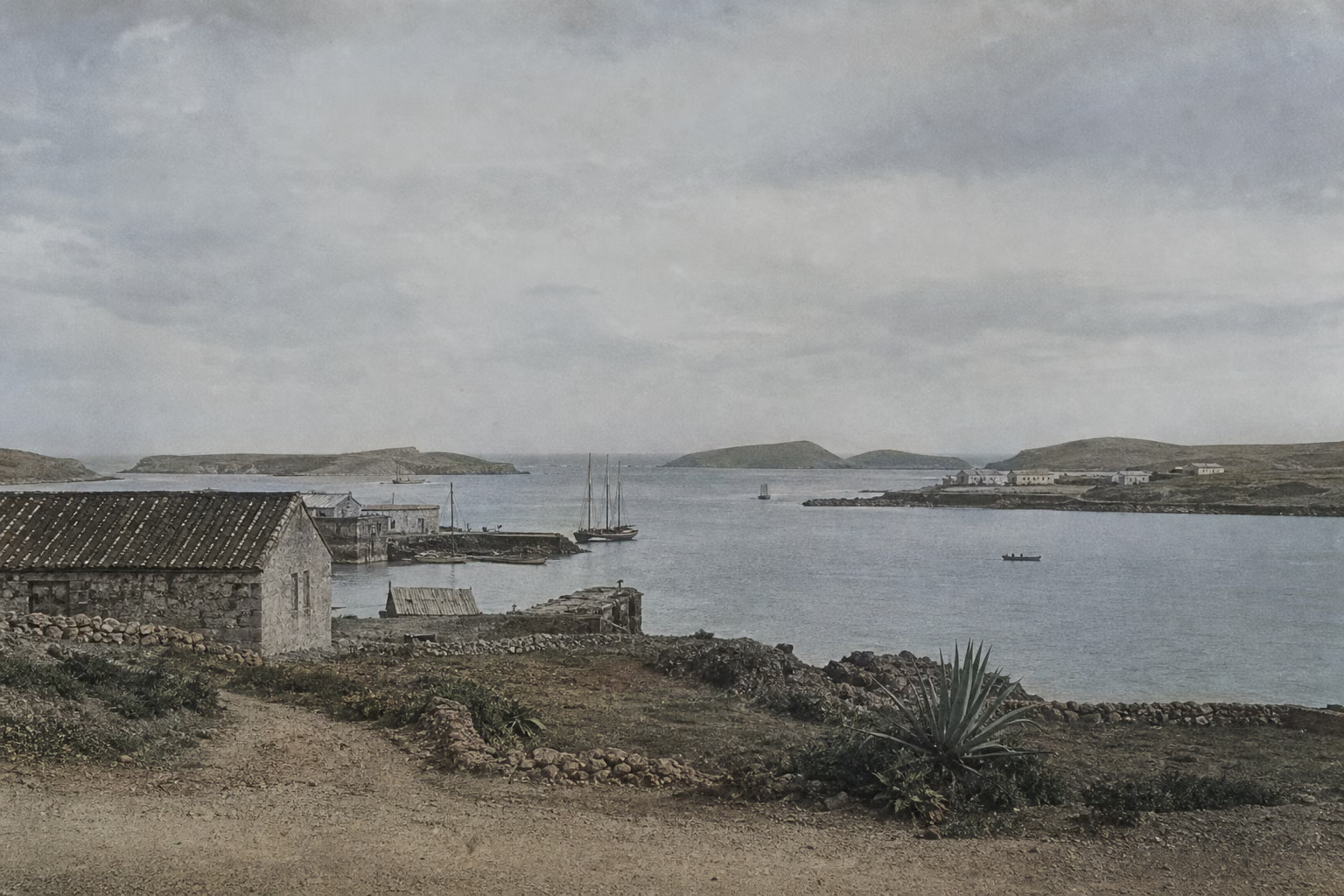
(For the larger situation--the Shimonoseki peace negotiations and the posture of the foreign powers--see *First Sino-Japanese War: Overview*.)
Penghu: Taiwan's gateway; Magong harbor controlled the Taiwan Strait. Japanese forces seized Penghu first while treaty negotiations were under way, making it a bargaining chip at the negotiating table.
Taiwan proper: In 1895, Taiwan had been a province for 10 years; Taipei was the provincial capital, and Tainan was the earliest-developed prefectural city. Changhua and Chiayi in the center were agricultural hinterlands, while Hsinchu and Miaoli had many Hakka settlements. The terrain and population distribution of the island's northern, central, and southern zones were written into the 3-stage course of the resistance.
Why It Was Fought
The fighting in Liaodong ended at Tianzhuangtai on March 9 (see *Collapse in Liaodong*). The Qing court had no field army left with which to continue the war, and a little more than half a month later Li Hongzhang took his seat at Shimonoseki. While the peace talks were under way, on March 23, the Japanese Hishijima Mixed Brigade landed in Penghu and took Magong in 3 days--Taiwan's gateway had been seized first, becoming a bargaining chip at the negotiating table. The next day Li Hongzhang was shot at Shimonoseki; fearing that the foreign powers would use the incident as an occasion to intervene, the Japanese side agreed to an armistice, but the armistice zone did not include Taiwan or Penghu (details unverified)--Taiwan and Penghu were left inside the theater of war. On April 17 the Treaty of Shimonoseki was signed: the Liaodong Peninsula was ceded, the whole island of Taiwan and the Penghu Islands were ceded, and 200 million taels in war indemnity were to be paid.
Before the treaty ink was dry, Russia, Germany, and France intervened; Liaodong was later redeemed. For Taiwan and Penghu, no one spoke. The Qing court ordered officials guarding the territory to cross back to the mainland--in the court's ledger, Taiwan was the price paid for peace. The island did not recognize that account: officials and gentry refused cession, and on May 25 established the "Republic of Formosa," installing Tang Jingsong as president, adopting the reign title "Yongqing," and using a blue flag with a yellow tiger. The first polity in modern China to bear a republican name was, in substance, an expedient for resisting Japan (interpretations of its nature vary; see the Disputes section)--the 2 characters "Yongqing," meaning "forever Qing," made clear that it was not seeking independence; it refused to be ceded.
For Japanese forces, this should not have been a war: the treaty had been signed, Taiwan was territory obtained on paper, and the Imperial Guard Division crossed the sea in the name of "taking possession of Taiwan"; its business was reception and takeover. It did not count the people defending the land--besides Tang Jingsong's official troops and Liu Yongfu's Black Flag Army, there were local volunteer armies and villagers with fowling pieces and locally made muskets, without unified command yet fighting locality by locality.
Those who signed the treaty still had to be responsible for handing it over. From late April onward, Beijing sent telegram after telegram ordering civil and military officials in Taiwan to cross back to the mainland. On June 2, transfer commissioner Li Jingfang met Kabayama Sukenori, Japan's first governor-general of Taiwan, aboard a Japanese warship outside the mouth of Keelung harbor and completed the transfer--no one went ashore, yet the land was counted as handed over (transfer documents and details of those present unverified). The island's gentry had made another calculation: before and after the Republic of Formosa was founded, they telegraphed Britain, France, and other countries asking them to intervene, offering rights and interests in all Taiwan in return, hoping to replay in Taiwan the Triple Intervention that had returned Liaodong (aid-seeking telegrams and each country's replies unverified). There was no reply--this was the defenders' greatest misjudgment: they thought the foreign powers wanted balance; the foreign powers wanted only business. The Japanese misjudgment lay at the other end: Tokyo prepared for "reception," judged that official troops under imperial order would necessarily withdraw and that resistance would be at most scattered (basis for the Japanese assessment unverified), and sent troops and money across the sea on the scale of a short war.
After the Qing court carried out the transfer, it strictly ordered the coastal provinces not to send Taiwan a single gun or a single tael of pay (ban and implementation details unverified; accounts differ on claims that Zhang Zhidong and other governors-general and governors secretly sent support). For the defenders, every round fired was one round fewer, and volunteer armies relied on local self-funding. The Japanese side had sea transport and government bonds; however many troops were needed could be replenished. The one thing it miscalculated was disease on the island: malaria and cholera did not obey military orders, and later deaths from disease were dozens of times deaths in battle. Opposition to ceding Taiwan was in fact not small: before and after the signing, pro-war governors-general and governors telegraphed memorials arguing for Taiwan, while Taiwan-born officials in Beijing and provincial candidates in the capital submitted tearful petitions, but none of them could keep Taiwan--the war had already been fought to its end, and the court had not an inch of bargaining leverage in hand. These objections did not rewrite the treaty, but they were the origin of the "Republic of Formosa."
On May 29, the Imperial Guard Division landed at Audi and immediately met resistance--from that day on, the treaty transfer on paper became more than 5 months of war. Officials could cross back to the mainland, and later Tang Jingsong and Liu Yongfu did indeed leave one after the other; the people on the island could not go. From beginning to end, this war was fought by those who stayed.
Course of the Engagement
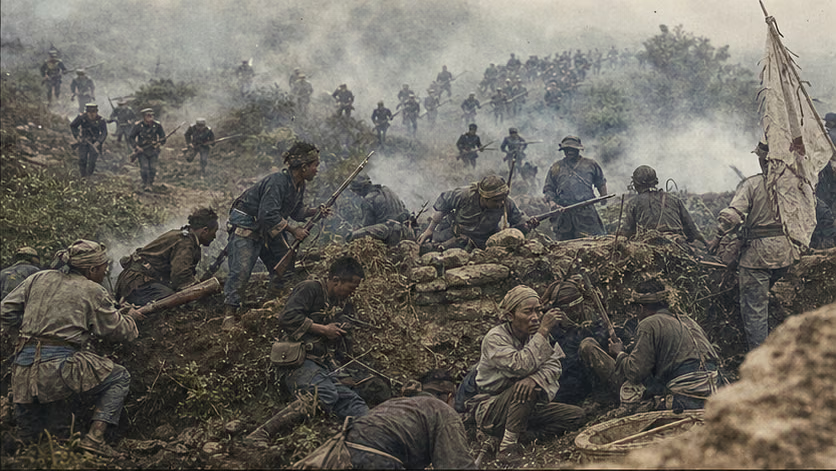
| Stage | Time | Key points |
|---|---|---|
| Battle of Penghu | 3.23–26 | The Japanese Hishijima Mixed Brigade landed and occupied Magong, pressing the price in negotiations; after the occupation, cholera raged, and more than 1,000 Japanese soldiers died of disease (figures vary by accounting basis) |
| Republic of Formosa founded | 5.25 | Tang Jingsong became president, with the reign title "Yongqing" and a blue flag with a yellow tiger |
| Fall of the north | 5.29–6.7 | 5.29 the Imperial Guard Division landed at Audi; 6.3 Keelung fell; 6.6 Tang Jingsong crossed to Xiamen in disguise; 6.7 Japanese forces entered Taipei (Gu Xianrong guided them into the city; his later position is noted briefly, with disputes placed side by side) |
| Hsinchu-Miaoli volunteer-army seesaw | 6–8 | Hakka volunteer armies under Wu Tangxing, Jiang Shaozu, Xu Xiang, and others fought a guerrilla seesaw; Jiang Shaozu was captured and died before reaching 20 (actual age disputed) |
| Battle of Baguashan | 8.28 | Changhua, the largest engagement of 1895: volunteer armies and the Black Flag Army's Seven Stars Unit fought hard for a day and a night; Wu Tangxing and Wu Pengnian (commander of the Black Flag Army) died in battle |
| Chiayi seesaw | 9–10 | Volunteer armies temporarily succeeded in a counteroffensive (details unverified); accounts of land-mine warfare and other fighting survive (record unverified) |
| 3-column encirclement of Tainan | 10 | Japanese forces were reinforced: Nogi Maresuke's force landed at Fangliao, Prince Fushimi Sadanaru's force landed at Budaizui (landing points and corresponding units unverified), and together with the Imperial Guard Division they formed a 3-column encirclement; 10.19 Liu Yongfu crossed back to the mainland; 10.21 Tainan fell |
| Aftermath | From 10.28 | Prince Kitashirakawa Yoshihisa died of illness in Tainan; large-scale resistance ended, while guerrilla fighting and suppression continued for many years afterward; the 1896 Yunlin Massacre and similar events belong to the early history of Japanese rule |
Casualties and Losses
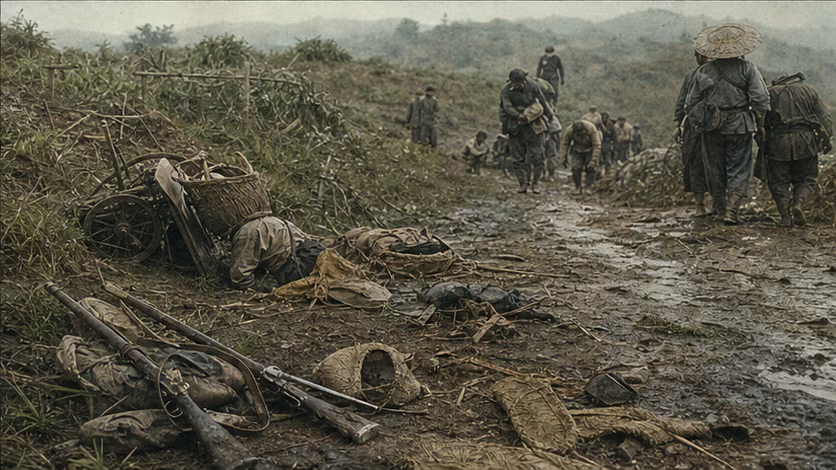
- Japanese side: a little more than 100 killed in battle, more than 4,000 dead of disease (Japanese war-history accounting, figures unverified)--in the Taiwan campaign, the main enemy of Japanese forces was disease.
- Anti-Japanese side and civilians: volunteer armies and civilians killed in the fighting totaled from more than 10,000 to several tens of thousands (figures differ widely; accounts vary).
- Prince Kitashirakawa Yoshihisa died in Tainan on 10.28: the Japanese account says he died of illness (malaria); Taiwanese folk tradition includes an account that he died of battle wounds--both accounts are presented side by side.
Aftermath
- Taiwan entered 50 years of Japanese rule; scattered guerrilla fighting and suppression continued for many years, with the 1896 Yunlin Massacre and other events treated in the early history of Japanese rule (cross-reference reserved).
- The death of Kitashirakawa Yoshihisa was built on the Japanese side into a narrative of "imperial demise," and the Taiwan Shrine enshrined him as its chief deity (details unverified).
- On the Qing court's side: the cession of Taiwan became the most painful entry in the ledger of defeat in the First Sino-Japanese War, and Taiwanese resentment that "the Qing court abandoned us" began from this point.
- On the local side: volunteer-army dead entered folk religion as Yiminye; memories of 1895 ran especially deep in Hakka settlements; modern retellings include the film and television work *1895*--the contemporary face of memory is noted only briefly.
Accounts of Those Present
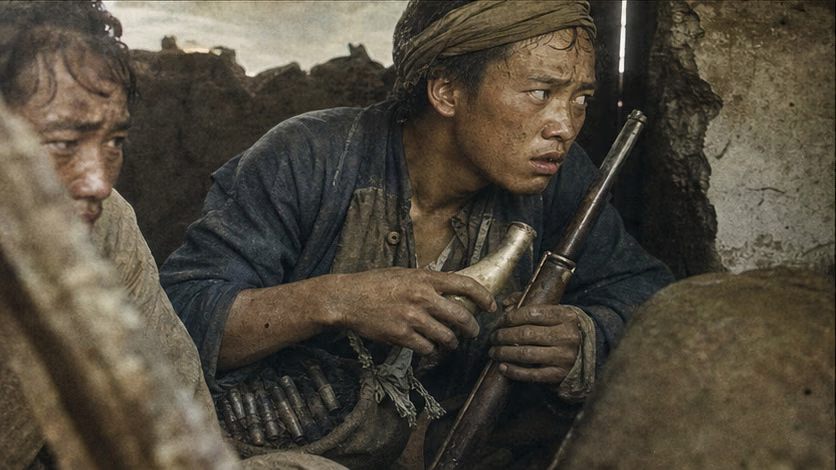
- Jiang Shaozu: a Hakka youth not yet 20, who spent his family fortune raising troops and died after capture (actual age disputed)--one of the people most often recounted in narratives of 1895.
- Wu Tangxing and Xu Xiang: the main figures in the Hsinchu-Miaoli seesaw, one civil and one military (background details unverified), who died in succession along the Baguashan front.
- Wu Pengnian and the Seven Stars Unit: the Black Flag Army commander died in battle at Baguashan--the Black Flag Army had fought from Annam to Taiwan, and here it stopped.
- Tang Jingsong and Liu Yongfu: the 2 "leaders" crossed back to the mainland one after the other. Those who stayed finished the war they did not finish--in the 3 layers of record, this crossing-back is written differently in each.
- Gu Xianrong: the man who guided Japanese forces into Taipei. His later position under Japanese rule (in the business world and as a member of the House of Peers, details unverified) makes him one of the most divisively evaluated figures in Taiwanese history; he is noted briefly, with disputes placed side by side.
- Kitashirakawa Yoshihisa: a prince who campaigned in person and died on Taiwan; the Japanese side deified him, while folk tradition says he was battle-wounded--the manner of one man's death is also 2 systems of memory.
The Ground
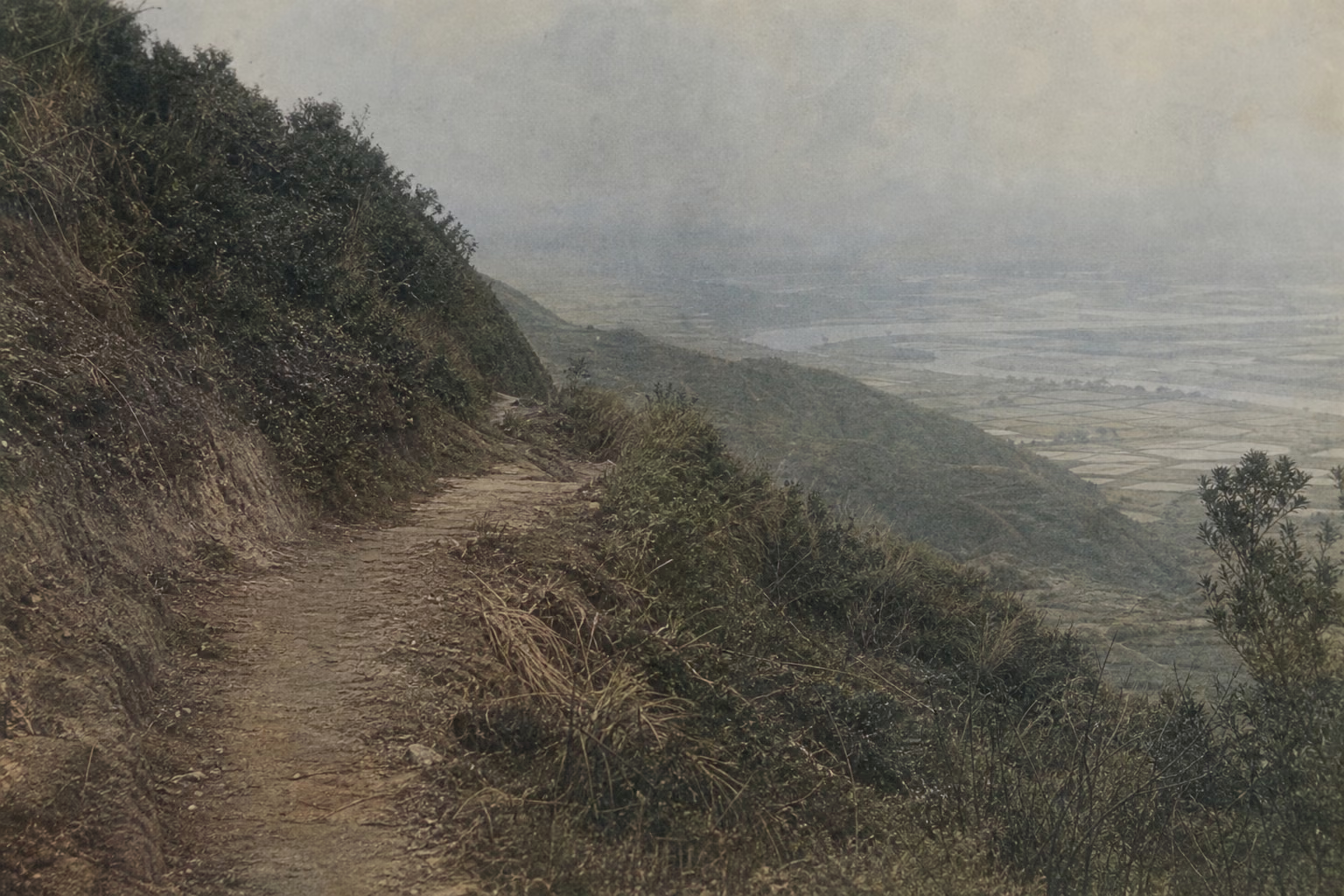
- The whole island in 3 sections: landing on the northern plain--collapse of the official troops (the polity fell quickly); central hills and river valleys--volunteer-army guerrilla seesaw (terrain came to the rescue); southern plain--3-column encirclement (overwhelming force).
- Baguashan: a lone hill overlooking the Changhua Plain, the high ground of the engagement, and still a memorial site today.
- Spatial grammar of landing points: Audi (northeast), Budaizui (west), and Fangliao (south) were multiple landing points; Japanese forces always held command of the sea, and could come ashore wherever they chose.
- Epidemic disease as a spatial factor: the killing power of humid, hot, miasmatic ground against troops from the north was written into the Japanese figure of "deaths from disease dozens of times deaths in battle."
How Each Side Records It
This article has 3 layers of record:
- Qing court layer: treaty cession, officials ordered to cross back to the mainland--in the court's ledger, Taiwan was the price paid for peace. The word "abandonment" is the core of this layer of memory.
- Japanese layer: the discourse of "taking possession of Taiwan" and "bandit suppression"--writing 5 months of war as reception and pacification; the disease deaths of the Imperial Guard Division and the prince's death were constructed into a loyalist narrative of an "imperial expedition" (Japanese commemorative lineage unverified).
- Taiwan local layer: the war of resistance by volunteer armies and the people--the Yiminye faith brought the dead into folk worship, and memories of 1895 were handed down generation after generation in Hakka settlements; modern retellings include *1895* and other film and television works. Narrative differences across the strait (the mainland perspective of the "anti-cession struggle" and the multiple memories local to Taiwan) are presented as they are, without harmonization.
- The 3 kinds of record--Qing court, Japan, and Taiwan local--coexist; none can replace the others.
Disputes and Sensitivities
- Nature of the Republic of Formosa: the first polity with a republican name in modern times / an expedient for resisting Japan / an act of gentry self-preservation--accounts coexist.
- Evaluation of Gu Xianrong: one of the most divided evaluations of a figure in Taiwanese history; his act of guiding Japanese forces into Taipei is clear, while later judgments remain unsettled to this day.
- Death of Kitashirakawa Yoshihisa: death by illness (Japanese account) / battle wound (folk-tradition layer), with both accounts placed side by side.
- Casualty accounting: Taiwanese-side deaths range from more than 10,000 to several tens of thousands; the accounting bases differ greatly, and any citation must mark its source.
- Officials crossing back to the mainland: the characterization of Tang Jingsong and Liu Yongfu's departure (abandoning defense / expedient measure / obedience to imperial order) differs by narrative layer and is presented side by side.
Sources and Open Questions
Known main sources:
- Japanese war histories and records of the Imperial Guard Division's Taiwan campaign (titles unverified)
- *General History of Taiwan* (Lian Heng) and Taiwanese local-history materials
- Hong Qifu's *Taiwan War Chronicle* and other contemporary accounts (versions unverified)
- Qing court archival telegrams, edicts, and memorials related to ceding Taiwan and ordering officials to cross back to the mainland (titles unverified)
Open questions: correspondence between landing points and unit designations for each Japanese force; cumulative accounting basis for the strength of both sides; number of cholera deaths in Penghu; detailed figures for Japanese killed in battle / dead of disease (details of Japanese war-history accounting); statistical basis for each Taiwanese-side death figure; Jiang Shaozu's actual age and details of his deeds; backgrounds of Wu Tangxing and Xu Xiang; details of the Chiayi counteroffensive and land-mine warfare; key facts of Gu Xianrong's life; sources for the 2 accounts of Kitashirakawa Yoshihisa's cause of death; Taiwan Shrine and the Japanese commemorative lineage; cross-reference accounting for the Yunlin Massacre; transfer documents and details of those present at the offshore handover outside Keelung by Li Jingfang; telegrams in which Taiwanese gentry sought foreign-power intervention and each country's replies; the Qing court's ban on coastal provinces assisting Taiwan and its implementation; differing accounts of Zhang Zhidong and other governors-general and governors secretly sending pay and arms; basis for the Japanese assessment of the scale of resistance on the island.
All images on this site are AI-generated depictions. They are not historical photographs, not primary sources, and do not depict any real individual.