Engagement Archive · Battle of the Yalu River (1894)
On the afternoon of 1894.9.17, twelve main warships of the Beiyang Fleet and twelve of the Japanese Combined Fleet fought for about five hours off Dadonggou at the mouth of the Yalu River: a rare large-scale fleet action of the steam-and-ironclad age. Beiyang lost five ships; Japan lost none. From that day, command of the Yellow Sea changed hands.
Engagement Data
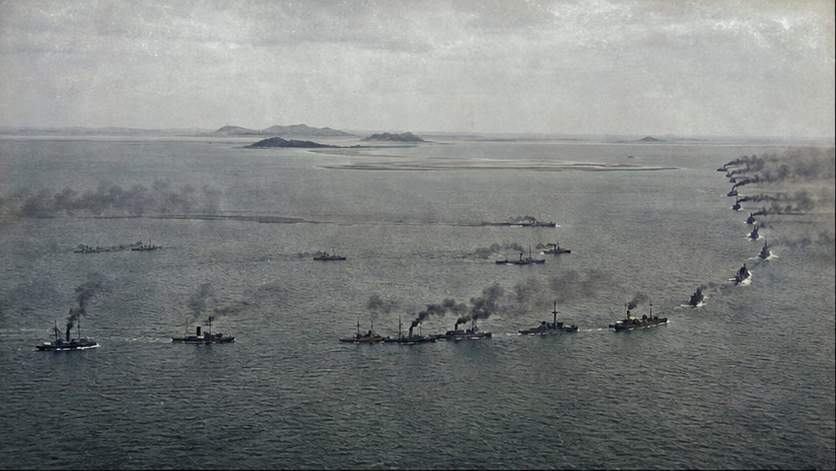
| Item | Details |
|---|---|
| Date and time | Enemy sighted before noon on 1894.9.17; firing opened around 12:50; fleets disengaged at dusk; about five hours (all times unverified article by article) |
| Location | Off Dadonggou at the mouth of the Yalu River (today the waters near Donggang, Liaoning, south of Dalu Island) |
| War | First Sino-Japanese War · struggle for command of the Yellow Sea (for the larger situation, see "First Sino-Japanese War · Overview") |
| Beiyang Fleet | Naval admiral Ding Ruchang; 12 main warships, with several gunboats and torpedo boats |
| Japanese Combined Fleet | Commander-in-chief Ito Sukeyuki; 12 ships (Main Squadron 6, First Flying Squadron 4, detached unit 2) |
| Result | Beiyang lost 5 ships (Chaoyong, Yangwei, Zhiyuan, Jingyuan, Guangjia); 4 Japanese ships heavily damaged, none sunk; the two sides broke contact, and Beiyang escorted the convoy back to Port Arthur |
Belligerents
Beiyang's 12 ships: Dingyuan (flagship), Zhenyuan (ironclad), Zhiyuan and Jingyuan (靖远; protected cruisers), Jingyuan (经远) and Laiyuan (armored cruisers), Jiyuan (protected cruiser), Pingyuan (coast-defense ironclad), Chaoyong and Yangwei (older ram cruisers), Guangjia, and Guangbing (a Guangdong ship, retained with the fleet after maneuvers); also accompanying the fleet were the gunboats Zhennan and Zhenzhong and four torpedo boats (boat names and organization unverified).
Japan's 12 ships: Main Squadron: Matsushima (flagship), Itsukushima, Hashidate, Chiyoda, Hiei, Fuso; First Flying Squadron: Yoshino, Takachiho, Akitsushima, Naniwa; detached unit: Saikyo Maru (with naval general staff chief Kabayama Sukenori aboard) and Akagi.
| Item | Beiyang Fleet | Japanese Combined Fleet |
|---|---|---|
| Total tonnage | A little over 30,000 tons (statistical bases vary) | Several tens of thousands of tons, slightly superior (statistical bases vary) |
| Armor | Dingyuan and Zhenyuan had ironclad citadels more than 300 mm thick, which Japan lacked | No ironclads; the "Three Scenic Ships" (Matsushima, Itsukushima, Hashidate) were weakly protected |
| Heavy guns | Dingyuan and Zhenyuan carried four 305 mm main guns, the largest in the action | Matsushima had one 320 mm main gun, of limited practical value in battle (malfunctions and rate-of-fire details unverified) |
| Quick-firing guns | Very few modern quick-firing guns | Dozens of 12 cm and 15 cm Armstrong quick-firing guns, with a rate of fire several times that of older recoil-carriage guns (margin of advantage disputed) |
| Speed | Average about fifteen knots; Chaoyong and Yangwei were ships more than ten years old, limiting the fleet's maneuverability | First Flying Squadron's Yoshino was said to be the fastest cruiser of the time (23-knot class); Hiei, Fuso, and Akagi in the Main Squadron were slower |
| Ammunition | Shortage of high-explosive shell; mostly solid shot; uneven quality in domestically produced shells (see disputes section) | Generally supplied with Shimose-powder high-explosive shells, with strong incendiary effect; many Beiyang ships caught fire after being hit |
| Command | Unified command was lost as soon as the battle opened (see below) | The Main Squadron and First Flying Squadron advanced separately and struck together; battlefield communications remained intact |
Terrain and Conditions
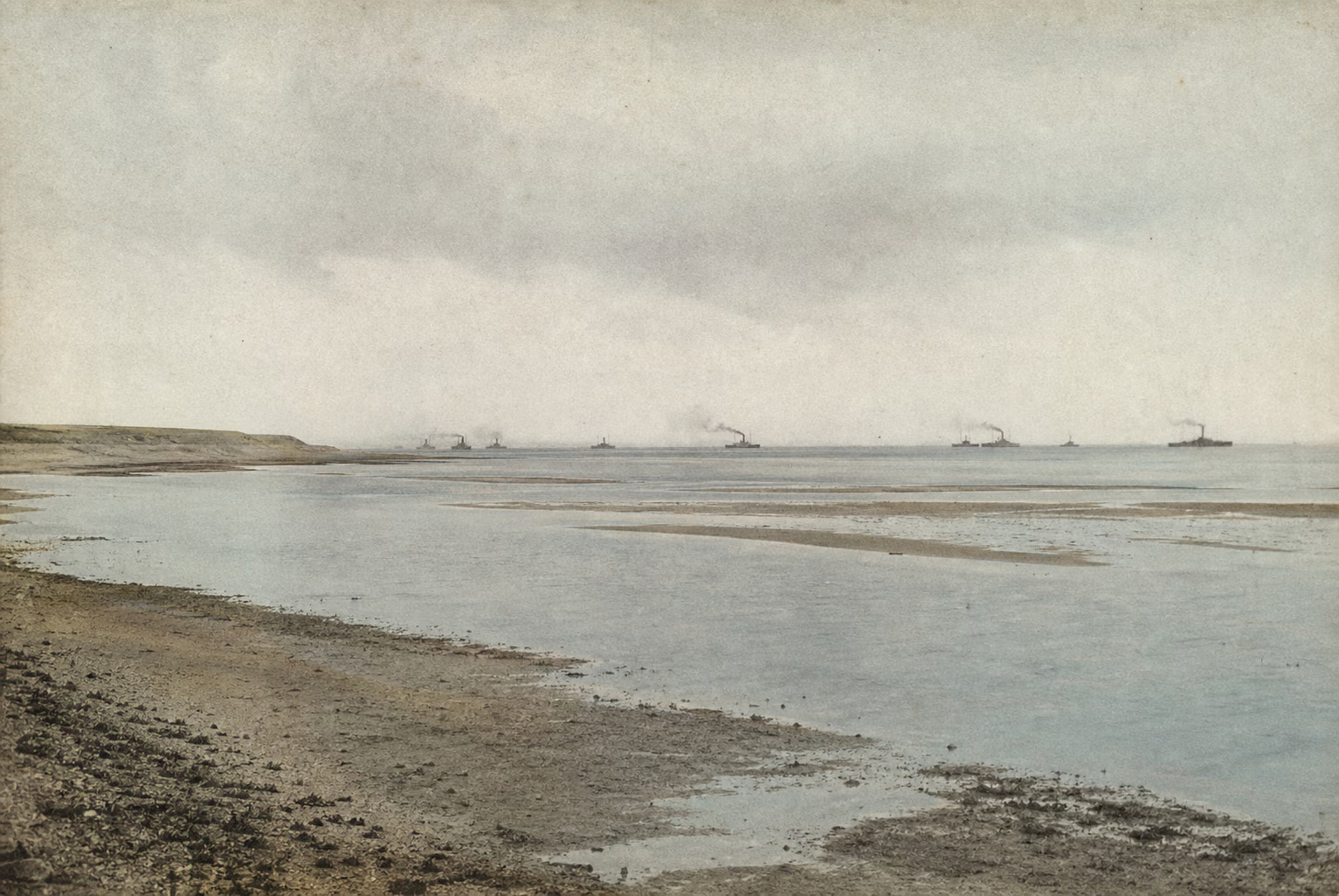
(For the larger situation in 1894: Japan's more than twenty years of military expansion and preparation, the Qing court's struggle between emperor and empress dowager and its policy of avoiding battle to preserve the fleet, and Korea already under Japanese control, see "First Sino-Japanese War · Overview".)
Mouth of the Yalu River: the estuary of the boundary river between China and Korea, thick with shoals and sandbars. Dadonggou was a landing point at the river mouth. Two days earlier (9.15), Pyongyang had fallen (see "Battle of Pyongyang (1894)"), and overland reinforcement into Korea shifted to the sea route: on 9.15-16, the main force of the Beiyang Fleet escorted about four thousand Ming Army troops aboard China Merchants Steam Navigation Company vessels to land at Dadonggou (troop figures vary by account). When the naval battle broke out, the fleet had just completed its convoy duty and was preparing to return to Port Arthur. The battlefield lay at its own doorstep, after the transports had unloaded.
Korean perspective: after the abandonment of Pyongyang, all Korea was already under Japanese control. These waters off the river mouth were the front waters of a third country. After this battle, the war moved out of Korea and burned toward China's own territory.
Why It Was Fought
Pyongyang was lost on the night of 9.15 (see "Battle of Pyongyang (1894)"), and Qing forces were retreating along the main road toward the Yalu River. During the same day and night, the main force of the Beiyang Fleet was escorting China Merchants troop transports at sea: about four thousand Ming Army troops (troop figures vary by account) landed at Dadonggou at the mouth of the Yalu on the 15th and 16th, originally by sea to reinforce the Korean battlefield. By the time the ships arrived and unloaded, the city they were meant to relieve had changed hands. The fleet anchored outside the river mouth, waiting only to return to Port Arthur.
The Japanese Combined Fleet had been searching for this fleet for nearly two months. For Tokyo, taking command of the Yellow Sea was settled policy: every army movement through Korea and every transport by sea required this water to be secure, and from the opening of the war the Combined Fleet sought a decisive battle with the Beiyang main force. Pungdo had been only a forward interception. Afterward Beiyang avoided battle to preserve the fleet: Li Hongzhang treated Beiyang as his capital asset; six years after the fleet's formation, not one ship had been added, quick-firing guns were nearly absent, and speed was at a disadvantage. His approach was to preserve the fleet to defend the gateway of the Bohai Sea, going to sea only for convoy duty. Japan sought battle but could not get it. On the morning of 9.17, learning through reconnaissance that the Beiyang main force lay off Dadonggou, Ito Sukeyuki brought all twelve of his ships forward, while naval general staff chief Kabayama Sukenori accompanied the force aboard Saikyo Maru.
The desire for battle was not an impulse at fleet level; it was written into Tokyo's plan. Imperial General Headquarters set three plans for this war according to command of the sea: if command of the sea were won, the army would be sent directly to the Zhili plain for decisive battle; if the issue at sea remained undecided, Korea would first be secured; if the war at sea were lost, Japan would fall back to defense of the home islands (texts of the three plans unverified). The Combined Fleet's sortie in search of the enemy was a move from the second plan toward the first. In 1894.9, the emperor moved to Imperial General Headquarters in Hiroshima, framing the war as a national war. On Beijing's side, resolve dragged on amid argument: remonstrating officials pressed for battle day after day, while Li Hongzhang made a different calculation: preserving Beiyang preserved the gateway of the Bohai Sea and the capital for future negotiations. After Pungdo and the Kowshing affair, court officials submitted memorials impeaching Ding Ruchang for timidity and avoidance of battle; the court issued a stern edict rebuking him and ordering him to redeem himself by service (the impeachment memorials and punitive edict are unverified). What could not be seen when the policy of "preserving the fleet" was set was the fire density that Japanese quick-firing guns and Shimose-powder shells would produce in actual combat; meanwhile Beiyang's convoy anchorage and return schedule both fell within the opponent's reconnaissance net (how Japan learned of the Dadonggou anchorage is unverified).
The financial boundary had been drawn even earlier: in 1891 the Board of Revenue approved the suspension of foreign purchases of ships and guns for the southern and northern fleets. After that, no ship was added and no quick-firing guns were increased. The generational gap in the naval battle opened during those three years (the origins and duration of the purchase-suspension memorial are unverified). The accounting was more detailed still: high-explosive shell reserves aboard ship were thin, and the heavy guns mostly carried solid shot; the coal burned aboard was mixed with fragments and fines, further discounting speed (correspondence over coal quality is unverified). On the Japanese side, military spending passed through the Imperial Diet, bonds were issued in succession, and the money of the whole country was pressed into a seven-month war budget. Dissent did exist: calls to impeach Ding Ruchang and arguments for sorties and raiding at sea continued. But what these voices demanded was still results, and what they could offer was still the same fleet with no new ships and no new guns. On the Tokyo side, from Imperial General Headquarters to the Combined Fleet, there is no recorded dissent from the policy of opening war and seeking battle.
The decisive battle avoided for two months under the policy of "preserving the fleet" finally arrived at the anchorage on the return from convoy duty. Around ten before noon, lookouts on each ship saw coal smoke on the southwestern sea. The escort mission was over, and Ding Ruchang had intended to return to Port Arthur that day; now he ordered the fleet to weigh anchor, raise steam, form line, and meet the enemy. This was a main-fleet action sought by Japan and encountered by China: the troop transports had already unloaded, shoals lay behind them, and there was no natural cover at sea. Neither side had much choice.
Course of the Engagement
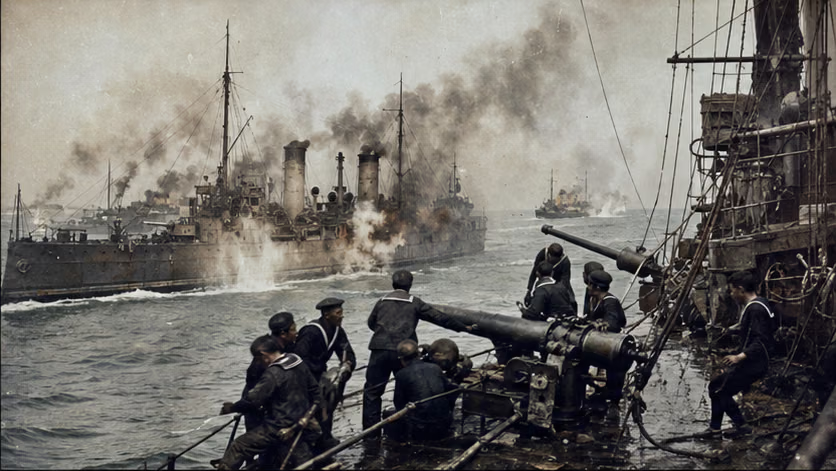
| Phase | Time | Main points |
|---|---|---|
| Contact | Around 10:30 before noon | Smoke from Japanese ships sighted; Beiyang weighed anchor and deployed in a transverse formation (horned echelon), bows toward the enemy; the Japanese Main Squadron advanced in single column, with the First Flying Squadron ahead |
| Opening fire and accident | Around 12:50 | Dingyuan fired first with her main guns; the flying bridge where Ding Ruchang stood collapsed from shock (one account says it was hit, unverified); Ding, wounded, had his wounds bound and sat on deck to direct the battle; the signal-flag apparatus was destroyed, and from then on the fleet lost unified command (right-wing brigade commander and Dingyuan captain Liu Buchan acting in command, unverified) |
| Right wing attacked | After 13:00 | The First Flying Squadron maneuvered around to attack weak ships on Beiyang's right wing; Chaoyong and Yangwei were hit and caught fire in succession |
| Japanese ships fall behind | Around 13:30-14:30 | Hiei, Akagi, and Saikyo Maru in the rear of the Japanese Main Squadron fell behind and, under Beiyang attack, escaped the battle line damaged (Akagi captain Sakamoto Hachirota killed, unverified) |
| Middle phase | Around 15:00 | Dingyuan was hit and caught fire; Zhiyuan, badly damaged and listing, headed toward the enemy line and exploded and sank en route; Jiyuan withdrew first, and Guangjia fled with her |
| Matsushima badly damaged | Around 15:26 | A 305 mm gun from Zhenyuan hit Matsushima, setting off ammunition on deck and causing more than a hundred casualties; the Japanese flagship shifted afterward to Hashidate (time unverified) |
| Jingyuan surrounded | Around 16:00-17:30 | The four ships of the First Flying Squadron surrounded Jingyuan; captain Lin Yongsheng was killed by a shell, and Jingyuan sank |
| Disengagement | Around 17:00-18:00 | Jingyuan (靖远) raised a flag to gather the ships (acting as flagship to assemble the fleet, unverified); Japanese ships withdrew from the battlefield at dusk; Beiyang escorted the convoy back to Port Arthur, arriving on the morning of 9.18 |
Ship-by-ship losses, kept clear:
- Chaoyong: hit and set on fire soon after the battle opened; sank around 14:23 (time unverified); captain Huang Jianxun died with the ship (record unverified).
- Yangwei: after being hit and set on fire, headed toward Dalu Island and ran aground, then burned out (whether she was shelled by Japanese ships the next day is unverified); captain Lin Lüzhong drowned himself (record unverified).
- Zhiyuan: heavily hit and badly damaged, with the hull listing; captain Deng Shichang ordered full speed toward the enemy line (the traditional target is Yoshino, unverified), and the ship exploded and sank en route. The torpedo and shell explanations both survive (see disputes section); of more than 240 officers and men aboard, only a few survived (figures vary by account), and Deng Shichang refused rescue after falling into the water and died for his country.
- Jingyuan (经远): surrounded by the First Flying Squadron; captain Lin Yongsheng was killed by a shell (battle report says a shell struck and split his head, disputed); sank around 17:30; survivors were very few (figure disputed).
- Guangjia: fled at night with Jiyuan, ran aground off Sanshan Island outside Dalian Bay, and was later destroyed by her own side (whether she was destroyed by Japanese fire is unverified). She is counted as the fifth sunken ship.
Japan lost no ship: Matsushima suffered more than a hundred casualties and lost combat effectiveness ("the unexpected disaster of Matsushima," words of a Japanese soldier, unverified); Hiei, Akagi, and Saikyo Maru were all badly damaged and left the line. Dingyuan and Zhenyuan were each hit from more than a hundred to more than two hundred times (claims of Dingyuan 159 and Zhenyuan 220 are unverified) yet did not sink, and escorted the convoy back to port.
Casualties and Losses
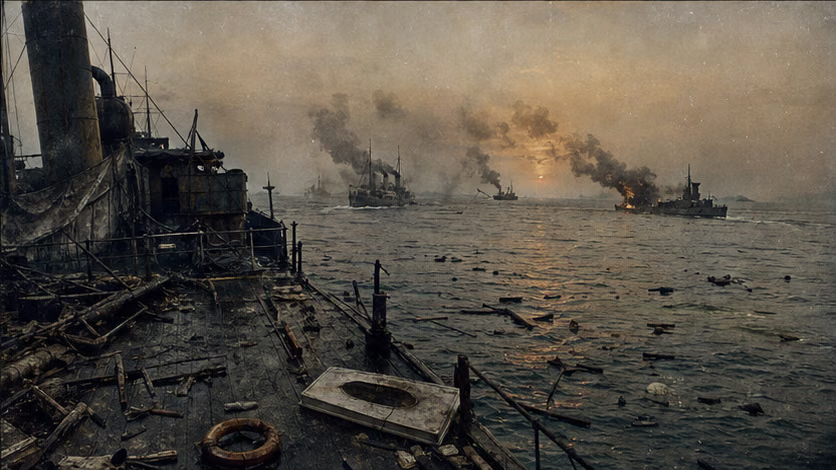
- Beiyang: 5 ships sunk; roughly seven hundred to more than one thousand killed (Qing and later figures differ: Zhiyuan and Jingyuan (经远) together already approach five hundred, while Chaoyong and Yangwei each lost more than a hundred; aggregate figures unverified); several hundred wounded.
- Japan: no ship sunk; Japanese war-history figures give about more than one hundred twenty dead and more than one hundred seventy wounded (Matsushima alone accounting for more than a hundred casualties), about three hundred in all; older Chinese works give Japanese casualties as more than six hundred. The two sets of figures are listed together; their boundaries are unverified.
- Whichever set of figures is used: Beiyang lost ships, Japan lost men. Ships, once sunk, could not be replaced. Since its formation, Beiyang had not added another ship; the loss of five ships became a permanent reduction in force.
Aftermath
- The transfer of command of the sea: the heaviest stroke in this article. After repairs at Port Arthur, the remaining Beiyang ships entered Weihaiwei and thereafter did not put to sea again to seek battle. The Yellow Sea and the gateway of the Bohai Sea lay open. One month later (10.24), the Japanese Second Army landed at Huayuankou in Liaodong; for more than ten days, not one soldier or ship blocked it from the sea (cross-reference: see "Defense of the Yalu River Line"; the Jinzhou-Port Arthur fighting belongs to the second half of this batch). Thereafter Japanese troop landings were as if into empty country, and the war burned into China's own territory.
- On 9.24, Jiyuan captain Fang Boqian was executed at the front at Port Arthur for "fleeing first and throwing the fleet formation into disorder." This case has been disputed for a century; see the disputes section.
- Although Japan won, it did not annihilate the Beiyang main force. Matsushima was badly damaged and left the line, and the Combined Fleet also needed rest and refit; but from then on battlefield initiative and sea lines of communication belonged entirely to Japan.
Accounts of Those Present
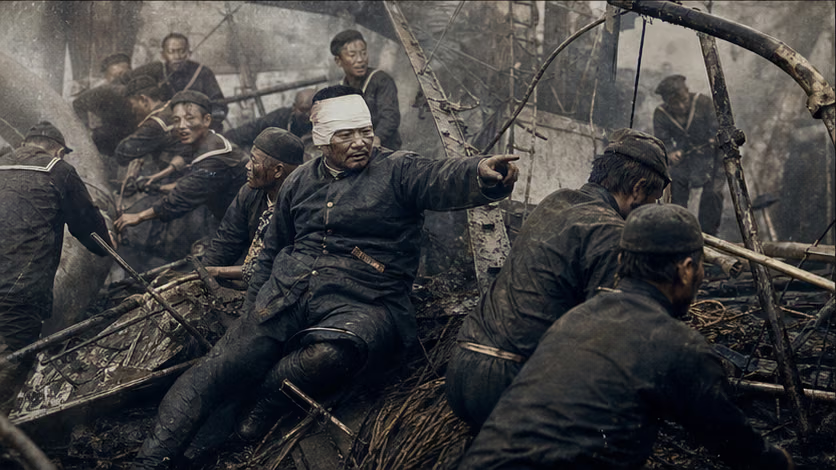
- On the flying bridge: Ding Ruchang stood on the flying bridge above the 305 mm main guns to observe the battle. The first shot from his own main guns collapsed it from shock (one account says it was hit), and the admiral fell and was injured. With his wounds bound, he sat on deck and directed the battle until disengagement. Beiyang thereafter had no effective orders; each ship fought on its own.
- Deng Shichang and the loyal dog: Zhiyuan sank, and Deng Shichang fell into the water. The transmitted account says that when attendants threw him a life buoy he would not take it; his beloved dog seized his arm in its mouth, and Deng pressed the dog down and sank with it. This detail has circulated very widely, but belongs to the level of transmitted account; the original source and the dog's name (one account says "Taiyang") are both unverified. What can be stated securely: he refused rescue and died for his country.
- Lin Yongsheng: Jingyuan (经远) was surrounded; he "was suddenly struck by a shell and killed, his head split open" (battle-report wording, disputed). When the ship was about to sink, the whole ship was still firing (according to Japanese records, unverified).
- Matsushima's military band: after the ammunition explosion, the gun crews were almost all killed or wounded, and members of the military band filled the gun positions. This is a Japanese war-history narrative, unverified.
- The danger of Saikyo Maru: naval general staff chief Kabayama Sukenori was aboard; the ship was hit, fell out of line, and was then attacked at close range by Beiyang torpedo boats. The torpedoes missed (one account says one passed under the hull; the sigh "my affair is finished" belongs to the level of transmitted account, unverified).
- Laiyuan: fire burned across the deck, while the engine-room crew held their posts; the hull was riddled with hits yet still returned to Port Arthur. Like Chaoyong and Yangwei, she was a weak ship on the right wing; one sank, one returned.
- Foreign officers present: Dingyuan had the British officer W. F. Tyler aboard, and Zhenyuan's American assistant officer P. N. McGiffin was wounded. Both left memoirs. This steam-and-ironclad fleet action was watched by the world's naval circles even at the time, and Western firsthand accounts are third-party historical materials.
The Ground
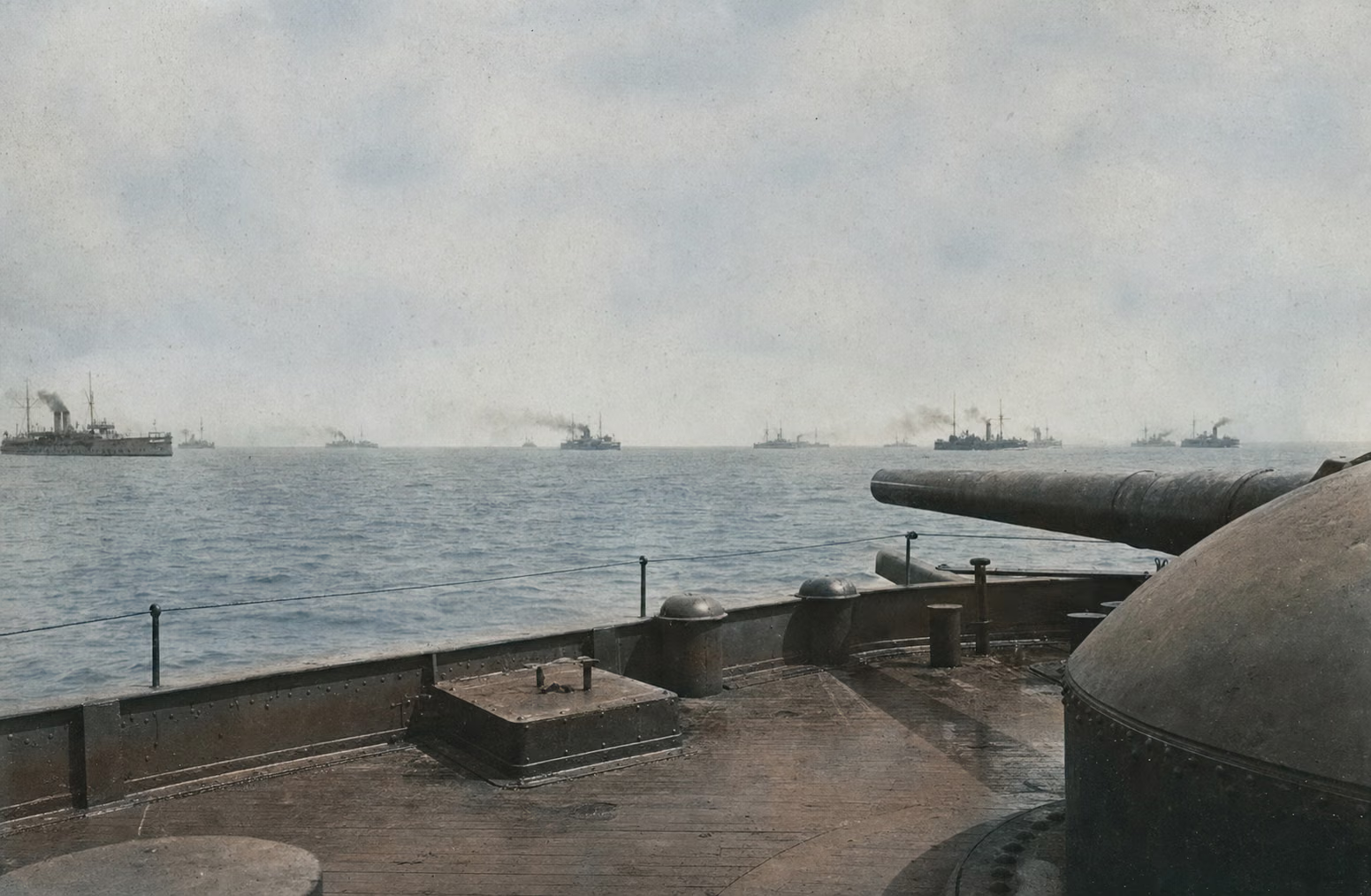
- An encounter battle on open sea, with no cover and no shore batteries; the outcome depended wholly on ships, guns, speed, and command. It was one of the most "pure" kinds of battlefield in the world at the time.
- Formation was space: Beiyang's transverse formation, bows toward the enemy, was intended to use bow main guns and keep weaker ships to the rear. But the Japanese column brought broadsides of quick-firing guns to bear and unfolded a fire net. The speed gap gave Japan the initiative to choose engagement range and maneuver around the flank, and Beiyang's weak right-wing ships were singled out first.
- Shallow water and nearshore elements: Yangwei grounded near Dalu Island, and Guangjia grounded at Sanshan Island. The endpoint of both flight and pursuit was the shoal.
- Dadonggou landing point, Dalu Island, and the sandbars at the mouth of the Yalu River: convoy route and battlefield were one. The naval battle's geographical origin was an army transport operation.
How Each Side Records It
- Chinese side: Deng Shichang and Zhiyuan became the first symbols of the First Sino-Japanese War, and "ramming and sinking Yoshino" entered textbooks and collective memory (both the target of the charge and the cause of sinking have points still unverified; see disputes section). Fang Boqian's "flight before the enemy" placed him with Wei Rugui and Ye Zhichao in the sequence of "failures," while a century later each has had voices seeking reversal. Recent research has gradually shifted from explanations centered on "incompetent officers" toward structural gaps in ammunition, quick-firing guns, and speed.
- Japanese side: called the "Yellow Sea Naval Battle," it was the most important naval battle of the "Sino-Japanese War." The disaster of Matsushima and the failure to sink Dingyuan and Zhenyuan left a deep impression on Japan (the fearful expression "unsinkable Dingyuan" is unverified). This was the climax of Meiji Japan's first national war: special newspaper extras, victory celebrations, military songs, and donation movements swept the country after the victories at Pyongyang and the Yellow Sea; the emperor's residence at Imperial General Headquarters in Hiroshima (from 1894.9) incorporated the war into a "holy war" narrative. Inside Japan, the war was experienced as a national festival (details of mobilization unverified; cross-reference "First Sino-Japanese War · Overview").
- Korea's position: the naval battle occurred at the end of the Korean fighting, at the river mouth of the China-Korea boundary. For Korea, this was a battle in which others decided its fate on the sea in front of its own door. Afterward Korea was no longer the battlefield, only the corridor for Japan's advance.
Disputes and Sensitivities
- Cause of Zhiyuan's sinking: the older account says she was hit by a torpedo; modern studies more often argue that quick-firing shells or a boiler explosion caused it. From 2014, underwater archaeology of "Dandong No. 1" confirmed the wreck as Zhiyuan (confirmation process and details unverified), but the cause of sinking remains undecided. The torpedo and shell explanations both survive.
- "Shells mixed with sand": the popular account blames military-industrial corruption, saying sand was substituted for powder and shells therefore failed to explode. Ordnance studies instead point out that using sand to weight solid armor-piercing shot was common practice internationally; the real problems were the severe shortage of high-explosive shells (bursting shells), uneven quality in domestically produced shells, and some shells not fitting the bore and having to be filed down before battle. The popular account and the technical revision are listed together as unverified: the former is a moral narrative, the latter an institutional narrative.
- The Fang Boqian case: the Qing judgment found him guilty of "fleeing first, throwing the fleet formation into disorder, and retreating before the enemy," and he was executed at the front. The wrongful-conviction view argues that Jiyuan's guns and machinery had already been damaged, that withdrawal fell within the range of possible combat conduct, and that this should be discussed separately from his false report after Pungdo (for Pungdo, see "Outbreak of War: Pungdo and Seonghwan"). For a century, the guilty-evidence and wrongful-conviction views have coexisted, and no final conclusion has been reached.
- Attribution of the command failure: after Ding Ruchang was wounded, Liu Buchan acted in command (accounts differ); the failure of the transverse formation has been read both as the necessary act of protecting weak ships and as a miscalculation against a fire net; whether responsibility for "avoiding battle to preserve the fleet" lay in Li Hongzhang's telegraphed orders or in the officers' timidity is also a point of later dispute. The accounts are listed together; the basis remains unverified.
Sources and Open Questions
Known major sources:
- Li Hongzhang, memorial and telegram drafts in Complete Works of Li Wenzhonggong; Historical Materials on Sino-Japanese Negotiations in the Guangxu Reign of the Qing
- Yao Xiguang, Brief Account of the Eastern War (an early private Qing-side war history); Chi Zhongyou, Chronicle of Major Naval Events (title unverified)
- Japanese Naval General Staff, Naval History of Meiji 27-28 (Japanese official history)
- Memoirs by W. F. Tyler and P. N. McGiffin (foreign officers' firsthand accounts; titles and editions unverified)
- Qi Qizhang, History of the First Sino-Japanese War; Chen Yue, The Sunken Ships of the First Sino-Japanese War, and other later studies
- Underwater archaeological report on "Dandong No. 1" (Zhiyuan) (National Cultural Heritage Administration, 2014-2016, details unverified)
Open questions: the number and organization of ships on both sides and the names of the gunboats and torpedo boats; each ship's tonnage, speed, number of quick-firing guns, and rate-of-fire multiples; precise times for each phase (opening fire, Chaoyong sinking, Matsushima being hit, Jingyuan sinking, disengagement); whether the flying bridge collapsed from shock or was hit, and the matter of Liu Buchan acting in command; details of Yangwei being shelled by Japanese ships after grounding, and whether Guangjia was destroyed by her own side or by enemy fire; total Beiyang deaths and the figures for survivors by ship; the boundary between the two sets of Japanese casualty figures; sources for "the unexpected disaster of Matsushima" and "unsinkable Dingyuan"; the transmitted level of the Deng Shichang loyal-dog detail and the dog's name; Zhiyuan's target when charging the enemy line; the original source for the Saikyo Maru torpedo anecdote; Japanese records of Matsushima's military band filling gun positions; details of Japanese wartime national mobilization; the archaeological confirmation process for "Dandong No. 1" and evidence for the cause of sinking; the texts and decision sequence of Imperial General Headquarters' three command-of-the-sea plans; the origins and duration of the 1891 memorial suspending ship and gun purchases; the memorials impeaching Ding Ruchang and the edict ordering him to "redeem himself by service"; the reconnaissance route by which Japan learned of the Dadonggou anchorage; correspondence over Kaiping coal quality; the actual high-explosive shell reserves for Dingyuan and Zhenyuan's main guns.
All images on this site are AI-generated depictions. They are not historical photographs, not primary sources, and do not depict any real individual.