Engagement Archive · Chiang–Gui and Chiang–Feng Wars (1929)
In the second year after the Northern Expedition's "unification," just after the Demobilization and Reorganization Conference had finished cutting troop numbers, the Nanjing center fought the New Guangxi clique and then the Northwestern Army -- neither war was won by breaking the enemy in battle, but by buying him apart: the decisive move was defection, with guns and artillery only secondary.
Engagement Data
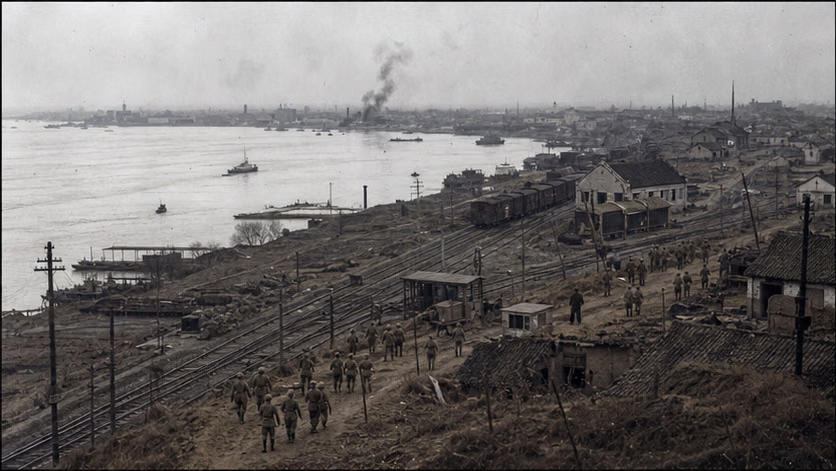
| Item | Chiang-Gui War | Chiang-Feng War |
|---|---|---|
| Time | 1929.3 – 6 (March-June; beginning with the Wuhan incident) | 1929.10 – 11 (October-November; the defection rehearsal came in May) |
| Place | Mainly Hubei and the Hunan-Hubei line, with effects reaching Guangdong and Guangxi | Western Henan and the Tongguan-Luoyang-Zhengzhou line |
| Belligerents | Chiang's army (Nanjing Central Army) / Guangxi Army (Li Zongren and Bai Chongxi's New Guangxi clique, then called the Fourth Group Army) | Chiang's army / Northwestern Army (Feng Yuxiang, then called the Second Group Army) |
| Result | New Guangxi commanders such as Yu Zuobai defected at the front; Hunan and Hubei collapsed; Li Zongren and Bai Chongxi fled in defeat to Guangxi | Han Fuju and Shi Yousan were bought off and defected in advance (May); in October the Northwestern Army came out through Tongguan for another fight, lost again, and Feng Yuxiang left office |
| Affiliation | Warlord Era Conflicts · internal war of the KMT's new warlords (after the Northeast changed flags in 1928.12, completing nominal unification) | Same as left |
Belligerents
| Item | Chiang's army (central) | Guangxi Army | Northwestern Army |
|---|---|---|---|
| Strength | First Group Army, with the best equipment among Chiang's direct-line forces and several hundred thousand men able to fight (numbers committed in each campaign unverified) | Fourth Group Army, extending from Hunan and Hubei to Guangdong and Guangxi, claiming several hundred thousand men (actual number able to fight unverified) | Second Group Army, large in number but poorly equipped, with chronic shortages of pay and provisions |
| Finances | Nanjing held the central finances, Jiangsu-Zhejiang tax sources, and public bonds -- "silver bullets" were the chief weapon | Territory in Hunan, Hubei, Guangdong, and Guangxi, but the front was too long and internal factions were mixed | The Northwest was poor; troops were maintained by raising pay locally, and officers and soldiers suffered hardship but endured in battle |
| Decisive move | Buying enemy commanders into defection + the central name ("punishing rebellion") | Internal defection: Yu Zuobai, Li Mingrui, and others changed flags at the front | Internal defection: Han Fuju and Shi Yousan took elite units away with them |
Terrain and Conditions
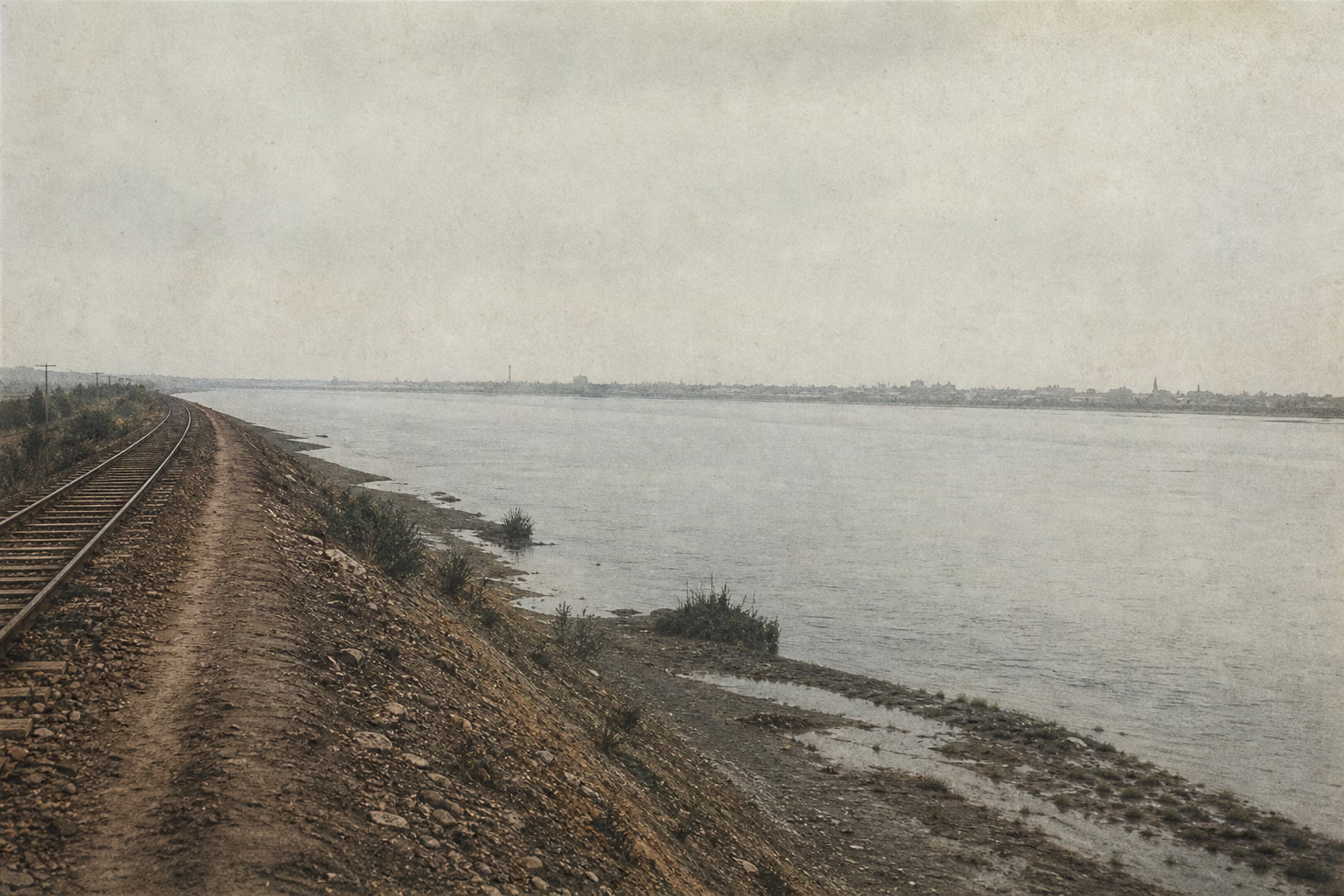
(For the larger situation of 1929 -- the completion of the Northern Expedition, the Northeast changing flags, the beginning of tutelage, and the troop-reduction plan of the Demobilization and Reorganization Conference -- see Warlord Era Conflicts · Overview; here only the local war zones are covered.)
Hunan and Hubei: Wuhan was the largest prize the New Guangxi clique had taken on the Northern Expedition route, and the Fourth Group Army headquarters was stationed there; but Hubei had been infiltrated by Nanjing, while the men commanding the Guangxi forces were from Guangxi and the ground they garrisoned was Hubei -- the situation of a guest army, and therefore soil for defection.
Western Henan-Tongguan: the Northwestern Army's territory was poor, and moving out through Tongguan was its old road for seeking survival in the Central Plains; Luoyang and Zhengzhou controlled the crossing points of the Longhai and Pinghan railways -- whoever held this crossroads would have the first move in the later Central Plains War.
Why It Was Fought
The Second Northern Expedition closed with two events: in June 1928 the National Revolutionary Army entered Beijing, ending the seventeen years of the Beiyang government; on 1928.12.29 the Northeast changed flags, and in name the Blue Sky, White Sun flag flew across the country. But under the books of "unification" lay four group armies: Chiang Kai-shek's First Group Army held Jiangsu-Zhejiang and the central finances; Feng Yuxiang's Second Group Army held Henan, Shaanxi, and Gansu; Yan Xishan's Third Group Army held Shanxi, Suiyuan, Beiping, and Tianjin; and Li Zongren and Bai Chongxi's Fourth Group Army extended from Hunan and Hubei to Guangdong and Guangxi. National troop strength stood around 2,200,000 (methods of counting vary by account), which the finances could not support, while troops were still each faction's capital.
In 1929.1, the Demobilization and Reorganization Conference opened in Nanjing with only one subject: troop reduction. The conference proposed reducing the national army to several dozen divisions (scheme figures unverified); after repeated discussion, the four sides saw the same thing clearly -- the troops to be cut were someone else's, while Chiang's direct-line forces were to be preserved. After the conference ended, no side truly handed over troops; what the negotiating table did not resolve, each side took home to sharpen its guns. On the surface they still spoke of "the center" and "comrades"; underneath lay an account of troop reduction.
The first place to move was Hunan and Hubei. Wuhan was the largest prize the New Guangxi clique had taken on the Northern Expedition route, and down the Yangtze from there lay Nanjing -- an army beside the bed. Chiang Kai-shek wanted to cut down the regional lords, and he had three instruments in hand: the central name, with which any opponent could be denounced by public telegram as a "rebel"; the "silver bullets" supported by Jiangsu-Zhejiang tax sources and public bonds, used especially to buy the other side's front-line commanders; and a sequence of breaking each opponent separately -- one house at a time. The Guangxi Army's weak point was already there: the men commanding the troops were from Guangxi, the ground they garrisoned was Hubei, and a guest army's situation was exactly the soil for defection. Nanjing's hidden hand was also moving: it activated the idle Tang Shengzhi to go north and recover old subordinates -- many of the troops Bai Chongxi had taken north were Tang's old Hunan forces; front-line commanders sent public telegrams welcoming Tang, and Bai went south almost alone (details differ among books).
The boundary of these two wars was drawn by finance. Military spending swallowed more than half of national annual expenditure (proportions vary by account), and no one could afford to keep troops; the only question was who would pay for them. Nanjing held customs revenue, salt-tax revenue, and the Jiangsu-Zhejiang public-bond market, so "silver bullets" were a budget item, not a figure of speech; the territory in Hunan and Hubei had to support a front stretching to Beiping and Tianjin, while the poor soil of the Northwest could not even feed its own soldiers. The Guangxi center itself disputed this pretext: Li and Bai later said that the reorganization of the Hunan provincial government was done on the front line without authorization by Hu Zongduo and Tao Jun, and that the two of them had not known about it beforehand (Li Zongren's memoirs, one-sided account) -- the fuse was not lit by the center, but the center had to pay the account.
In February 1929, the Wuhan Political Branch controlled by the Guangxi clique reorganized the Hunan provincial government without authorization and removed the provincial chairman favored by Nanjing (details of the incident unrecorded). Hunan had been a buffer, and this move amounted to handing over a pretext. In March, Nanjing issued a punitive order, Chiang and Guangxi denounced one another by public telegram, and fighting began in Hunan and Hubei.
After the Guangxi Army retreated in defeat, it was the Northwestern Army's turn. In May 1929, Feng Yuxiang issued a public telegram opposing Chiang and pulled back west of Tongguan to prepare for war -- but the showdown never became a battle: the "silver bullets" arrived first, Han Fuju and Shi Yousan took elite troops with them and issued public telegrams leaving Feng, the Northwestern Army lost its main strength before fighting, and Feng Yuxiang withdrew and left office (details such as "entering Huashan to study" remain unrecorded). In 1929.10, Song Zheyuan and others supported Feng's return; the Northwestern Army came out through Tongguan and attacked Henan, and the two sides formally went to war. Whether there were objections inside the Northwestern Army before the opening of hostilities has not been systematically recorded (unverified).
From beginning to end Yan Xishan did not enter the field. He watched from Taiyuan and waited for a better price.
Course of the Engagement
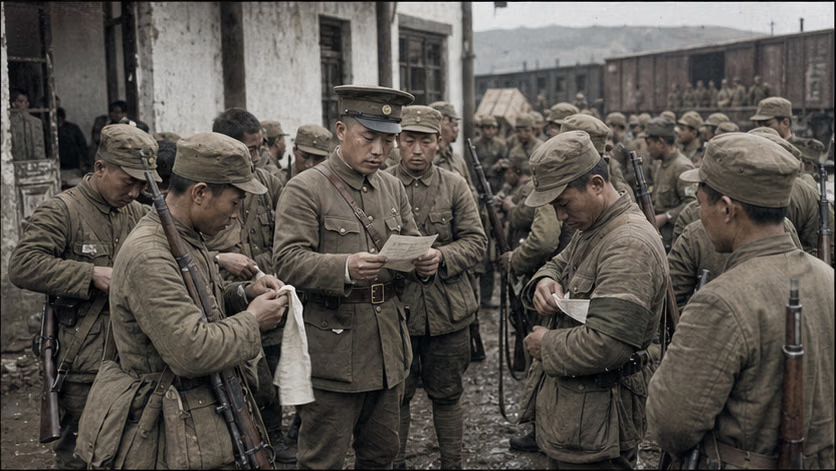
Chiang-Gui War (3–6)
| Stage | Time | Key Points |
|---|---|---|
| Wuhan incident | March | Nanjing ordered a punitive campaign on the grounds that the Guangxi-controlled Wuhan Political Branch had reorganized the Hunan provincial government without authorization (details of the incident unrecorded); Chiang and Guangxi denounced one another by public telegram |
| Defection decides the issue | Late 3–4 (late March-April) | Guangxi front-line commanders such as Yu Zuobai and Li Mingrui were bought off and defected (buying details and amounts vary by account and remain unverified), and the Wuhan front fell into disorder without fighting; the Central Army entered Wuhan without bloodshed |
| Closing phase | 5–6 (May-June) | Li Zongren and Bai Chongxi retreated from Hunan and Hubei to Guangxi; the Central Army and Chiang-attached forces entered Guangxi, while the Guangxi clique fell back to defend its old base (details of the fighting in Guangxi unrecorded) |
Chiang-Feng War (5 defection rehearsal / 10–11 main fighting)
| Stage | Time | Key Points |
|---|---|---|
| First showdown | May | Feng Yuxiang issued a public telegram opposing Chiang, and the Northwestern Army pulled back west of Tongguan to prepare for war; Han Fuju and Shi Yousan were turned by Chiang's "silver bullets" and took elite divisions with them in public-telegram defection -- the Northwestern Army lost its main strength before fighting, and Feng withdrew and left office (details of the telegram saying he would "enter Huashan to study" and related matters remain unrecorded) |
| War reopened | October | Northwestern Army commanders such as Song Zheyuan supported Feng's return and came out through Tongguan to attack Henan; the Central Army responded along the Longhai and Pinghan railways |
| Defeat | November | The Northwestern Army offensive stalled and withdrew to Tongguan; Feng Yuxiang left office again (dates of individual battle nodes vary by account) |
Casualties and Losses
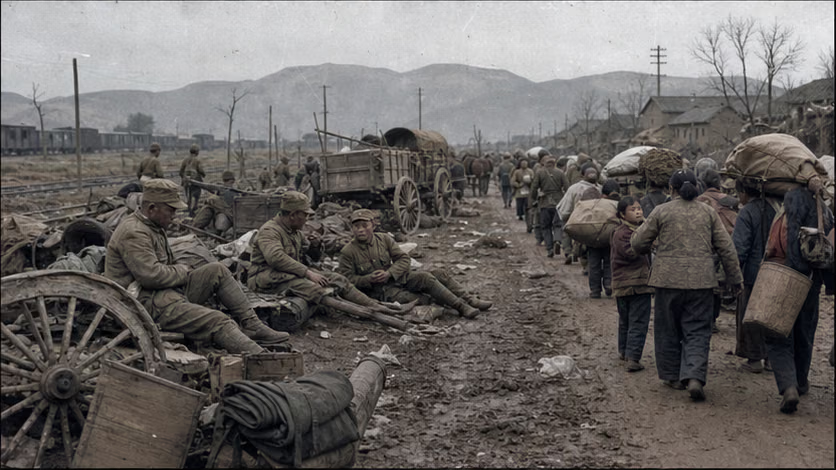
- Combat casualties in the two wars were relatively limited -- many positions never truly opened fire because of defection; the real "casualties" were recorded in the civilian account: requisitions in the war zones, forced labor, and local fund-raising for army pay continued as before, adding burdens onto western Henan and Hunan-Hubei ※ (newspaper and local-gazetteer records unverified).
- Army account: the Guangxi clique lost Hunan and Hubei, and the Northwestern Army lost the elite forces of Han and Shi -- a layer was pulled out of the frame of each of the two group armies.
- Political account: demobilization and troop reduction completely became empty talk, and the factions all saw that "negotiation is useless," directly preparing the road for the larger Central Plains War the next year.
Aftermath
- The Guangxi clique retreated to Guangxi and confronted Nanjing; half a year later, in the name of the Army for Protecting the Party and Saving the Nation, it joined the anti-Chiang coalition (continues in Central Plains War).
- Feng Yuxiang left office but did not give up; Yan Xishan watched the price from Taiyuan -- the negotiations for a Yan-Feng convergence matured in early 1930 (continues in Central Plains War).
- Han Fuju received Henan for the merit of defection and later held Shandong; Shi Yousan was fickle, and two years later was destroyed for defecting again -- the defectors' endings entered history in their own ways.
- Chiang Kai-shek won twice and his authority expanded greatly, but everyone saw the same principle clearly: to oppose Chiang, one had to combine forces; acting alone meant being broken one by one -- 1929 was the rehearsal for 1930.
Accounts of Those Present
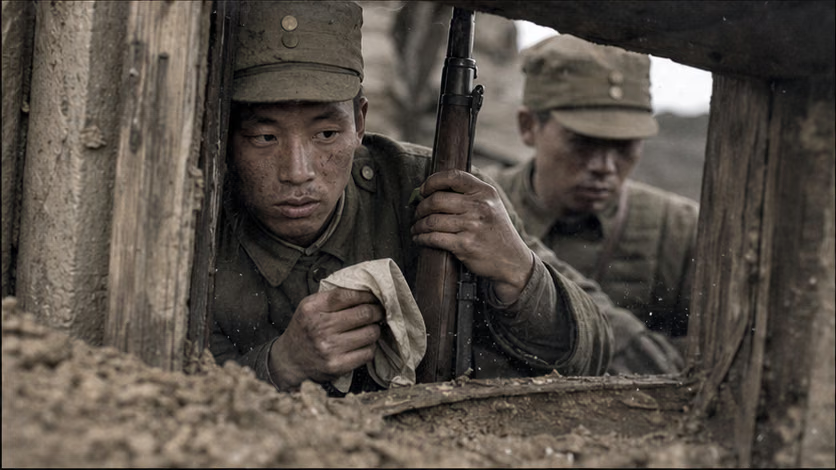
- The route of the "silver bullets": the intermediaries, prices, and delivery methods for buying defections formed the darkest layer of these two wars -- the amounts recorded in different memoirs vary, often counted in millions of silver dollars (each item unverified).
- The night Han Fuju defected: the course of the officers' meeting at which Han's forces announced their separation from Feng Yuxiang is written in sharply different styles in Han-side and Feng-side memoirs (details unrecorded) -- the cracks in the Northwestern Army's "patriarchal" way of commanding troops appeared here.
- Feng Yuxiang leaving office twice: the wording of the public telegrams, where he avoided residence (Huashan and Taiyuan accounts coexist, unverified), and the performative quality and practical effect of "leaving office" in Beiyang-KMT politics.
- Soldiers: once the order to defect came down, company and platoon commanders led whole companies in changing armbands -- most soldiers served for food, and whose war they fought was the commander's business (for this insoluble layer of "for whom they fought," see Warlord Era Conflicts · Overview).
The Ground
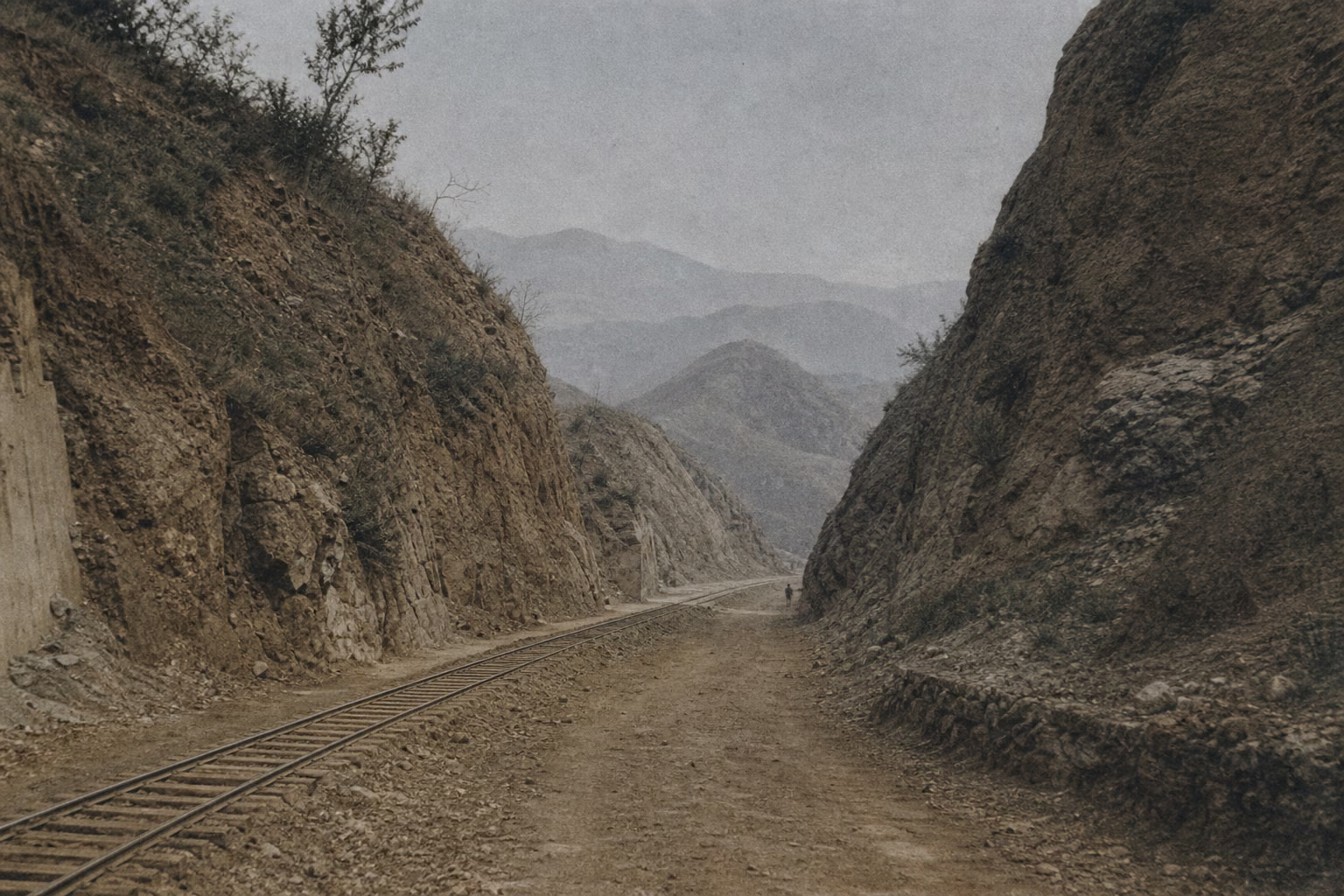
- The Chiang-Gui battlefield was the water network and railways of Hunan and Hubei: the Yangtze, the Yuehan line, and the Hunan-Guangxi corridor -- but in most stretches no battle actually happened; spatially, it was an "unfought battlefield."
- The Chiang-Feng battlefield was the mountains of western Henan and the Tongguan corridor: the Hangu-Tongguan line had been the gateway to Guanzhong since antiquity. If the Northwestern Army advanced, it could contend for the Central Plains; if it retreated, it could close the pass and defend itself -- this line would be used again in the Central Plains War of 1930.
- The space that truly decided victory or defeat was not on the battlefield: it was in Nanjing's banks and in the headquarters of commanders about to defect -- the spatial grammar of these two wars was "positional warfare yielding to secret talks."
How Each Side Records It
- Public-telegram layer (the voices of the warring sides themselves): Nanjing issued public telegrams in the central name to "punish rebellion," accusing the Guangxi and Feng factions of "destroying unification and disobeying demobilization and reorganization"; the Guangxi clique issued telegrams denouncing Chiang for "dictatorship and betraying the Party"; Feng Yuxiang issued public telegrams listing Chiang's offenses and calling himself "protecting the Party and saving the nation" -- the two sets of names, "protecting the Party" and "punishing rebellion," collided, and whoever held "the center" held juridical legitimacy. This was the core of civil-war discourse that year (original texts and dates of the telegrams vary by account).
- Civilian and newspaper memory: what people in the war zones remembered was forced labor and fund-raising for army pay; the commentary layers of Shanghai newspapers had already begun to tire of it -- "unification has only just been completed, and civil war rises again" was the common tone of opinion in 1929 (article titles unverified); records of the use of the term "qiu-ba" in the popular context of Hunan-Hubei and western Henan (figure disputed).
- Later narratives: textbooks merge the two wars into the section on "the KMT's new-warlord conflicts" and pass over them together with the Central Plains War; researchers, by contrast, treat 1929 as the key year when demobilization failed and Chiang had his showdown with the factions (representative works unverified).
Disputes and Sensitivities
- Characterization: the two characterizations of "the center reducing regional lords and unifying the country" and "new-warlord civil war" have long coexisted; each frame connects to later KMT-CPC narratives.
- Evaluation of defecting commanders: Yu Zuobai, Han Fuju, Shi Yousan, and others each had multiple sides (Yu later governed Guangxi and cooperated with the CPC; Han abandoned Shandong in the early War of Resistance and was executed by firing squad), and their actions in 1929 were only one segment of their lives.
- Amounts paid for buying defections: the figures recorded in various memoirs and secondary writings differ greatly, and the source levels are uneven.
Sources and Open Questions
Known main sources:
- Li Zongren's memoirs (recorded by Tang Degang)
- *Feng Yuxiang's Diary* and memoirs by Northwestern Army commanders (sections on the defections of Han Fuju and Shi Yousan)
- Contemporary newspapers: Ta Kung Pao, Shen Bao, Central Daily
- Tao Juyin, *Anecdotal History of the Beiyang Warlords' Rule*, and related studies of new-warlord conflicts (narrative reference; original sources must be checked back)
Open questions: details of the Wuhan incident; the course and purchase amounts of the defections of Yu Zuobai and Li Mingrui; meeting details and amounts in the Han-Shi defections; exact dates for each stage of the two wars; battle nodes of the Northwestern Army's October offensive; newspaper and local-gazetteer sources for war-zone requisitions and livelihood records; original texts of each round of public telegrams in 1929; the provisions and reduction figures of the demobilization scheme; the course of Tang Shengzhi's move north to recover old subordinates and Bai Chongxi's departure; corroboration for Li and Bai's claim that they "had not known beforehand"; whether there are records of internal objections inside the Northwestern Army before hostilities; the proportion of military spending in national annual expenditure.
All images on this site are AI-generated depictions. They are not historical photographs, not primary sources, and do not depict any real individual.