Engagement Archive · Zhili–Anhui War
The first civil war after the Beiyang house split apart lasted only five days: the Japanese-equipped, Japanese-trained, "most modern" Frontier Defense Army scattered at first contact, proving a rule that would recur throughout the next decade: the deciding factor in Beiyang wars was never weapons, but factional alignment and morale.
Engagement Data
| Item | Content |
|---|---|
| Time | 1920.7.14 – 7.18, five days |
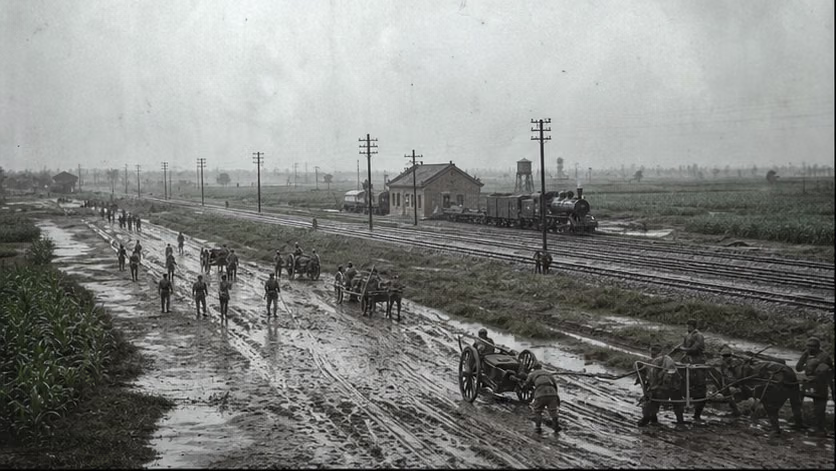
| Place | The capital region: the Zhuozhou-Gaobeidian-Liulihe line (western front), and the Yangcun line on the Beijing-Tianjin Railway (eastern front) |
| Belligerents | Zhili clique (Cao Kun and Wu Peifu, under the banner of the "Army to Punish Rebels") allied with the Fengtian clique / Anhui clique (Duan Qirui's "National Pacification Army," with Xu Shuzheng as staff officer) |
| Result | The Anhui Army collapsed across five days; Duan Qirui stepped down, the Anfu Club was dissolved, and the Anhui clique's four years in power came to an end |
Belligerents
| Item | Zhili Army (with Fengtian support) | Anhui Army |
|---|---|---|
| Strength | Tens of thousands of Zhili troops at the front, with Fengtian troops entering the passes to support and stiffen the line (figures by source unverified) | Three Frontier Defense Army divisions as the core, totaling tens of thousands across all units (figure disputed) |
| Equipment | The Zhili Army had long fought in Hunan and Hubei; its equipment was ordinary | The Frontier Defense Army (formerly the War Participation Army) was Japanese-equipped and Japanese-trained, and on paper the Beiyang Army's most elite force |
| Morale | Wu Peifu withdrew north from Hengyang and advanced under the slogans of "opposing betrayal of the country" and "opposing Anfu," fully occupying the ground of public opinion | The officer corps was newly recruited and hastily trained; the soldiers had no will to fight; Xu Shuzheng had made enemies too widely |
Terrain and Conditions
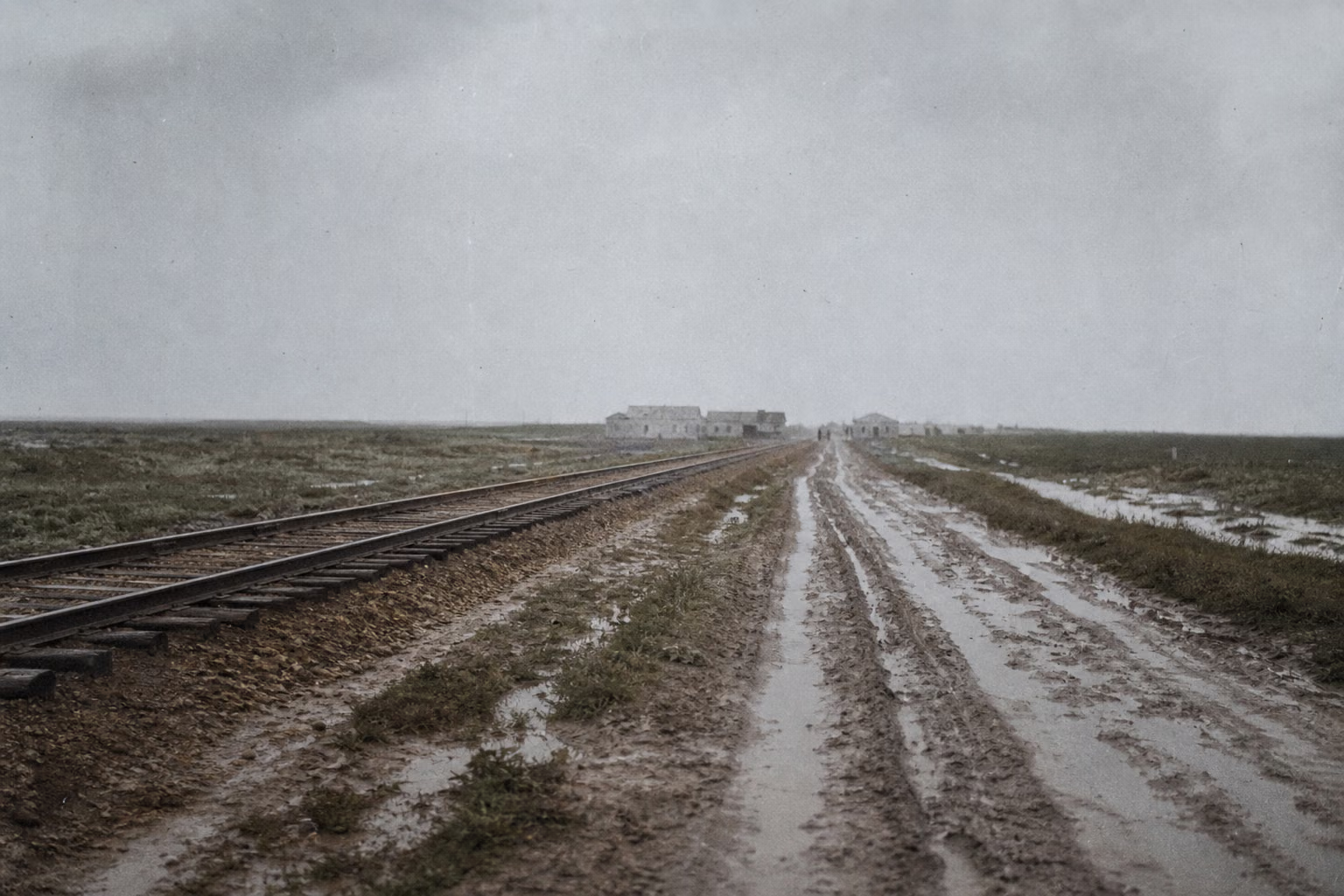
The capital-region railway network formed the skeleton of the battlefield: the Beijing-Hankou Railway (western front) and the Beijing-Tianjin Railway (eastern front) each made a separate axis. The summer of 1920 had seen prolonged rain; roads were muddy, and artillery deployment was difficult (battlefield weather records unverified). The political air was this: after May Fourth, the charge of "betraying the country" carried enormous weight, and the Anhui clique had accumulated a full debt of public anger through the Nishihara Loans and its pro-Japanese image. Before the battle opened, popular feeling had already decided the winner.
Why It Was Fought
Once Yuan Shikai died, the Beiyang machine had no common master. For the next four years, Duan Qirui governed as premier: in the name of entering the war against Germany, he trained a three-division Frontier Defense Army, Japanese-equipped and Japanese-trained, the most elite force on paper; he relied on the Nishihara Loans to pay military expenses, and on the Anfu Parliament to monopolize constitutional legitimacy; year after year, his policy of armed unification sent troops south in the Constitutional Protection War, which sank into stalemate, while real power never left his hands. Xu Shuzheng leaned on the Frontier Defense Army and the Anfu clique to monopolize authority, offending almost everyone who could be offended. With the Anhui clique in charge, the Zhili clique had accumulated a ledger full of grievances.
The fracture opened on the Constitutional Protection front. Wu Peifu led the Third Division as far as Hengyang, then held his troops in place, sending repeated telegrams against the war and advocating peace talks between north and south. In May 1920, without obeying orders, he withdrew on his own and led his troops north along the railway; a soldier had defied command, and the whole country applauded. Only one year had passed since May Fourth. "Betraying the country" was the heaviest charge, and the Nishihara Loans and pro-Japanese image had left the Anhui clique carrying the full debt of public opinion; all along the route, Wu Peifu sent circular telegrams denouncing Anfu and made "opposing betrayal of the country" the battle flag of the Zhili Army. Before the battle opened, popular feeling had already decided the winner.
If there was to be fighting, it could only be in the capital region. Inside Beijing were Duan's cabinet and the Anfu Parliament. The Beijing-Hankou and Beijing-Tianjin lines linked Beijing with Cao Kun's main base at Baoding into a line of confrontation. "The center," the largest prize of all, lay between the two armies; for every day the Zhili Army remained stationed at Baoding, the muzzles of the Frontier Defense Army had to point inward for one more day.
Duan Qirui's calculation was to establish authority through a single battle. He trusted the Frontier Defense Army's Japanese equipment and drill manuals, and believed that disposing of the Zhili troops, worn down by fighting in Hunan and Hubei, would be no difficult matter. What he failed to see was the foundation of this personal army: it had been formed a little over a year earlier, and its officers had been trained in haste (training duration varies by account). He also misread whether Zhang Zuolin would really act. After the defeat, his circular telegram admitted "poor choice of personnel"; that was an account settled only afterward. Cao Kun wanted territory; Wu Peifu wanted the legitimacy of bringing down Anfu; and they also drew in a third party. Zhang Zuolin first entered Beijing as a mediator, setting the removal of Xu Shuzheng as his price. Duan refused (mediation process unverified). The mediator turned back through the passes and formed the "Eight-Province Anti-Anhui Alliance" with Cao Kun.
Resolution also had to come down to money and grain. For Duan's four years in power, the bulk of military and political spending had depended on Japanese loans. By 1920 the loans had been spent through, the treasury was bare, and the Frontier Defense Army's arms and pay could not be interrupted even for a day. Where the money would come from was itself an underlying cause of this battle (the direct link between loan exhaustion and the decision to open war remains unverified). The Zhili Army was just as deeply in arrears, but Wu Peifu raised funds for himself along the way and also held popular support. The fighting lasted only five days; ammunition and provisions had no time to become the problem. The boundary was not drawn in the warehouses. It was drawn in people's hearts.
It was not that there were no objections on the surface. Jin Yunpeng, a major general under Duan who had served as premier, refused to follow Xu Shuzheng's line of armed force and was pushed out of office two months before the war (causation of his departure unverified). Within the Anhui clique, the person best able to check Xu Shuzheng had already been removed before the war began. In early July, Duan forced President Xu Shichang to order punishment of Cao Kun and Wu Peifu. Xu hesitated; Duan pressed the presidential office with military force, and the punitive order was finally issued, dismissing Wu Peifu and stripping him of his titles (accounts of the coerced order vary; details unverified). Within a few days, the Anhui clique had organized the "National Pacification Army," and the Zhili clique had raised the banner of the "Army to Punish Rebels." On July 14, the two fronts opened fire at the same time.
In fact, the situation did not have to come to this point. If Duan had been willing to abandon Xu Shuzheng and disperse the Anfu clique, there might still have been a step down between Zhili and Anhui. But those three things were the whole capital he had accumulated in four years of rule. To dismantle any one of them was the same as falling without a fight. The steps were set out, and no one took them.
Course of the Engagement
| Phase | Time | Key Points |
|---|---|---|
| Eastern-front contact | 7.14-16 | In the Yangcun direction, the Anhui Frontier Defense Army advanced for a time, and the Zhili Army fell back (details unrecorded) |
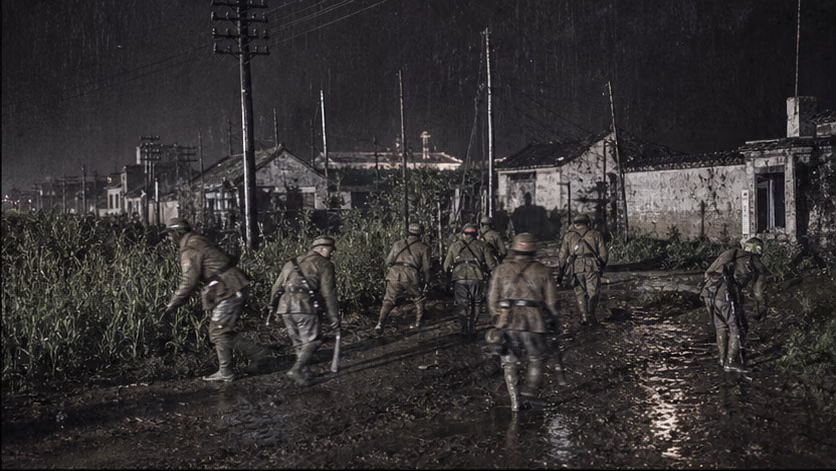
| Western-front surprise attack | 7.16-17 | Wu Peifu led his troops in a rainy-night flanking movement and launched a surprise attack on the Anhui forward command post at Songlindian, capturing Qu Tongfeng, the Frontier Defense Army's forward commander; Anhui command on the western front was paralyzed |
| General collapse | 7.17-18 | The western-front rout spread to the eastern front; Fengtian troops pressed in from the flank, the Anhui Army disintegrated along the whole line, and Duan Qirui sent a circular telegram resigning on 7.19 |
Casualties and Losses
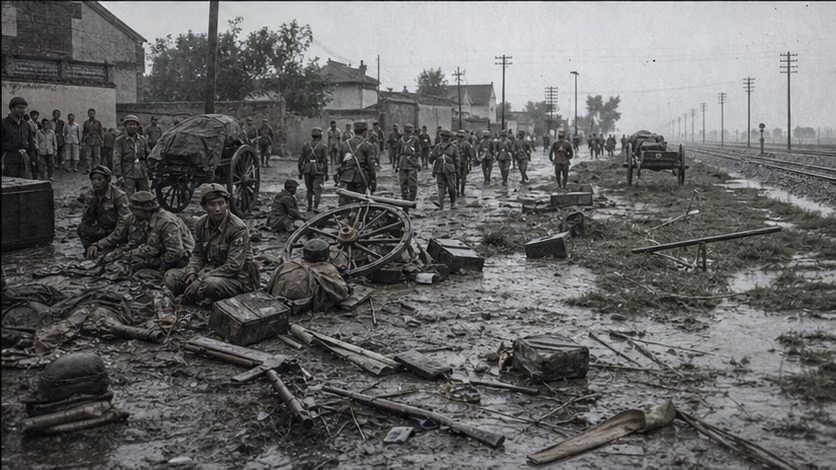
- Combat casualties on both sides totaled from several hundred to more than a thousand (figures by source unverified). By Beiyang standards, this was a "small battle," but its political consequences amounted to a change of regime.
- The three Frontier Defense Army divisions were dissolved and incorporated elsewhere; the Anfu Parliament was dissolved, and Anhui clique core figures, including Xu Shuzheng, were wanted by the authorities.
- Civilians: troops passing along the capital-region lines caused disturbance and burdens (record unverified), but the fighting period was short, and the military disaster was relatively light.
Aftermath
- The Zhili and Fengtian cliques jointly controlled Beijing, then fell out after two years of dividing the spoils (see the First Zhili–Fengtian War).
- After the Anhui clique left the stage, Duan Qirui lived in seclusion in Tianjin; after the Beijing Coup of 1924, he returned as provisional chief executive (see the Second Zhili–Fengtian War).
- Wu Peifu suddenly gained national fame through the image of "a scholar leading troops" and of a man who "did not live in the foreign concessions and did not borrow foreign money." The Zhili clique's moral capital and his later obstinacy came from the same source.
Accounts of Those Present
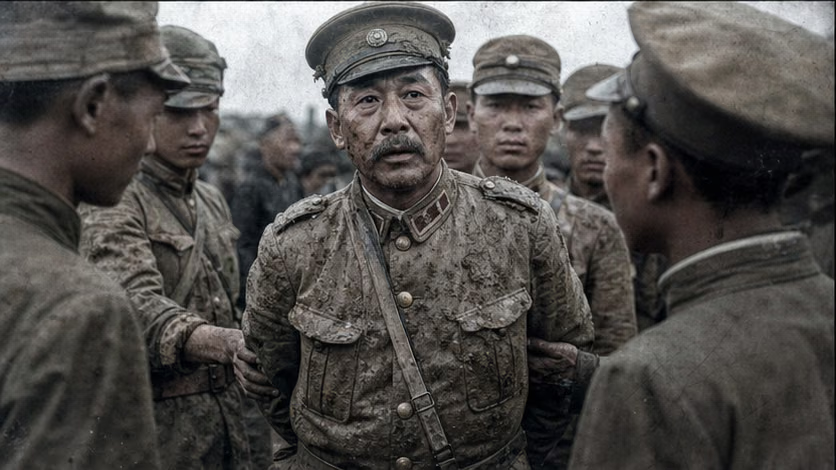
- Qu Tongfeng captured: The forward commander, who had once been commandant of the Baoding Military Academy, was captured by troops of his own students' generation. The Beiyang military circle was small; contests between teachers, students, and men of the same school were normal, and this was the first large sample.
- Wu Peifu's circular telegrams: During the withdrawal north, he sent one circular telegram after another, denouncing Anfu and opposing betrayal of the country; newspapers reprinted them, and the whole country passed them around. An army won the public-opinion war by telegraph before taking the battlefield.
- Five days: More than a month of mobilization, five days of fighting. The first lesson of Beiyang civil war taught everyone that this kind of war was decided not by firepower but by popular feeling; falling quickly was more common than fighting fiercely.
The Ground
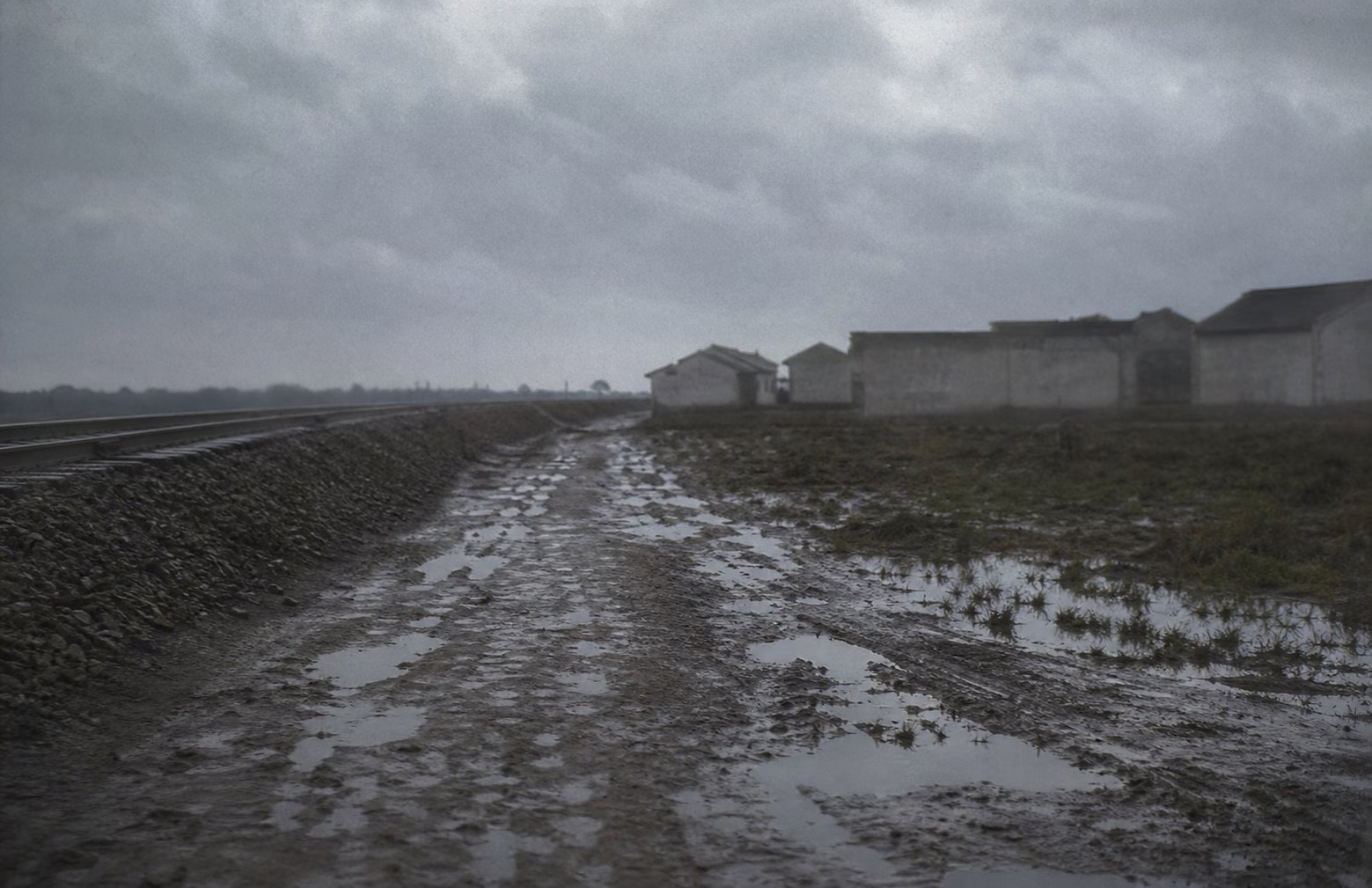
- Railway lines were battle lines: the Beijing-Hankou and Beijing-Tianjin lines each formed an axis of battle; stations were nodes, and armored trains and railway transport were the means of maneuver.
- The Songlindian surprise attack: rain at night, muddy roads, and the space of a command post made it an early example of a decapitation-style raid.
- The capital-region plain had no strongpoints to hold. Victory or defeat lay in "who breaks first," not in "who holds."
How Each Side Records It
- Zhili clique and public opinion: newspapers of the time almost unanimously recorded it as a "campaign to punish traitors to the country"; Wu Peifu became a national hero.
- Anhui clique: Duan Qirui's circular telegram on stepping down admitted "poor choice of personnel"; in the writings of Anhui clique literati, this battle was a case of "Zhili–Fengtian collusion" overthrowing the government (the competing circular telegrams and notes remain unverified).
- Later accounts: As the first battle after Beiyang's split, it is often passed over in abbreviated form. Its significance as a sample, in which a modernized force collapsed at first contact and public opinion moved first, deserves to be retold.
Disputes and Sensitivities
- The mystery of the Frontier Defense Army's fighting power: why did a Japanese-equipped, Japanese-trained force collapse in five days? Historians differ on the relative weight of short training time, hastily trained officers, and lack of will to fight.
- The size of the Fengtian role: Zhili narratives diminish Fengtian and elevate Zhili; Fengtian narratives do the reverse. The accounts should be placed side by side.
- The characterization of Wu Peifu's withdrawal and defiance of orders: it was one of the beginnings of military interference in politics, and the fact that his later opponents used the same methods against him forms an ironic closed loop.
Sources and Open Questions
Sources: Lai Xinxia et al., *History of the Beiyang Warlords*; Tao Juyin, *Anecdotal History of the Beiyang Warlord Period*; *Selected Materials on the Zhili–Anhui War* (bibliography unverified); wartime reports and circular telegram collections from *Shenbao* and *Morning Post*.
Open questions: the order of battle and casualty figures for both sides; details of the eastern-front fighting; primary records of the Songlindian surprise attack; details of Qu Tongfeng's capture; battlefield weather records; the causation and primary records of Jin Yunpeng's departure from office; the process by which Xu Shichang was forced to seal the punitive order; the total amount of the Nishihara Loans and the Anhui clique's fiscal condition in 1920; the formation and training duration of the Frontier Defense Army; the direct link between loan exhaustion and the decision to open war.
All images on this site are AI-generated depictions. They are not historical photographs, not primary sources, and do not depict any real individual.