Engagement Archive · Battle of Nankou (1926)
The Zhili, Fengtian, and Shanxi forces, four to five hundred thousand men among them, besieged the Guominjun for four months and pinned the main Beiyang armies along the Great Wall; in those same months the southern National Revolutionary Army set out on the Northern Expedition, and this vast battle was later almost wholly covered over by the Northern Expedition's own narrative.
Engagement Data
| Item | Content |
|---|---|
| Time | 1926.5 - mid-August (the frontal fighting around Nankou had been forming since April; the main fighting ran from May to August; dates of individual junctures vary by account) |
| Place | Northwest of Beiping: the Nankou-Juyongguan line was the main battlefield; the northern wing toward Duolun and the western wing toward Datong were secondary battlefields |
| War | Warlord Era Conflicts · the joint Zhili-Fengtian-Shanxi campaign against Feng (a continuation of northern politics after the 1924 Beijing Coup and Guo Songling's Revolt Against the Fengtian Clique in 1925) |
| Belligerents | Guominjun (Feng Yuxiang's forces; Feng himself had announced his retirement from office and gone to the Soviet Union in early 1926, while the front was commanded by Zhang Zhijiang, Lu Zhonglin, and others) / Zhili army (Wu Peifu), Fengtian army (Zhang Zuolin), and Shanxi army (Yan Xishan), in a three-party coalition |
| Result | After holding out for nearly four months, the Guominjun withdrew westward in mid-August to Wuyuan, Suiyuan; the coalition won a costly victory, while the Beiyang main forces were consumed and tied down; in September Feng Yuxiang held the Wuyuan oath-taking, and the whole army joined the National Revolution |
Belligerents
| Item | Guominjun | Zhili-Fengtian-Shanxi coalition |
|---|---|---|
| Strength | About 200,000 (figures vary by basis), with the main force concentrated along the Nankou line and detachments sent toward Duolun and Datong | Around 400,000 to 500,000 in all (figures vary by basis): Fengtian forces attacked toward Duolun, Zhili forces attacked the Nankou front, and Shanxi forces attacked toward Datong |
| Positions | The natural barrier of Nankou plus reinforced-concrete fortification groups built over years, reportedly designed with the participation of Soviet Russian advisers (claim unverified) | Frontal assaults into the Juyongguan gorge, with artillery and manpower several times greater than the defenders' |
| External aid | Rifles and ammunition supplied by Soviet Russia entered via the Khuree (Ulaanbaatar)-Suiyuan line (scale unrecorded) | The Fengtian army had the backing of the Northeast Arsenal; Wu Peifu received supplies from Hankou |
| Supply | Besieged in fixed positions, with food and ammunition steadily running short and no strategic depth | Encircling from three sides, but the factions watched one another, and their willingness to press assaults varied |
Terrain and Conditions
(For the wider situation of 1926 - the Taku Forts Incident and the March 18 Massacre, the collapse of Duan Qirui's provisional government, and the Guangzhou National Government preparing its forces - see Warlord Era Conflicts: Overview. Here the focus is only the Nankou line.)
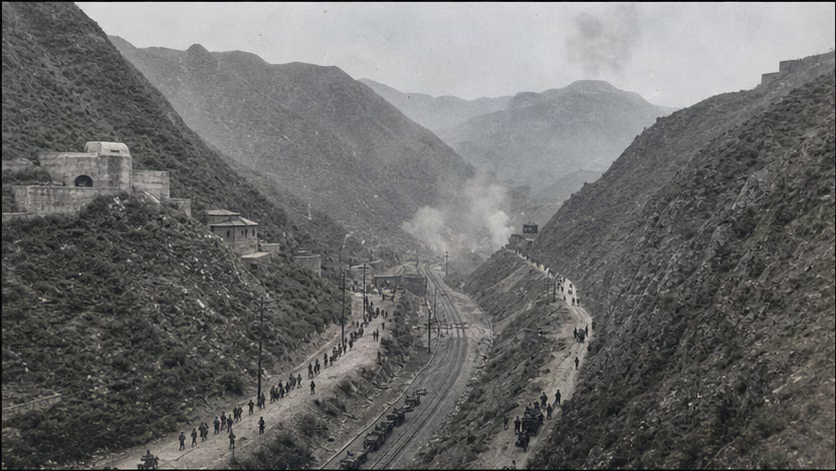
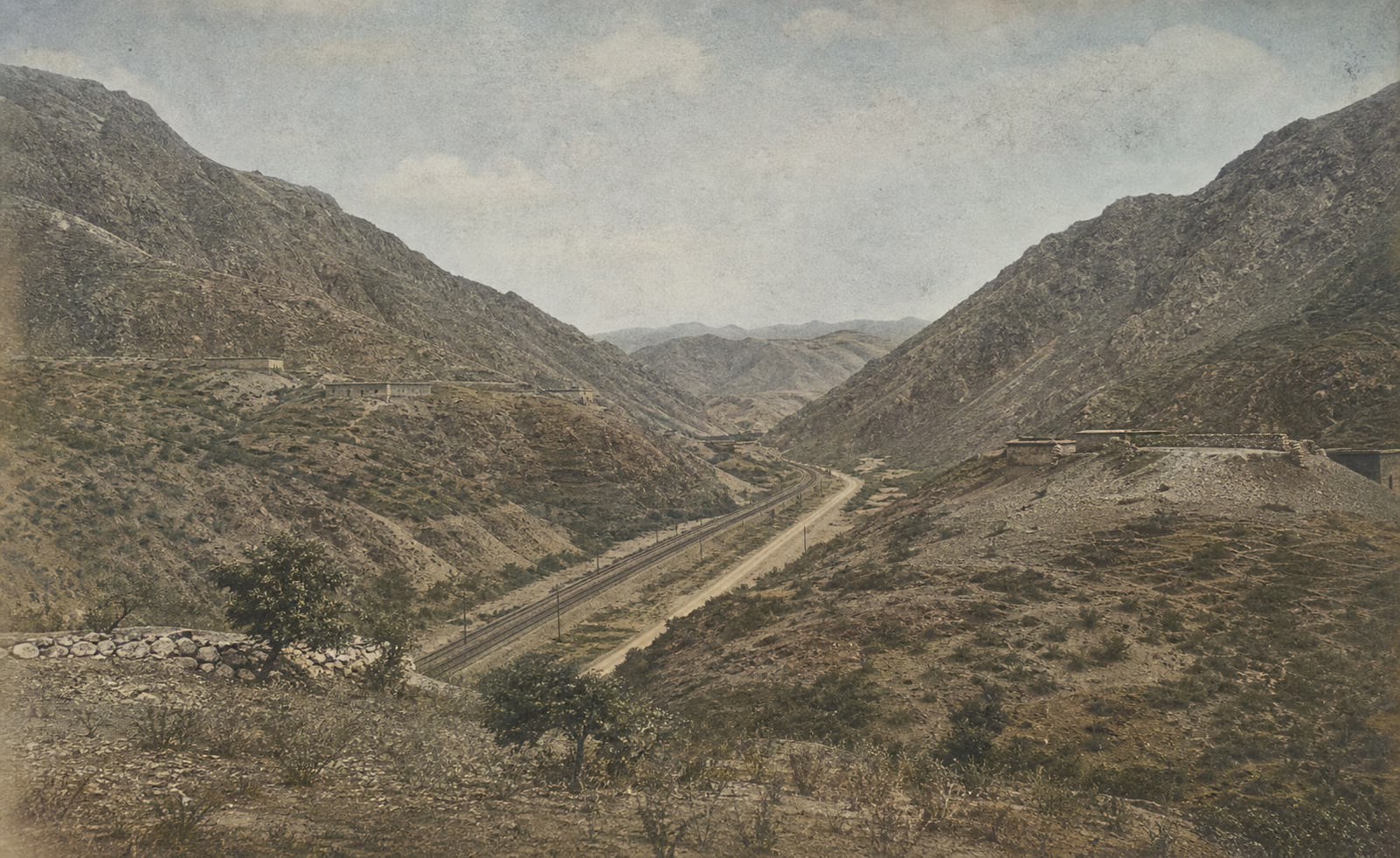
Nankou: a gorge passage northwest of Beiping, the throat through which the Beijing-Suiyuan Railway left Juyongguan. Mountain ridges pressed in on both sides, leaving a narrow front: standard terrain in which defenders could hold off a force many times their size. Since taking the capital region in 1924, the Guominjun had spent years building fortifications here.
Along the Beijing-Suiyuan line: west of Nankou lay the railway route beyond the passes, leading to Zhangjiakou and Suiyuan. The Guominjun's line of retreat and Soviet Russian supply line both ran along it. To hold Nankou was to hold that route of retreat.
Inside Beiping: the March 18 Massacre (1926.3.18) had only just passed, Duan Qirui's provisional government collapsed in April, and the political order in North China was hollowed out. A siege battle was fought in plain sight, while townspeople and newspapers saw yet another round of soldiers passing through.
Why It Was Fought
Less than half a year after the gunfire by the Julu River fell silent, the muzzles turned back around. In the alliance formed during Guo Songling's revolt against Fengtian, the Guominjun first lost Li Jinglin and then lost credibility, even as its territory expanded by a full ring. By 1926, the Guominjun was already the largest military bloc in the north, and it was also the shared old account of the Zhili and Fengtian sides: its defection in the Beijing Coup had ruined Wu Peifu, and its alliance with Guo against Fengtian had nearly ruined Zhang Zuolin. Two men who had just finished fighting one another discovered that they hated the same third party most.
At the start of 1926, Wu and Zhang set aside their enmity, and "suppressing the Reds" became the banner for joining hands. The label was ready-made: the Guominjun received Soviet Russian aid, and Feng Yuxiang was pro-Soviet. Yan Xishan of the Shanxi army watched two powerful neighbors ally on his flanks and joined the containment effort to protect Shanxi's side; a man who had balanced on the fence for ten years placed his stake this time. Feng Yuxiang tried the only available solution: in January he announced that he was stepping down, left the country for the Soviet Union, and hoped to exchange his own departure for breathing room for this army. He did not get it. What his opponents wanted was not Feng Yuxiang's name, but the disappearance of the Guominjun from North China.
After spring began, the ring tightened. The Taku Forts Incident and the March 18 Massacre followed one another, Duan Qirui's provisional government collapsed in April, and Beijing politics were left in a vacuum. The Guominjun voluntarily abandoned Beijing and Tianjin and contracted to the Nankou-Duolun-Datong line. Once it had fallen back to Nankou, there was nowhere left to retreat: this was the throat where the Beijing-Suiyuan Railway left Juyongguan, and the Guominjun, having held the capital region for two years, had built fortifications here over a long period. West of Nankou, the Beijing-Suiyuan line ran to Zhangjiakou and Suiyuan, and both the route of retreat and the Soviet-supplied arms lay on that railway. To hold Nankou was to hold the last road.
The decision came down to Wu Peifu's timetable. He went to the front in person to supervise operations, set his general headquarters at Changxindian, and pressed the Zhili main force against the Nankou front. The natural barrier had to be assaulted because time was short: in the two Hunan-Hubei provinces, the struggle between Tang Shengzhi and Ye Kaixin was tightening, the Guangzhou Northern Expedition was already in preparation, and urgent telegrams kept coming north. Wu wanted to finish the north first and then look south (the pace of deterioration in the south, and the moment when he knew the Northern Expedition had set out, remain uncertain in sequence). He underestimated how long a natural barrier could hold. The Fengtian calculation was different: its main force attacked Duolun, with eyes on Chahar territory; the blood on the Nankou front was to be shed mainly by Zhili troops, and in the later phase the units of Zhang Xueliang and Han Linchun also joined the frontal assaults (this point is record unverified). The Shanxi army attacked Datong, aiming at Suiyuan. Four to five hundred thousand men surrounded two hundred thousand (figures vary by basis), and whose soldiers would bleed for whom was built into coalition decision-making from the start.
On the defenders' side, Zhang Zhijiang, Lu Zhonglin, and others decided to hold the Nankou line rather than withdraw at once to Suiyuan. Their capital was written on the railway: roughly two hundred thousand men held positions without depth, with food and ammunition dependent on Soviet aid brought in via Khuree-Zhangjiakou and on prewar stocks. The supply line was also the retreat line, and consumption flowed only outward, not back in. To hold, Soviet aid had to continue, the south had to move first, or the three encircling parties had to fall into internal strife. The coalition's base was much broader: the Fengtian army had the Northeast Arsenal and finances beyond the passes, while the Zhili army drew on Henan-Hubei territory and Hankou supplies. Yet ammunition, grain, and pay for several months of siege assaults by 400,000 to 500,000 men were also under strain; the three parties shared the burden, and each had its own arithmetic for how much blood it was willing to spend (unverified).
Records of dissent are thin on both sides. No public dissent inside the coalition is visible; hesitation in assaulting fortifications belonged to the level of action and did not surface openly. Whether the Guominjun had internal proposals for an early withdrawal to Suiyuan is also not clearly recorded (unverified). The only attempt at peace remained Feng Yuxiang's stepping down, and it received no answer. In May, the Zhili offensive pressed into the Juyongguan gorge (dates of individual junctures vary by account), and the Great Wall line became a long siege of a kind rarely seen in the Beiyang era. In that same spring and summer, the National Revolutionary Army in Guangzhou was preparing to move.
Course of the Engagement
| Phase | Time | Points |
|---|---|---|
| Encirclement and opening | April-May | The Guominjun voluntarily abandoned Beijing and Tianjin and fell back to the Nankou-Duolun-Datong line; the Shanxi army advanced toward Datong, the Fengtian army attacked Duolun, and the Zhili army pressed Nankou frontally |
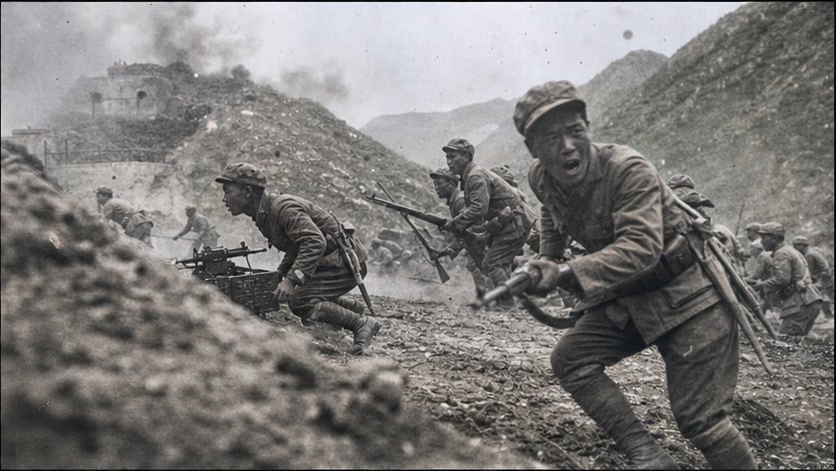
| Frontal fighting at Nankou | May-early August | The Zhili army, personally supervised by Wu Peifu, repeatedly stormed the Juyongguan gorge. The defenders' works were solid and their fire dense; the attackers suffered heavy casualties and measured progress in meters. The frontal battle became a long siege rare in the Beiyang era (sequence of the general assaults unverified) |
| The two wings give way | Early to mid-August | The Duolun front fell first (Fengtian forces took Duolun in early August; dates vary by account), while Shanxi forces encircled from the Datong direction; the rear of the defenders on the Nankou front came under threat |
| Withdrawal west | Mid-August | The Guominjun ordered a general withdrawal and moved west along the Beijing-Suiyuan line to Wuyuan, Suiyuan; the withdrawal remained broadly organized and did not collapse - an important fact about the defenders in this battle (records of withdrawal order unverified) |
| Coda | September | On 9.17, Feng Yuxiang returned from the Soviet Union, held the Wuyuan oath-taking, and brought the whole army into the National Revolutionary Army, then moved by way of Shaanxi and Gansu to emerge eastward (see the Northern Expedition articles) |
Casualties and Losses
- Casualties on both sides: coalition casualties in the assaults on the Nankou front were extremely heavy, and the Guominjun defenders were also badly worn down, with combined losses at the level of tens of thousands (figures vary widely, and multiple accounts coexist). The Zhili clique's elite formations were consumed in this battle, and a year later, on the Northern Expedition battlefield, the old fighting power of the Zhili army was no longer there; historians often point to this layer of causation (figure disputed).
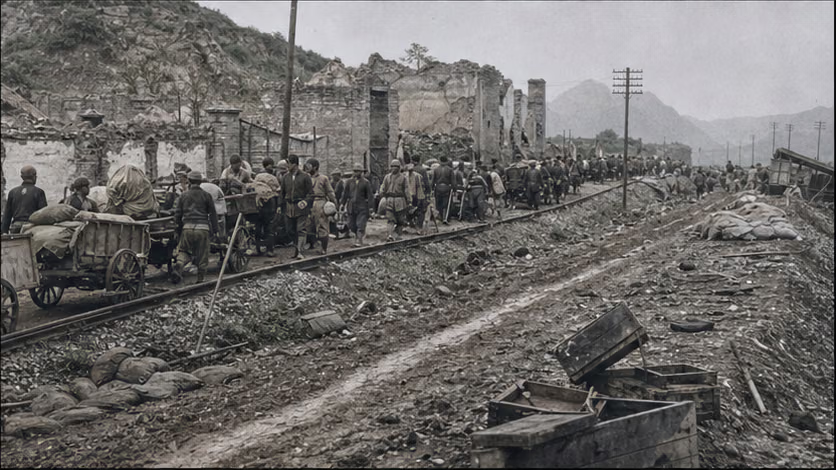
- Military disaster and forced labor: for four months, large armies gathered along the Beijing-Suiyuan line, requisitioning carts and laborers and raising funds locally; villages near Nankou were destroyed by shellfire (local gazetteer and newspaper records unverified).
- After the Guominjun withdrew westward, the Chahar-Suiyuan region became a place where routed soldiers and famine refugees intermingled ※ (disaster records unverified).
Aftermath
- The Beiyang three-party coalition divided the spoils of a "costly victory": the Fengtian clique took Chahar, the Shanxi army expanded into Suiyuan, and Wu Peifu gained little. Each party got what it needed, then immediately faced the southern Northern Expeditionary forces in its own way.
- The most elite Beiyang main forces were pinned along the Great Wall for four months and consumed over several months, objectively giving the National Revolutionary Army, which set out on the Northern Expedition in July, a window of time. The way this battle interlocked with the Northern Expedition is its largest historical place.
- The Guominjun did not disintegrate after withdrawing: it held the Wuyuan oath-taking, entered Shaanxi, relieved the siege of Xi'an, and in 1927 emerged again through Tongguan as the Second Group Army (see the Northern Expedition articles and the article on the Central Plains War).
- After finishing at Nankou, Wu Peifu turned back to confront the Northern Expedition and then suffered successive defeats in the Battles of Tingsi Bridge and Hesheng Bridge. The Beiyang era entered its closing phase.
Accounts of Those Present
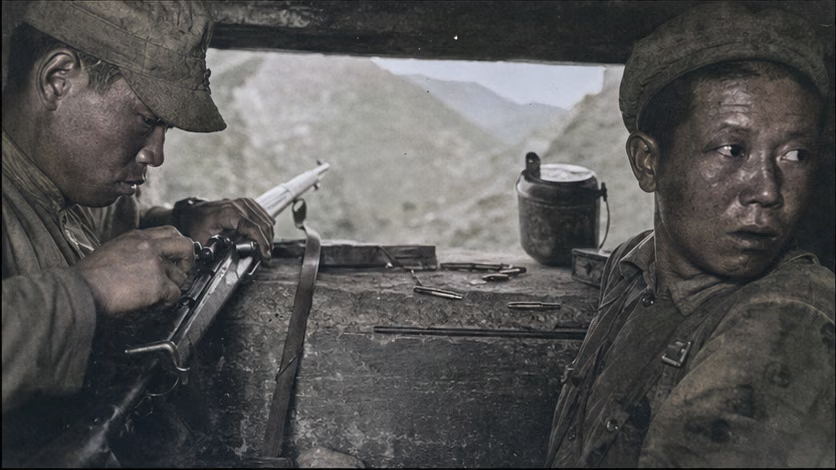
- Diaries and memoirs of the main attackers: participants on the Zhili side recalled the Nankou siege in terms such as "attacking upward against sheer cliffs" - the frontal gorge could not withstand the crossfire of machine guns and mortars (specific titles unverified).
- Fortification groups: the reinforced-concrete fortress groups the Guominjun built at Nankou were a rare instance of modern fortification among Beiyang armies. The claim that Soviet Russian advisers took part in their design has circulated widely (figure disputed); later remnants of the works could still be seen intermittently.
- Retreat without collapse: the forces withdrawing west to Wuyuan largely preserved discipline. The Guominjun tradition of "not disturbing the people" along the way - a "Christian Army" style of flatbread, slogans, and teaching songs - left popular memories along the Beijing-Suiyuan line (oral materials unverified).
- Observers across the way: family members of the March 18 dead, and Beiping newspapermen after the collapse of the provisional government, wrote about this siege battle in the tone of "they fight their war, and the city goes on living." Military disaster and forced labor appeared in the social-news columns of the newspapers (article titles unverified).
The Ground
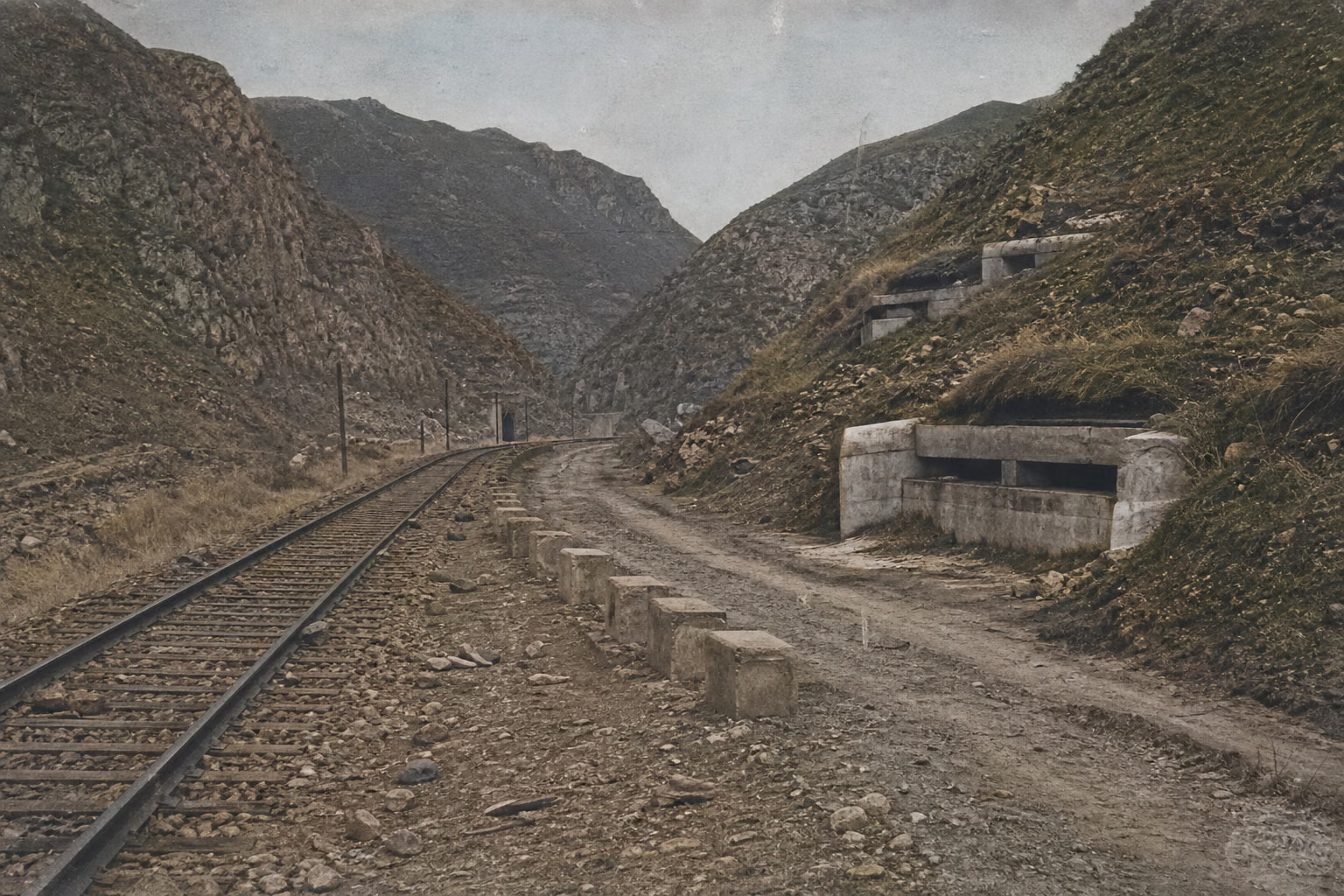
- Nankou-Juyongguan is a gorge passage of a dozen or so kilometers. The Beijing-Suiyuan Railway and the road passed through the valley, while high ground on the ridges to either side faced across at one another. The defensive line had little depth, the front was narrow, and fire density decided everything.
- Three directions made one map: Duolun, the northern route toward the steppe; Nankou, the central gorge; and Datong, the western route onto the northern Shanxi plateau. The three secondary battlefields had completely different geographies, yet they were tied to the same front line.
- The Beijing-Suiyuan Railway was the lifeline: for the defenders it was both supply line and withdrawal line, and for the attackers the logic of encirclement was to cut it.
How Each Side Records It
- The telegram level (the voices of the combatants themselves): Zhili and Fengtian used "suppressing the Reds" as their shared banner, sending telegrams before and after the battle to support one another and list the Guominjun's alleged "Redization" crimes. The Guominjun side answered with telegrams opposing "joint warlord strangulation" (original texts and dates of the telegrams vary by account). This framing of "suppressing the Reds" was itself a core text of the 1926 opinion war.
- Popular and press memory: what Beiping and the Chahar-Suiyuan line remembered was military disaster, forced labor, and prices. Beijing and Tianjin newspapers reported continuously on this war of several hundred thousand men, but its heat was quickly covered over by the Northern Expedition fighting that began in July: a "great battle whose headlines were taken by the south."
- Later narratives: in the textbook system this battle has almost disappeared. The Northern Expedition narrative begins from Guangzhou, while this northern battle is passed over in a stroke or omitted completely. Recent studies of Beiyang history and the Guominjun have pulled it out separately and called it a "great battle covered over by the Northern Expedition narrative" (representative works unverified). More than 500,000 men were involved, and later generations almost forgot it.
Disputes and Sensitivities
- "Suppressing the Reds" and "Redization": it is a fact that the Guominjun received Soviet Russian aid, but "Redization" was the attackers' wartime mobilization slogan. "The fact of Soviet aid" and "the slogan's characterization" belong to two different layers.
- Troop figures: the coalition's "400,000 to 500,000" and the Guominjun's "200,000" are both approximations; reports and memoirs from different sides vary greatly.
- The Soviet Russian role: claims such as advisers participating in fortification work and military aid entering via Khuree need to be checked item by item against archives, so that rumor is not written as fact.
- Strategic evaluation: "pinning down the Beiyang main forces and enabling the Northern Expedition's window of time" is the mainstream reading among later historians. But whether the coalition's internal factional calculations at the time - Fengtian holding back, Shanxi watching and waiting - were instead the main reason Nankou could not be taken quickly remains open. The two explanations coexist.
Sources and Open Questions
Known main sources:
- Memoirs by Zhang Zhijiang, Lu Zhonglin, and Guominjun participants
- Wu Peifu-side and Fengtian-side battle reports, and contemporary Beijing-Tianjin newspapers such as Ta Kung Pao and Chenbao
- Studies of Russian-language archives related to Soviet Russian advisers and military aid (secondary studies to be checked)
- Lai Xinxia and others, History of the Beiyang Warlords (framework)
Open questions: the sources behind each side's troop figures; the sequence of Nankou's general assaults; the exact date Duolun fell; the order and losses of the Guominjun's westward withdrawal; archival evidence for Soviet Russian fortification advisers and military aid; the various figures for coalition casualties; newspaper and local-gazetteer records of military disaster along the Beijing-Suiyuan line; changes in unit organization between the withdrawal from Nankou and the Wuyuan oath-taking; the chronology of Wu Peifu's "north first, south later" priorities in relation to urgent telegrams from the two Hunan-Hubei provinces, and the moment when he knew the Northern Expeditionary Army had set out; the time and scale of Zhang Xueliang and Han Linchun's units joining the frontal assaults at Nankou; the raising of ammunition, grain, and pay for the coalition siege assaults and the way the burden was divided among the three parties (this layer is an inference from established facts, pending direct records); whether there had been proposals within the Guominjun for an early withdrawal to Suiyuan.
All images on this site are AI-generated depictions. They are not historical photographs, not primary sources, and do not depict any real individual.