Engagement Archive · Second Northern Expedition (incl. the Jinan Massacre)
Four group armies converged on Beijing and Tianjin, and in military terms the outcome was scarcely in doubt--what was actually remembered were two things that happened along the road: Japanese forces slaughtered soldiers and civilians in Jinan, forcing the Northern Expeditionary Army to detour, and the Kwantung Army blew Zhang Zuolin, train and all, into the air at Huanggutun. A Chinese war of unification was rewritten twice by Japanese intervention.
Engagement Data
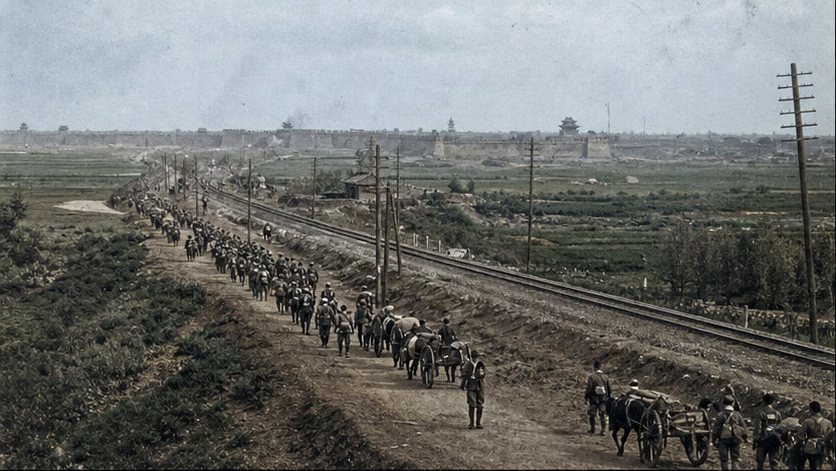
| Item | Details |
|---|---|
| Time | 1928.4 - 6.8 (entry into Beijing); 12.29 Northeast Flag Replacement as the political endpoint |
| Place | The Tianjin-Pukou and Beijing-Hankou lines and Beijing-Tianjin; Jinan; Huanggutun (western outskirts of Shenyang) |
| Belongs to | Northern Expedition (for the larger situation, see "Northern Expedition: Overview") |
| Belligerents | Four group armies of the National Revolutionary Army (Chiang Kai-shek's First, Feng Yuxiang's Second, Yan Xishan's Third, Li Zongren's Fourth), about 700,000 in total (figures vary by account) / Zhang Zuolin's Anguojun (remnants of the Fengtian and Zhili-Shandong allied forces), about 400,000 (figures vary by account) |
| Third Party | Japan: sent troops into Shandong (Second Shandong Expedition) and created the Jinan Massacre ※; the Kwantung Army created the Huanggutun Incident |
| Result | 6.8 the National Revolutionary Army entered Beijing, ending the Beiyang government; 12.29 Northeast Flag Replacement, completing nominal unification |
Belligerents
| Item | National Revolutionary Army | Anguojun |
|---|---|---|
| Strength | Four group armies in coalition, superior in both numbers and morale | Interior-line defense, with morale already resigned to fate |
| Variables | Not on the battlefield--but in the Japanese forces at Jinan and the Kwantung Army beyond the passes | Zhang Zuolin wavered between "retreating beyond the passes" and "holding on with Japanese backing" |
Terrain and Conditions
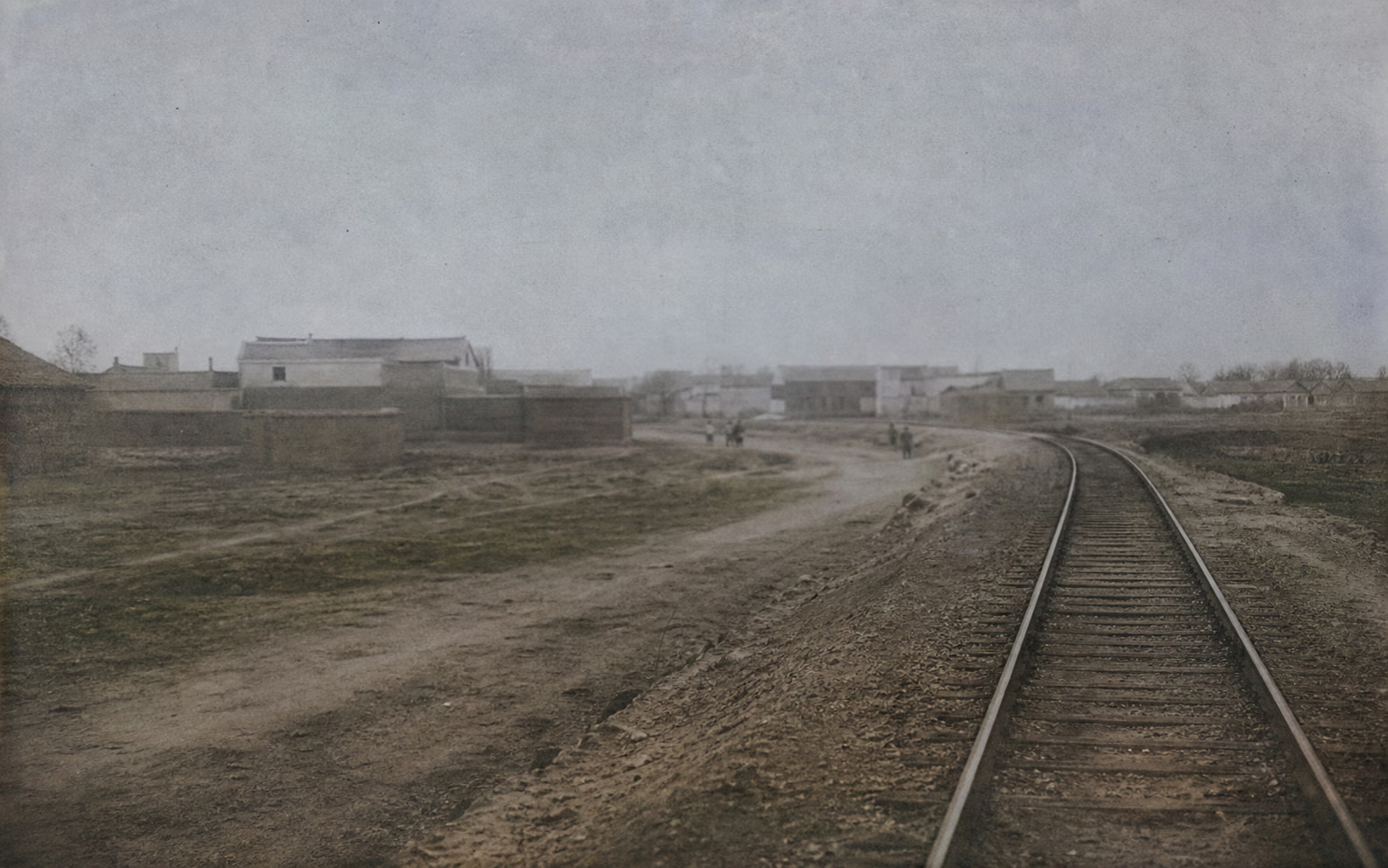
Spring 1928: after the Nanjing-Wuhan reunion, Chiang returned to office and four factions joined for the Northern Expedition--an allied force sharing a bed but not a dream (one year later they would be fighting one another; see the chapter on the Chiang-Gui and Chiang-Feng Wars). Japan's Tanaka cabinet was intensely anxious over "rights and interests in Manchuria and Mongolia," and twice sent troops into Shandong in the name of "protecting nationals," placing itself across the Northern Expedition's road.
Why It Was Fought
Seven days at Longtan destroyed Sun Chuanfang's last 60,000 men by the river (see "Battle of Longtan"). What that victory changed was not only the battlefield: in September, Nanjing and Wuhan reunited, forcing a revolutionary camp that had stood opposed for years back into one piece; in early 1928, Chiang Kai-shek resumed office after half a year out of power. Of the three great Beiyang blocks, Wu Peifu had collapsed in Hubei and Hunan, Sun Chuanfang had been destroyed at Longtan, and only the last and largest remained--Zhang Zuolin, together with the Anguojun government he had formed in Beijing in June 1927, the Beiyang order's last central form.
The Northern Expedition, paused for more than half a year, restarted. This time the south was not one army but four: Chiang Kai-shek's First Group Army, Feng Yuxiang's Second, Yan Xishan's Third, and Li Zongren's Fourth, about 700,000 in total (figures vary by account). What the Nanjing-Wuhan reunion produced was not one heart but one road--each of the four had its own calculations, each wanted its own territory and title, and they shared a bed without sharing a dream; one year later they would fight one another (see the chapter on the Chiang-Gui and Chiang-Feng Wars). But in the spring of 1928, their direction of general attack toward Beijing and Tianjin was the same. The Anguojun opposite them had about 400,000 men (figures vary by account), defended on interior lines, and its morale was already resigned to fate; Zhang Zuolin himself wavered between "retreating beyond the passes" and "holding on with Japanese backing"--a man who had spent his life walking a tightrope between Japan and Russia still treated Japan as a variable he could maneuver around.
The objective allowed no second interpretation: Beijing and Tianjin were where the Beiyang government stood; the two great arteries of the Tianjin-Pukou and Beijing-Hankou railways ran north from the south; the four group armies advanced on separate lines into a pincer. Take Beijing and Tianjin, and the Beijing government that had existed since 1912 would have reached its end.
On paper, the process by which the decision was made is clear: in February, the Fourth Plenum of the Kuomintang's Second Central Executive Committee resolved to continue the Northern Expedition; in early April, the order for the general attack was issued at the Xuzhou front (two dates are given; dates vary by account). What could be seen when the decision was made was the enemy opposite: the Anguojun defending on interior lines with loosening morale, Fengtian banknotes issued in excess and depreciating, and the Northeast's finances unable to sustain a long war (Fengtian financial records unverified). What could not be fully seen was Tokyo--how far an expedition in the name of "protecting nationals" would go. Negotiations with Japan were pursued along one line by Foreign Minister Huang Fu (course unverified), and the records are insufficient to judge Nanjing's prewar estimate of Japan's resolve (unverified). Military expenses depended on tax revenue from Jiangsu and Zhejiang and the circulation of public bonds (details unrecorded); military transport was entirely tied to the Tianjin-Pukou and Beijing-Hankou railways, and large armies could only move along the rails. Jinan could not be bypassed even if one wished to bypass it. No record shows disagreement among the four factions over the broad policy of a general attack on Beijing and Tianjin; their differences lay in how to divide things after it was over. Within the Fengtian clique, the idea of abandoning Beijing and Tianjin had long existed (the positions of the factions are unverified), and Zhang Zuolin wavered both ways until he reached the bridge opening on June 4.
The real variable was not on the battle line. Japan's Tanaka cabinet regarded "rights and interests in Manchuria and Mongolia" as a lifeline, and was acutely anxious over the Northern Expeditionary Army crossing the Yangzi and moving north. In 1927 it had already used "protecting nationals" as its pretext to send troops into Shandong once; as the four group armies moved north, Japanese forces sent troops again and placed themselves across Jinan, the required passage on the Tianjin-Pukou line. Tokyo's calculation lay one layer deeper than the battlefield: do not allow Northern Expedition forces into the Northeast; as for Zhang Zuolin, support him if he could be supported, and remove him if he would not listen. On the operational maps of the four group armies, Jinan was only a station on the way.
In April, the general attack began along the Tianjin-Pukou and Beijing-Hankou lines, and the Fengtian, Zhili, and Shandong armies retreated step by step. The outcome on the battlefield had largely been written before the fighting began; the two strokes not yet written were both outside Chinese operational maps--one at Jinan, one at Huanggutun.
Course of the Engagement
| Phase | Time | Key Points |
|---|---|---|
| Northward advance on the Tianjin-Pukou line | April-early May | The First Group Army advanced along the Tianjin-Pukou line, took Tai'an, and came within sight of Jinan; the Fengtian, Zhili, and Shandong armies retreated step by step |
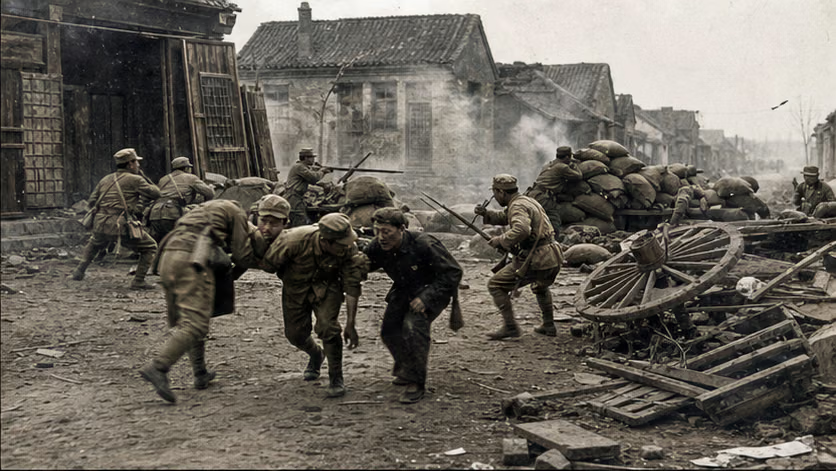
| ※ Jinan Massacre (May Third Massacre) | From 5.3 | Japanese forces provoked an exchange of fire and slaughtered soldiers and civilians: negotiator Cai Gongshi was killed after his ears and nose were cut off, and several thousand soldiers and civilians died (Chinese investigations gave more than 6,000, figures vary by account); the Northern Expeditionary Army yielded, withdrew, detoured, crossed the Yellow River, and continued north--a war of unification gave way to a foreign army on its own soil, the heaviest stroke in this chapter |
| Three-line convergence | May-June | Feng's forces on the Beijing-Hankou line, Yan's forces in the Zhengtai direction, and Chiang's forces on the Tianjin-Pukou line advanced together; by the end of May the Fengtian army was retreating along the entire line |
| Huanggutun Incident | 6.4 | Zhang Zuolin took a special train out beyond the passes; when it reached Huanggutun Bridge, explosives pre-planted by the Kwantung Army destroyed it, and he died of his wounds (Japanese planners included Komoto Daisaku; the Japanese government covered it up afterward as a "certain major incident in Manchuria"--details unrecorded)--Japan itself blew up the man it had once backed |
| Entry into Beijing and Tianjin | 6.8-12 | The National Revolutionary Army entered Beijing (soon renamed Beiping) and Tianjin; the Beiyang government ended after seventeen years |
| Northeast Flag Replacement | 12.29 | Zhang Xueliang withstood Japanese pressure and telegraphed his change of allegiance; national nominal unification followed (details of the flag-replacement negotiations and Japanese obstruction unrecorded) |
Casualties and Losses
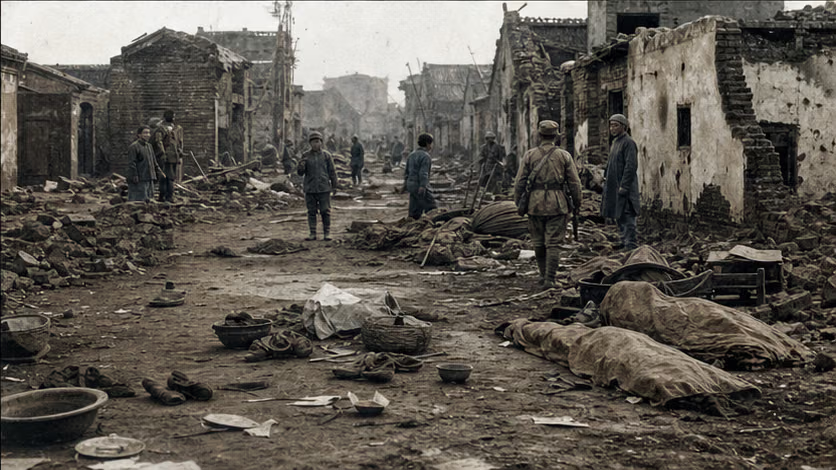
- Military casualties: total battle casualties across all lines numbered in the tens of thousands (figures vary by account)--a light military cost among the four Beiyang wars.
- ※ Jinan: several thousand soldiers and civilians died (the Chinese figure exceeded 6,000, the Japanese figure differed sharply, and multiple accounts coexist); the deaths of Cai Gongshi and the staff of the Negotiation Office became symbols of national humiliation.
- Political legacy: the territorial arrangement of the four group armies became the chessboard of the next year's civil war (see the chapter on the demobilization question and the Chiang-Gui and Chiang-Feng Wars).
Aftermath
- The Beiyang era ended: the history of the Beijing government from 1912 to 1928--seventeen years and fourteen heads of state (figures vary by account)--came to a close.
- After the Jinan Massacre came a "National Humiliation Day" and boycotts of Japanese goods; diplomatically, the matter dragged on until the 1929 Sino-Japanese Jinan Agreement closed it (terms unverified)--a blood case ended in diplomatic wording.
- After Huanggutun: Zhang Xueliang killed Yang Yuting and Chang Yinhuai (1929.1, the "Old Tiger Hall Incident") to stabilize his authority, then withstood Japanese pressure and replaced the flag--the Northeast entered the Zhang Xueliang era; three years later came the Mukden Incident.
- Nominal unification was the beginning of a new civil war--the ending of this chapter connects directly with the openings of the 1929 chapters on warlord conflicts.
Accounts of Those Present
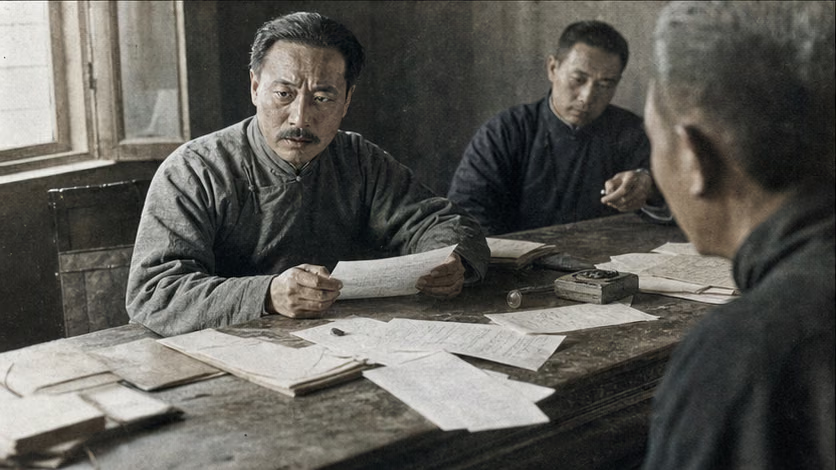
- Cai Gongshi: a battlefield diplomat, tortured and killed by Japanese forces at the Negotiation Office--he had gone to "reason with them," and the manner of his death became the first image in education about national humiliation ※.
- The army that detoured: hundreds of thousands of Northern Expeditionary troops did not return fire at the Japanese forces inside Jinan, rolled up their flags, and went around--"endurance" as state policy had its first national rehearsal; nine years later there would be a larger one.
- The bridge opening at Huanggutun: Zhang Zuolin spent his life walking a tightrope between Japan and Russia, and at the end died over explosives pre-planted by an ally--the end of one who sought to "use one foreign power to control another."
- The Blue Sky with a White Sun flag at the flag replacement: 1928.12.29, Shenyang changed flags--Zhang Xueliang answered the men who had blown up his father with a flag.
The Ground
- The vast pincer formed by the parallel advance along the Tianjin-Pukou and Beijing-Hankou lines; Jinan was a foreign nail in the mouth of the pincer.
- Jinan city: an urban space where three layers--the Japanese forces' defense zone, Chinese troops, and civilian neighborhoods--pressed onto one another, with conflict igniting where they interlocked.
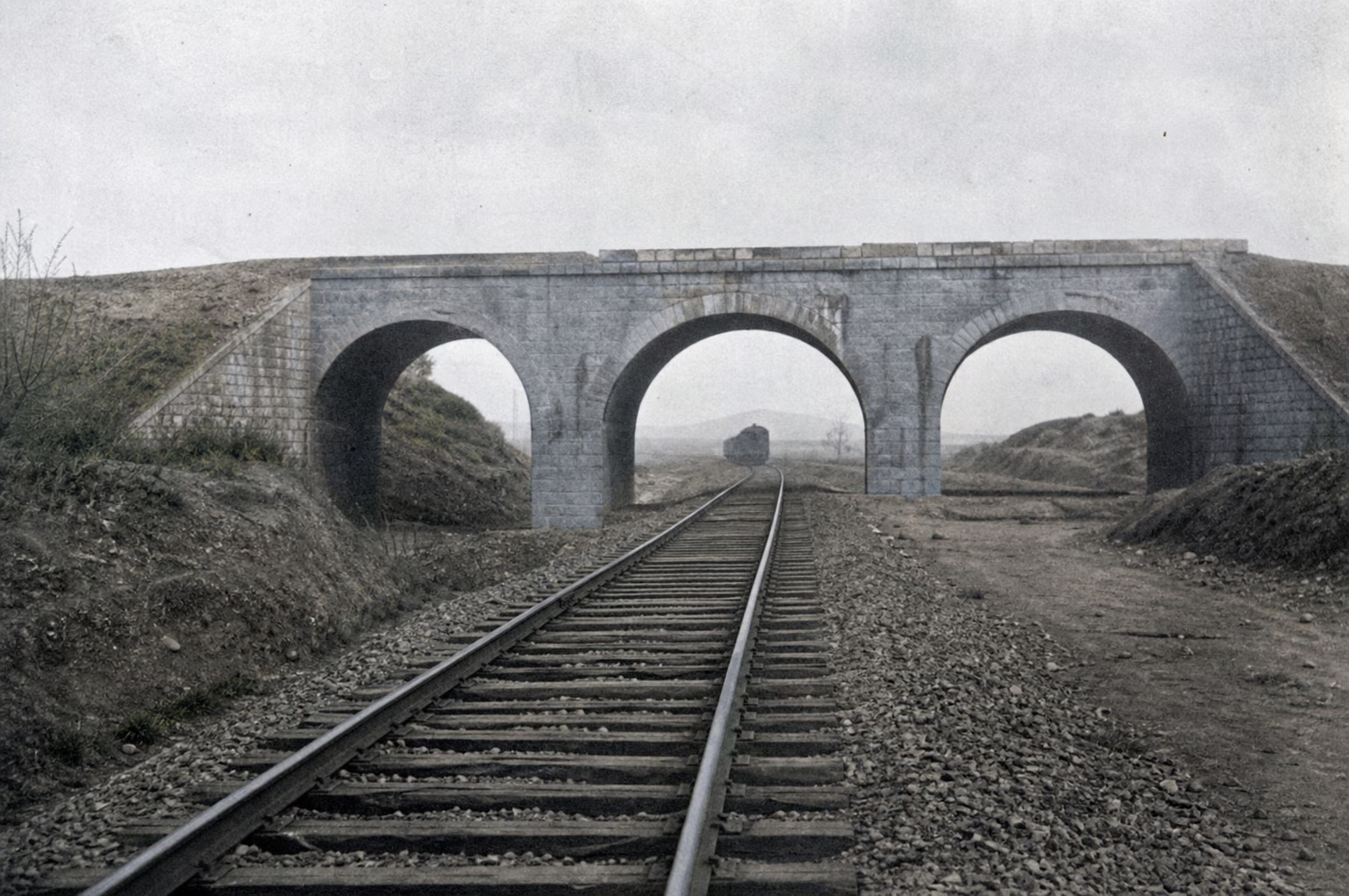
- Huanggutun Three-Arch Bridge: the blast point in the railway bridge opening--the spatial prototype of a "precision assassination."
How Each Side Records It
- National Revolutionary narrative: a triumphal chapter in which the Northern Expedition was completed and unification achieved; the endurance at Jinan was recorded as "bearing humiliation to shoulder a heavy task."
- Japanese side: the Shandong expeditions were recorded as "protecting nationals," the death toll in the Jinan case was pressed extremely low; Huanggutun was long euphemized as a "certain major incident in Manchuria," and was confirmed only after Komoto Daisaku's postwar confession (confession text unverified).
- Later generations: after the War of Resistance narrative rose, the Jinan Massacre was polished back into visibility, and "May Third" entered the sequence of national humiliation days; Huanggutun was positioned as a prelude to the Mukden Incident.
Disputes and Sensitivities
- Chinese and Japanese figures for deaths in the Jinan case differ sharply; evaluations of the "detour" decision--as pragmatic or humiliating--stand side by side.
- The decision chain at Huanggutun, between independent action by the Kwantung Army and tacit permission from Tokyo, remains under historical examination.
- The layers of motive behind Northeast Flag Replacement--national vengeance, self-preservation, and the larger trend--are all argued in parallel.
Sources and Open Questions
Sources: compiled volumes of "Materials on the Jinan Massacre" and National Government investigation reports; related self-narratives by Komoto Daisaku and Japanese archives (figure disputed); Zhang Xueliang oral histories; "Historical Materials on the Northern Expedition."
Open questions: troop figures for the four group armies and the Anguojun; the various figures for deaths in the Jinan case and the texts of the investigation reports; the terms of the "Sino-Japanese Jinan Agreement"; planning details for Huanggutun; the course of the flag-replacement negotiations; the counting basis for successive Beiyang heads of state; the two accounts of the dates for the Xuzhou oath-taking and the general-attack order; the original text of the Second Central Executive Committee's Fourth Plenum resolution to continue the Northern Expedition; the details of Fengtian finances and Fengtian banknote depreciation; the course of Huang Fu's negotiations with Japan; materials on the Nanjing government's prewar estimate of Japan's resolve to send troops; details of the Nanjing government's military financing (Jiangsu-Zhejiang tax revenue and public bonds); and the positions of the various factions within the Fengtian clique over abandoning Beijing and Tianjin and retreating to defend beyond the passes.
All images on this site are AI-generated depictions. They are not historical photographs, not primary sources, and do not depict any real individual.