Engagement Archive · Johnson South Reef Skirmish
For the protective cordon around an ocean observation station, Chinese and Vietnamese soldiers waded into knee-deep water on an ebb-tide reef flat and faced one another down; after the first shot came several dozen minutes of naval-gun action -- two Vietnamese vessels sank, one ship ran aground, and China from then on had a foothold in the Spratlys; Vietnam from then on commemorated every March 14 the 64 people of "Gac Ma."
Engagement Data
| Item | Content |
|---|---|
| Time | Morning of 1988.3.14 (the prelude was the reef-occupation standoff that began in 1988.1) |
| Place | Jiuzhang Reefs, Spratly Islands: Chigua Reef, Guihan Reef, and Qiong Reef, with fighting at all three on the same day |
| War | Guarding the Frontiers · Paracel and Spratly Islands (see overview for the larger picture) |
| Chinese side | Frigates 502 *Nanchong*, 531 *Yingtan*, and 556 *Xiangtan*, plus reef-landing detachments; formation commander Chen Weiwen (post held at the time unrecorded) |
| Vietnamese side | Transport vessels HQ-604 and HQ-605, landing ship HQ-505 (U.S.-built tank landing ship, received from South Vietnam in 1975, ship history unverified), carrying engineers and reef-defense detachments |
| Result | 604 and 605 sank; 505, heavily damaged, beached herself on Guihan Reef; the Chinese side held Chigua Reef and entered six reefs in the Spratlys that year |
Belligerents
| Item | Chinese Formation | Vietnamese Vessel Group |
|---|---|---|
| Ships | 3 frigates, with 100 mm naval guns and rapid-fire guns (ship-type details unrecorded) | 2 transport vessels and 1 landing ship, mainly guns below 40 mm and small arms (details unrecorded) |
| On the reef | Reef-landing detachments of several dozen men (the figure of 58 is unverified), with small arms | Several dozen reef-landing engineers and reef-defense troops, carrying building materials and small arms |
| Situation | Naval guns against transport vessels; the firepower balance was completely asymmetrical -- exactly the reverse of 1974 | Close to the mainland and Cam Ranh Bay, backed by already occupied reefs and islands (Sin Cowe Island and others), with convenient transport and supply |
| Support base | More than a thousand kilometers from Hainan bases, beyond the effective reach of land-based aviation (range details unverified), relying on newly occupied reef-flat anchorages for a foothold | The Soviet garrison at Cam Ranh Bay was close at hand -- but did not move throughout the whole engagement |
Terrain and Conditions
(For the larger situation in 1988 -- the Sino-Soviet thaw, Vietnam mired in Cambodia, and the ebb of Soviet aid -- see *Paracel and Spratly Islands · Overview*; this article covers only the Spratlys.)
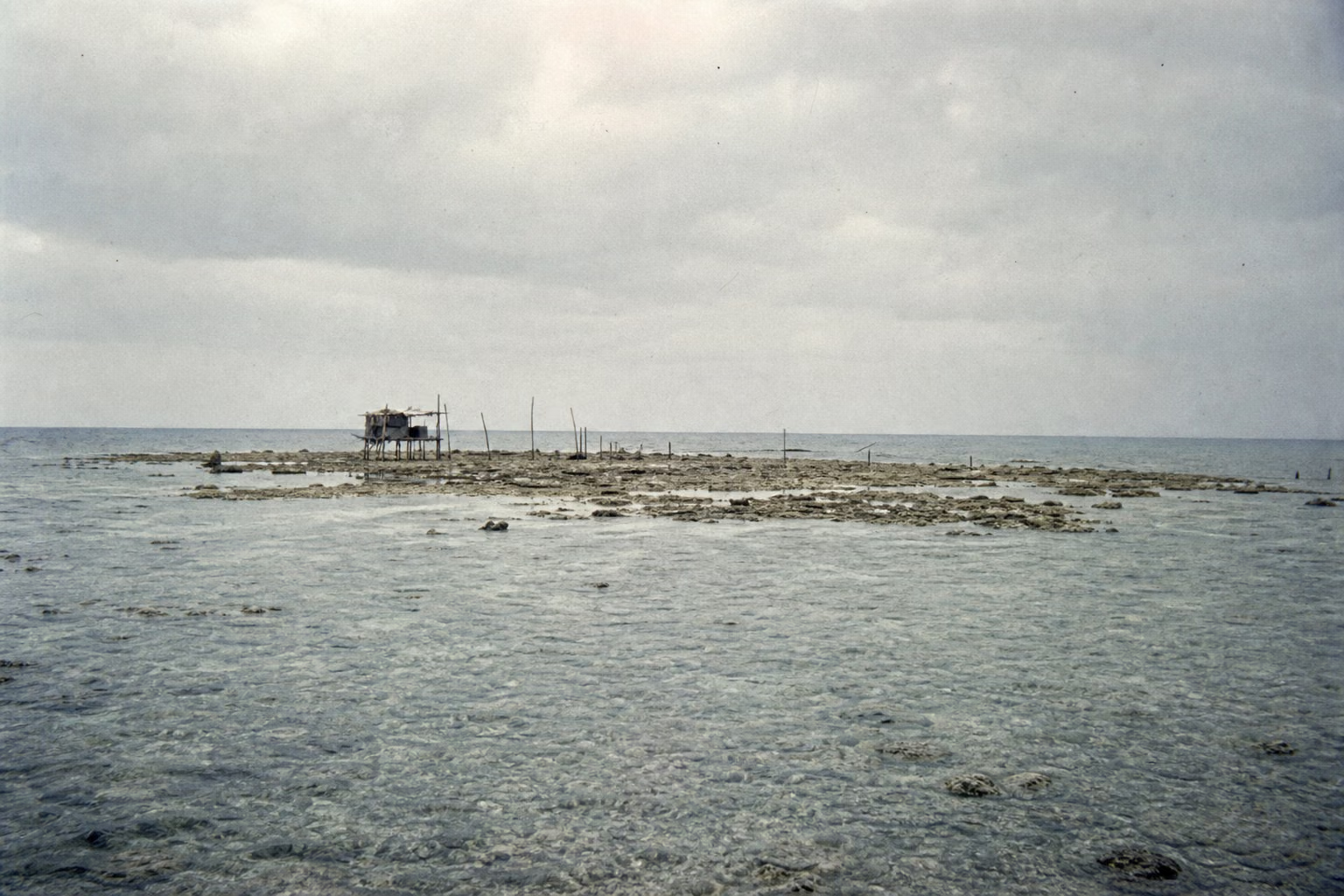
Among the Spratly Islands' more than two hundred reefs, banks, and sand cays, only a few dozen remain above water year-round; the rest are reef flats that vanish at high tide -- the smallest unit of "occupation" here is not an island, but a patch of coral exposed only at low tide. In the Spratlys at the beginning of 1988, the Vietnamese side held more than twenty islands and reefs, the Taiwan side held Taiping Island, the Philippines and Malaysia each held positions, and the Chinese side had not stationed itself at a single point. Yongshu Reef lay isolated to the northwest, with no other side's positions nearby, and was chosen for that very reason as the site of Observation Station No. 74; the Jiuzhang Reefs lay several dozen nautical miles to its northeast (distance unverified), with dense reef flats, and Vietnam-held Sin Cowe Island sat within the same reef group -- here the observation station's outer security cordon and Vietnam's existing positions interlocked. By March, the Spratlys were past the height of the northeast monsoon season, suitable for construction and also for sailing.
Why It Was Fought
In the fifteenth month after the Paracel battle, Saigon fell. Before the end of 1975.4, North Vietnamese ships moved into the Spratlys and received the islands and reefs occupied by South Vietnam -- the gap China had closed in the Paracels, Hanoi occupied first in the Spratlys (see *Battle of the Paracel Islands*). Over the next thirteen years, unified Vietnam expanded its reef occupations to more than twenty places, while China and Vietnam also changed from comrades into enemy states -- from 1979 onward they fought on land, and by the spring of 1988 the guns in the Laoshan direction had still not fully fallen silent (for the land engagements, see the articles under *Sino-Vietnamese War*). In the maritime Spratlys, the Chinese side had only notes of protest, not a single soldier.
The turning point was a scientific document. In March 1987, the Intergovernmental Oceanographic Commission of UNESCO adopted the Global Sea Level Observing System plan, and Observation Station No. 74, to be built by China, was sited at Yongshu Reef in the Spratlys (session number unverified). Building the station required occupying the reef; occupying the reef required a protective cordon -- from January 1988, Chinese engineering ships and escorting naval vessels entered the Spratlys and drove piles at Yongshu Reef; the Vietnamese navy immediately sortied, and the two sides repeatedly seized positions and confronted each other at Yongshu, Huayang, and other reefs: one side landed and the other drove it off, one side occupied and the other blocked it, pushing and shoving but never opening fire. By mid-March, the race had advanced to the Jiuzhang Reefs -- the Chinese side wanted to turn the reefs around the observation station into a ring, while the Vietnamese side wanted to cut it before the ring was complete.
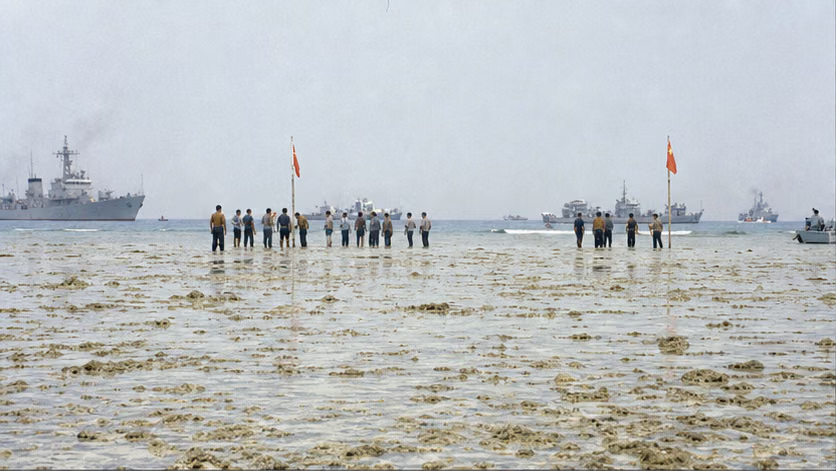
Both sides' calculations included "not fighting": the Chinese side's rules of engagement were not to open fire first (the formulations vary by account); the Vietnamese side had come through the previous standoffs unharmed, and Soviet retrenchment also meant Hanoi did not dare expect Cam Ranh Bay to intervene -- both assumed this time, too, would end after a face-off. The miscalculation lay in the reef flat itself: from the evening of March 13 into the night, ships from both sides successively reached Chigua, Guihan, and Qiong reefs; in the early hours of the 14th, two groups of men waded in succession onto Chigua Reef's low-tide reef flat -- this was no distant ship-to-ship standoff, but men against men, flagstaff against flagstaff, within several dozen meters in knee-deep water.
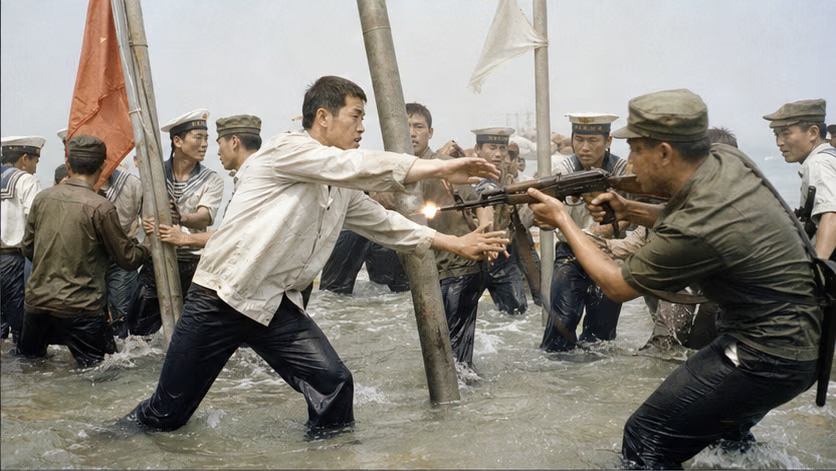
At daybreak, shots rang out during the struggle over the flag. Who fired first: the Chinese account says Vietnamese soldiers fired first and wounded a Chinese reef-landing team member (Yang Zhiliang was struck in the arm); the Vietnamese account says the Chinese side opened fire on engineers on the reef. After the gunshots, the guns at sea took over.
Course of the Engagement
| Phase | Time | Main Points |
|---|---|---|
| Reef-occupation race | 1988.1-2 | The Chinese side entered Yongshu and cordoned the surrounding reefs, and confronted the Vietnamese side several times at Huayang and other reefs (sequence unverified), all without opening fire |
| Night arrival at three reefs | 3.13 evening-night | Chinese formation 502 and Vietnamese 604, 605, and 505 successively reached the Jiuzhang Reefs: 604 anchored at Chigua, 605 at Qiong Reef, and 505 at Guihan Reef |
| Standoff on the reef | Morning of 3.14 | The two reef-landing teams planted flags and faced each other on Chigua Reef's low-tide reef flat, body against body, flag against flag; shots rang out in the struggle over the flag (the two accounts of sequence are placed side by side), and Yang Zhiliang was struck in the arm |
| Naval-gun action | Morning of 3.14 | Lasted several dozen minutes (one account says 28 minutes; formulations vary by account): 502 sank 604 at Chigua Reef; 556 heavily damaged 605 at Qiong Reef (605 sank; one account says it sank the next day, unverified); 531 heavily damaged 505 at Guihan Reef, and 505 beached herself and grounded |
| Closure | After 3.14 | The Chinese side held Chigua Reef, rescued Vietnamese military personnel from the water at sea, and captured 9 people; the Vietnamese side thereafter garrisoned Guihan and Qiong reefs (details unrecorded) |
Casualties and Losses
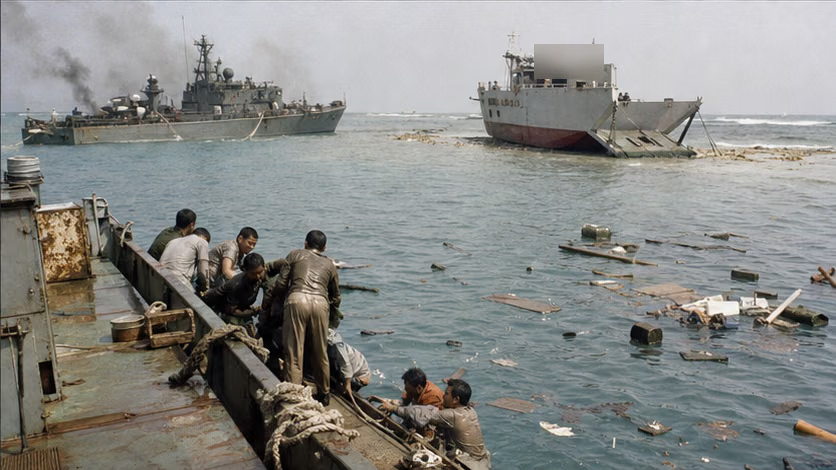
- Vietnamese side: 604 and 605 sank, and 505 was heavily damaged and grounded (its later fate unverified); the Vietnamese side announced 64 killed (martyrs), with the roll of names read year after year; others were wounded, and 9 were captured (repatriated in 1991, year unverified).
- Chinese side: 1 person wounded (Yang Zhiliang, struck in the arm); vessels suffered minor damage (unverified).
- On Vietnamese casualties, Chinese early battle-report figures differ from the number published by Vietnam (formulations vary by account).
- No civilians were involved.
Aftermath
- In 1988.8, Ocean Observation Station No. 74 at Yongshu Reef was completed (dates vary by account); that year the Chinese side entered Yongshu, Huayang, Dongmen, Nanxun, Zhubi, and Chigua reefs (sequence unverified) -- from zero to six, China from then on had permanent positions in the Spratlys.
- The Vietnamese side expanded its occupation by more than ten reef flats that same year (bases vary by account), and garrisoned Guihan and Qiong reefs -- the Spratlys became an interlocking pattern. The South China Sea after this belongs to another era; this article stops here.
- The 9 captured people were repatriated in 1991; in the same year, China-Vietnam relations normalized, and there was no further exchange of fire at sea.
- Yang Zhiliang recovered from his wound and stayed in the navy (later course unverified).
Accounts of Those Present
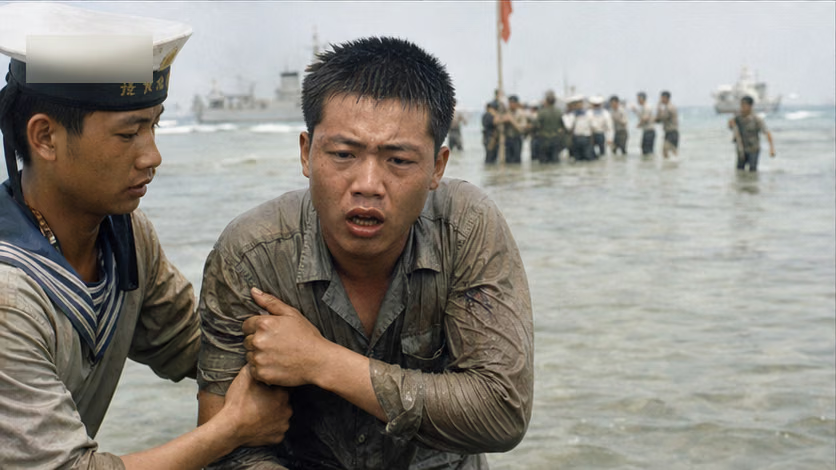
- The instant of pushing the gun barrel: in the Chinese account, when a Vietnamese soldier raised his gun and aimed at the reef-landing team, Yang Zhiliang, in his early twenties (age unverified), reached out to push the barrel away; the gun fired, and the bullet passed through his arm -- the Chinese side's only wound that day.
- The man who guarded the flag: in the Vietnamese narrative, Corporal Tran Van Phuong (translated name unverified) held the flag in his hand before he was hit, leaving a dying injunction to guard it (circulating on the Vietnamese side; wording not recorded) -- he is the center of the "immortal circle" narrative.
- The captain who beached his ship: after ship 505 was hit and caught fire, its captain Vu Huy Le (translated name unverified) drove the landing ship at full speed onto Guihan Reef and beached it -- the ship was saved, and the reef was held; the Vietnamese side awarded him the title "Hero of the People's Armed Forces." Fourteen years earlier, ship 389 beached herself on the Chenhang reef flat; fourteen years later, ship 505 beached herself on Guihan Reef -- each of the two navies had a morning when a ship was driven onto a reef.
- Rescue and capture: after the guns stopped, Chinese vessels rescued 9 Vietnamese military personnel from the sea -- first prisoners, then repatriated home three years later (details unverified).
- Homes on the reef: before and after this engagement, Chinese reef-defense troops lived in first-generation stilt houses -- bamboo and timber members driven into the reef flat, planks laid as barracks, one house forming one position.
The Ground
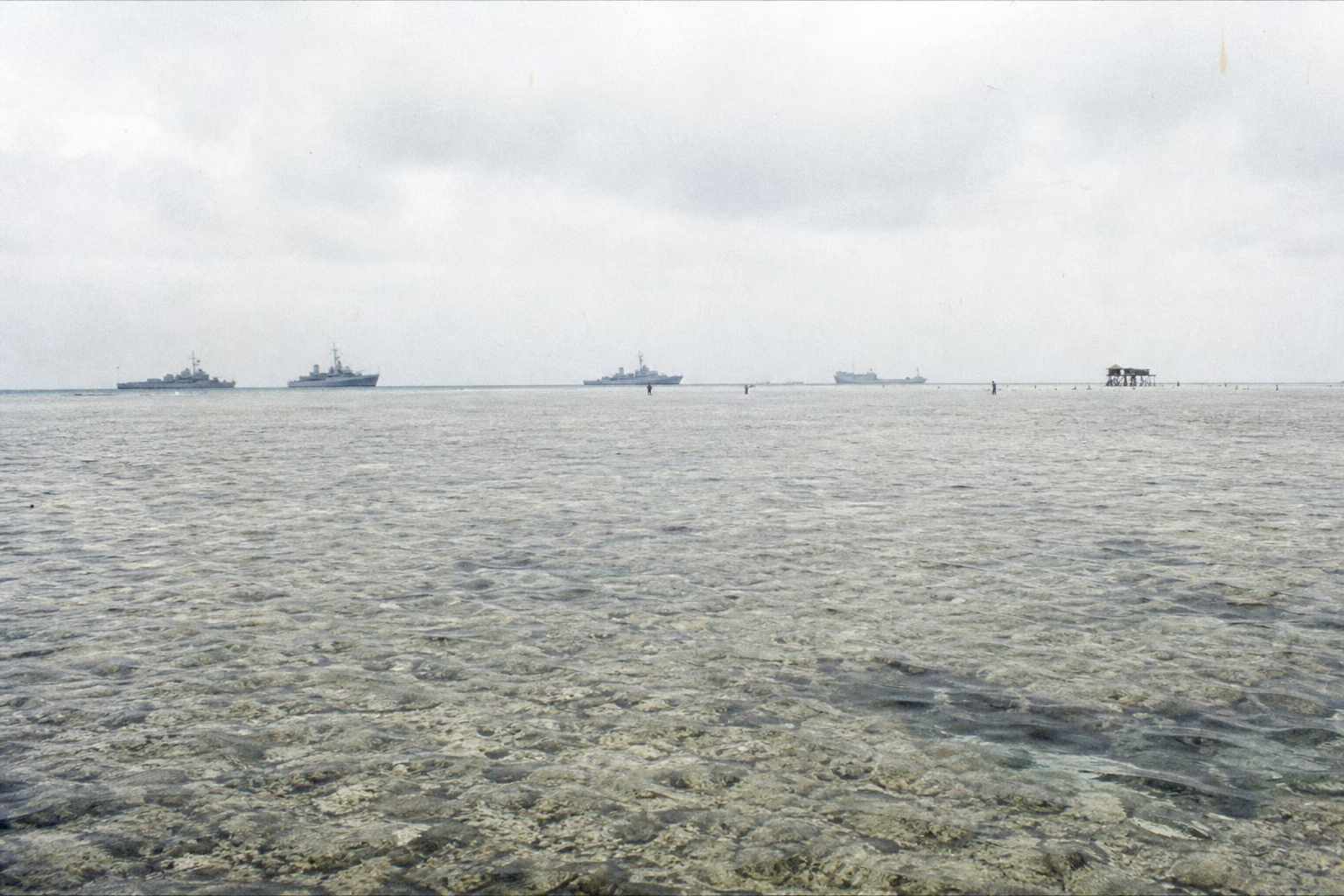
- The battlefield was a coral reef flat exposed only at low tide: men stood in knee-deep water in lines facing each other, without an inch of cover and without a single high point -- the most primitive infantry line, set in the middle of the ocean.
- A collision of human and ship scale: on the reef, people stood face to face within several dozen meters; several hundred to more than a thousand meters beyond the reef edge were 100 mm naval guns -- only a few minutes separated gunfire from cannon fire.
- The three reefs were engaged on the same day, several nautical miles apart, close enough to see columns of smoke but not to hear the gunfire clearly -- the same spatial grammar cut apart by reef flats as at Yongle Atoll (1974), on an even starker scale.
- More than a thousand kilometers from the mainland: no air cover, no nearby coastal line of retreat, and supply counted in weeks -- stilt houses, anchorages, and reef-flat channels formed a point-like battlefield.
How Each Side Records It
- Vietnamese side: every March 14, Vietnam commemorates the 64 killed at "Gac Ma" -- reading the roll of names and scattering flowers at sea; the "immortal circle" (the image of 64 people locking arms around the flag) is the narrative core, and in 2017 a memorial park was completed in Khanh Hoa Province (details unrecorded); 505's captain Vu Huy Le entered the roll of heroes.
- Chinese side: long low-key -- after China and Vietnam normalized relations in 1991, this engagement rarely appeared in public narratives, though military commemoration continued (forms unverified); after the 2010s, reporting gradually increased, and Yang Zhiliang's name returned to print -- the rise and fall of commemorative temperature is plainly visible.
- Record of wording differences: Vietnamese commemorative language often uses "massacre," while the Chinese formulation is "self-defense counterattack" -- two vocabularies coexist.
- Footage: footage of the naval-gun battle filmed aboard Chinese ships later leaked into public view, and the two sides interpret the same footage in opposite ways (source and course of public release unverified).
- The Soviet absence: Cam Ranh Bay was close at hand but did not move throughout -- Vietnamese disappointment after the battle appears in its commemorative writings (literature unverified).
Disputes and Sensitivities
- Who fired first: China and Vietnam each maintain their own account; this is the central dispute over formulations in this engagement.
- The dispute over defining it as "massacre" or "naval battle": Vietnam's commemorative system and the Chinese war-history classification are opposite.
- Statistical bases: 64 is the number published by Vietnam, while Chinese early battle reports and third-party studies differ (unverified).
- The dispute over the footage's source, editing, and interpretation (unverified).
- Present boundaries: this engagement remains a sensitive node in China-Vietnam relations and South China Sea issues; this section concerns the historical facts of 1988 at the time.
Sources and Open Questions
Sources: naval war histories and yearbooks (specific titles unverified); interviews and recollections by Chen Weiwen, Yang Zhiliang, and others (specific titles unverified); Vietnamese Gac Ma commemorative literature and related books (publication and controversy status unverified); U.S., Australian, and other third-party maritime studies (bibliography unverified).
Open questions: details of the three ships' types and gun positions; number of people on the reef (the figure of 58); duration of the naval-gun action and time of 605's sinking; session number for Station No. 74 and completion date; sequence of entry into the six reefs; number of reefs newly occupied by Vietnam and the later fate of 505; year of repatriation of the 9 people; Yang Zhiliang's age and later course; translated names of Tran Van Phuong and Vu Huy Le; source of the footage; formulations of the Chinese side's rules of engagement; Vietnamese reviews and commemorative literature.
All images on this site are AI-generated depictions. They are not historical photographs, not primary sources, and do not depict any real individual.